

文件与数据
插件

OpenViking
volcengine
Self-evolving Context Database for AI Agents. Unify Agent Memory, Knowledge RAG and Skills.
PROJECT TOPICS
INSTALL REFERENCE
dsh plugin --profile web add github:santera-pixel/dsh-scriptorium
该命令指向仓库当前默认分支;尚无绑定当前 commit 的完整验证结果。
PROJECT README


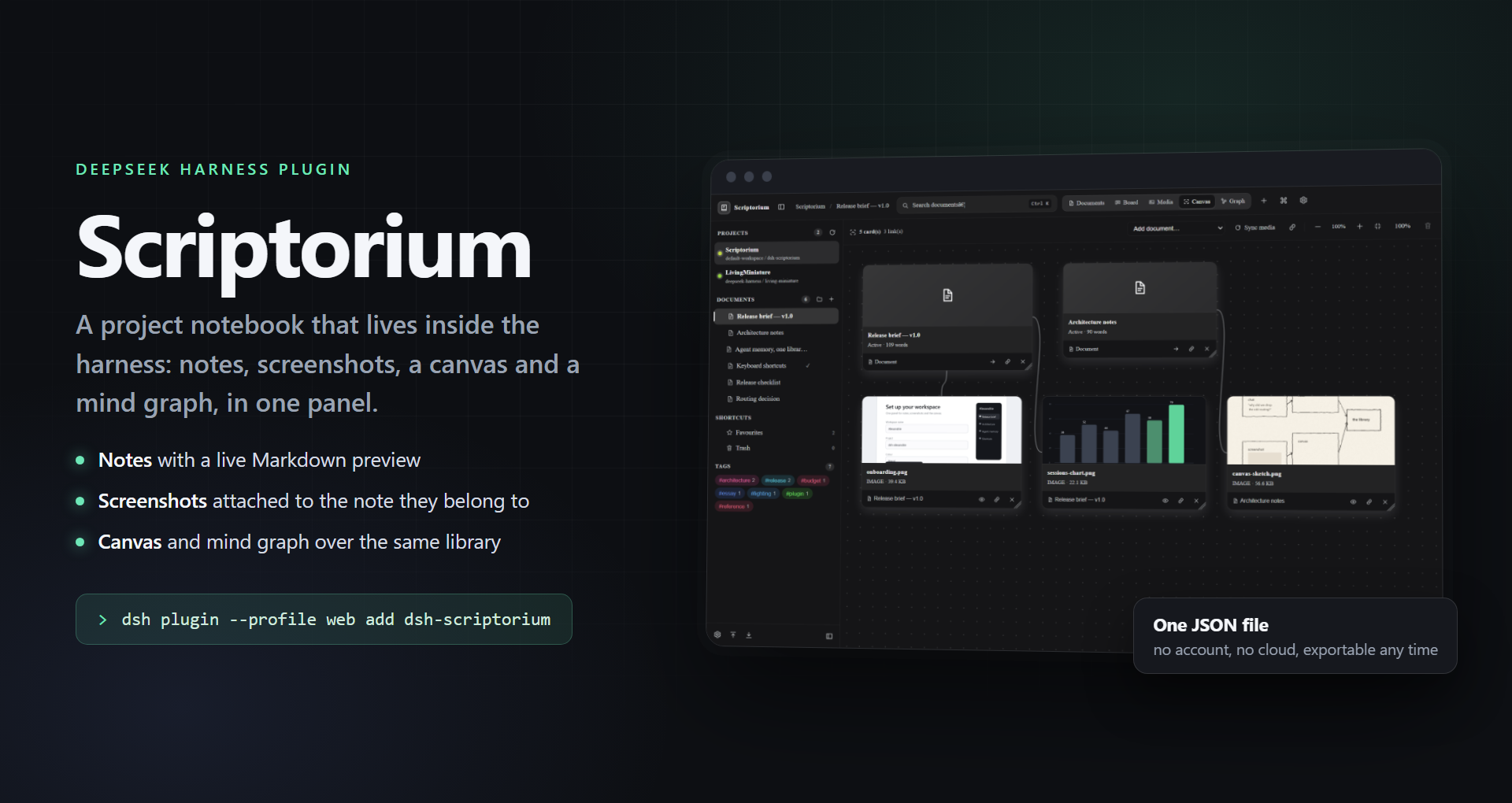
Scriptorium is a project knowledge base inside the DeepSeek Harness Web GUI: workspaces bound to Harness projects, nested documents, a Markdown editor with live preview, full-text search, a command palette, a kanban board, a free-form media canvas, an Obsidian-style mind graph, tags, favourites, trash and ZIP/JSON archives — all stored in one JSON file on the host that this plugin owns.
The panel lives in the sidebar (book icon, "Scriptorium"). Everything else is one keystroke away.
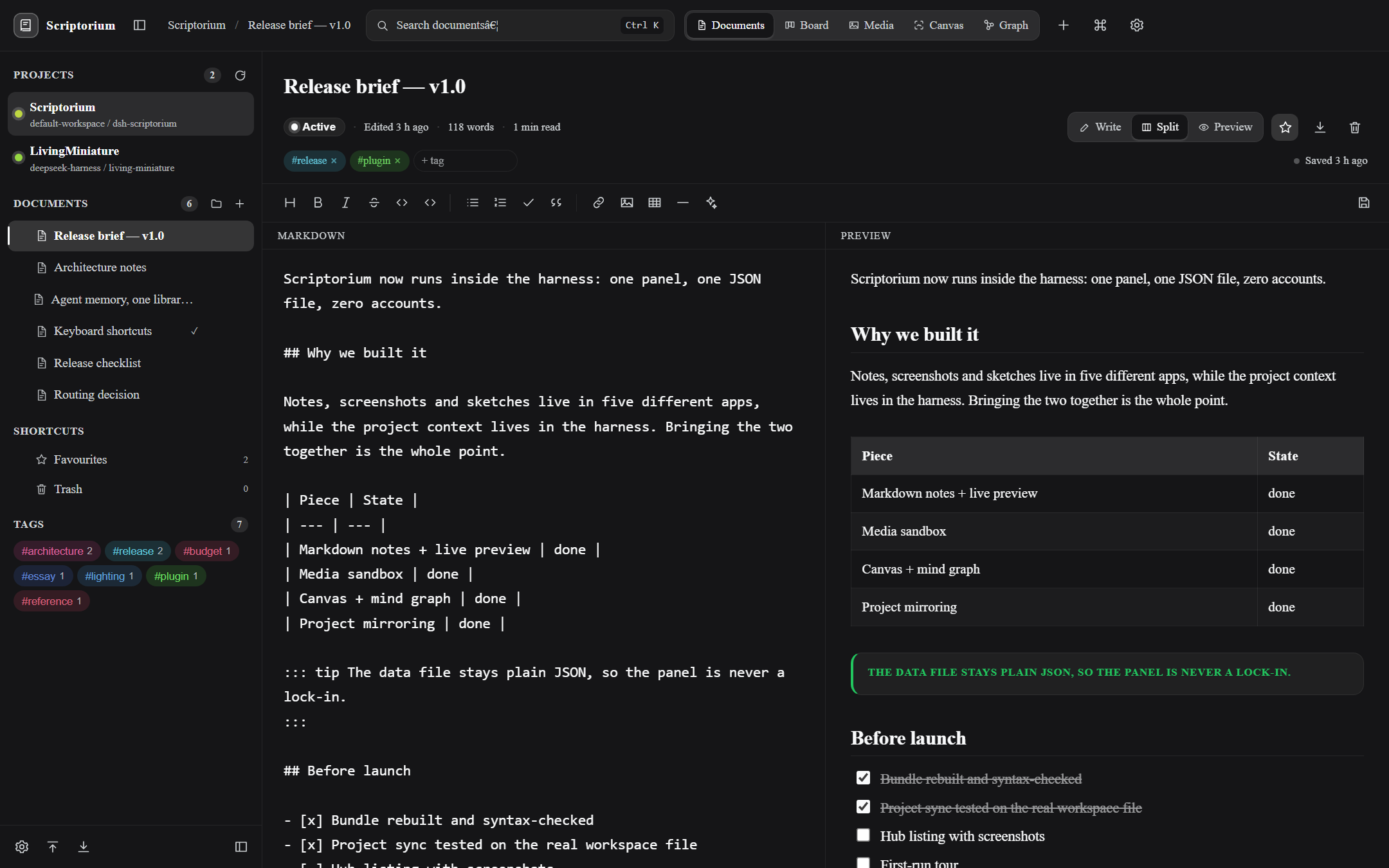 |
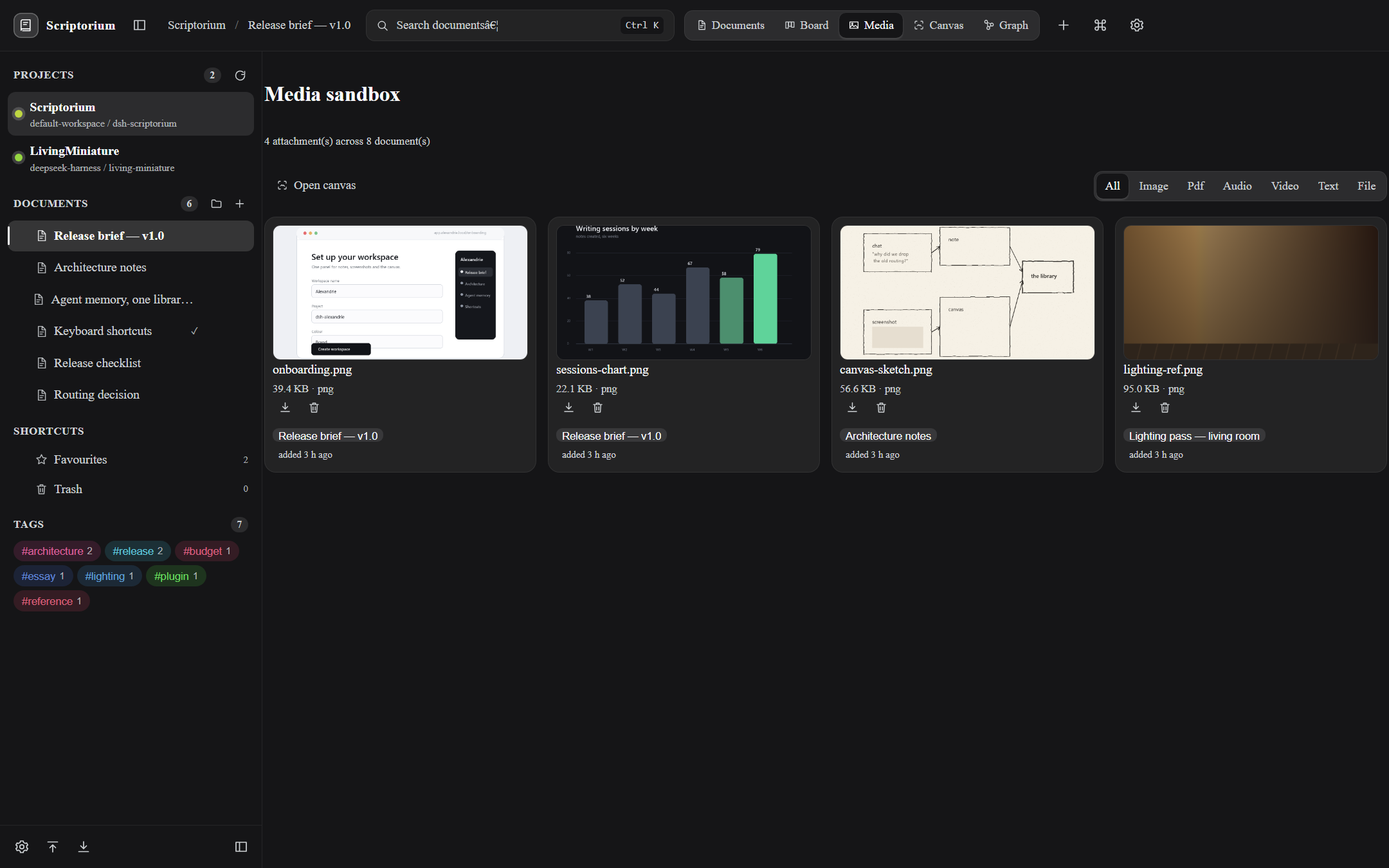 |
| Documents — nested notes, split editor and a live preview, tags and status in the header. | Media sandbox — every screenshot, PDF and clip in the project, filterable by kind. |
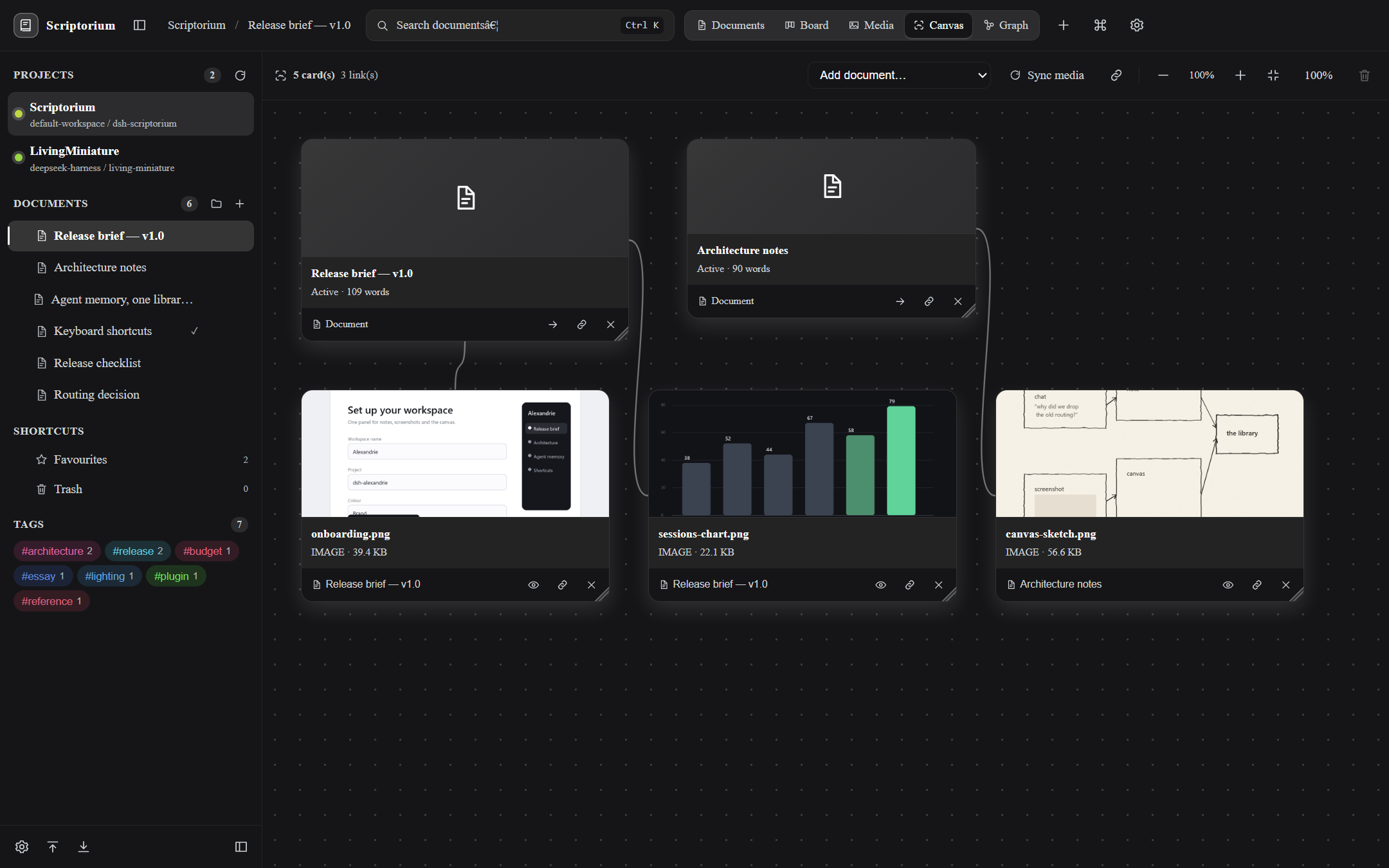 |
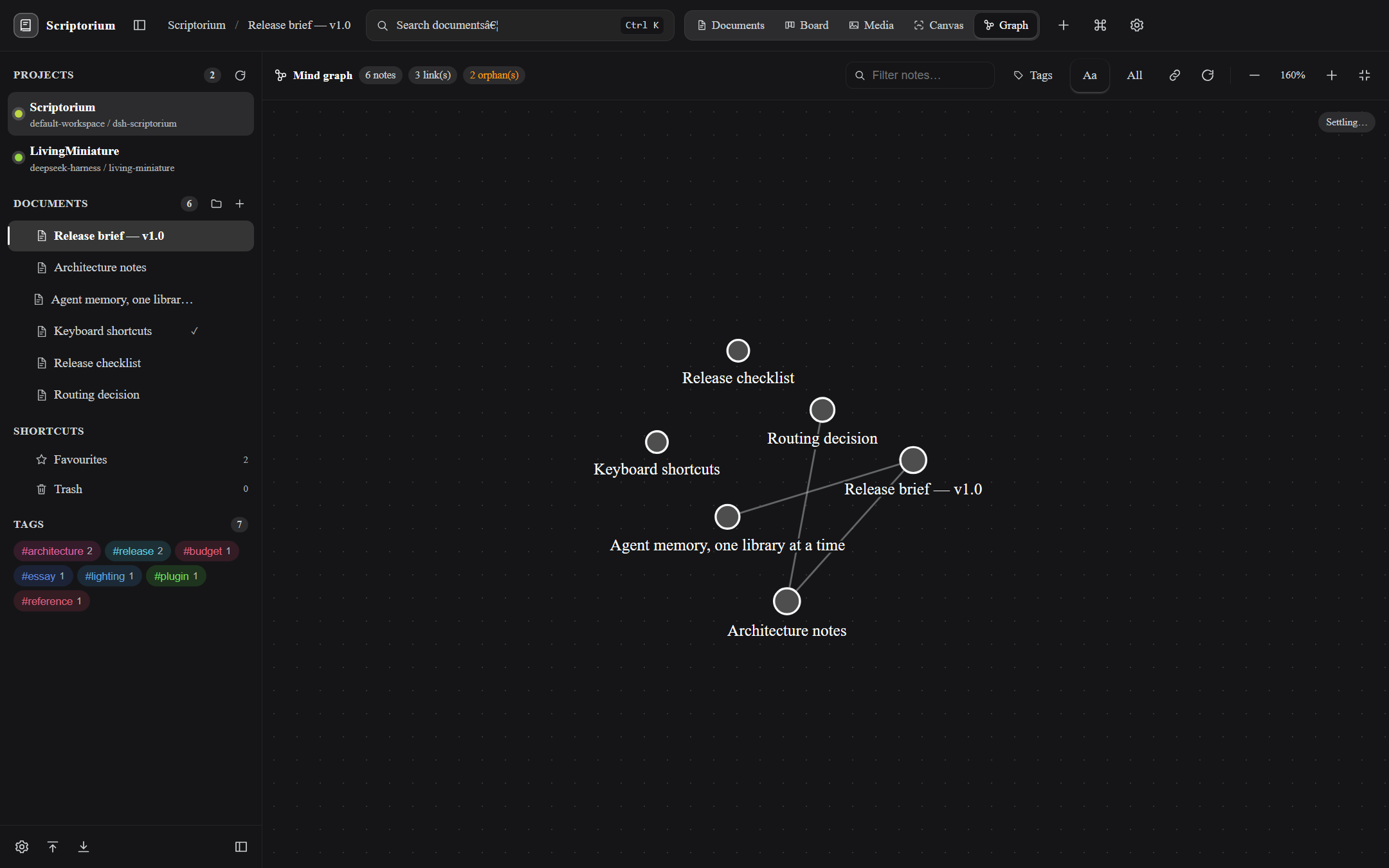 |
| Canvas — attachments become cards beside the note that owns them, joined by an edge. | Mind graph — notes are nodes, [[wiki links]] are edges; opens fitted to the panel. |
 |
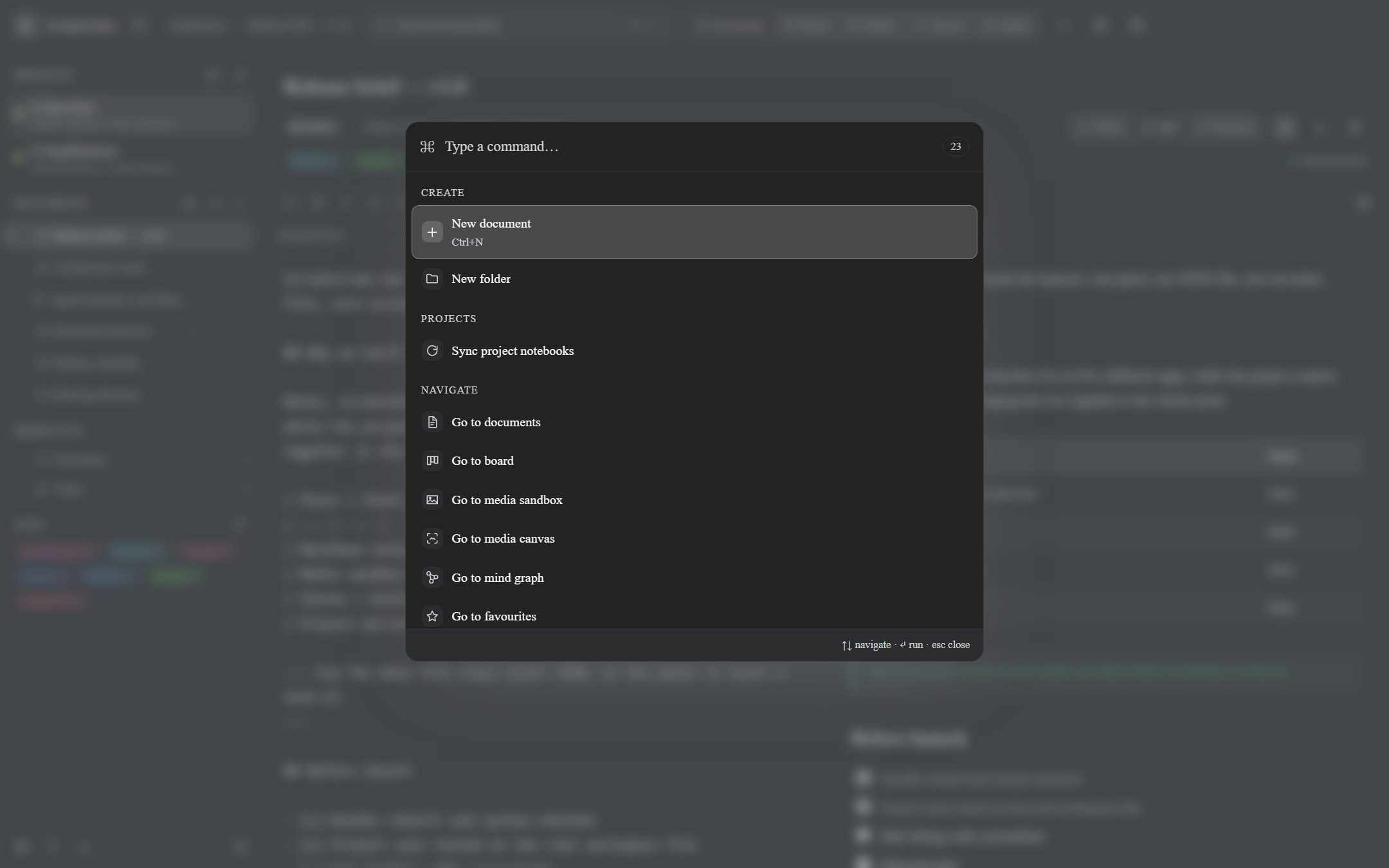 |
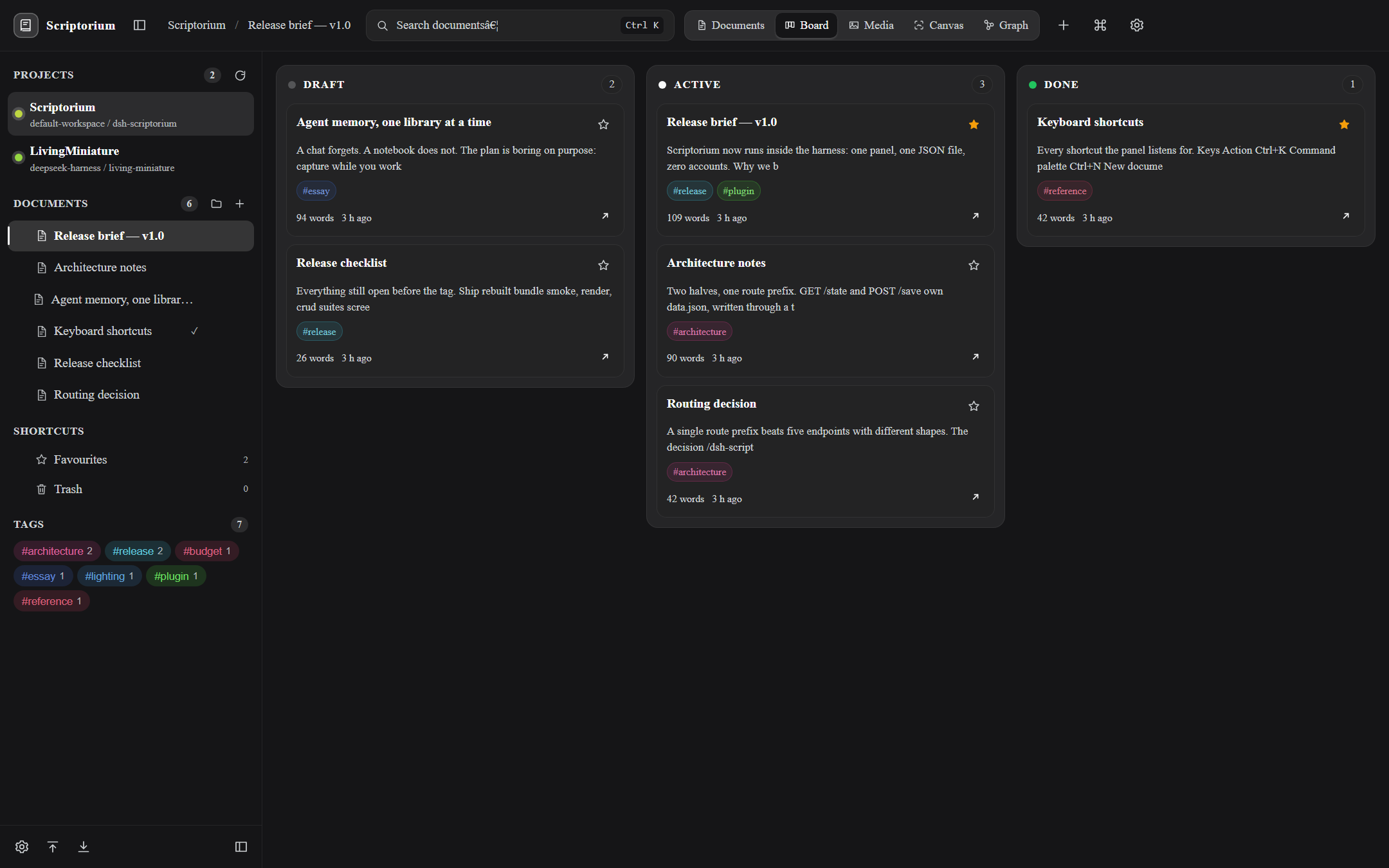
| Board — Draft / Active / Done, straight from each note's status. | Command palette — Ctrl+K, every action one fuzzy query away. |
In practice:
Ctrl+K or search finds the note, the graph shows its neighbours, and the
attachment is still next to the paragraph it explains.| Area | Behaviour |
|---|---|
| Organize | Workspaces → folders → nested documents, drag a document onto a folder, inline rename, reorder |
| Projects | Every notebook mirrors one Harness project from <DSH_HOME>/storages/workspace.json: the sidebar lists each project with its path and accent dot, sync creates/renames notebooks, a vanished project is flagged missing (its documents are kept), and an unlinked notebook can be linked — or merged into the existing project notebook |
| Write | Markdown editor: headings, bold, italic, code, links, images, tables, task lists, ::: note/tip/warning/danger callouts, fenced code with a copy button, $math$, horizontal rules |
| Preview | Write / split / preview modes, task checkboxes toggle the source line, scroll sync |
| Find | Ctrl+K command palette (fuzzy, recency-aware) and full-text search with highlighted title/body matches and relevance ranking |
| Track | Kanban board with Draft / Active / Done columns; drag a card to change its status |
| Classify | Tags on every document, tag cloud filtering, generated per-tag colours, a per-tag view |
| Keep | Favourites, soft trash with restore, permanent purge, empty trash |
| Attachments | Upload images, PDF, audio, video and text files per document; in-app preview modal (PDF via the browser viewer); media sandbox view with kind filters |
| Canvas | Free-form media canvas: every attachment becomes a draggable, resizable card beside the document that owns it, joined by an edge; pan, wheel/button zoom, fit-to-screen, link two cards, keyboard nudging, delete a link |
| Connections | Obsidian-style mind graph: notes are nodes, [[wiki links]] (with |alias and #heading) and optional tags are edges; animated force layout, drag nodes, pan/zoom, search dimming, neighbour highlighting, click to open, "connect two notes" writes the link into the source note |
| Portability | Export JSON, export ZIP (manifest + Markdown notes + media bytes), import JSON (merged, never overwriting) and import ZIP (ids remapped, media stored); the canvas travels both ways and is re-pointed at the imported ids |
| Feel | Shared animation set (fade, pop, toast, tree expansion), theme-token colours only, prefers-reduced-motion respected |
Keyboard: Ctrl+K palette, Ctrl+N new document, Ctrl+S save, Ctrl+B/Ctrl+I bold/italic,
Esc closes overlays; shortcuts stay out of the way while the caret is inside a field.
<DSH_HOME>/scriptorium/data.json (atomic tmp+rename writes, one serialized queue,
revision counter; oversized or malformed snapshots are rejected with a 400).POST /save or a ZIP import can persist them:
workspace ids are unique, every node belongs to an existing workspace, parent chains resolve and
stay inside one workspace without cycles, tags are non-empty strings, attachment ids are unique
and resolvable, canvas cards point at live nodes/attachments with canonical ids, canvas links
connect existing cards, and graph preferences are the three known booleans. Errors name the
exact path (for example nodes[12].media[0].id) and nothing is written when validation fails.
A snapshot newer than this build's STORE_VERSION is rejected with a clear message; older
versions run the ordered migrations first. Unknown top-level blocks are still carried through.<DSH_HOME>/scriptorium/media/<id> plus a <id>.json sidecar with name/mime/size.
DSH_HOME defaults to ~/.dsh. A directory left by the pre-rename build (<DSH_HOME>/alexandrie/)
is moved into place on first mount, so existing notes, attachments and layout survive the rename.<DSH_HOME>/scriptorium/layout.json holds only canvas + graph and is written
before data.json on every save. A pre-canvas build rebuilds data.json from a fixed key list
and never touches this file, so a downgrade cannot destroy the board: the next load merges the
layout back (cards whose document was deleted meanwhile are pruned), and the read itself never
rewrites data.json.<DSH_HOME>/storages/workspace.json (the same file the Harness
workspace switcher uses) and returns { projects, defaultProjectId, directory, source, exists }.
The file is read-only for this plugin: notebook names/paths come from global.workspaceIds
order plus tables.workspaces metadata, a missing file yields an empty list, a malformed one
yields an empty list plus a warning, and GET /projects never touches data.json. The legacy
single notebook is adopted by the default project on the first sync so existing notes are
never stranded, and a project that disappears from the Harness stays in the sidebar flagged
missing rather than being deleted.canvas/graph block is filled with empty defaults on load
(95 bytes on disk), and a build never erases a top-level block it does not know, so newer
features' data survives an older build's save.archive exceeds safety budget: <reason> instead
of expanding without bound.The browser half never touches the disk: it talks to the plugin's own same-origin route
(/dsh-scriptorium/*) with a { ok, value } / { ok: false, error: { message } } envelope, the
same proven pattern as the shipped dsh-taskboard plugin.
Host routes: GET /health, GET /state, GET /projects, POST /save, GET /export,
GET /archive/export, POST /archive/import, GET|POST /media, GET|DELETE /media/<id>.
Repository: https://github.com/santera-pixel/dsh-scriptorium
From npm — the one-step command the DSH Plugin Hub runs:
dsh plugin --profile web add dsh-scriptoriumStraight from GitHub (works before any npm publish; npm runs this package's prepare script, so
the browser bundle is rebuilt during install):
dsh plugin --profile web add github:santera-pixel/dsh-scriptoriumFrom the Web GUI: Settings → Plugins and install from a package, or let the agent call
plugin_manager with install_bundle and target dsh-scriptorium (or a path to a local
checkout). Whichever route installs it, a page refresh is enough for a client change; the host
half (lib/index.js) is ESM and only reloads on a harness restart.
After installing, open the book icon in the sidebar.
platform: "web" and injects
only the slots service. The host half injects webServer and registers routes under
/dsh-scriptorium.>=22 (the host half is dependency-free ESM).<DSH_HOME>/scriptorium/ (data.json, layout.json, media/). Reads
<DSH_HOME>/storages/workspace.json read-only to mirror the Harness project list.The hub discovers public GitHub repositories that carry the dsh-plugin topic and contain a root
package.json with an apply(ctx) export. To publish:
dsh-plugin topic.npm publish (the package is not private and sets publishConfig.access = "public"); the
hub only offers one-step installs for packages that exist on npm.dsh-plugin and verify the listing appears under Settings → Plugin Hub.No bundler and no JSX: src/client/*.js are plain-JavaScript parts concatenated, in filename
order, into lib/client.js inside the window.__ModuleLoader__ factory wrapper.
node build.mjs
node --check lib/client.js
lib/index.js (host half) and lib/zip.js / lib/archive.js are plain ESM with no dependencies.
The suites below live in tests/ on the dev branch. The main branch — what GitHub shows and
what the plugin hub installs — ships without them, and the npm tarball never includes them either.
| Suite | Covers | Checks |
|---|---|---|
tests/smoke.mjs |
model readers/mutators, markdown rendering, search ranking, store seed/save | 13 |
tests/render.mjs |
every component body under a React shim, all App views, media library/preview/grid, canvas and graph roots, project sidebar groups | 41 |
tests/crud.mjs |
create/rename/move/trash/restore/purge/workspace cascade through the real store | 10 |
tests/editor.mjs |
toolbar transforms, modes, task toggling, sanitising, undo-safe insert | 27 |
tests/interactions.mjs |
search/overlay keyboard, palette recency, board drag, tags, shortcut guards | 23 |
tests/canvas.mjs |
canvas geometry (bounds/fit/zoom anchor), item/link mutators, hostile snapshot sanitising, purge/media cleanup, wide-card placement | 19 |
tests/graph.mjs |
wiki-link parsing, graph building (tags, scope, orphans, undirected dedupe), deterministic force layout including 1000-node spread, zoom/fit maths | 13 |
tests/merge.mjs |
JSON archive parsing and merge semantics (no overwrite, orphan re-rooting) | 8 |
tests/archive.mjs |
ZIP writer/reader round-trip, archive build/parse, id remapping | 8 |
tests/zip-budget.mjs |
hand-built ZIPs prove the reader's safety budgets: ratio, entry-count, declared single-entry and actual single-entry bombs and a declared-total bomb all fail closed, while a legitimate multi-megabyte archive imports | 6 |
tests/canvas-import.mjs |
an exported board survives both import paths: ZIP remap re-points cards/links onto fresh ids, drops dangling/dead references and dedupes; JSON merge keeps the target layout, folds imported cards/links in deterministically | 9 |
tests/compat.mjs |
a pre-canvas data.json survives load→save→reload verbatim (old bytes unchanged, 95-byte block overhead, no drift); unknown top-level blocks carried through; no prototype pollution; nested tag/media/workspace/canvas/parent-cycle rejection with exact paths; newer-version rejection; version-0 migration |
13 |
tests/downgrade.mjs |
a pre-canvas build's fixed-key rewrite of data.json is recovered from the layout copy on the next load: positions/sizes/links restored, document edits kept, deleted-document cards pruned, idempotent cycles, export carries the layout |
7 |
tests/projects.mjs |
project sync (create/adopt/rename/missing/idempotent), unsafe ids ignored, linking and merge-into-existing semantics, store project state success/failure | 11 |
tests/migrate.mjs |
the pre-rename data directory is moved into place on mount with documents, attachments, layout copy and revision counter intact; a second mount repeats nothing | 1 |
tests/http.mjs |
the real host half on a throwaway server: state/save, project mirror + malformed file, media, ZIP export/import including the board round-trip, a bomb import answering 400 without touching the store, nested-validation 400 paths, and 409 conflicts on stale revisions | 35 |
tests/export.mjs |
Markdown and JSON download naming and payload | 3 |
tests/gui.mjs |
the built bundle in jsdom against a throwaway host: mount, create, type, preview, Ctrl+K, search, board move, trash/restore, settings, upload→canvas→drag→zoom, graph→connect→filter, hostile-SVG preview, and the 409 banner (Reload/Overwrite) — asserting on the rendered DOM and on data.json |
13 |
tests/battle.mjs |
adversarial pass: 400-operation model fuzz with invariants, hostile canvas payloads, wiki-link abuse, 800-node layout budget, concurrent saves, traversal names, broken archives, 3000-document round-trip | 10 |
tests/live.mjs |
the running harness (health/state/save/conflict/export/projects) | 9 |
279 checks in total (247 node suites, 13 jsdom GUI, 10 adversarial, 9 live).
The suites live in tests/ on the dev branch. main — what GitHub shows, what the hub
installs and what npm publishes — is dev minus tests/, so a plain checkout of main contains
no test code. Tests are never in the npm tarball either.
git switch dev        # or: git fetch origin dev && git switch dev
npm install           # jsdom + react for the DOM suites
npm test              # the fifteen node suites above
npm run test:battle   # adversarial suite only
npm run test:gui      # real DOM end to end
npm run test:live     # against the running GUI
tests/live.mjs reads the GUI URL from DSH_WEB_URL (it defaults to the current harness port).
To release, rebuild main from dev (the script copies dev's tree, drops tests/, and refuses
when main has commits of its own, i.e. someone edited the release branch directly):
npm run sync:main
git push origin main dev --tags
Tag only after the dev CI run is green. release-gate.yml rejects a release whose tree is not
exactly dev minus tests/, or whose dev CI run did not succeed, and release.yml restores the
tests/ from dev into the tag checkout and re-runs npm test, npm run test:battle and
npm run test:gui. A tag can therefore fail even when main itself looked fine — the suite, not
the branch colour, decides whether the release is sound.
401 to plain HTTP without a browser session, so visual end-to-end
checking is manual: the automated evidence is the component tree, the host route suite and the
slot-registration check (main key + sidebar.panellist row).MIT — see LICENSE.
CLASSIFICATION EVIDENCE
系统优先读取 GitHub Topics,再与站内分类词典和词根规则比对。当前命中: knowledge-base、notes。
volcengine
Self-evolving Context Database for AI Agents. Unify Agent Memory, Knowledge RAG and Skills.

mindscale-noah
该仓库暂未提供项目说明。

himovo
Turn DeepSeek Harness into a self-hosted enterprise Agent platform with knowledge, deep research, content generation, vibe coding, browser automation, governance, and admin controls.