DSH Hub CLI
English · 简体中文
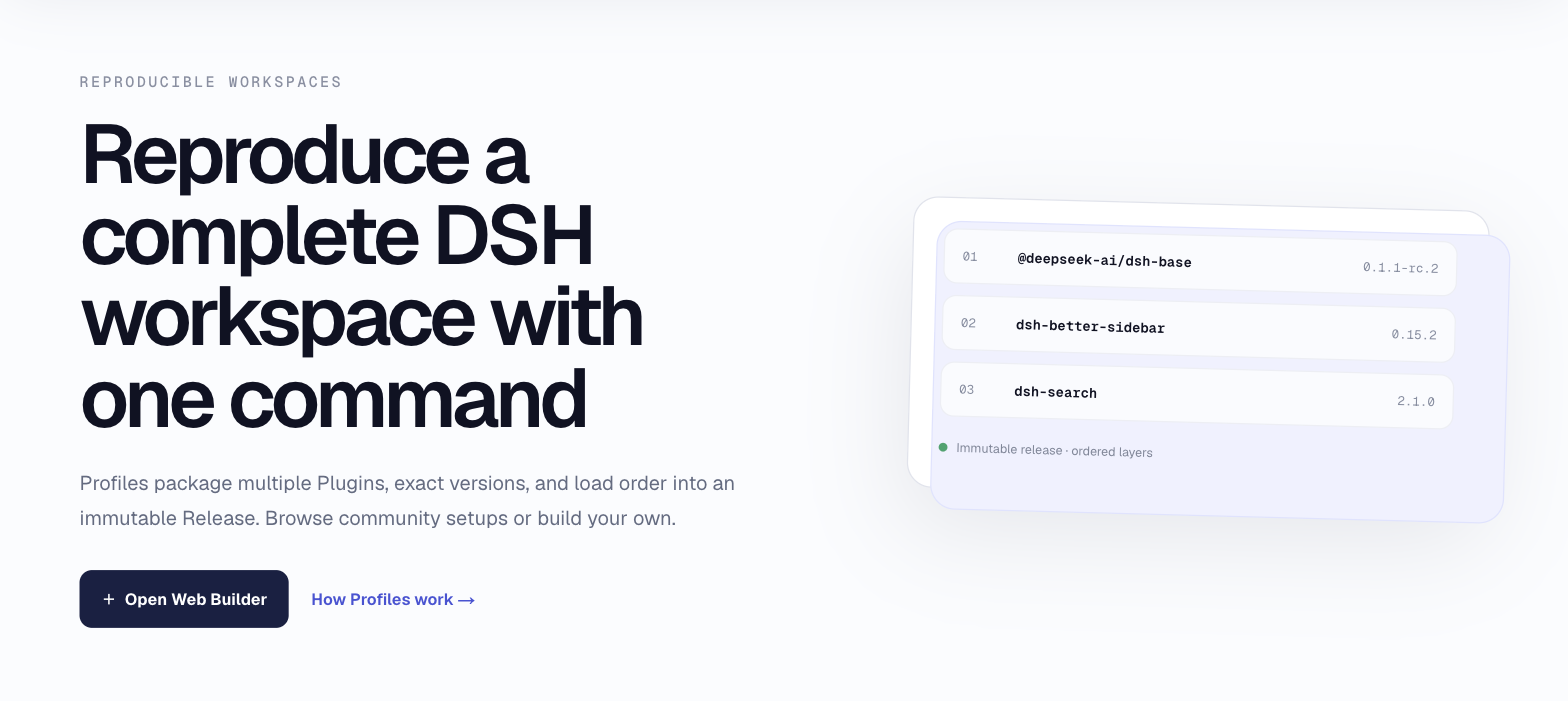
Share your DeepSeek Harness plugins and configuration as a versioned Profile.
Capture the plugins, order, runtime, and config you have running locally. Publish it as an immutable Release. Anyone can apply it with a single command, review every change before it lands, and roll back if they don't like it.




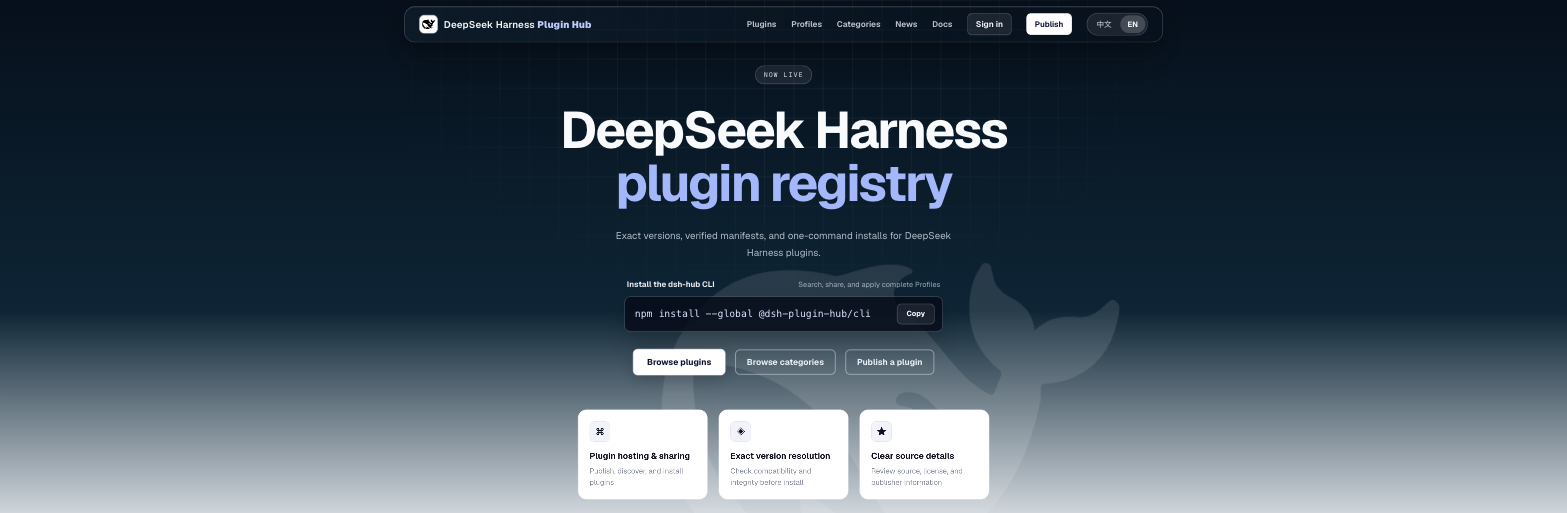
This repository is the open-source client for the Hub. The website, API, and registry live at dshpluginhub.ai.
Quick start · Why Presets · Commands · Support · Contributing · Governance · Security
npm install --global @dsh-plugin-hub/cli

# Apply a teammate's Preset to your local "web" harness
dsh-hub profile apply dsh-web-workspace --version 0.1.0 --profile web
That one command installs the exact plugin versions, in the exact order, with the exact patch the author published. Not "whatever is latest today." What they had.
Why shareable Presets
A DeepSeek Harness (DSH) setup is more than a list of plugins. It is a specific runtime version, a set of plugins at specific versions, the order they load in, a cordis.patch.yml that wires them together, and a handful of environment variables that hold your keys.
Getting that onto a colleague's machine usually means a wiki page, a Slack thread, and an afternoon of "works on my machine."
DSH Hub turns that setup into a first-class, versioned artifact.
flowchart LR
    subgraph author["Author's machine"]
        A["~/.dsh/profiles/web<br/>plugins · order · patch · runtime"]
    end
    subgraph hub["DSH Plugin Hub"]
        R["Preset Release<br/><b>dsh-web-workspace@0.1.0</b><br/>sha256 content hash"]
    end
    subgraph team["Anyone else"]
        T1["Teammate"]
        T2["CI runner"]
        T3["AI agent"]
    end

    A -- "dsh-hub profile share" --> R
    R -- "dsh-hub profile apply" --> T1
    R -- "dsh-hub profile apply" --> T2
    R -- "dsh-hub profile apply" --> T3
| Without DSH Hub |
With a shared Preset |
| "Install these six plugins" |
One slug and one version |
| Direct versions drift within days |
The Release records exact direct versions and sources |
| Load order lives in someone's head |
Order is part of the Release and validated on apply |
| Secrets get pasted into docs |
Only ${ENV_VAR} references are published; values stay local |
| Upgrades are a fresh install |
profile diff shows exactly what changes before you upgrade |
| Broke it? Start over |
profile rollback restores the previous complete revision |
What's inside a Preset Release
A Release is a small, content-addressed document. The CLI verifies its hash before doing anything with it.
flowchart TB
    R["<b>Preset Release</b><br/>dsh-web-workspace @ 0.1.0<br/><code>contentHash: sha256:…</code>"]
    RT["<b>Runtime</b><br/>@deepseek-ai/dsh 4.2.1"]
    P["<b>Patch</b><br/>cordis.patch.yml"]
    I["<b>Inputs</b><br/>OPENAI_API_KEY (secret)<br/>SEARCH_ENDPOINT"]
    subgraph B["Ordered bundles"]
        direction TB
        B1["1 · @deepseek-ai/dsh-base<br/><i>builtin</i>"]
        B2["2 · dsh-better-sidebar @ 0.15.2<br/>npm · sha512 integrity"]
        B3["3 · dsh-search @ 2.1.0<br/>npm · sha512 integrity"]
        B4["4 · acme/dsh-notes # 9f3c…a1<br/>github · pinned commit"]
        B1 --> B2 --> B3 --> B4
    end
    R --> RT
    R --> B
    R --> P
    R --> I
- Runtime pins the exact DSH version the author verified against.
- Bundles are ordered. npm sources carry integrity hashes. GitHub sources must point at a full 40-character commit, never a branch.
- Patch is the author's
cordis.patch.yml, published verbatim.
- Inputs declare which environment variables the Preset needs. The CLI refuses to publish a patch that contains a credential-looking value.
Quick start
Requires Node.js 22.13+ and pnpm on your PATH.
npm install --global @dsh-plugin-hub/cli
dsh-hub --help
Apply someone's Preset
# Find one
dsh-hub profile search workspace

# See exactly what would change on your machine
dsh-hub profile diff dsh-web-workspace --version 0.1.0 --profile web

# Apply it (staged, validated, then swapped in atomically)
dsh-hub profile apply dsh-web-workspace --version 0.1.0 --profile web

# Confirm everything is healthy
dsh-hub profile doctor --profile web
Share your own
# Preview what would be captured from ~/.dsh/profiles/web
dsh-hub profile share my-stack --version 1.0.0 --profile web --dry-run

# Sign in once, then publish an immutable Release
dsh-hub login
dsh-hub profile share my-stack --version 1.0.0 --profile web

# CI: publish with a publish-scoped token instead of an interactive login
DSH_HUB_TOKEN=dshhub_... dsh-hub profile share my-stack --version 1.0.0 --profile web
Upgrade and roll back
dsh-hub profile upgrade --version 0.2.0 --profile web --dry-run   # review the diff
dsh-hub profile upgrade --version 0.2.0 --profile web             # apply it
dsh-hub profile history --profile web                             # see saved revisions
dsh-hub profile rollback --profile web                            # restore the previous one
Install a single plugin
dsh-hub search memory
dsh-hub info dsh-context --version 1.2.3
dsh-hub install dsh-context --version 1.2.3 --profile web
How it works
Review a plan before applying it
Use --plan to save a reviewable, expiring description and a fingerprint of the current state. Apply it by ID after review. If the local Profile changed or the plan expired, create a fresh plan. Direct CLI mutation commands execute immediately unless you request --plan or --dry-run; agent tools use the plan/apply flow.
sequenceDiagram
    autonumber
    participant U as You / Agent
    participant CLI as dsh-hub
    participant Hub as DSH Hub API
    participant FS as ~/.dsh

    U->>CLI: profile apply dsh-web-workspace --plan --json
    CLI->>Hub: fetch Release + resolve bundles
    Hub-->>CLI: Release (hash verified)
    CLI->>FS: write plan {id, expiresAt, precondition}
    CLI-->>U: plan JSON (exact versions, sources, inputs)
    Note over U: Review. Confirm.
    U->>CLI: operation apply <plan-id>
    CLI->>FS: check precondition hash + expiry
    CLI->>FS: stage → install → validate → atomic swap
    CLI-->>U: operation.completed {revision}
This is what makes the CLI safe to hand to an AI agent. The agent can plan freely, but a human confirms the exact plan ID before anything moves.
Apply is staged, validated, and atomic
flowchart LR
    S["Stage into<br/>.hub-web-xxxx/"] --> I["dsh plugin add<br/>each bundle in order"]
    I --> V["Structural check +<br/>dsh --dump-config"]
    V -->|pass| M["Move current web/<br/>to revisions/"]
    M --> W["Rename stage → web/"]
    W --> L["Write lockfile"]
    V -->|fail| X["Delete stage.<br/>Nothing touched."]
The previous Profile directory and its lockfile are kept as a complete revision. Rollback is a rename, not a reinstall.
Packages
flowchart LR
    S["<b>schemas</b><br/>zod contracts for<br/>manifests, Releases, API"] --> RG["<b>registry</b><br/>semver resolution,<br/>bundle ordering"]
    RG --> C["<b>cli</b><br/>dsh-hub command,<br/>plans, apply, rollback"]
    C --> P["<b>dsh-plugin</b><br/>agent tools that<br/>call the CLI"]
    C -.->|HTTPS| H["DSH Hub API"]
All four ship in lockstep under one version. See docs/architecture.md for trust boundaries.
Command reference
| Command |
What it does |
dsh-hub search <query> |
Search the Plugin catalog |
dsh-hub info <package> [--version] |
Show a plugin's resolved version, source, compatibility, and security assessment |
dsh-hub sync <package> |
Run an immediate npm sync so a just-published Plugin or Preset version is indexed without waiting for the schedule |
dsh-hub install <package> [--version] [--profile] [--runtime-version] |
Create or edit a local Profile with exact runtime, staging and history |
dsh-hub runtime prepare --runtime-version <exact> |
Prepare the isolated runtime cache before a read-only local preview |
dsh-hub profile plugin remove\|enable\|disable <package> |
Edit dependency and enabled bundle state transactionally |
dsh-hub profile plugin reorder <package...> |
Set the full enabled bundle sequence |
dsh-hub profile configure --file <patch.yml> |
Validate and apply a local configuration patch |
dsh-hub profile inputs declare\|undeclare <KEY> |
Manage local input declarations, separate from stored values |
dsh-hub profile search <query> |
Search published Presets |
dsh-hub profile list |
List local Profiles without contacting the Hub |
dsh-hub profile status [--profile] |
Inspect source, recorded runtime, drift and history |
dsh-hub profile run [--profile] [--dry-run] |
Start with the recorded exact runtime or preview its command |
dsh-hub profile inputs list\|set\|unset [KEY] [--profile] |
Inspect input readiness or manage local saved values |
dsh-hub profile apply <slug> [--version] [--profile] |
Apply a Preset Release |
dsh-hub profile upgrade [slug] [--version] [--profile] |
Upgrade the installed Preset to another Release |
dsh-hub profile diff [slug] [--version] [--profile] |
Compare local state with a Release |
dsh-hub profile doctor [slug] [--profile] |
Check directory, lockfile, order, installed versions, required inputs, and drift |
dsh-hub profile share <slug> --version <v> [--profile] |
Publish the local Profile as an immutable Preset Release |
dsh-hub profile capture <slug> [--profile] |
Print the captured Preset draft without publishing |
dsh-hub profile import <file.dshprofile> [--profile] |
Apply a Release from an exported archive |
dsh-hub profile history [--profile] |
List recoverable local revisions |
dsh-hub profile rollback [revision] [--profile] |
Restore a previous revision |
dsh-hub operation apply <plan-id> |
Execute a previously created plan |
dsh-hub init [dir] --repository <owner/repo> |
Scaffold a new plugin package |
dsh-hub validate [dir] |
Validate a plugin or Preset package directory |
dsh-hub login / logout |
Sign in to the Hub with a device code |
dsh-hub telemetry state\|on\|off |
Manage anonymous usage reporting |
Common flags: --profile <name> (default web), --version <exact|tag|range>, --dry-run, --plan, --json, --no-telemetry, --api <url>.
Use it from an agent
Install the adapter into a Profile to use the CLI through DSH agent tools:
dsh plugin --profile web add @dsh-plugin-hub/dsh-plugin
Read-only tools (dsh_hub_search, dsh_hub_profile_diff, dsh_hub_profile_doctor, …) run freely. Mutating tools only ever create plans. A single dsh_hub_operation_apply tool executes a plan, and it requires confirmed: true, which the agent may only set after the user approves that exact plan.
The repository also ships a reviewable dsh-hub agent Skill that spells out the confirm-before-apply rules for any agent driving the CLI.
Security and privacy
The CLI installs packages, edits local DSH Profiles, and stores a Hub login session. It is built to make each of those inspectable and reversible:
- Content-addressed Releases. A Release carries a
sha256 hash. The CLI recomputes it and refuses mismatches.
- Pinned direct sources. Releases record direct package versions, source references and available integrity metadata. GitHub references use full commits. Enforcing declared artifact digests and distributing complete transitive dependency locks remain unfinished.
- Explicit plans. Mutations expire after 30 minutes and fail if the local state changed since planning.
- Staged apply. Validation happens in a staging directory. Your live Profile is swapped only after it passes.
- Recoverable revisions. The previous Profile and lockfile are kept intact for rollback.
- Secrets stay local.
profile share refuses patches containing credential-looking values and publishes only environment-variable references.
- Session storage. Tokens live in
~/.dsh/.hub/auth.json with mode 0600. The embedded WorkOS client ID is a public OAuth identifier.
Local management and customization-preserving upgrade commands require CLI 0.5.0 or later. See CHANGELOG.md and the CLI reference for their scope, and next-stage work for remaining reliability and end-to-end validation.
Telemetry. After a first-run notice, lifecycle commands send anonymous, aggregate-only usage events (slug, version, outcome, error category, duration, platform, CLI version). No account, machine ID, path, config, or environment value is ever included. Disable it with dsh-hub telemetry off, --no-telemetry, DSH_HUB_TELEMETRY=0, or DO_NOT_TRACK=1. Full field list and retention policy: packages/cli/README.md.
To report a vulnerability, follow SECURITY.md.
Development
corepack enable
pnpm install --frozen-lockfile
pnpm check        # typecheck + tests + package-content audit
packages/
  schemas/       zod contracts
  registry/      resolver + bundle ordering
  cli/           the dsh-hub command
  dsh-plugin/    agent tool adapter
skills/dsh-hub/  agent Skill
docs/            architecture, releasing
Tests use Node's built-in runner. After pnpm build, run a single package's suite with:
node --test packages/cli/tests/*.test.ts
Release notes live in CHANGELOG.md and the release process in docs/releasing.md.
Contributing
Bug reports and pull requests are welcome. Start with CONTRIBUTING.md. By participating you agree to the Code of Conduct.
License
MIT
DSH Hub is an independent community project and is not affiliated with or endorsed by DeepSeek.