workspace-metabolism
MCP server and CLI for governing files left by AI coding agents: policy-driven
audit, reversible cleanup, rollback, and hash-chained verification. Python
3.11+, zero dependencies, Windows / Linux / macOS.






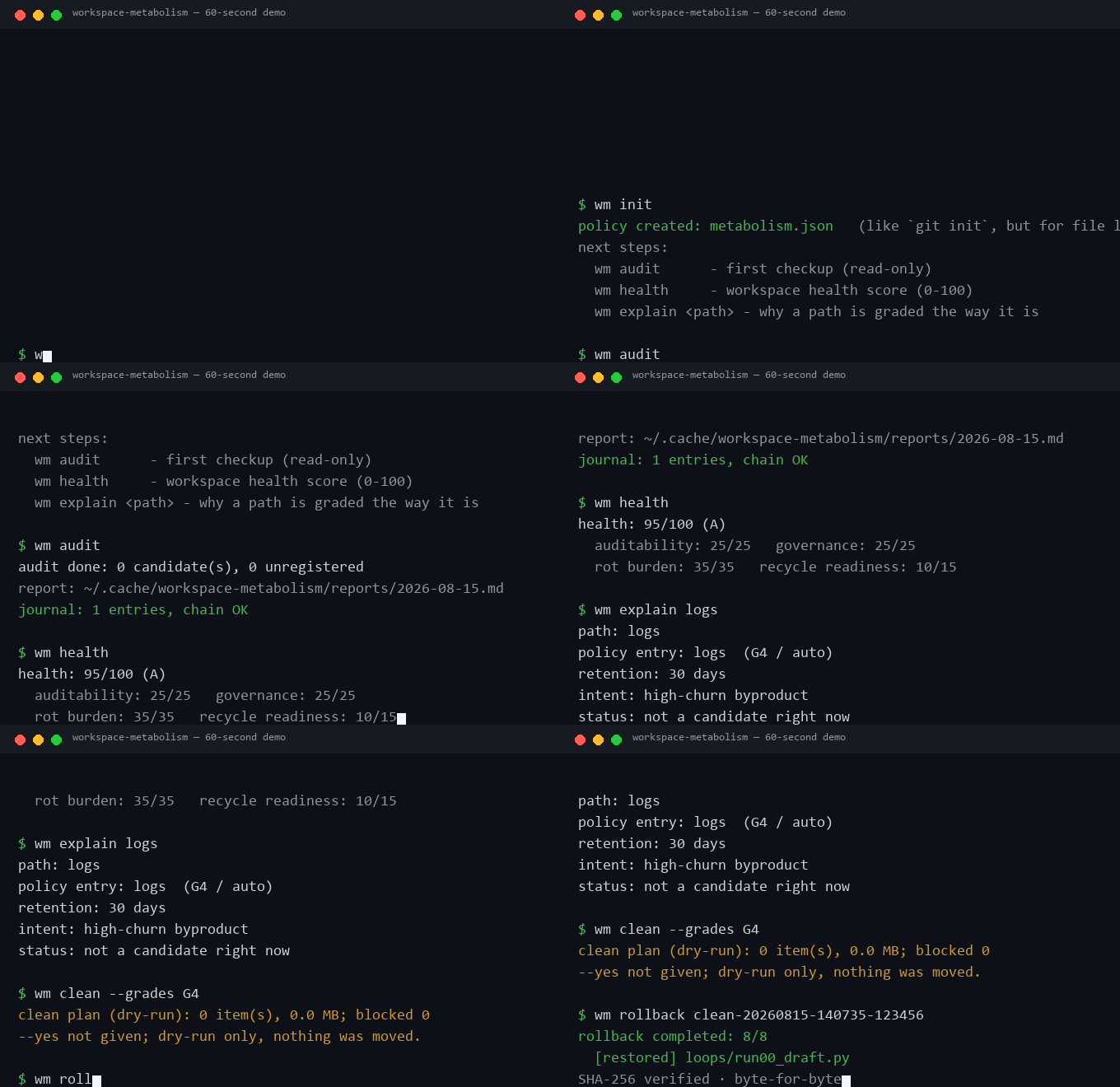

▶️ Watch the 60-second animated demo: docs/demo-terminal.html
The problem
AI coding agents (Claude Code, Codex, DeepSeek Harness, …) share one thing —
your workspace — and they leave a trail of scratch files, caches and staged
directories behind. Nobody owns the cleanup: deleting by hand is irreversible,
scheduled scripts have no audit trail, and the next agent run works in the
garbage the last one left.
workspace-metabolism is the policy layer for that: one metabolism.json
decides what every path is worth (G1 never touch → G4 auto), nothing is ever
deleted by pattern — items move to a recycle area with per-file SHA-256 hashes
and rollback restores them exactly — and every action lands in a
hash-chained journal that verify can audit.
Try it in 30 seconds:
pip install workspace-metabolism
wm doctor --residue                  # what agent byproducts your policy doesn't govern yet
wm doctor --residue --apply-policy   # adopt the suggestions as policy entries (creates the file if missing)
wm audit                             # read-only checkup with health score
Distribution status (v0.6.0): GitHub release and installable wheel;
PyPI v0.5.1.
The new features require the GitHub wheel/source; PyPI publication is separate.
See v0.6.0 release notes for installation.
See the Glama tool-definition assessment
for interface quality; it does not establish production reliability or lower supervision.
Honest: no large production deployments yet, and the policy schema may shift
before v1.0. Early adopters are welcome to break it on weird directory
structures.
Honest boundaries — what this is not:
- Not a sandbox.
wm gate is a governance/audit layer for cooperative
agents; a compromised or malicious agent can bypass it and call the target
server directly. OS-level sandboxing is a different layer.
- Not a heuristic classifier. It never decides "this file is garbage" on
its own — only the policy you approved decides.
doctor only suggests
entries; nothing is governed until you adopt them.
- Does not fix agent bugs. It governs the byproducts agents leave; it does
not stop agents from producing them.
- Local audit, not a notary. The hash-chained journal detects tampering
with the tool's own records; it is not a distributed or court-grade ledger.
This repo has two linked ideas:
- Agentic Metabolic Engineering is the method: how to think about workspace lifecycle.
- AI governance as code is the implementation: how
wm applies that method with policy files and commands.
中文快速上手(30 秒)
v0.6.0 新增:先认领再写入、清理避让未完成认领、精确绑定 SQLite 路径及不建库的只读
检查。复用现有任务和数据入口,不另建 AI 调度系统。见接入指南、
认领使用说明和数据库检查。
AI 编程(Claude Code / Codex / Aider 等)会在工作区留下大量草稿、缓存和
废弃文件,越堆越多,下一轮 AI 还得在垃圾堆里干活。这个工具用一份策略文件
管理文件的整个生命周期:检查(只读)→ 回收(可回滚)→ 验证(防篡改记录)
→ 清理。
pip install workspace-metabolism        # 安装(零依赖)
python examples/demo.py                 # 30 秒演示:盲删 vs 回收+回滚
wm init                                 # 生成策略文件 metabolism.json
wm audit                                # 只读体检,给文件贴营养标签
wm clean --grades G4 --yes              # 回收过期项(默认 dry-run,确认后加 --yes)
wm rollback <run_id>                    # 删错了?一键原样找回
wm govern write --path src/main.py      # 写文件前先问策略:允许吗?(AI 执行点拦截)
wm slim --db data/app.db --yes          # 数据库也会膨胀:策略驱动的库内瘦身(v0.3)
默认只读、绝不直接删文件;每步操作都有防篡改记录;Windows / Mac / Linux 通用。
项目处于早期,认领和受控编辑仍为实验能力;策略格式在 v1.0 前可能调整。完整英文文档见下文。
Why this exists
Most disk tools either show you space (ncdu, duf) or delete things
(rmlint). workspace-metabolism is different: a policy file defines what
every path is worth (grades G1–G4), and the tool only ever does what the policy
allows — nothing more. It is the policy layer for multi-agent workspaces:
Claude Code, Codex, Aider, OpenClaw and every other agent share one thing —
your workspace — and the policy governs the byproducts all of them leave
behind, regardless of which tool created them. It fixes no vendor and judges
no file; see What this is not before you judge it.
- G1 never touch / G2 keep / G3 approve + reference check / G4 auto
- Deletion is never direct: items move to a recycle area, then
rollback
restores them after a per-file SHA-256 integrity check
- Every action lands in a hash-chained journal;
verify detects any edit
- Read-only
audit reports candidates, unregistered paths, disk alerts, growth
trend and possible duplicates — plus residue on memory-backed mounts
(tmpfs/ramfs: it costs RAM, not just disk)
- Optional protected window (e.g. trading hours, business hours) during
which marked entries are never touched
- Scheduled runs are supported out of the box on Windows (Task Scheduler) and
Linux/macOS (cron) via templates in
examples/
Why not just a scheduled cleanup?
A scheduled task — or asking Codex to "clean up old files" on a timer — gets
you at some point, files get removed. workspace-metabolism gets you:
- rules that live in the repo (
metabolism.json), versioned and reviewable
- cleanup that never deletes directly: recycle area, per-file SHA-256, exact
rollback
- a hash-chained journal that detects tampering
- the same behavior on every machine and every run, no AI judgment involved
Scheduling and metabolism are complementary, not rivals: this repo ships cron,
Windows Task Scheduler and CI templates that run wm itself. The scheduler
answers when; the policy answers what, how, and how to undo it.
What this is not
Four objections come up so often they deserve their own page
(docs/positioning.md). The short version:
- Not a fix for vendor bugs — Claude Code's
/tmp leak, OpenClaw's
staged-dir residue: those belong upstream. We govern the workspace, which
is the one thing every agent shares.
- Not a heuristic classifier — no guessing, no AI judgment. Only the
policy file you wrote decides anything;
wm explain <path> shows the rule.
- Not a rival to agent self-cleanup — agents should clean up after
themselves;
wm mcp + session-end hooks make that safe and audited.
- Not a blind-delete script — nothing is ever deleted by pattern: items
move to a recycle area with per-file hashes, and
rollback restores them.
purge is the only real delete, and only inside the recycle area.
See it in action
This repo ships a reproducible benchmark: two identical workspaces run 30
simulated agent loops; one ends every loop with wm clean, the other never
cleans. The result — 2 active files vs 242 — is a number you can reproduce
yourself:
python examples/metabolism_benchmark.py
A recorded run (2026-08-16, wm 0.2.0) is in
docs/publish/benchmark-run-20260816.json
(raw log:
docs/publish/benchmark-run-20260816.txt).
Case study: a 20.7 GB database that stalled a research engine
wm slim was born from a production incident, and the dogfooding round
produced the most honest review the tool has had. Read
docs/case-studies/research-engine-db-rot.md:
three failure modes (dead work units, database rot, silently-dead jobs), the
fixes, and what we found when we used wm slim to verify them — a policy
stripping the wrong field, two path-matching bugs, a CLI flag-order pitfall
that failed the first scheduled run, and the first successful run reclaiming
10.15 GB (21.7 GB → 11.3 GB) before uncovering a third real problem: the
dead-position exclusion rule forgot itself once "clean" epochs diluted its
learning window. Real usage is the final test.
🧬 Philosophy
workspace-metabolism treats your AI-generated workspace as a finite system:
audit → clean → verify → rollback, with recyclable cleanup and a hash-chained
audit trail. Cleanup is the means; metabolism is the frame. The one-liner:
loops keep the agent running; metabolism keeps the workspace usable. We
call this framing Agentic Metabolic Engineering — managing the byproducts
of agent-driven software workspaces. Full write-up:
docs/philosophy.md · the story ·
competitive analysis ·
academic anchors.
Quick start
# install from PyPI
pip install workspace-metabolism

# or run without installing anything:
#   PYTHONPATH=src python -m workspace_metabolism --help

# try it on a throwaway workspace (builds demo files; shows the usual
# blind-delete fix vs the wm way: recycle + rollback + journal)
python examples/demo.py
Point the tool at your own workspace:
cd /path/to/workspace
wm init            # scaffold metabolism.json (like `git init`)
wm doctor          # check readiness before the first audit or cleanup
wm audit           # first checkup (read-only)
wm health          # workspace health score (0-100)
wm explain logs    # why a path is graded the way it is
wm clean --grades G4 --yes   # recycle expired G4 items (dry-run without --yes)
wm rollback <run_id>
wm init scans your workspace and registers common directories (source and
docs as G2 keep, logs/tmp/cache as G4 auto, archive/staging as G3 approve).
Edit metabolism.json and commit it like any source file. The tool
auto-discovers metabolism.json (or .wm.json) in the workspace root, so
--registry is optional. Nothing is cleaned unless it is registered in the
policy file. Advanced users can start from
examples/registry.example.json.
Commands
| Command |
What it does |
audit |
Read-only health check; writes a report and a journal entry (also flags sensitive files and git-tracked content) |
clean --grades G4 |
Move expired items to the recycle area (dry-run by default) |
clean --grades G3 |
Same, but requires --approve + --approver |
rollback <run_id> |
Restore one cleanup run after an integrity check |
purge --older-than 30 |
Delete expired recycle batches (the only real delete) |
verify |
Check the journal hash chain and run manifests |
status |
Overview of workspace, recycle area and pending candidates |
init |
Scaffold a metabolism.json policy file (like git init) |
explain <path> |
Show what the policy says about a path (the nutrition label) |
health |
Workspace health score (0-100), with --json and --badge output |
doctor |
Read-only readiness check (workspace, policy, state, locks); --residue also lists common agent byproducts (.cursor, .claude, caches, logs) the policy does not govern yet — each with the exact policy entry that would govern it, --apply-policy adopts them |
govern <action> |
Check whether an AI action is allowed by policy and record the decision |
gate --target ... |
MCP governance proxy: every tool call of the wrapped server is checked against the policy first |
slim --db PATH |
Policy-driven in-place trimming of heavy JSON fields in a SQLite database (journaled; dry-run by default) |
mcp |
MCP stdio server so agents can run micro-metabolism themselves |
Global flags:
| Flag |
Meaning |
--root PATH |
Workspace to govern (default: current directory) |
--state-dir PATH |
Journal / recycle / runs / reports (default: system cache directory, outside the workspace) |
--registry PATH |
Policy JSON (optional; auto-discovers metabolism.json / .wm.json) |
--protected-window HH:MM-HH:MM |
Weekday window; entries marked protected are skipped while active |
The default state directory lives outside the workspace on purpose — a
git add . in your project can never sweep the audit journal into version
control.
wm doctor is a read-only preflight check. It reports whether the workspace
and state directory are writable, whether the policy exists and is valid, and
whether another wm operation currently holds the state lock. The lock
serializes audits, cleanup, rollback and purge so concurrent scheduled or
agent-triggered runs cannot interleave journal and recycle operations.
AI governance as code
The optional ai_governance section is the concrete implementation of this
repository's AI governance layer. It uses the same policy file to check AI
actions before they happen. Unknown actions are denied by default; write
actions can require a preview, while execute, delete and network actions can
require a named approver. wm govern only makes and records a decision; it
does not perform the action for the caller.
wm govern write --path src/main.py
wm govern write --path src/main.py --preview
wm govern execute --path scripts/release.ps1 --approve-by "name"
wm govern network --approve-by "name" --json
wm gate turns decisions into enforcement. It wraps any MCP stdio server
and checks every tools/call against the policy before forwarding it;
denied calls never reach the target and every decision lands in the journal:
wm gate --target "python -m my_mcp_server"
Map tool names to actions with tool_patterns (glob), e.g.
"fs_write*": "write", "shell*": "execute". Unmatched tools default to the
execute action. For tools whose calls carry a preview mode, pass
"preview": true in the call arguments to satisfy requires_preview.
Every decision includes the policy hash and is written to the same
hash-chained journal; govern returns a decision_id that clean /
rollback / slim accept via --decision-id, so the journal shows the full
intent → decision → execution chain. The approver value is an auditable
declaration, not an authentication mechanism.
Honest boundary: wm gate is a governance and audit layer, not a
sandbox. A compromised or malicious agent can bypass the proxy and talk
to the target directly. Gate governs the cooperative agent; OS-level
sandboxing governs the hostile one.
First run, guided: wm doctor --residue scans for the byproducts agents
usually leave behind (.cursor, .claude, node_modules/.cache,
__pycache__, logs …) that your policy does not govern yet. Every hit shows
the exact policy entry that would govern it; --apply-policy adopts the
suggestions into metabolism.json (creating it if needed). Nothing is ever
deleted — the suggestions become policy, and the policy still decides
everything afterwards:
wm doctor --residue               # what is ungoverned, and the suggested entries
wm doctor --residue --apply-policy  # adopt them as policy entries, then audit
Policy file
{
  "version": 1,
  "defaults": {
    "recycle_retention_days": 30,
    "max_item_mb": 2560,
    "disk_alert_free_gb": 20,
    "disk_alert_free_pct": 15,
    "dupe_scan_dirs": ["tmp", "cache"]
  },
  "never_clean": [".git", "README.md", "src"],
  "entries": [
    {"path": "logs", "grade": "G4", "cleanup": "auto", "retention_days": 30},
    {"path": "archive", "grade": "G3", "cleanup": "approve", "retention_days": 60},
    {"path": "**/__pycache__", "grade": "G4", "cleanup": "auto", "retention_days": 30}
  ]
}
| Field |
Meaning |
path |
Path or glob (*, **/) relative to --root |
grade |
G1 never / G2 keep / G3 approve / G4 auto |
cleanup |
never, auto or approve |
retention_days |
Idle days before the item becomes a candidate (required unless cleanup=never) |
scope |
Optional: files_only (top-level files of a directory) |
protected |
Optional: skip while a --protected-window is active |
remote_authoritative |
Optional: display marker for data with a remote source of truth |
category |
Optional free-form label for your own classification |
owner |
Optional: who is accountable for this rule |
intent |
Optional: why this rule exists |
review_after |
Optional: when this rule should be revisited |
The policy format is versioned and validated against
schema/metabolism.schema.json, so editors and
agents can check your file before the tool does.
Health score
wm health combines the audit summary into one number from 0 to 100: 25
points for journal auditability, 25 for governance (unregistered paths, disk
alerts), 35 for rot burden (expired candidates), and 15 for recycle
readiness. Grades: A (90+), B (75+), C (60+), D (below).
wm health --json
wm health --badge   # shields.io endpoint JSON for a README badge
The badge above is generated from docs/health.json. A CI
template that fails when the score drops below a threshold is in
examples/ci-audit.yml.
Agents
wm mcp runs a zero-dependency MCP stdio server. Agents can init a policy,
audit, explain, verify, and dry-run clean plans themselves; clean only
executes when the caller explicitly passes execute=true, rollback restores
a previous run from the recycle area (SHA-256 verified), and the policy file
still decides everything. The end-of-loop ritual is automated in
examples/micro_metabolism.py — wire it into a
session-end hook so every loop ends with a checkup.
DeepSeek Harness (DSH)
DSH is an agent harness where everything is a plugin (Cordis). Its official
third-party tool channel is MCP, and wm mcp already speaks it — one
cordis.yml row exposes all eight wm tools to the DSH agent (audit, health,
explain, verify, wm_govern pre-action policy checks, clean, init, rollback):
- insert:
    - id: workspace-metabolism
      name: '@deepseek-ai/dsh-mcp-client'
      config:
        serverName: wm
        transport: stdio
        command: wm
        args: [mcp]
        cwd: !!js process.cwd()
Full walkthrough (project cordis.yml vs --patch overlay, pinned
--root/--state-dir, safety notes):
docs/dsh-integration.md. A policy tuned for
DSH-style workspaces (.agents/notes, scratch plugins, generated artifacts):
examples/registry.dsh.example.json.
The optional Metabolic Maintenance skill plugin
adds consequence-aware maintenance rules and downstream recovery verification to
DSH's skill catalog. It loads instructions on demand and can pair with the MCP
tools above. Download the plugin.
Safety model
clean is dry-run unless --yes is given.- G4 needs
--yes; G3 needs --approve and --approver (audit trail).
- Sensitive files are never auto-cleaned:
audit flags secrets/keys/credentials
(.env*, *.pem, *.key, *token*, *secret*, *credential*, id_rsa, …) in a
dedicated report section, the policy validator refuses to register a sensitive path
as G4 auto-clean, and clean skips any candidate that contains sensitive files.
- Git-aware classification: in a git repo, tracked files count as controlled by git
(effectively G2) — they are excluded from the audit's unregistered list, and
clean
skips candidates that contain git-tracked files. Non-git workspaces fall back to pure
policy matching. (Git is optional; wm never depends on it.)
- Items move to the recycle area with per-file SHA-256 hashes;
rollback
verifies them before restoring and refuses to overwrite an existing path.
purge is the only command that truly deletes, and only inside the recycle
area after retention.- The journal is a hash chain;
verify detects any tampering.
Scheduled runs
Templates with {{PLACEHOLDERS}} are in examples/:
- Windows —
register_schedule.template.ps1: daily read-only audit (20:30),
weekly G4 clean (Saturday 10:00), monthly purge (1st, 10:30).
- Linux/macOS —
register_cron.template.sh: same schedule via cron.
Replace {{WM_CMD}}, {{ROOT}}, {{REGISTRY}}, {{STATE_DIR}} (and
{{USER}} in cron) with your values. The scripts deliberately do not
auto-detect your environment — your paths, your call.
Development
python -m pip install -e . pytest
python -m pytest
CI runs the full test suite on Ubuntu, Windows and macOS with Python 3.11 and
3.12. Issues are handled on weekends; pull requests are welcome.
Project family
Sister organization: Holdout — a
toolchain against self-deception in quantitative research:
If workspace-metabolism keeps the workspace alive, Holdout keeps
the research honest.
License
MIT
Maintenance evidence (0.5.1)
wm --state-dir /path/to/state evidence prints a bounded, read-only JSON
summary of journal.jsonl. Optionally add --observation check.json to read
an existing check containing timezone-aware checked_at and boolean ok.
No policy is required. Each input is limited to 8 MiB; no files are written.
Exit 0 means a nonempty internally consistent journal and, when requested,
a readable valid check. It does not mean the system is healthy. Missing,
empty, damaged, unsupported or oversized evidence returns exit 1.
Time association does not establish matching scope, freshness, causality or
business recovery. Human supervision, Token cost and net savings remain unknown.
See case collection guide.
Safe recent-row retention (0.5.2)
slim can now match a real database relationship instead of assuming the
ordering timestamp is embedded in every JSON payload:
"db_slim": {
  "table": "work_units",
  "blob_column": "payload_json",
  "strip_keys": ["regenerable_detail"],
  "protected_keys": ["consumer_evidence", "failure_reason"],
  "keep_recent": {
    "table": "epochs", "column": "created_at", "n": 3,
    "key_column": "epoch_id", "row_column": "epoch_id"
  },
  "vacuum_min_gb": 1.0
}
column sorts the reference table; key_column joins to the work table's
row_column. Reference keys must be unique and non-null. For a row that would
change, a missing relationship stops the whole plan before any update. The
report's rows_kept_recent counts otherwise-modifiable rows protected by age.
Policies that omit the two new columns retain legacy JSON matching, but missing
or unknown references now stop instead of silently stripping the row. Migrate
such policies before scheduled use. Protected keys are top-level JSON keys;
conflicting CLI strip requests are rejected. This is not recursive field matching.
Execution holds the wm state lock and a SQLite write transaction across planning
and updates. Preview opens the database read-only but still writes the existing
wm journal. External writers must still observe the application's maintenance
window; these locks do not validate consumer correctness or coordinate other
systems. Backup/restore and post-maintenance consumer checks remain required.