

消息通讯
插件

Invoice-Downloader
EthanYoQ
电子发票整理与报销准备工具:从邮箱批量收集 PDF/OFD/XML 发票,OCR 识别、分类归档并生成 Excel 汇总;提供 Windows/macOS 桌面版与 DSH 插件。
PROJECT TOPICS
INSTALL REFERENCE
dsh plugin --profile web add github:lucagiftzek/dsh-phone
该命令指向仓库当前默认分支;尚无绑定当前 commit 的完整验证结果。
PROJECT README
SMS, calls, live voicemail and Telegram in the DSH sidebar, with call audio through your own server.
Install from npm: dsh plugin --profile web add @lucagiftzek/dsh-phone, or from GitHub: dsh plugin --profile web add github:lucagiftzek/dsh-phone.
dsh plugin --profile web add dsh-better-sidebar   # the tab host, skip if installed
dsh plugin --profile web add @lucagiftzek/dsh-phone
# or from GitHub: dsh plugin --profile web add github:lucagiftzek/dsh-phone
# restart dsh web, then run phone-hookd and connect your provider (see Install)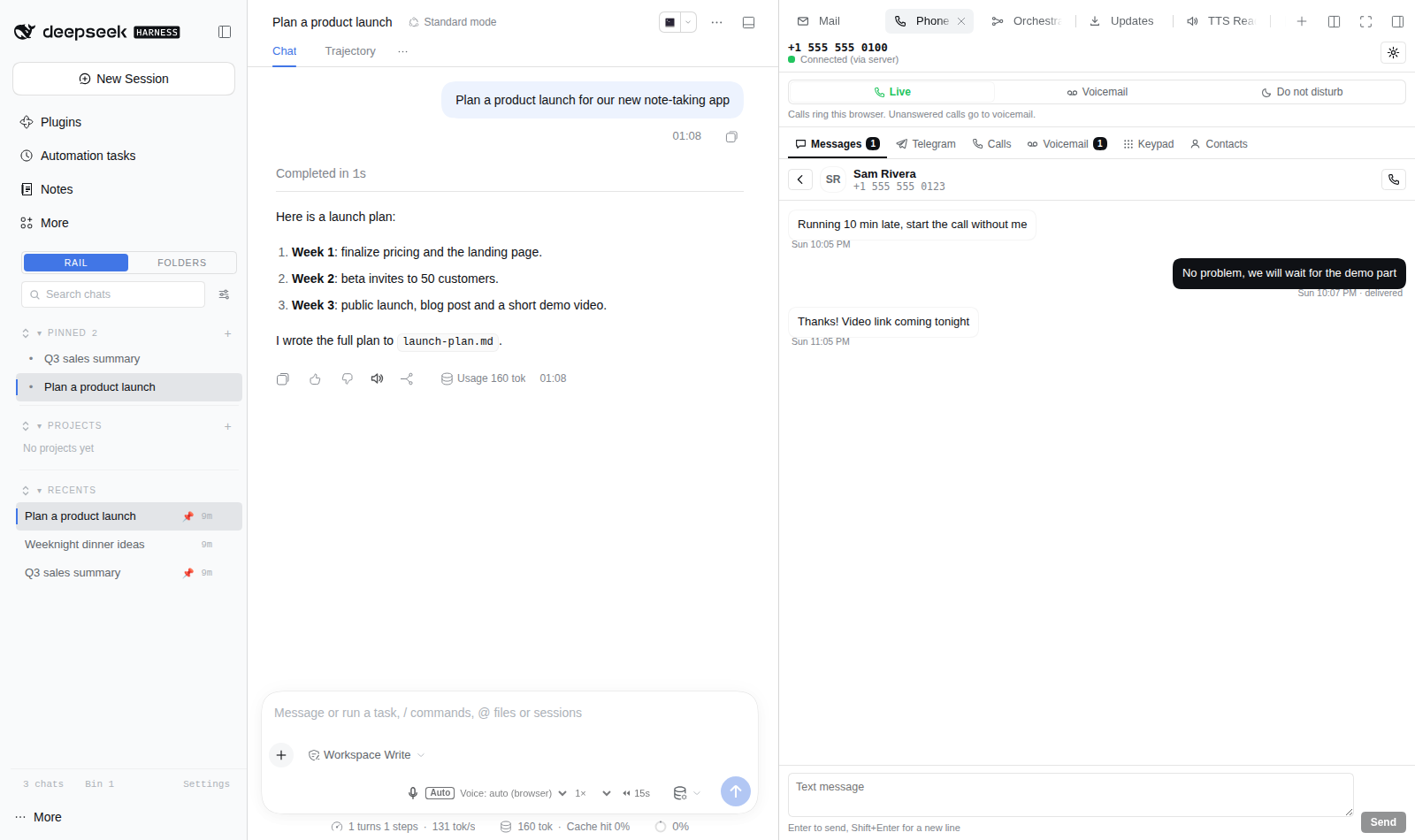
Screenshot from a demo DSH instance with sample data.
A phone in the DeepSeek Harness web GUI. It adds a Phone tab to the sidebar (dsh-better-sidebar) where you can:
phone_status, phone_set_mode, phone_sms_threads, phone_sms_thread, phone_sms_send, phone_calls, phone_voicemails, phone_contacts, phone_call_say, and the read-only phone_doctor. Sending an SMS or placing a spoken alert call always returns a draft first and needs confirm: true.dsh-phone is provider-agnostic by design. Twilio is the first adapter (done, tested on a real line). Next: any SIP account or trunk through a relay on your server (for example an existing landline from a local VoIP provider), Twilio-compatible SignalWire, then Telnyx, Vonage, Plivo and SMS gateways. A SIP account (an existing landline) can join through an Asterisk relay in bridge mode: docs/RELAY.md. See docs/PROVIDERS.md for every option, the standards behind each setting (SIP, WebRTC, SRTP, codecs, DTMF, E.164, SMS encodings) and which setup to pick.
 Browser (DSH web UI)                         Your server                               Twilio
 ───────────────────                          ───────────                               ──────
 Phone tab + call overlay ──/dsh-phone/api──▶ dsh-web: dsh-phone plugin  ──unix socket──▶ phone-hookd ◀──signed webhooks── voice + SMS
   (behind your login)        (gated)          settings, tools, gates        (0600)        SQLite, TwiML,  ──REST──────────▶ calls, SMS,
 Twilio Voice SDK  ◀════════════════════════ WebRTC media ═══════════════════════════════════ recordings,                       recordings
local Whisperdaemon/hookd.mjs) is a small Node service that owns the database and talks to the provider. It has two listeners:127.0.0.1:3098, exposed only as https://<host>/phone-hook/) for provider webhooks. Every request must carry a valid X-Twilio-Signature; anything else gets 403.~/.dsh/phone/hookd.sock, mode 0600) used only by the plugin.
It runs outside the web UI on purpose: calls still reach voicemail and texts still arrive while the UI restarts.lib/index.js) runs inside dsh-web. It registers the settings, the agent tools and /dsh-phone/api/*, where every request passes the same four gates as dsh-mail / dsh-hpc (loopback peer, same-origin trust fence, short-lived capability token, harness session cookie) before it is forwarded to the socket. It also serves the Voice SDK locally (no CDN).src/client.jsx, built to lib/client.js) starts one phone service per page: live events (SSE), the Twilio Device, a WebAudio ringtone, browser notifications, and an overlay for incoming calls, the active call, live voicemail and toasts, visible whichever tab is open.Requirements: DSH web with dsh-better-sidebar, Node 22.5+ (for node:sqlite), a Twilio account with a voice + SMS number, and a public HTTPS hostname your reverse proxy can route to a loopback port.
git clone https://github.com/lucagiftzek/dsh-phone && cd dsh-phone
npm install && npm run build && npm test

# 1. the daemon (edit YOUR_USER, the node path and the repo path first)
sudo install -m 644 deploy/dsh-phone-hookd.service /etc/systemd/system/
sudo systemctl daemon-reload && sudo systemctl enable --now dsh-phone-hookd

# 2. the public webhook route: send ONLY /phone-hook/ to 127.0.0.1:3098, without your login
#    middleware (see deploy/traefik-phone-hook.yml for a Traefik example)

# 3. the plugin, in your DSH web profile: link the checkout (the daemon runs from it too)
dsh plugin --profile web add link:$PWD   # then restart dsh web
Plugin only (the Phone tab and agent tools, when the daemon runs elsewhere): from npm dsh plugin --profile web add @lucagiftzek/dsh-phone, or from GitHub dsh plugin --profile web add github:lucagiftzek/dsh-phone. The package declares dsh.bundle, so dsh plugin add lists it in the profile bundles.
Then open Settings > Phone: put the account SID and auth token in the fields or in a KEY=value credentials file (TWILIO_ACCOUNT_SID, TWILIO_AUTH_TOKEN; default ~/.config/twilio/credentials), add your number as a line (or pick it from "Numbers on the Twilio account"), set the public webhook base URL, Save, then Apply to Twilio. The checklist should go green, and the browser registers so calls can ring.
With Via server the browser captures the microphone (echo cancellation, noise suppression and auto gain on), encodes G.711 mu-law in an AudioWorklet and sends 20 ms blocks over ONE wss socket to the DSH origin (/dsh-phone/api/io, about 70 kbit/s each way at the default 40 ms per message); far audio plays through a small adaptive jitter buffer. No Twilio SDK, CDN, STUN or TURN is loaded. phone-hookd bridges the socket to the call:
<Connect><Stream>, mu-law 8 kHz) to wss://<host>/phone-hook/s, accepted only with a valid X-Twilio-Signature over the wss URL and a one-time ticket bound to the CallSid. Incoming calls ring the Phone tab through the event stream while the caller hears ringback from the server; unanswered or declined calls go to voicemail as before, and Pick up on a live voicemail works the same way.audio.maxCalls (default 2) calls and audio.maxTests (2) tests at once; a dropped browser socket keeps the call for 15 s while the tab reconnects.Choose the route per browser in the Phone tab (Keypad, "Call audio"), or set the default with audio.route.
dsh-phone)| Key | Default | Meaning |
|---|---|---|
publicBaseUrl |
empty (required) | What Twilio calls, e.g. https://your-host/phone-hook. Must reach phone-hookd's public listener. |
trustedHosts |
[] |
Public hostnames the browser uses for the UI (loopback is always trusted). |
identity |
owner |
The browser client identity that rings. |
defaultCountry |
empty | Prefix for numbers typed without one (+30). |
lines[] |
[] |
{ id, label, provider: twilio, number, numberSid, sms, voice, enabled } |
twilio.* |
empty | accountSid, authToken, apiKeySid, apiKeySecret, twimlAppSid, edge, credentialsFile. Empty fields fall back to the credentials file, then to what Apply created (~/.dsh/phone/provisioned.json, 0600). |
incoming.* |
live, 25 s | defaultMode, ringSeconds, forwardTo, dndBypassStarred, rejectAnonymous |
voicemail.* |
on | greeting text / voice / language / audio URL, maxSeconds, liveTranscript (+ liveLanguage, liveEngine, liveModel), transcriber (local, mistral, off), localUrl + localCredentialsFile (KEY=value with TTS_BASE_URL, TTS_API_KEY) for the local Whisper endpoint, deleteFromProvider |
sms.dndAutoReply |
empty | Sent once per sender per 12 h while DND is on. |
notifications.* |
all on | sound, browser, toasts |
agent.* |
all on | allowSms, allowCalls, allowModeChange |
audio.* |
server | route (server or direct), maxCalls (2), maxTests (2), packetMs (20, 40, 60), jitterMinMs / jitterMaxMs (40 / 400), testSeconds (30), audioSocketPort (9093, loopback), ringbackTone (eu, us, uk, empty = from the line number) |
The incoming-call mode itself is runtime state (the switch in the tab, or phone_set_mode), so flipping it never rewrites your settings file. incoming.defaultMode only applies to a fresh database.
Calls on the server route over a Twilio line are billed as a normal PSTN call plus Media Streams (0.0044 USD per minute); SIP-line calls on the server route do not touch Twilio at all. Direct browser calls are billed as Twilio Client minutes plus the PSTN leg; SMS per segment (Greek lowercase is Unicode: 70 characters per segment); the live voicemail transcript uses Twilio real-time transcription (about 0.027 USD per minute, voicemail only); the final transcript is local and free; recordings are deleted from Twilio after download, so there is no storage charge.
voicemail.liveLanguage to el-GR and voicemail.liveModel to chirp_2. The final transcript (local Whisper) detects the language by itself.A Telegram account on the server, in its own Phone tab section: chats, groups and channels, photos, voice messages (transcribed by the voicemail engine) and files, channel posts, 1:1 voice calls on the server audio route, and telegram_* agent tools, with the browser talking only to the DSH origin. A Go daemon (telegramd/, MTProto via gotd/td) holds the account behind a private unix socket.
Setup in short (details in docs/TELEGRAM.md):
~/.dsh/phone/telegram/api.env (0600) as TELEGRAM_API_ID=... and TELEGRAM_API_HASH=..., or in Settings. Never use a sample or published api_id.telegramd (deploy/dsh-telegramd.service is an example unit), then log in from Settings, Phone, Telegram: QR code (Telegram app, Settings, Devices, Link Desktop Device) or the login code, then the cloud password.Terms caveat: Telegram watches accounts that log in through third-party API clients, and flooding or spam gets an account banned. The agent tools therefore only write to existing conversations or allowlisted chats, with rate limits, an audit log and a kill switch; read "Rules for automated use" in docs/TELEGRAM.md before you enable agent sending. Use it on your own account at your own risk.
Voice calls use ntgcalls (libntgcalls, LGPL-3.0). It is not part of this repository: telegramd/scripts/fetch-ntgcalls.sh downloads the pinned release (v3.0.5) and checks its sha256, and go build -tags ntgcalls (cgo) links it dynamically, so you can replace the library with your own build. Without the build tag, telegramd builds as pure Go and calls report that the engine is missing; chats, media and transcription work either way.
See docs/SECURITY.md. In short: the only unauthenticated path is the signature-checked webhook prefix, served by a hardened daemon that never reaches the web UI; secrets are never returned by any read endpoint; sending and calling from agents are opt-in and draft-first.
npm test            # signature (Twilio's published vector), JWT, TwiML, E.164, segments, settings, store
npm run build # src/client.jsx -> lib/client.js (verified before it replaces the live file)phone-doctor skill (bundled in skills/phone-doctor/). The plugin registers it with the skills service at start, so it is offered after dsh web restarts. If your DSH does not list it, copy it once by hand: P=$(node -p "require('path').dirname(require.resolve('dsh-phone/package.json',{paths:[(process.env.DSH_HOME||require('os').homedir()+'/.dsh')+'/profiles/web']}))"); mkdir -p "${DSH_HOME:-$HOME/.dsh}/skills" && cp -r "$P/skills/phone-doctor" "${DSH_HOME:-$HOME/.dsh}/skills/" (see docs/TROUBLESHOOTING.md).GET /dsh-phone/api/doctor (same access rules as the other read routes) or the read-only agent tool phone_doctor. It reports settings mode, lines, provider credentials (set or missing, never the values), the public webhook URL (set or not), whether the hook daemon answers on its private socket, SIP account registrations and the media server configuration. It never calls the provider, never places a call or sends a text, and failing checks carry a PHONE_* code and a hint. The read-only commands in section 0 of the troubleshooting guide give the same facts by hand.code, and the daemon log lines start with it: docs/ERRORS.md.MIT licence. The Twilio Voice SDK is Apache-2.0 and is served from node_modules, not committed. libntgcalls (optional, Telegram calls) is LGPL-3.0, fetched by a script and linked dynamically, never committed.
All of them are open source and run on DeepSeek Harness 0.2.x (several on 0.1.5 too).
| Plugin | What it does |
|---|---|
| dsh-artifacts | An Artifacts tab that lists the files an agent produced and previews them in place, plus a template library agents can use and extend |
| dsh-mail | Mail client and agent mail tools: IMAP, POP3, SMTP and OAuth2 accounts, scheduled and bulk sends with unsubscribe handling |
| dsh-note-keeper | Obsidian-compatible Markdown notes in the sidebar with search, graph, audio notes and transcription, OCR and client-side encryption |
| dsh-phone (this one) | SMS and calls (Twilio, SIP via Asterisk) with call audio through your own server, live voicemail and Telegram |
| dsh-voice | Read-aloud, dictation and language-aware speech with 23 TTS and STT providers, per-language routing and word highlighting |
| dsh-orchestrator | Agent swarm and task orchestration: an Orchestrate tab, orch_* tools, runners, provider cards and a machine API |
| dsh-workspace-rail | A workspace-first sidebar rail: pinned chats, projects as folders, live Recents, search and unread markers |
| DSH-Idle-Watchdog | Idle-chat nudges and an authenticated HTTP API that posts a prompt into any chat |
| dsh-plugin-updates | Update checker that only offers releases your running DSH core can load |
| dsh-subagent-tiering | Subagents default to a cheaper sibling of the parent model unless the agent names a route |
| dsh-fs-reobserve | Ends self-inflicted stale-file errors after an agent's own shell commands |
| dsh-request-image-cap | Clamps every image sent to the model to a pixel cap, fixing many-image request errors |
| dsh-seal | An encrypted channel in front of DSH: a Go reverse proxy plus a service worker that seal all DSH browser traffic |
Built by Luca Tzekos, who also makes Job Opportunities API: employer-direct job data with per-field provenance you can verify yourself, free to read and available as an API. If dsh-phone is useful to you, a star on this repo or a look at jobopportunitiesapi.org is the best thanks.
CLASSIFICATION EVIDENCE
系统优先读取 GitHub Topics,再与站内分类词典和词根规则比对。当前命中: telegram。
EthanYoQ
电子发票整理与报销准备工具:从邮箱批量收集 PDF/OFD/XML 发票,OCR 识别、分类归档并生成 Excel 汇总;提供 Windows/macOS 桌面版与 DSH 插件。

Bytedesk
Open Souce IM with AI powered live-chat, email, ticket support, omni-channel customer service,alternative to slack + zendesk

wenbin-wb
🚀 DeepSeek Harness 多通道远程访问与安全守护插件 | 局域网扫码直连、Cloudflare / 自建公网隧道、微信 / QQ / 飞书 / Telegram 机器人全生命周期对话 | 内置全协议访问安全认证、后台防篡改与容灾保命体系