

文件与数据
插件

OpenViking
volcengine
Self-evolving Context Database for AI Agents. Unify Agent Memory, Knowledge RAG and Skills.
PROJECT TOPICS
INSTALL REFERENCE
dsh plugin --profile web add github:lucagiftzek/dsh-note-keeper
该命令指向仓库当前默认分支;尚无绑定当前 commit 的完整验证结果。
PROJECT README
dsh-note-keeper)Obsidian-compatible Markdown notes in the DSH sidebar, with search, graph, audio notes and agent tools.
Install from npm: dsh plugin --profile web add @lucagiftzek/dsh-note-keeper (the package carries a prebuilt Linux x64 daemon), or from GitHub: clone, build and link a checkout:
git clone https://github.com/lucagiftzek/dsh-note-keeper.git && cd dsh-note-keeper
npm ci && npm run build   # Go daemon + browser bundle (Go 1.22+, Node 22.5+)
dsh plugin --profile web add link:$PWD   # then restart dsh web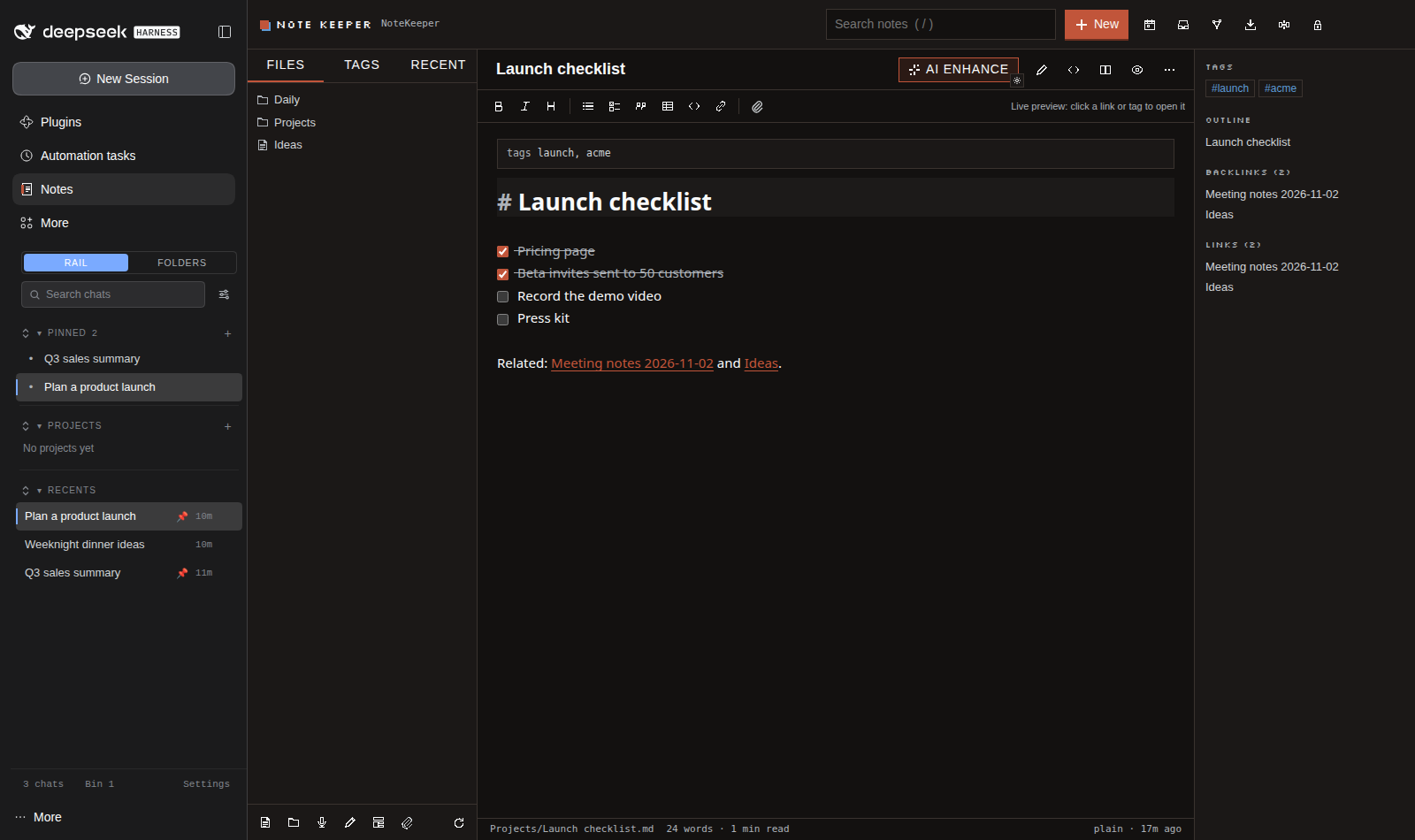
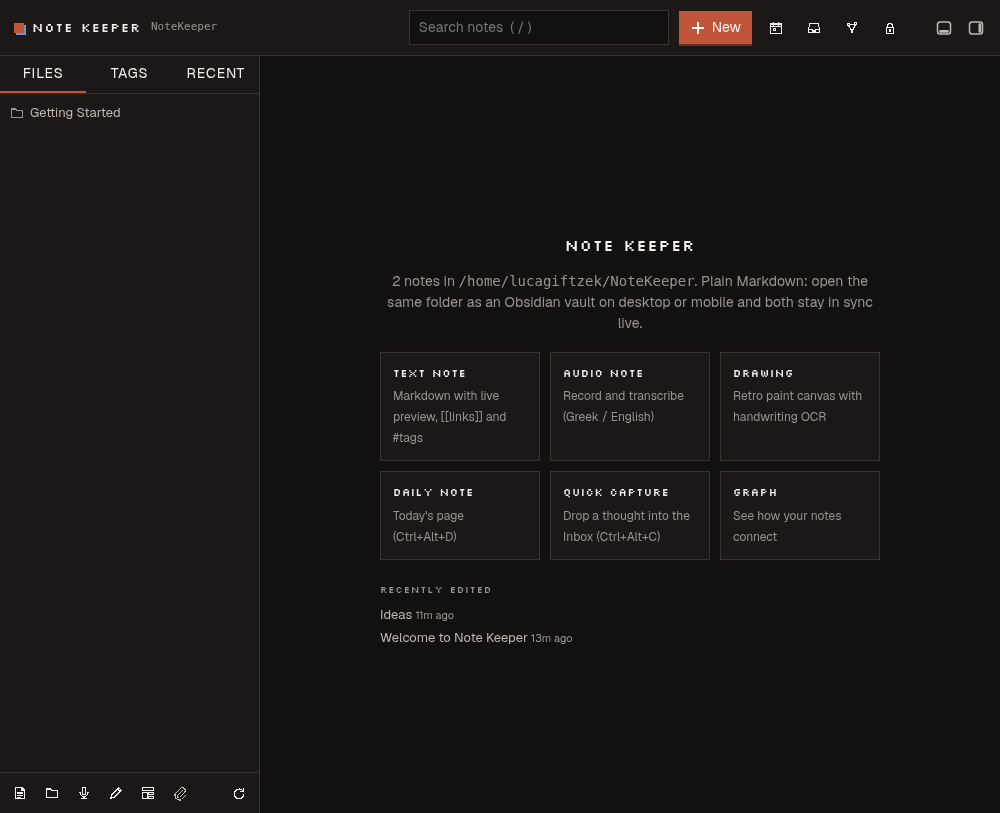
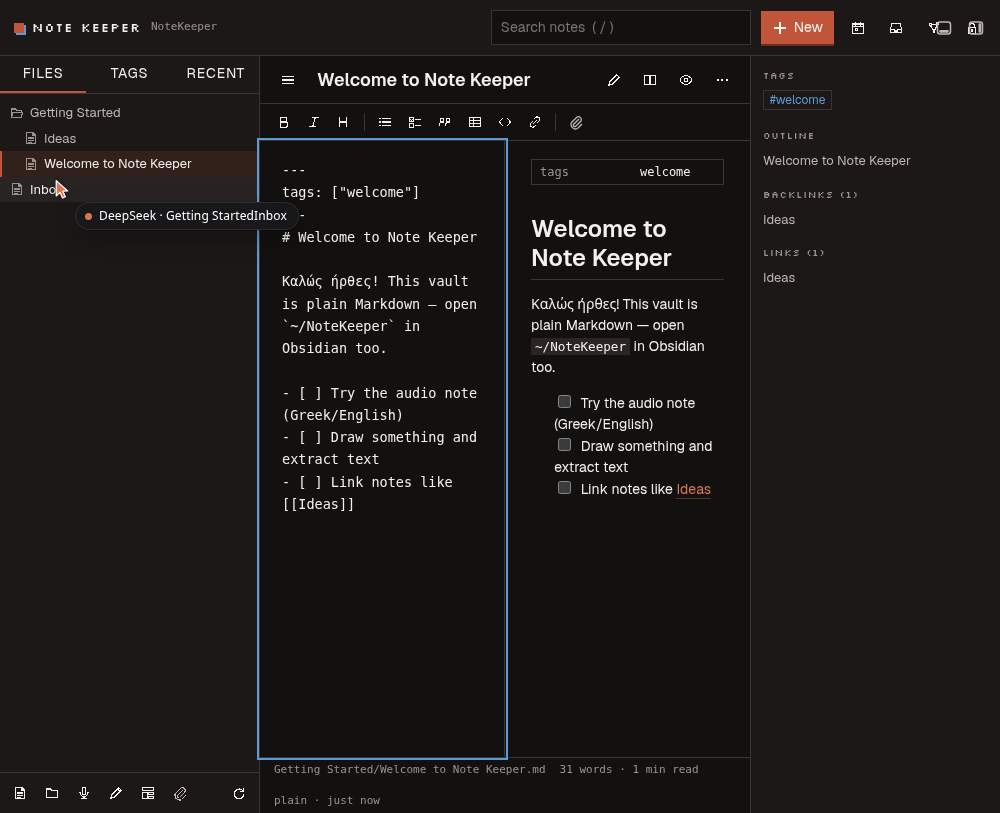
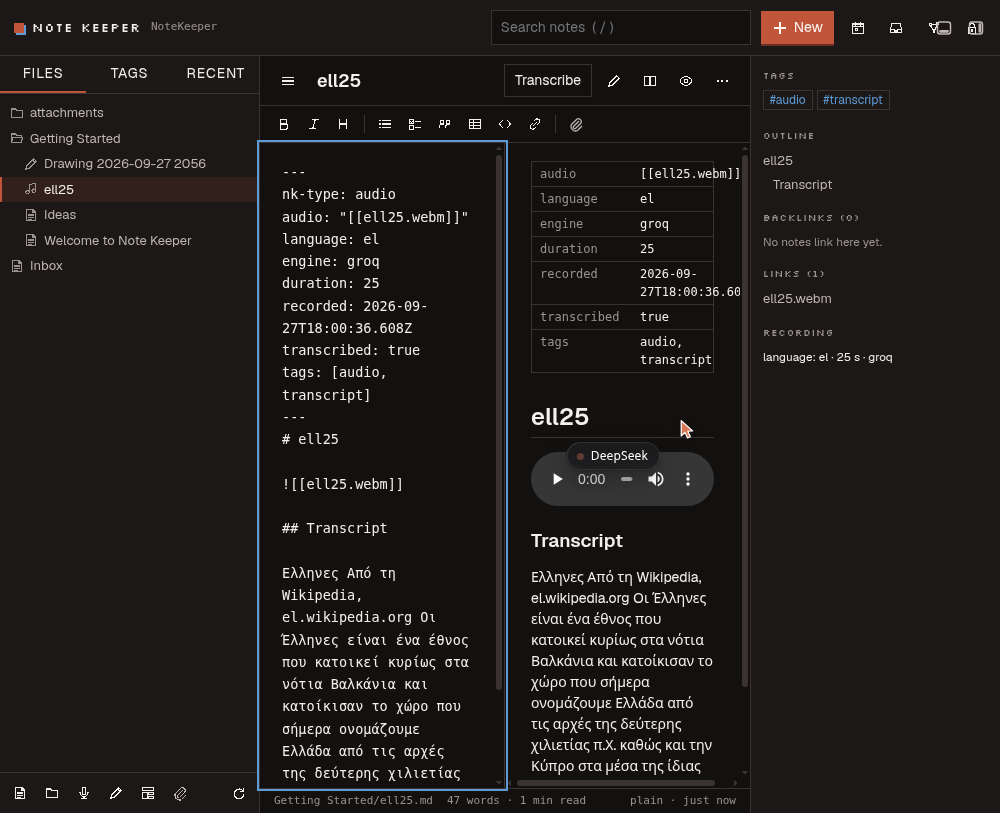
Screenshot from a demo DSH instance with sample data.
Note Keeper is a plugin for the DeepSeek Harness (DSH) web GUI: an
Obsidian-compatible, local-first notes app that lives in the left sidebar and
opens as a full-page panel. It stores notes as plain Markdown files in a
regular directory on disk, so any Obsidian-compatible sync method keeps it in
step with a phone or another desktop. It also exposes a set of notes_*
tools so an AI in the same DSH chat can read, search and write the user's
notes under a clear set of guardrails.
Author: Loukas "Luca" Tzekos. License: MIT.
sidebar.panellist slot) that opens Note Keeper as a full-page panel
registered in the main-column keyed slot.~/NoteKeeper, configurable via vault). Wikilinks
([[Note]]), embeds (![[Note]]), #tags (including nested
project/alpha), YAML frontmatter, callouts (> [!warning]), and a
.trash folder for recoverable deletes, exactly the way Obsidian lays
them out.[[wikilink]]/![[embed]] that pointed at it, in every other note, the
same way Obsidian does."quoted phrase" matching. Filterable by tag (nested tags included)
or folder.- [ ] task) to Inbox.md; another opens or creates
today's daily note at Daily/YYYY-MM-DD.md, expanding
Templates/Daily.md when present.Templates/ folder can be used to
start a new note, with {{title}}, {{date}} and {{time}} expanded.MediaRecorder, send the clip to the
dsh-voice plugin's /api/voice/stt endpoint with the language pinned
(Greek and English are first-class; several others are offered; "auto"
lets the engine detect), optionally run a text-polish pass, and save the
result as a Markdown note with nk-type: audio frontmatter
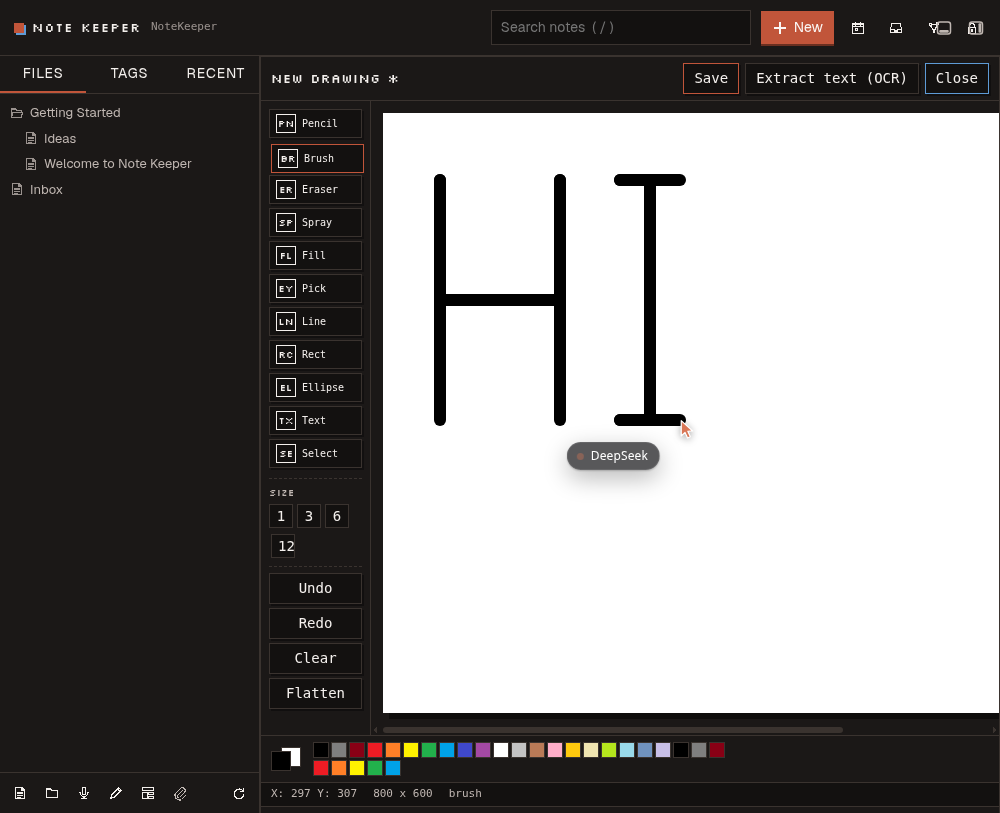
(language, engine, duration) embedding the audio clip.eng+ell by default) runs over pasted/attached
images and over paint-canvas drawings to extract text (handwriting
included, on a best-effort basis).begin / chunk… / finish), because an edge such as Cloudflare refuses
any single request body over 100 MB. The server stages the slices in a hidden
.nk-up-* file, renames it into place at finish, and removes it on any
failure or abort. The assembled-file cap is 1 GiB (maxAttachBytes).notes_*), see the AI tools table.v0.2: live preview (links and tags clickable), AI Enhance diff review, Connect (Obsidian pairing):
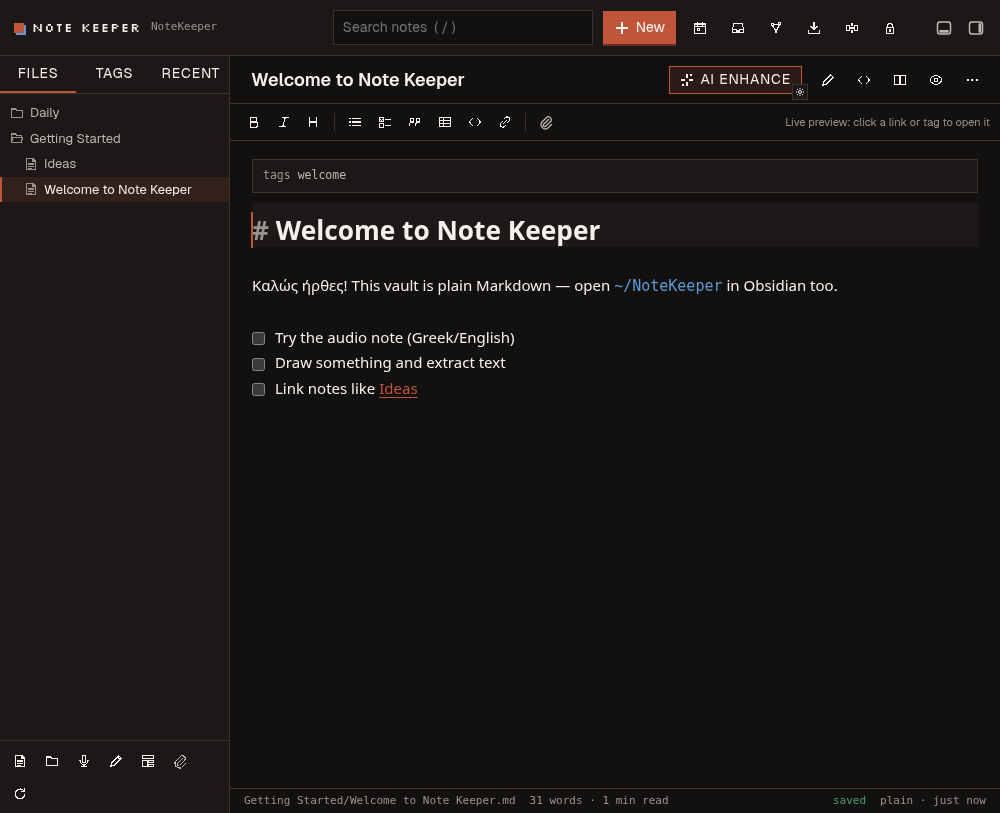
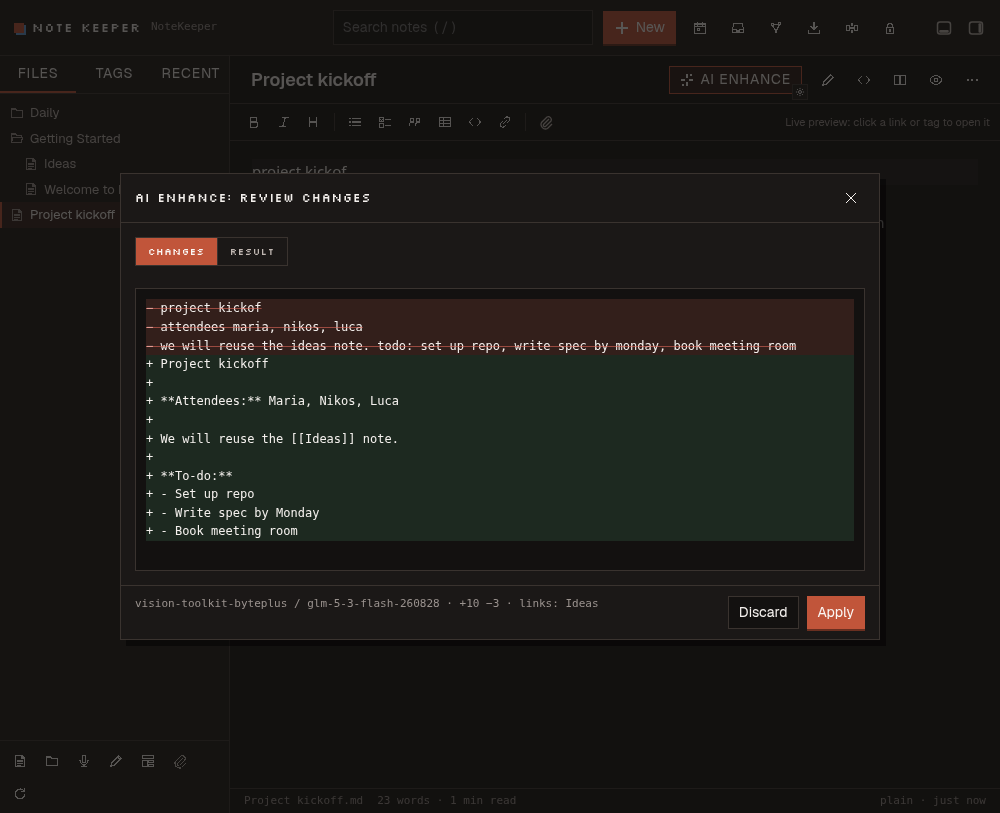
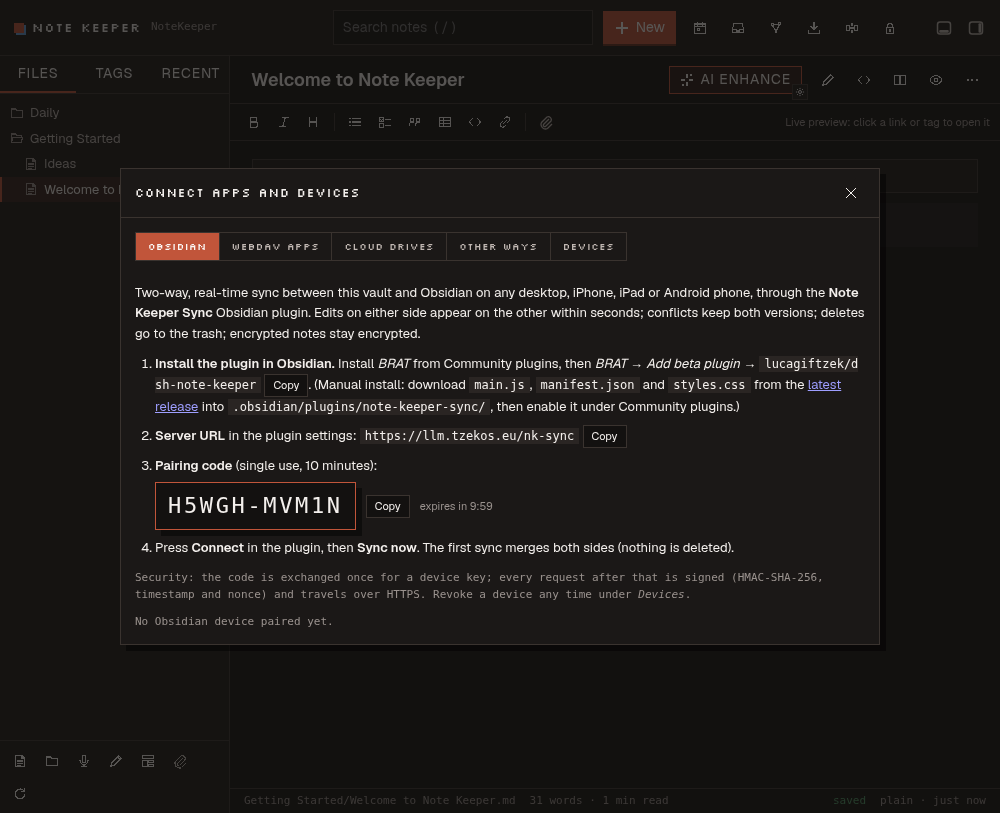
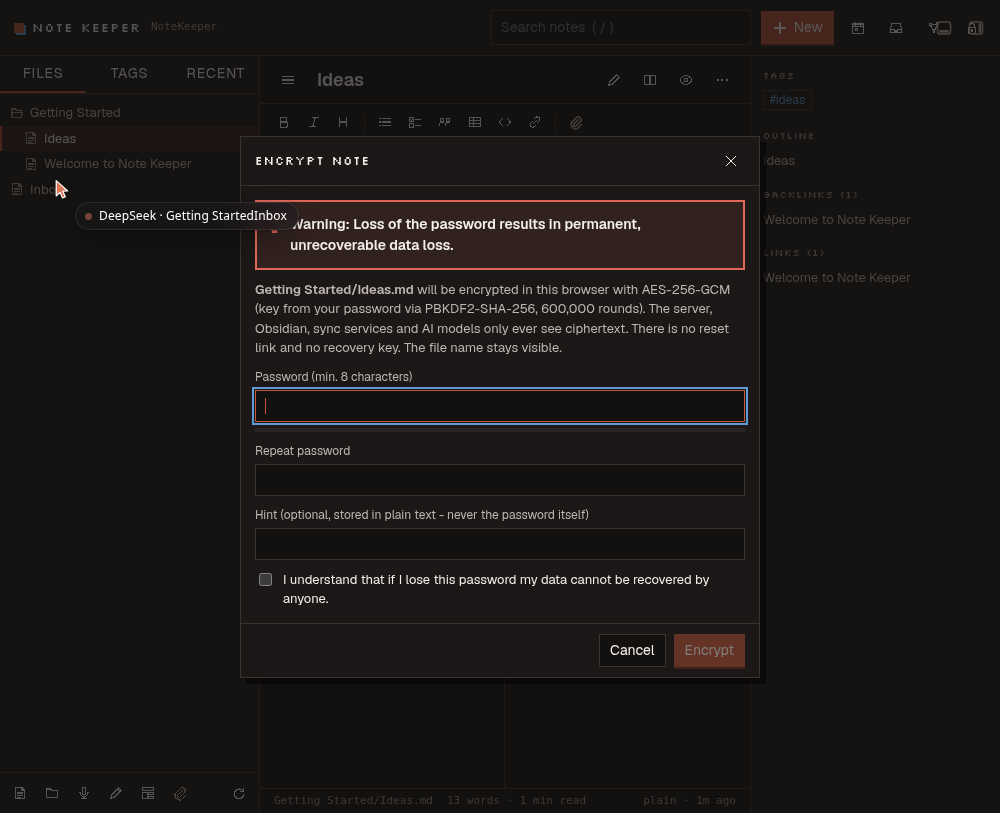
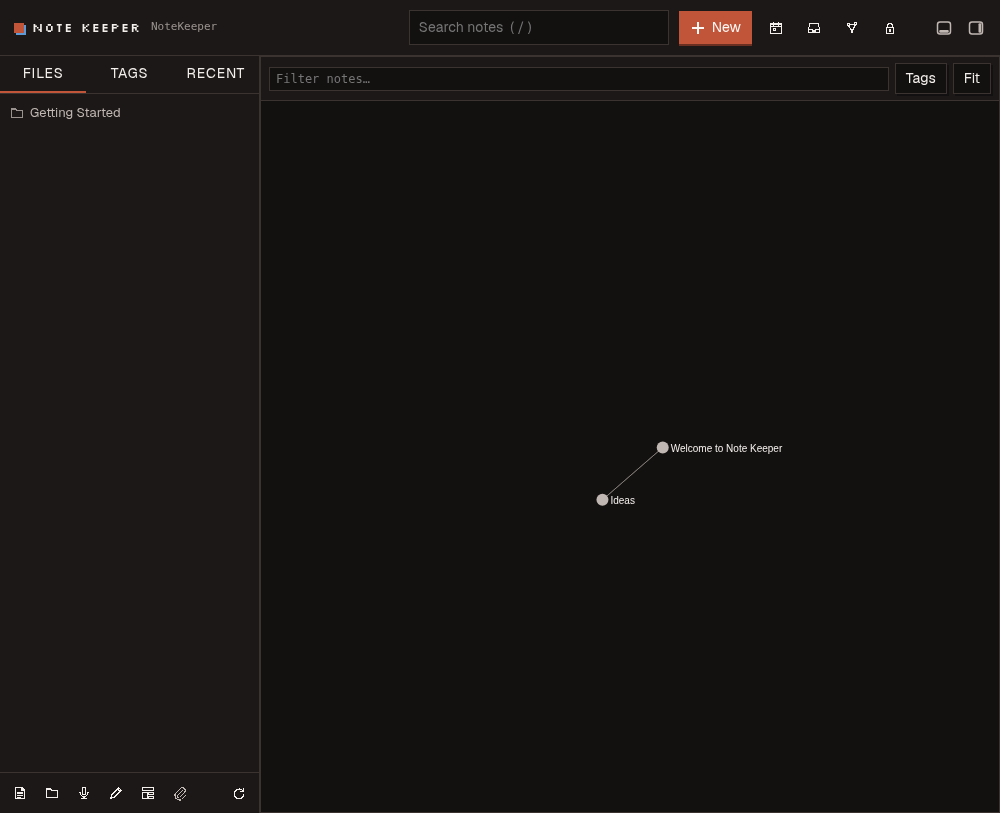
Captured from the live DSH GUI with a custom theme (dark mode).
 |
 |
 |
 |
 |
 |
Install from npm: dsh plugin --profile web add @lucagiftzek/dsh-note-keeper, or from GitHub: build a checkout and link it (steps below; dsh plugin add github:lucagiftzek/dsh-note-keeper alone does not build the daemon).
The npm package carries a prebuilt bin/notekeeperd for Linux x64, so on that platform the
one command above is the whole install (restart dsh web afterwards). From GitHub, or on any
other platform, Note Keeper needs its small Go daemon built on your machine, so install it from
a checkout:
Build it (Go ≥ 1.22 and Node ≥ 22.5):
git clone https://github.com/lucagiftzek/dsh-note-keeper.git
cd dsh-note-keeper
npm ci
npm run build      # bin/notekeeperd (Go daemon) + lib/client.js (browser bundle)
Optional: sudo apt install tesseract-ocr tesseract-ocr-ell for OCR.
Link it into the web profile, ~/.dsh/profiles/web/package.json: add
"@lucagiftzek/dsh-note-keeper": "link:/path/to/dsh-note-keeper" to dependencies and
"@lucagiftzek/dsh-note-keeper" to dsh.profile.bundles, then run pnpm install there.
Optional configuration goes on the plugin row in
~/.dsh/profiles/web/cordis.patch.yml:
- id: dsh-note-keeper
  config:
    vault: ~/NoteKeeper          # or point at an existing Obsidian vault
    trustedHosts: [dsh.example.com]
    aiWrite: true
    aiDelete: true
Restart dsh-web. A Notes row appears in the left sidebar.
Kill switch: DSH_NOTE_KEEPER_DISABLE=1 in the dsh-web environment, or
- id: dsh-note-keeper / disabled: true in cordis.patch.yml.
All keys are optional; defaults come from DEFAULTS in lib/index.js.
| Key | Default | Meaning |
|---|---|---|
vault |
~/NoteKeeper |
Vault directory (created if missing). Point at an existing Obsidian vault to share it. ~ is expanded; the NK_VAULT environment variable overrides this. |
trustedHosts |
[] |
Extra hostnames (besides loopback) the browser gate accepts as same-origin. |
requireCookie |
true |
Require the DSH browser-session cookie on every request (reads included). |
binary |
bin/notekeeperd inside the package |
Path to the notekeeperd Go binary. |
tesseract |
tesseract |
Tesseract binary/name used for OCR. |
dailyFolder |
Daily |
Folder for daily notes (Daily/YYYY-MM-DD.md). |
inboxNote |
Inbox.md |
Target note for quick capture. |
attachmentsFolder |
attachments |
Default folder for uploads. |
maxAttachBytes |
0 (= 1 GiB) |
Cap for one assembled attachment (daemon env NK_MAX_ATTACH). |
templatesFolder |
Templates |
Folder scanned for note templates. |
aiWrite |
true |
Whether the notes_* tools may create/modify notes. |
aiDelete |
true |
Whether the notes_* tools may delete (trash) notes/folders. |
Global (active while the Note Keeper page is mounted):
| Shortcut | Action |
|---|---|
Ctrl+Alt+N |
New note |
Ctrl+Alt+C |
Quick capture dialog |
Ctrl+Alt+D |
Open/create today's daily note |
Ctrl+E |
Toggle preview mode (while a note is open) |
/ (outside a text field) |
Focus the search box |
In the editor textarea:
| Shortcut | Action |
|---|---|
Ctrl+B / Cmd+B |
Bold |
Ctrl+I / Cmd+I |
Italic |
Ctrl+S / Cmd+S |
Save now |
Tab / Shift+Tab |
Indent / outdent the current line |
Enter |
Continue a list, numbered list or task item; an empty item ends the list |
[[ |
Triggers wikilink autocompletion (arrow keys to navigate, Enter/Tab to accept, Escape to dismiss) |
Note Keeper's vault is a plain directory of Markdown files laid out the way Obsidian expects, there is no proprietary database or format. This is deliberate: it is what lets the vault be edited from more than one place at once.
~/NoteKeeper) directly
as an Obsidian vault. Every change either app makes appears live in the
other (Note Keeper watches the folder with fsnotify and refreshes over
SSE within a fraction of a second; Obsidian watches it natively).nk-encrypted: v1 plus a
nk-cipher fenced block of base64 ciphertext), so Obsidian opens it
without errors, it just shows the placeholder warning text and the opaque
ciphertext block, never the plaintext. Encrypted attachments (.nkenc
files) are opaque binary blobs to Obsidian. Only Note Keeper can decrypt
and display encrypted content, Obsidian has no matching plugin. Open
and unlock encrypted notes in Note Keeper.enc-<18 hex>.nkenc). Its real name, size and type live
inside the ciphertext (an NKM1 header), so neither the connection (URLs,
bodies, chunk boundaries aside) nor the vault, the cloud mirror or the
daemon ever learns what the file was. Note Keeper shows the real name after
you unlock it. Older NKE1 blobs without the header still open. The note
embed inserted on upload references the opaque name, so type links by
pasting from the upload, not by guessing the file name. Sealing happens in
memory: budget about 4x the file size in browser RAM (roughly 1.2 GB for
a 300 MB file).Registered on ctx.get('tools') when the tool registry is available (the
sidebar and daemon still work if it is not). Every call goes through the
same daemon API the browser uses, so path validation, conflict detection and
folder-lock rules apply identically.
| Tool | Purpose |
|---|---|
notes_list |
List the vault (folders/notes, titles, tags, type, encrypted flag), optionally narrowed to a folder. |
notes_search |
Full-text search (accent-insensitive, prefix + phrase matching), filterable by tag or folder. |
notes_read |
Read one note's Markdown, frontmatter, tags, links and backlinks. |
notes_create |
Create a new Markdown note (title → safe file name, optional folder and tags). |
notes_update |
Modify an existing note: replace, append, prepend, or replace_text (exact-match substitution). Conflict-safe: reads, applies, writes with baseMtime, retries once on conflict. |
notes_move |
Rename/move a note or folder; rewrites wikilinks that pointed at it. |
notes_delete |
Move a note or folder to the vault trash (.trash, recoverable). |
notes_mkdir |
Create a folder (and parents). |
notes_capture |
Quick-capture text into Inbox.md (or another target), optionally as a task. |
notes_daily |
Open/create the daily note for a date, optionally appending text. |
notes_tags |
List every tag with its note count. |
notes_links |
Backlinks + outgoing links for one note, or a vault-wide connectivity summary. |
notes_create/notes_update/notes_move/notes_mkdir/notes_capture/notes_daily
are disabled (return a clear error) when aiWrite: false; notes_delete is
also gated on aiDelete: false. Encrypted notes and folders are always
off-limits to models: notes_read refuses to return ciphertext, and any
write tool that would touch an encrypted .md file is refused by the daemon
with code: "locked": the model is told to ask the user to do it in Note
Keeper instead.
Two independent layers protect the vault; see docs/ARCHITECTURE.md for the
full threat model.
lib/security.js): every browser request
to /note-keeper/api/* must pass four checks (R1 loopback peer, R2
trusted Host/origin, R3 CSRF markers on mutations, R4 the DSH session
cookie) before it is proxied to the Go daemon, which itself only listens
on loopback and requires a fresh per-spawn secret (X-NK-Secret) that
never appears in a browser-visible surface.src/client/crypto.js):
passwords are stretched with PBKDF2-SHA-256 (600,000 iterations) into a
non-extractable AES-256-GCM key that lives only in an in-memory key ring
(auto-forgotten after 10 minutes idle, or on demand). Encryption can be
applied per-note or per-folder; a folder carries a .nk-lock.json marker
with a KDF salt and a key verifier, never a key or the plaintext. The
server categorically refuses to store plaintext inside a locked folder,
and the notes_* AI tools can never read or write encrypted content:
"Warning: Loss of the password results in permanent, unrecoverable
data loss." There is no recovery path by design.npm run build # build:server (Go) + build:client (esbuild bundle)
npm run build:server # go build -> bin/notekeeperd
npm run build:client # esbuild -> lib/client.js
npm run check # node --check over every host-half .js file
npm test # test:server + test:host
npm run test:server # go vet ./... && go test -race -count=1 ./... (server/)
npm run test:host # node --test test/*.test.mjs (host + client logic)Server tests live under server/internal/*/**_test.go (vault, index, api).
Host/browser-logic tests live under test/*.test.mjs (client logic,
graph-core, paint-core, a jsdom UI smoke test, and host.test.mjs for the
node host half).
dsh-note-keeper/
├── lib/                  host half (Node/ESM, loaded by dsh-web)
│   ├── index.js          plugin entry: wires daemon + route + notes_* tools
│   ├── daemon.js         spawns/supervises notekeeperd, HTTP client to it
│   ├── proxy.js          /note-keeper/api/* route: gate + stream to daemon
│   ├── security.js       R1-R4 browser request gate
│   ├── tools.js          notes_* AI tool definitions
│   └── client.js         built browser bundle (esbuild output, checked in)
├── src/client/           browser half source (React, built by scripts/build.mjs)
│   ├── index.jsx         registers the sidebar row + main panel
│   ├── App.jsx           page shell: vault model, views, keyboard shortcuts
│   ├── Editor.jsx        Markdown editor (toolbar, preview, autocompletion)
│   ├── Recorder.jsx      audio note recording (MediaRecorder)
│   ├── Paint.jsx / paint-core.js   retro drawing canvas
│   ├── Graph.jsx / graph-core.js   force-directed graph view
│   ├── crypto.js         zero-knowledge encryption primitives
│   ├── upload.js         chunked upload transport + sealed uploads
│   ├── api.js            fetch client for /note-keeper/api
│   ├── markdown.js       Markdown rendering (marked + DOMPurify) + outline
│   ├── tree.js           vault-tree helpers
│   └── styles.js         CSS
├── server/               the Go daemon (notekeeperd)
│   ├── cmd/notekeeperd/  main: flags, wiring, HTTP listen
│   └── internal/
│       ├── vault/        filesystem operations, path safety, locks
│       ├── index/        in-memory search/link/tag index
│       ├── watch/        fsnotify watcher + SSE hub
│       ├── note/         Markdown/frontmatter/wikilink parsing
│       └── api/          the daemon's HTTP handlers
├── bin/notekeeperd       built Go binary (build:server output)
├── scripts/build.mjs     esbuild script for the client bundle
├── test/                 host + client-logic tests (node --test)
└── cordis.patch.yml the one bundle row dsh-web loadsMIT, see LICENSE.
All of them are open source and run on DeepSeek Harness 0.2.x (several on 0.1.5 too).
| Plugin | What it does |
|---|---|
| dsh-artifacts | An Artifacts tab that lists the files an agent produced and previews them in place, plus a template library agents can use and extend |
| dsh-mail | Mail client and agent mail tools: IMAP, POP3, SMTP and OAuth2 accounts, scheduled and bulk sends with unsubscribe handling |
| dsh-note-keeper (this one) | Obsidian-compatible Markdown notes in the sidebar with search, graph, audio notes and transcription, OCR and client-side encryption |
| dsh-phone | SMS and calls (Twilio, SIP via Asterisk) with call audio through your own server, live voicemail and Telegram |
| dsh-voice | Read-aloud, dictation and language-aware speech with 23 TTS and STT providers, per-language routing and word highlighting |
| dsh-orchestrator | Agent swarm and task orchestration: an Orchestrate tab, orch_* tools, runners, provider cards and a machine API |
| dsh-workspace-rail | A workspace-first sidebar rail: pinned chats, projects as folders, live Recents, search and unread markers |
| DSH-Idle-Watchdog | Idle-chat nudges and an authenticated HTTP API that posts a prompt into any chat |
| dsh-plugin-updates | Update checker that only offers releases your running DSH core can load |
| dsh-subagent-tiering | Subagents default to a cheaper sibling of the parent model unless the agent names a route |
| dsh-fs-reobserve | Ends self-inflicted stale-file errors after an agent's own shell commands |
| dsh-request-image-cap | Clamps every image sent to the model to a pixel cap, fixing many-image request errors |
| dsh-seal | An encrypted channel in front of DSH: a Go reverse proxy plus a service worker that seal all DSH browser traffic |
Built by Luca Tzekos, who also makes Job Opportunities API: employer-direct job data with per-field provenance you can verify yourself, free to read and available as an API. If this plugin is useful to you, a star on this repo or a look at jobopportunitiesapi.org is the best thanks.
CLASSIFICATION EVIDENCE
系统优先读取 GitHub Topics,再与站内分类词典和词根规则比对。当前命中: notes。
volcengine
Self-evolving Context Database for AI Agents. Unify Agent Memory, Knowledge RAG and Skills.

mindscale-noah
该仓库暂未提供项目说明。

himovo
Turn DeepSeek Harness into a self-hosted enterprise Agent platform with knowledge, deep research, content generation, vibe coding, browser automation, governance, and admin controls.