

部署运维
基础设施

sandbase-harness
sandbaseai
Local-first, self-hosted AI agent runtime and MCP bridge with sandboxed sessions, memory, credentials, audit/replay, and a local Console.
PROJECT TOPICS
INSTALL REFERENCE
dsh plugin --profile web add github:keyiadiannao/dsh-power-button
该命令指向仓库当前默认分支;尚无绑定当前 commit 的完整验证结果。
PROJECT README

A self-contained power & lifecycle controller for DeepSeek Harness: a sidebar power button with a Restart / Shutdown menu and a full-screen transition overlay. The restart/shutdown engine is built into the plugin — no third-party dependencies.
Developed with DeepSeek AI assistance; reviewed before release.
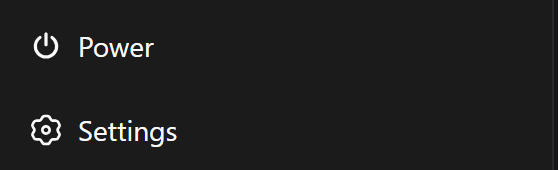
.cjs helper that takes over relaunching DSH through an ARM → COMMIT → ACK handshake, waits for the old process to exit, the port to free, and the session logs to stop growing, then relaunches with the same invocation and cwd — an ephemeral --port 0 is pinned to the port this process actually bound — and confirms the new instance by restartId. No PowerShell, no taskkill./restart and /shutdown commands, a restart_harness model tool (same name as anweat/dsh-restart; registration is skipped when another plugin already owns the name), and a read-only restart_status tool for checking whether a restart happened.locale.preference.① Sidebar power button — a theme-aware footer entry, styled to match the adjacent Settings trigger.
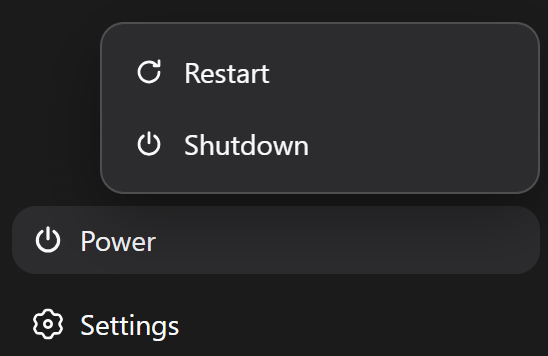
② Restart / Shutdown menu — opens from the power button; two actions, one click away.
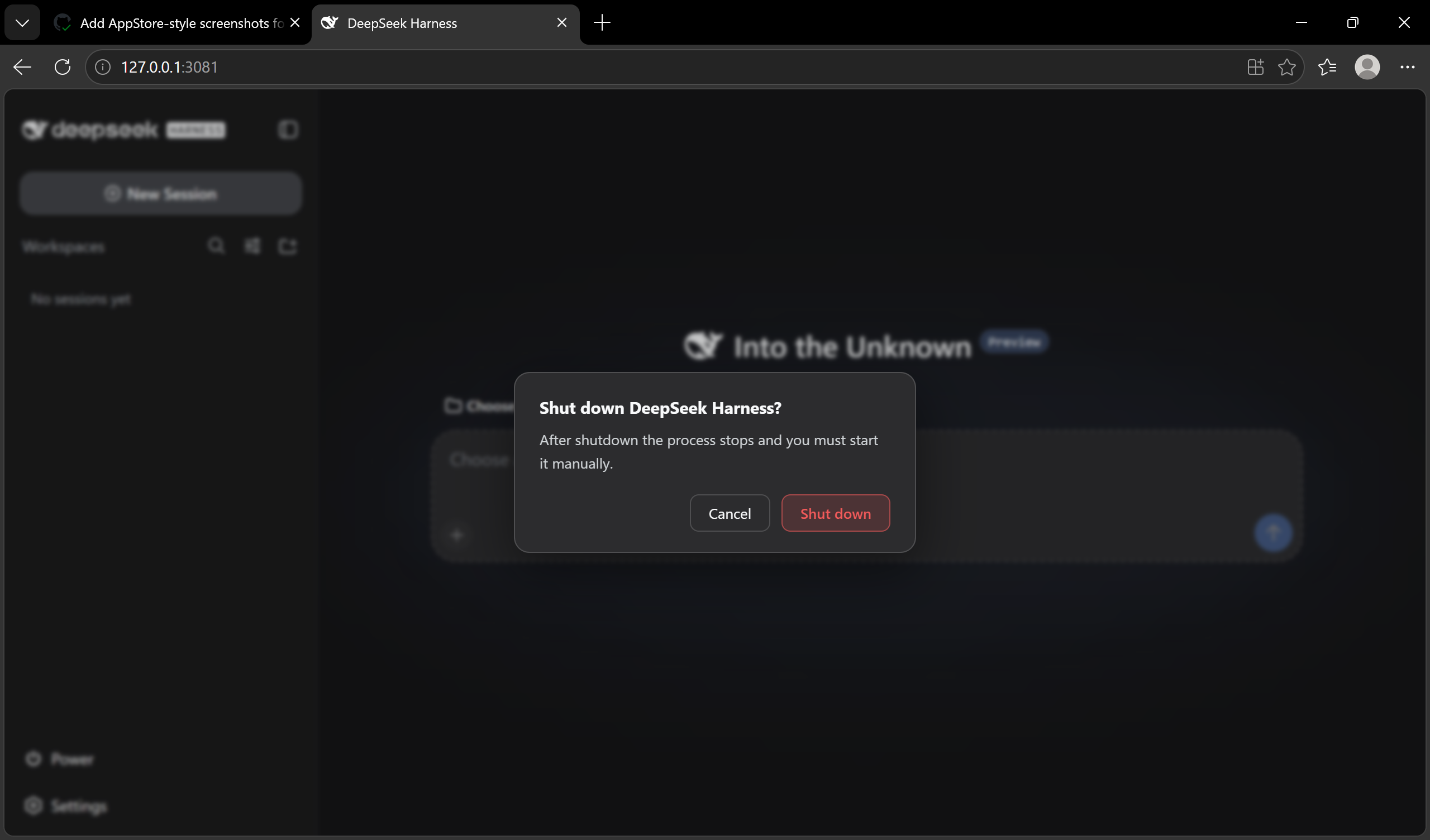
③ Shutdown confirm dialog — guard against accidental shutdowns: the default focus sits on Cancel, and only an explicit confirm actually stops the process.
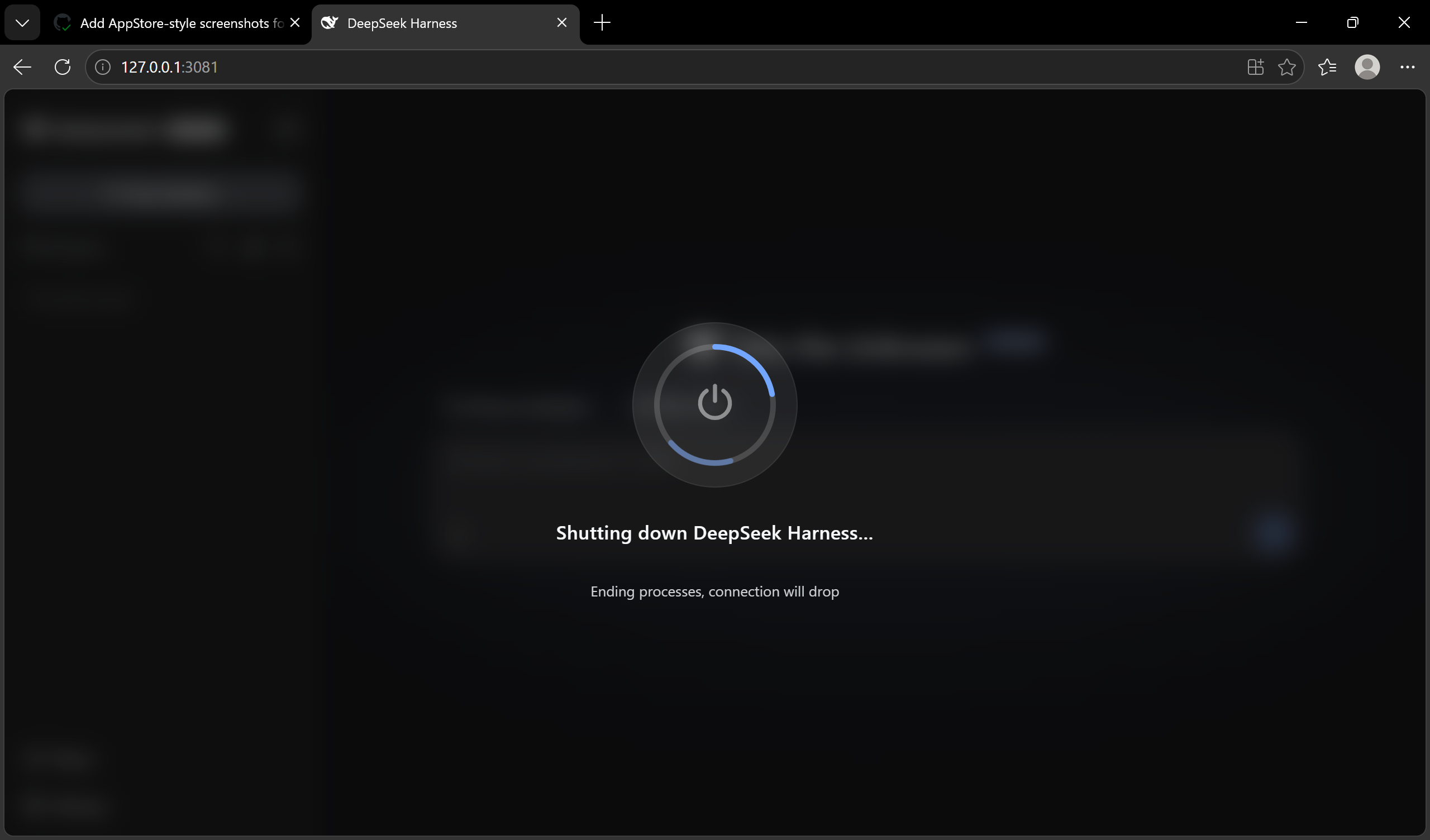
④ Shutdown progress overlay — a Windows-style full-screen transition showing the current stage while the process winds down.
⑤ Restart completed toast — after the page auto-reloads, a success notice confirms DSH is back.

dsh plugin --profile web add "github:keyiadiannao/dsh-power-button#master"Restart DSH; a power button appears in the sidebar footer. Requires Node ≥ 22.19.
The plugin is configured through the profile's cordis layer (cordis.patch.yml or the settings UI):
| Key | Default | Meaning |
|---|---|---|
enableModelTool |
true |
Register the restart_harness model tool. Set false to keep restart exclusively on the GUI button and /restart. |
maxDelayMs |
5000 |
Upper bound (ms) for the model tool's delayMs argument. The effective floor is 1000 ms. |
restartWakeMode |
quiet |
What the session that asked for a restart is told afterwards. quiet stages the notice for its next step without waking anything. notify additionally wakes that session once it is live, so the model reports the restart without the user sending a message. Neither mode ever restarts again on its own. |
Example:
- id: dsh-power-button
  config:
enableModelTool: trueThe old process may not exit until a live successor has taken responsibility for relaunching it. That is an explicit ARM → COMMIT → ACK handshake: an exit with nobody left to relaunch is the one outcome the UI cannot recover from, so every failure before the ACK leaves the old process running.
click power → menu → Restart
[host]    POST /api/dsh-power-button/restart
          → write the per-restart helper .cjs (0600: it embeds the relaunch argv)
          → spawn `node <helper>` (detached, windowsHide)
[helper]  ARM   → status { stage: 'armed', armedAt }
[host]    wait for ARMED (5 s) → write the COMMIT file for this restartId
[helper]  ACK   → status { stage: 'committed', committedAt }
[host]    only now: unref the helper → flush live sessions (capped at 5 s)
          → request exit after delayMs, with a 15 s watchdog behind it
[helper]  wait for the old PID to exit (bounded by the host's own budget)
          → wait for the port to free
          → wait for session logs to stop growing (quiescence)
          → write the v2 marker, then spawn DSH with the same invocation
            and cwd, plus a DSH_POWER_RESTART_ID launch token. A `--port 0`
            command line is rewritten to the port this process actually bound,
            so the
            successor lands on the port the helper is waiting for
          → poll /health until ok && instanceId != old && restart.restartId matches
          → self-delete
[client]  poll health → confirm new instanceId → auto reload
Shutdown posts /api/dsh-power-button/shutdown and terminates without relaunching. Because it is irreversible (the process must be started manually), both the power button and /shutdown open a GUI confirm dialog first — a second click is required. The model never exposes shutdown.
Design notes (from real issues hit during development):
detached + unref), otherwise terminating DSH kills the helper mid-flight..cjs file, not node -e: multi-line node -e scripts are mangled by Windows CreateProcess and die with a silent SyntaxError.instanceId that must change (old → new), so a brief outage alone never fakes success.(size, mtimeMs) until two consecutive samples are identical (bounded at ~15s) before relaunching. The old process's session write-behind buffer can keep draining after its main loop exits; relaunching into a file that is still being appended interleaves stale seq numbers and corrupts the session — this check closes that window.ctx.get('appExit'). appExit is an optional host value this plugin does not declare in inject, so the context proxy resolves ctx.appExit to undefined — reading it as a property silently skipped graceful disposal on every restart and shutdown, hard-killing through process.exit instead (losing the tree teardown, the storage flush, and the port release). Official readers (dsh-cmdline, dsh-headless) go through ctx.get for the same reason.appExit, a 15s watchdog hard-exits if the process is still alive; the session flush before it is capped at 5s. The helper's patience for the old PID is derived from that budget (flush cap + delayMs + watchdog, plus margin) rather than written as a second constant. An unbounded flush used to sit between the helper's COMMIT and the process exit while the helper waited a fixed 30s — a flush past roughly 13.5s already meant the helper gave up without relaunching and the user was left with no server. Deriving the two from each other is what keeps them from drifting apart.Host must be a loopback authority, and a browser Origin must match. /api/dsh-power-button/* is longer than the official /api route, so longest-prefix matching never routes these requests through DSH's own trust fence — this guard is the only one they get.127.0.0.1, ::1 and localhost as loopback, where the official helper accepts the whole of 127/8. Narrower cannot admit anything the official fence refuses; the cost is that if DSH ever serves another 127/8 address, its own routes would answer while these returned 403.Origin check compares the full authority, matching upstream. A browser that ever sends a port-less loopback Origin (reported, not standardised) would be refused by both fences — this plugin does not relax it unilaterally, and tests/trust-fence.spec.ts pins the current behaviour so a change is deliberate rather than incidental.409).delayMs is floored at 1000 ms — the model cannot kill the process before its own turn settles.~/.dsh/restart-helper-<pid>.log); helper and marker files are written 0600, the runtime directory 0700.Three separate things, deliberately not one:
/health (restart.fromInstanceId, restart.restartId)
for its whole lifetime; acknowledging the toast clears only the pending flag,
never the identity.restartWakeMode shapes. quiet passes it to Agent.inject(), which stages
it for that session's next step without waking anything; notify uses
Agent.followup() so the session wakes — once it is live — and reports the
restart with no user message at all. Only a restart with a recorded causal
session gets a notice: a GUI click records none, and is never attributed to
whichever conversation happens to be open. At most one notice per session is
queued, and it is deleted once delivered.restart_status tool, which reports the
durable record: whether a restart happened, its id, stage, the instance it
replaced and the one it produced, timings, who asked for it, and whether the
running process is the instance that restart produced. This is how a model
finds out about a restart it did not initiate.The plugin never appends a model-visible message itself and never forges a turn.
It hands the notice to the Agent API — inject() durably stages an
agent/inbox/spliced record for the next legitimate step to claim, and
followup() is the documented wake path. An earlier design appended a synthetic
assistant/message (turn: 0, step: 0) into the resumed conversation — that
tripped the token-meter's step-pairing invariant and could corrupt large
sessions, so it was removed. Tracked upstream:
deepseek-ai/DeepSeek-Harness#802.
Delivery is once per notice in normal operation. The notice file and the agent inbox are two durable states with no transaction between them, so a host crash in the window after the inbox write and before the deletion delivers the notice again on the next boot. That is accepted deliberately: claiming the notice first would trade a possible duplicate for a possible lost notice, and the notice text is written so a repeat is harmless — it says the restart already happened and that nothing else should be resumed.
Mechanics:
DSH_POWER_RESTART_ID launch token in the child's environment, so
the relaunched instance can claim the restart no matter how early it boots
(an earlier protocol confirmed the relaunch only after the child spawned, and
a fast boot could read "no marker yet" and miss it)./health reports the restart
identity — restart: { restartId, fromInstanceId } — permanently for
this process's lifetime, so the helper's ready gate (and future
diagnostics) can always tell a relaunched instance from a fresh boot. The
toast flag restarted: true, fromInstanceId: <old> is separate: it
disappears once the client ACKs via /notice-shown, without erasing the
identity./health also reports appExit: "available" | "missing" — whether the
launcher-provided exit channel actually resolves in this host. missing
means every restart falls back to process.exit (no graceful disposal), so
the field turns a delayed restart into a one-request diagnosis instead of
something only noticed once the helper gives up on the old pid./health once after load; when restarted is true it
shows the toast, then ACKs via POST /api/dsh-power-button/notice-shown
so a later refresh does not re-show it.pnpm build # tsdown: host + client bundle (committed to lib/)
pnpm typecheck # tsc --noEmit over src
pnpm typecheck:tests # the root tsconfig excludes tests/, and vitest only transpiles them
pnpm test # vitest: unit + process-level acceptance
pnpm check # all of the above, in orderCI runs on Windows, Ubuntu and macOS: install, both typechecks, tests, build, a
gate that the committed lib/ matches a fresh build byte for byte (a git install
runs those artifacts, so they must be what the source produces), and a pnpm pack
check that the published tarball actually contains lib/ and cordis.patch.yml.
A separate Linux job runs the same steps on Node 22.19, the floor
engines.node declares — nothing else here would otherwise exercise it.
tests/restart-runtime.spec.ts is a process-level acceptance suite: it
executes the EXACT helper script the host generates (buildRestartHelper) as
a real process against two fake DSH targets on a real TCP port, and pins the
outcomes that unit tests cannot prove — the full relaunch chain, no relaunch
without the host's COMMIT, spawn retries bounded at three, the health gate
refusing an old-instanceId answer, and a --port 0 restart landing the
successor on the port the old process actually bound (the successor's argv goes
through the plugin's own pinRelaunchPort, so the test exercises the fix rather
than restating it).
Tests isolate DSH_HOME via a vitest setup file, so they never touch your
real ~/.dsh. Artifacts: host at lib/index.js, client bundle at
lib/client.js (both committed — git installs are build-free).
MIT. The "detached helper relaunch" idea follows anweat/dsh-restart (MIT); the implementation is independently written (real .cjs file, no PowerShell, dynamic port), no code copied.
CLASSIFICATION EVIDENCE
系统优先读取 GitHub Topics,再与站内分类词典和词根规则比对。当前命中: restart。
sandbaseai
Local-first, self-hosted AI agent runtime and MCP bridge with sandboxed sessions, memory, credentials, audit/replay, and a local Console.

Han-1413141
Cost tracking for DeepSeek Harness: session and model costs, token usage, budgets, provider balances, and coding-plan quotas. Bilingual English/Chinese UI.

wssfk12138
DeepSeek Harness Token 余额监控插件:鲸鱼娘待机/扣费/复苏动画、峰谷计费、连续扣费飘字与会话费用统计。