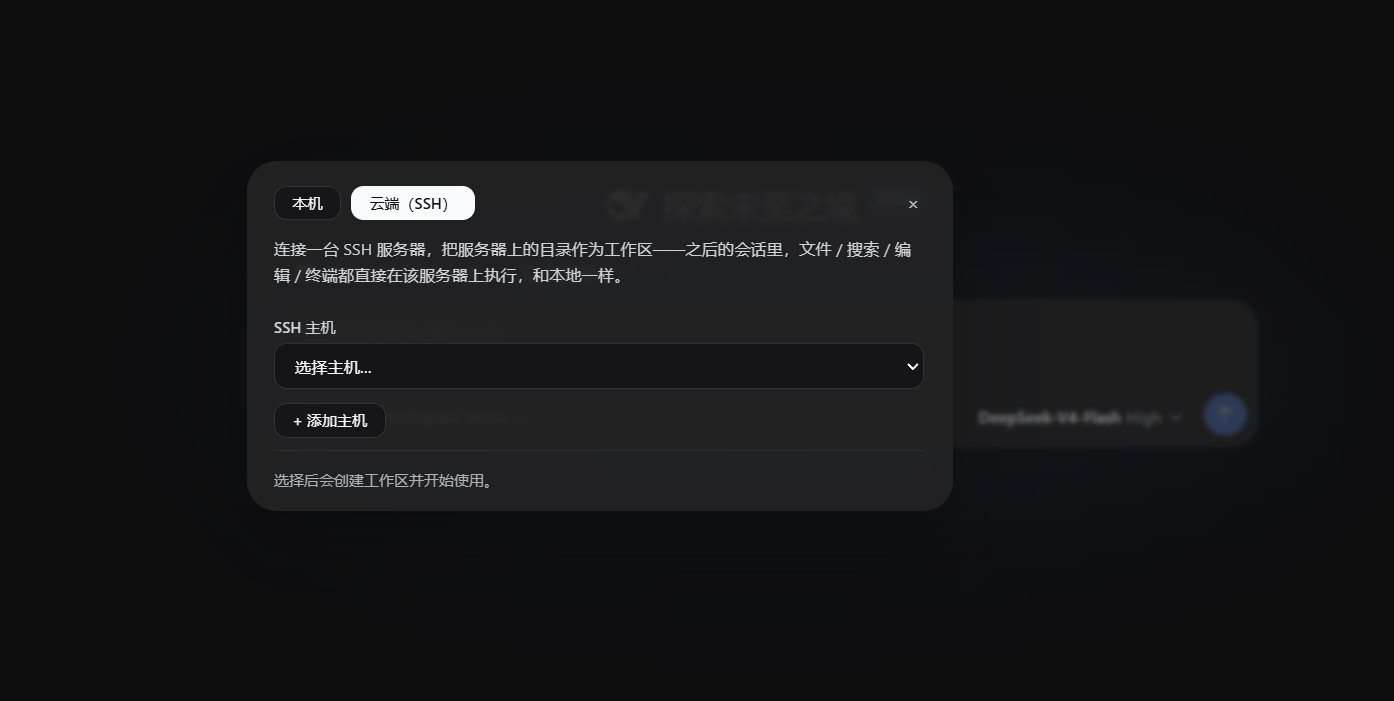
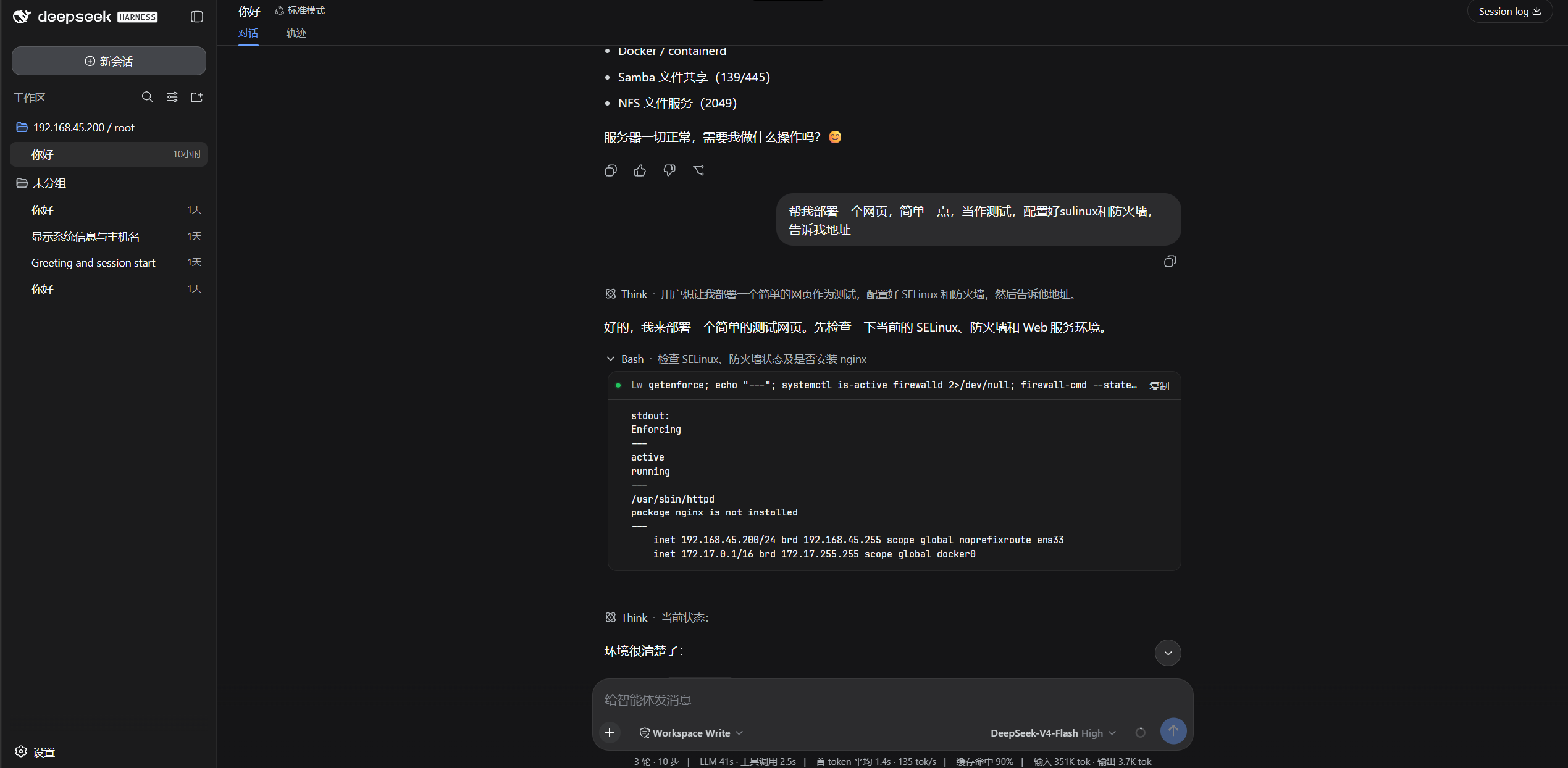
Cloud workspaces for DeepSeek Harness — pick Cloud (SSH) in the workspace picker and the agent's bash/read/write/edit/glob/grep tools transparently run on your Linux server over SSH. Zero remote install.
Pick Cloud (SSH) in DSH's workspace picker, and the coding agent works directly on your Linux server: bash, read, write, edit, glob, grep — the entire built-in toolset — transparently execute over SSH. Files, search, editing and terminal all live on the remote box.
Zero install on the server. No vscode-server-style remote agent, no daemon, nothing to download — a standard OpenSSH server is all it takes.
DSH's agent runs on your local machine. When your code, data or production box lives on a remote Linux server, you either SSH in separately or fight with sync tools. Competing remote solutions ship a fat remote component (hundreds of MB) that must be downloaded to the server on first connect.
dsh-cloud-workspaces takes a different route: everything rides standard SSH channels (exec / SFTP / PTY via ssh2). The server needs nothing beyond what it already has.
Features
Cloud workspaces (the headline)
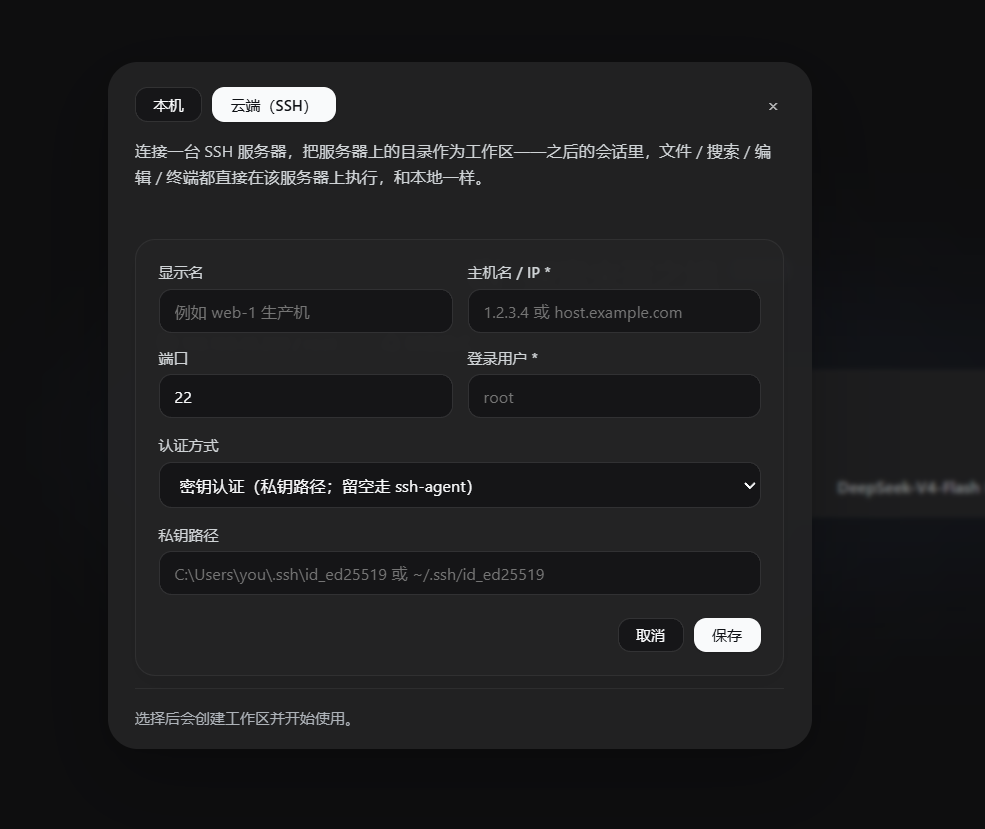
Dual-tab workspace picker — "Local" and "Cloud (SSH)" tabs; cloud workspaces are adopted by DSH's official workspace registry and show up in every session picker as host / path.
Transparent toolset redirect — when a session's cwd falls under a cloud placeholder, the plugin replaces the official ctx.fs (13 file methods) and ctx.subprocess seams with SSH-backed implementations. Local sessions are untouched; the seam is swapped per session scope.
Shadow tools with official UI — session-scoped remote bash / read / write / edit / glob / grep register in the agent's scope only, and implement the official presentCall / presentResult presenters, so chat rows render as real terminal / read / search cards — expandable, copyable, native.
Background jobs — run_in_background: true on bash / ssh_exec starts the command as a first-class DSH job (job_output / job_list / job_kill, completion notices, jobs UI): installs, builds and test suites run on the server without ever hitting an exec timeout.
SSH settings card (in DSH Settings → SSH Connections)
Host manager — display name, host, port, user; password auth (keyboard-interactive aware — works with PAM/Ubuntu servers that never offer the plain password method) or private key (path; ssh-agent fallback).
Connection test — one-click probe with latency; saved credentials are reattached server-side (the browser only ever sees a redacted view).
Remote directory browser — list, navigate, create and delete folders on the server; then bind any directory as a cloud workspace in one click.
ssh_list / ssh_exec / ssh_ls / ssh_read / ssh_write — explicit remote access from any session (subject to preset scoping).
ssh_workspace — create a cloud workspace binding from chat.
Connection layer
ssh2 connection pooling with keepalive, broken-connection detection and transparent rebuild.
Per-host latency-tested test endpoint reused by both the settings card and the picker.
Security
Hosts are stored in DSH's settings namespace; password fields are write-only secrets — the browser receives a redacted view and can never read stored credentials back.
Remote sessions are scoped: shadow tools exist only inside sessions bound to a cloud workspace. Local workspaces are never affected.
Remote file reads are capped; large files stream instead of buffering into memory.
Install
Requires DSH (web profile), Node ≥ 22, and a reachable SSH server.
From npm
dsh plugin --profile web add dsh-cloud-workspaces
From source
git clone https://github.com/harryopo/dsh-cloud-workspaces.git
cd dsh-cloud-workspaces
pnpm install
pnpm build

# link into the DSH web profile (use a junction on Windows if the path has spaces)
dsh plugin --profile web add link:C:\path\to\dsh-cloud-workspaces
Restart dsh web after installing or rebuilding (the host half loads in the Node process).
Usage
Add a host — Settings → SSH Connections → Add host → fill credentials → Test → Save.
Bind a cloud workspace — Add workspace → Cloud (SSH) tab → pick host → browse to your project → Use this directory as workspace.
Open a session on that workspace — the agent now runs entirely on the server. Ask it: run pwd, then list the files here and watch bash execute remotely.
Or drive it explicitly: use ssh_exec to run docker ps on web-1.
Architecture
DSH host process (Node)
┌────────────────────────────────────────────────────────────┐
│  ctx.fs ────────► fs-ssh adapter ──────┐                    │
│  ctx.subprocess ► subprocess-ssh ──────┤   seam swap per    │
│  shadow tools ─► session scope ────────┘   session scope   │
│                                          │                 │
│  SshEngine (ssh2) ◄──────────────────────┘                 │
│   ├─ connection pool / keepalive / rebuild                 │
│   ├─ exec · SFTP CRUD · PTY                                │
│   └─ ProxyJump hops                                        │
└──────────────┬─────────────────────────────────────────────┘
               │ SSH (exec / sftp / pty)  — nothing else
        ┌──────▼──────┐
        │ Linux server │  stock sshd. zero remote install.
        └─────────────┘

Browser (dsh web GUI): settings card + cloud-workspace picker
speak to the host over the official Typert remote bridge.
Agent skill for beautiful, verifiable architecture, workflow, sequence, data-flow, and lifecycle diagrams—self-contained HTML with motion and crisp export.