

部署运维
基础设施

sandbase-harness
sandbaseai
Local-first, self-hosted AI agent runtime and MCP bridge with sandboxed sessions, memory, credentials, audit/replay, and a local Console.
PROJECT TOPICS
PROJECT README


The front page for a session you left running: what happened, what broke, and what is waiting on you — computed from the durable event log, never written by a model.
It is a real Conversation View tab labelled Morning Paper, sitting next to Chat and Trajectory, and it is set like a newspaper: a masthead, a dateline, a boxed bulletin for anything waiting on you, a lede with a drop cap, columns, and small print.
$ dsh --profile web # …you leave the tab open and come back 42 minutes later============================================================================
THE MORNING PAPER - refactor auth
away 42m | 751 event(s) | 28m of wall clock | turn 18 | 0 action(s) required
============================================================================
LEAD: Turn 17 completed.
WHAT IT DID
9 turn(s): 8 finished, 0 blocked, 0 failed, 0 cancelled, 0 interrupted
140 tool call(s), 12 file(s) touched, 79 command(s) run (0 failed)
TURNS
turn took steps tools tokens outcome
10 57s 8 8 3,079,044 completed
11 4m 35 42 13,573,537 completed
13 9m 56 58 25,512,399 completed
18 24s 2 1 1,131,559 open
FILES (12 touched)
12x src/auth/session.ts
9x src/auth/token.ts
4x src/auth/__tests__/session.test.ts
... and 9 more file(s)
WHERE THE TIME WENT
##########...... 60.6% bash 1m (79 calls)
######.......... 37.8% ask_user_question 42s (1 calls)
#............... 0.6% edit 1s (25 calls)
longest single call: ask_user_question 42s
tool execution was 6.5% of the window; the rest was model time
WHERE THE MONEY WENT
turn 13 25,512,399 tokens 41% of the window 58 tools completed
turn 11 13,573,537 tokens 22% of the window 42 tools completed
turn 14 7,787,236 tokens 13% of the window 14 tools completed
BUSINESS
61,938,602 tokens | cache hit 99.9% | 11 message(s) from you
delivered:
- docs/refactor-plan.md
CORRECTIONS
3 tool failure(s): edit/FS_STALE_VERSION x2, read/FS_NOT_OBSERVED x1
1 model retry(ies)
UNRESOLVED (1)
18:24 edit failed: FS_STALE_VERSION (never retried)
YOU ASKED
- split the session token into its own module, keep it backward compatible
WEATHER
########................ 34% 340,115 of 1,000,000 tokens
route: deepseek-official/deepseek-flash(Illustrative output — the shape is exactly what /briefing prints.)
The tab renders that same document as a three-page newspaper; /briefing prints
it as plain text in the transcript. One computed briefing, two renderings.
A chat is a linear list of messages. It cannot tell you:
22x selftest.mjs is a fact no single
message contains;It deliberately does not quote the agent's reply. That is readable in the chat, and restating it is what makes a briefing worthless. The lead is one line of outcome; everything else is aggregation.
The tab is paginated like a paper, and a page only exists when it has something to say — a quiet session is a single sheet, not three pages of nothing.
| Page | Carries |
|---|---|
| 1 · Front | the action bulletin, the lead outcome, the what-it-did summary, what you asked, and context weather |
| 2 · The Log | the per-turn timeline, unresolved failures with their commands, and the corrections line |
| 3 · The Ledger | file churn, delivered files, where the time went, where the money went |
Page one gets the full nameplate; inner pages get a running head and a folio
(Page 2 of 3), with section links at the top and one footer row holding
previous/next beside the read controls. Switching sessions returns you to page one.
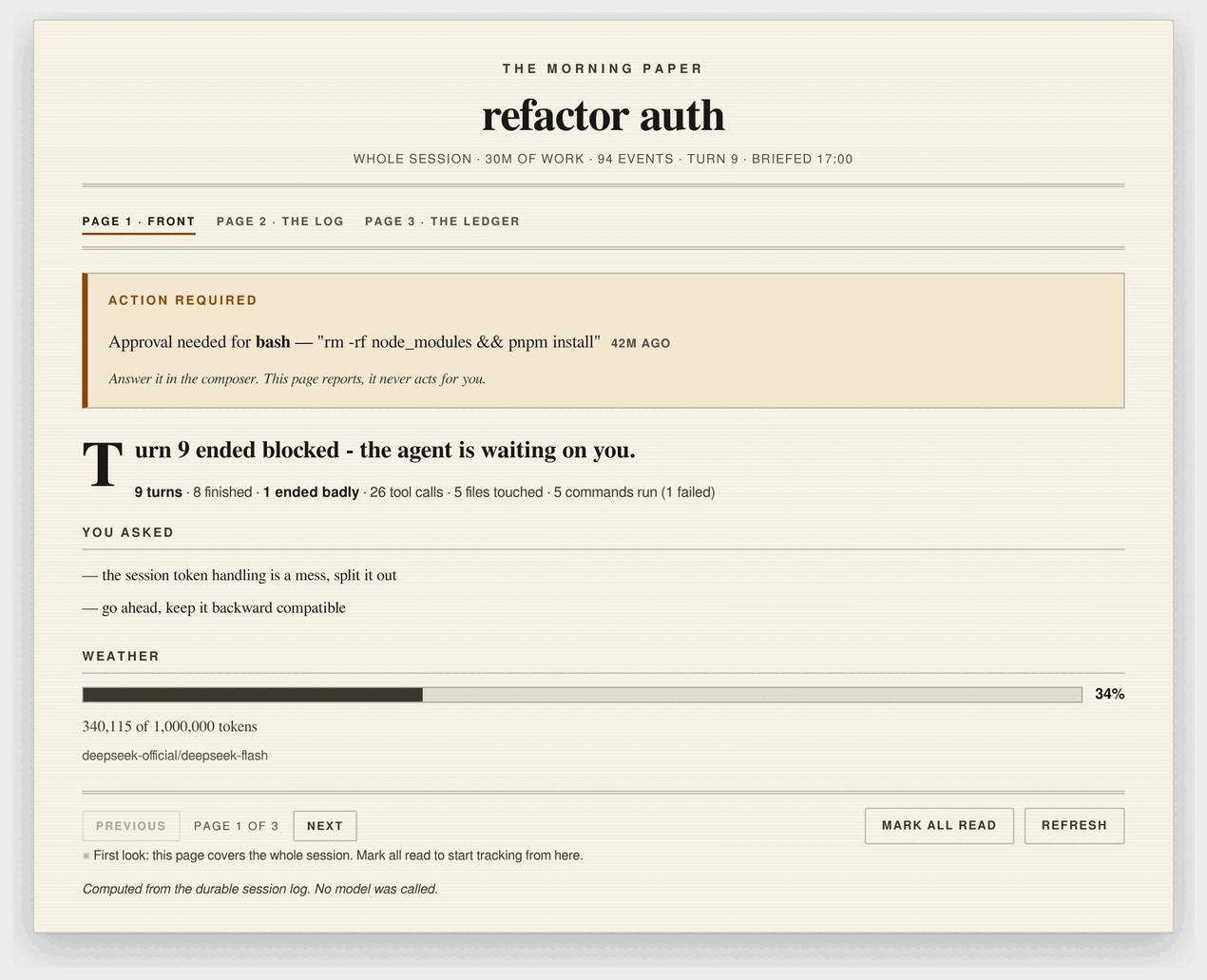
Page 1 · Front — the bulletin, a one-line outcome instead of a quoted reply, the
activity summary, what you asked, and the context gauge. The lead says
Turn 9 ended blocked - the agent is waiting on you, which is the whole point of
opening this tab.
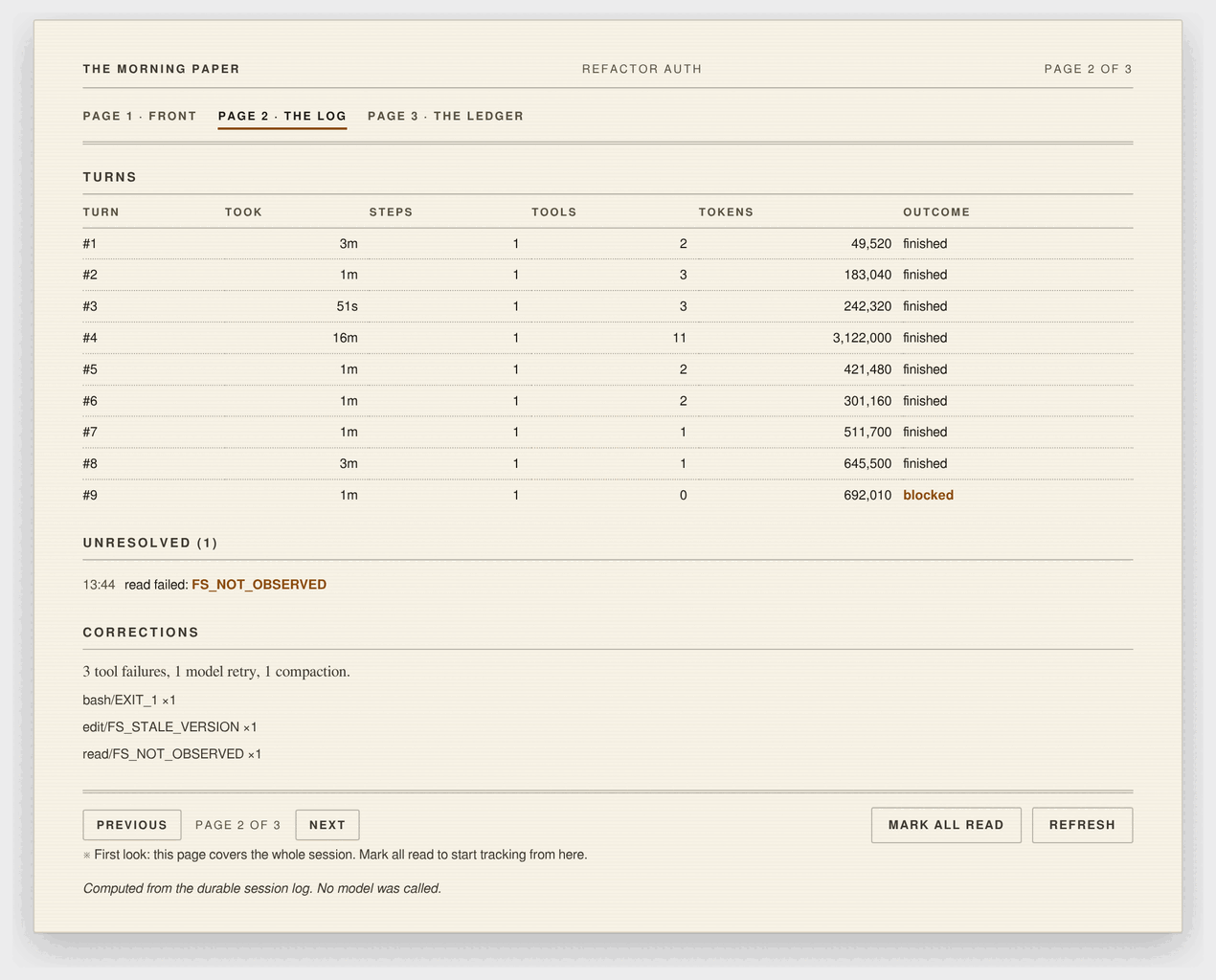
Page 2 · The Log — the timeline that shows a single turn taking 16 minutes and 3.1M tokens, the failures nobody retried with the command that failed, and the corrections line.
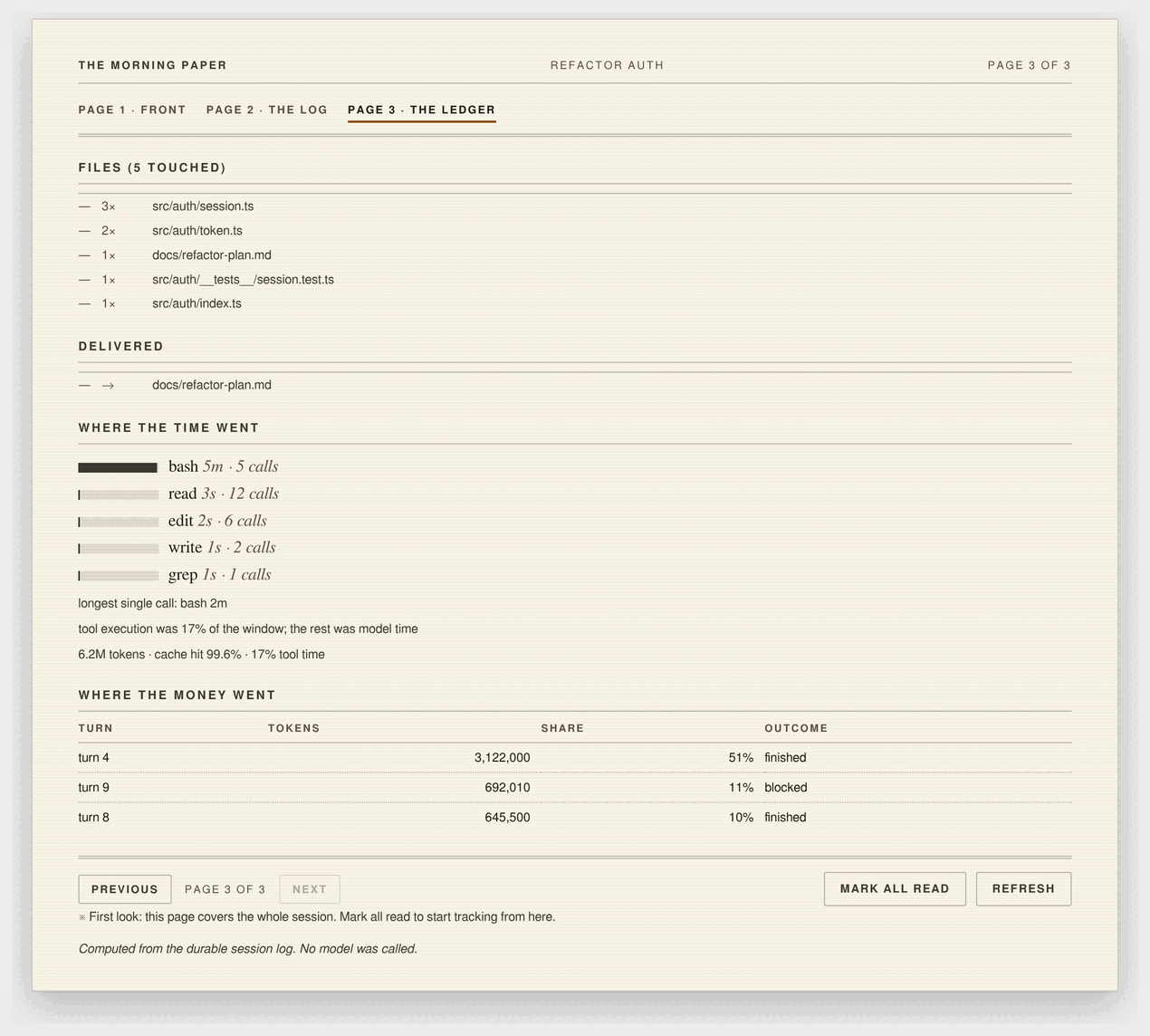
Page 3 · The Ledger — file churn counted per file, what was delivered, where the wall clock went (and how little of it was tool execution), and which turns ate the spend.
Screenshots are generated by node tools/screenshot.mjs from the shipped
stylesheet and render tree, so they cannot drift from the code.
/briefing prints the same document as one continuous column, because a
transcript cannot be flipped. Pagination is presentation, not data, so the text
rendering and the tab share one computed briefing.
The briefing is computed, never generated. Zero tokens, no hallucination,
byte-identical for the same log and clock. If you want prose about a session,
/briefing plus the agent can produce it — this plugin deliberately does not.
It never enters your context. The page is derived state. Nothing here calls
inject(), appends a session event, or sends anything to a model. The one path
that touches the transcript is the /briefing command, which you invoke. The
selftest asserts this.
A front page answers two different questions, so two different reads:
| Question | Source |
|---|---|
| What happened while I was away? | only events after the seq your browser last showed you |
| What needs me right now? | the whole log — an approval asked before you left is still waiting, and a turn that ended blocked an hour ago is still blocked |
Fork-inherited events are excluded from the "what happened" counts and named in
a notes line. If you forked a session, its inherited prefix did not happen
here; readSession reports the exact prefix length, so the page cannot inflate
your agent's work with someone else's.
dsh plugin --profile web add -w dsh-morning-paper
# restart dsh web, then reload the page
From a checkout, if you are working on the plugin itself:
git clone https://github.com/damlys99/dsh-morning-paper
dsh plugin --profile web add -w link:/absolute/path/to/dsh-morning-paper
Requires DSH >=0.1.2-alpha.1 <0.2.0-0. The row is added to the profile
automatically; a restart is required because both the host module and the client
bundle are composed at boot, and patchReload: live only watches patch files.
Uninstall:
dsh plugin --profile web remove dsh-morning-paperWEATHER is a gauge: a filled bar, the percentage beside it, the raw figures, and
the route it measured — because a percentage buried in a sentence is the one
thing you cannot read at a glance. It compares the session's current request
pressure against the routed model's own declared capacity. DeepSeek's adapter declares one — every model in
its catalog carries a contextWindow, 1,000,000 tokens on the current routes —
and the plugin reads it through ctx.llm.resolveModelInfo(), the same call
automatic compaction uses to decide when to compact. So the percentage is the
number DSH itself is working from, not an estimate.
The route is read from the newest request/header event in the log rather than
from the agent's options, because a session on the default model never sets a
provider explicitly, and the ceiling belongs to the route that actually ran.
A plugin-config ceiling is a fallback for adapters that declare nothing:
# ~/.dsh/profiles/web/cordis.patch.yml
- id: morning-paper
  config:
    contextWindow: 128000
A model-declared capacity always wins over it, and a configured one is labelled wherever it is shown because it is an assumption rather than a fact. An invalid value is ignored. With neither, the page reports the token count and says the ceiling is unknown rather than inventing a percentage.
/briefing                 # the whole session, as text in the transcript
/briefing --since 812 # only what happened after seq 812| Need | Seam |
|---|---|
| The log | ctx.sessionQuery.readSession() — concrete, so no search backend is required |
| The log tail | ctx.sessionQuery.listEvents() — metadata only; the cheap half of the auto-refresh poll |
| The title | ctx.sessionQuery.readTitle() |
| Pending approvals | durable approval/asked minus approval/decided — survives a host restart |
| Turn outcome | turn/end reasons: completed, blocked, error, aborted, max-tokens, interrupted |
| Failures, retries, compactions | tool/result.error, llm/retry*, compaction/* |
| Cost | assistant/message.usage — disjoint input / cache-read / cache-write / output buckets |
| Context pressure | ctx.tokenMeter.measure() + ctx.llm.resolveModel() for the model's declared window |
| Pending questions | the live user-questions/request waterfall (in memory only — see limits) |
| The route | ctx.webServer.register({ kind: 'exact', path: '/morning-paper' }) |
| The page | conversation.view, one tab labelled Morning Paper, next to Chat and Trajectory. No DOM decoration, no MutationObserver |
Optional services (agents, tokenMeter, llm, commands) are resolved with
ctx.get at use time. A composition without them still mounts and still serves
the durable half of the page; a headless profile loses only the weather line.
Every guard runs before any work, so a refused request changes nothing.
| Code | Status | When |
|---|---|---|
BAD_REQUEST |
400 | Missing or malformed sessionId / sinceSeq / format |
SESSION_NOT_FOUND |
404 | No live or persisted session with that id |
MARKER_AHEAD |
409 | Your reading marker is past the log tail. The browser forgets the marker and shows the whole session rather than a stale page |
LOG_TOO_LARGE |
413 | Above 20,000 events, which is more than this plugin will read in one request |
SUBAGENT_OWNED |
409 | A subagent session's briefing belongs to its parent |
BRIEFING_FAILED |
502 | The log could not be read |
dsh-user-questions declares no durable
session event, so a pending question cannot be found in a cold log after a host
restart. The watermark is set when the waterfall opens and cleared when it
settles, so it can never nag about a question you already answered — but it is
also absent after a restart. Approvals have no such limitation.dsh-session-query-sqlite ships mounted with
openAt: never, so this plugin uses only the concrete reads and depends on no
search backend.readSession clones the whole log. That is the ceiling that produces
LOG_TOO_LARGE; if it bites on real sessions, the fallback is a tail read of
the JSONL, which would couple this plugin to the on-disk format.Mark all read starts the tracking window from that point.since 18:12 · away 3h 12m and covers only what happened since you last read
it; a whole-session read says whole session · 45m of work and never claims an
away duration it did not measure.Mark all read never blanks the page. It advances the reading marker and
leaves what you just read on screen, with a line saying when you marked it; the
next new events appear on the following refresh. The previous behaviour —
clearing the page on the click — read as "my paper just vanished".
Show whole session forgets the marker to re-read everything.--dsw-alias-* variables whose names I had guessed, and --dsw-alias-bg-elevated
/ --dsw-alias-border-secondary do not exist, so the sheet fell back to cream
while the label token resolved light — unreadable. The selftest now fails if the
palette ever depends on a theme token again.node selftest.mjs # 131 assertions, no network, no browser, no build
node verify-real-log.mjs # build briefings from the session logs on this machine
node tools/screenshot.mjs # regenerate the images on this page (repo tool)tools/screenshot.mjs renders the three pages with the shipped PAPER_CSS and
paperTree, photographs them with headless chromium, and rewrites
screenshots.json. It needs a chromium binary and ImageMagick, so it is a repo
tool rather than runtime code, and it is excluded from the published package.
selftest.mjs covers the pure core, every refusal, the request decoder, the HTTP
surface, the live watermark, the command, the text renderer, and the real
client bundle evaluated in a node:vm sandbox — including its render tree,
built with a test element factory, and the stylesheet, so page content and
styling are covered without React.
verify-real-log.mjs reads the logs DSH actually wrote under
$DSH_HOME/sessions/ and builds a briefing from each, checking determinism,
non-mutation and renderability on real event payloads. It is a dev tool: session
logs are concatenated zstd frames, so it shells out to the zstd CLI, which the
plugin itself never does — the plugin reads through ctx.sessionQuery.
Real-log verification has already earned its keep twice:
tool/result.message.source.callId; without it there was no pairing, no
per-tool timing, no command counting, and failure groups had no tool name. The
entire Where the time went section exists because real data found that.GET /morning-paper?sessionId=… returns a session title, file
paths, failing commands, failure codes and token counts without the
GUI's session cookie — the same posture as the rest of the plugin HTTP surface,
but the payload here is conversation content, so it is worth stating plainly.
Session ids are unguessable UUIDs, the response is derived and capped, and a
cross-site browser request is blocked because the response carries no CORS
headers. If you bind this port beyond loopback, treat the whole plugin HTTP
surface as trusted-network-only, not just this plugin.conversation.view entry. That slot id and its label
option are published contracts in docs/subsystems/slots.md, not private
markup — unlike a DOM-decorating plugin, a restructured composer or dock cannot
break this one.<style> element with a
dmp- class prefix is appended to document.head on first render. There is no
CSS file and no build step, so there is no CSS-module contract to depend on.0.1.5-rc.1 contracts, in a browser-less harness and
against real session logs, and then used in a live browser — that pass is what
produced the footer, read-state and dateline corrections above.dsh-morning-paper. The
images ship inside the tarball so npm's README render resolves them.MIT
CLASSIFICATION EVIDENCE
系统优先读取 GitHub Topics,再与站内分类词典和词根规则比对。当前命中: observability、session-log。
sandbaseai
Local-first, self-hosted AI agent runtime and MCP bridge with sandboxed sessions, memory, credentials, audit/replay, and a local Console.

Han-1413141
Cost tracking for DeepSeek Harness: session and model costs, token usage, budgets, provider balances, and coding-plan quotas. Bilingual English/Chinese UI.

wssfk12138
DeepSeek Harness Token 余额监控插件:鲸鱼娘待机/扣费/复苏动画、峰谷计费、连续扣费飘字与会话费用统计。