
文件与数据
插件

OpenViking
volcengine
Self-evolving Context Database for AI Agents. Unify Agent Memory, Knowledge RAG and Skills.
PROJECT TOPICS
INSTALL REFERENCE
dsh plugin --profile web add github:Yukikaze-Ai/dsh-ladder-superagents
该命令指向仓库当前默认分支;尚无绑定当前 commit 的完整验证结果。
PROJECT README

English · 中文
Needs DSH 0.2.2 or newer. 0.3.0 targets the harness that flattened
subagents.startActivationand shipped the agent-team task board. On an older DSH, keep version 0.2.1: the harness rejects a nested activation request and every spawn fails with "Cannot read properties of undefined".engines.dshinpackage.jsonsays so, and the plugin manager refuses to install it below that version.Windows and macOS. The ladder, the routes, the settings page and the llm tiers are platform-independent. The CLI tiers branch on
process.platform: Windows runs a.cmd/.batshim through the shell with Windows quoting and PATH extensions; macOS and Linux execute the binary directly, so an npm shim's#!/usr/bin/env nodeshebang resolves. The launcher also adds the install roots a Dock-launched Host does not inherit (/opt/homebrew/bin,/usr/local/bin,~/.local/bin,~/.opencode/bin,~/.cargo/bin, the nvm/fnm/volta/asdf bins,~/Library/pnpm) and kills the CLI's whole process group on a timeout. The launcher is verified on macOS with fixture CLIs undernpm test(discovery, stdin, argument prompts, timeout kill); no Codex is installed on that Mac, so codex itself is still only verified on Windows, and Linux follows the same POSIX path untested.Of the ten CLI drivers, only codex is verified. kimi, claude, gemini, qwen, cursor, opencode, aider, copilot and goose are implemented from each CLI's documented invocation but were never run against a working account — claude in particular needs a paid Claude subscription, and kimi needs a Kimi account. Treat all nine as experimental. The launcher underneath them is verified on macOS with a fixture CLI; a real account is what they still need.
Approval behaviour is inherited: the plugin answers no approval request by itself.
autoApprove: trueis an explicit opt-in, not a default.
A DeepSeek Harness bundle that turns selected sessions in the profile into a SupA
session, following the concept of
deepseek-ai/dsh-superagent-prototype.
Package id: dsh-ladder-superagents.
The prototype's idea, reduced to three properties per session:
| Property | Prototype mechanism | This plugin |
|---|---|---|
| Never blocked | The router decides; Executors report instead of waiting | Approvals are decided in-process; a broken thing is diagnosed and repaired before anyone is asked; asking is reserved for what a repair cannot obtain (a credential, a payment, a decision on something irreversible) |
| Owns all context | Ticket records, scoped orchestrator_read |
A workspace ledger (.dsh-supa/context.jsonl) every session can read/write, injected as a live digest into the system prompt |
| Decides the child's context | Mandate + scoped Inputs handed to an Executor | supa_spawn builds a context pack from the parent's selection; the child pulls more with supa_context_request and the parent answers with supa_context_supply |
Tools (every session):
| Tool | Purpose |
|---|---|
supa_context |
write / read / search / list / digest the shared ledger |
supa_spawn |
Start a child with a brief plus an explicit context selection (ledger ids/tags, files, last N messages, extra text) |
supa_context_request |
Child → parent: ask for context it was not given |
supa_context_supply |
Parent → child: deliver that context (wakes the child if idle) |
supa_status |
Mode, ledger path/size, open todos, live children |
supa_report |
Child → parent: enqueue a progress/result record into the parent's inbound queue without waking it |
supa_inbox |
Parent: peek / drain / stats its inbound queue, grouped per child lane; drain takes optional ids so the SupA keeps the useful records pending and drains the rest |
supa_authority |
Parent: set a direct child's authority (workspace / full); clamped to the parent's own level |
supa_models |
Manage the ladder: list, scan (read codex debug models, optionally pin each model with a real call), add, remove, move, route |
System prompt: a SupA session charter section, plus a supa:state context with
the recent ledger digest and open todos.
Runtime behavior:
approval/request is answered allowed-once for SupA sessions, and every
grant is appended to the ledger as auto-approval.ask_user_question is allowed by default: when a decision is genuinely the
user's, the SupA pops the options instead of guessing. Set
denyBlockingQuestions: true to make that tool fail with a "decide and
record" directive instead.blocked is woken with a "do not wait" nudge (at most 3 per
10 minutes per session; the counter decays, so it cannot loop forever).completed with open todos wakes again
(continueOnOpenTodos, off by default).Set on the supa row in the bundle's cordis.patch.yml:
| Key | Default | Meaning |
|---|---|---|
enabled |
true |
Master switch |
mode |
session |
session = opt-in per session via supa_session enable; all = every session; root = only sessions without a parent; preset = only listed presets |
presets |
[] |
Preset ids for mode: preset |
ledgerDir |
.dsh-supa |
Ledger directory, relative to the session working directory |
autoApprove |
false |
Inherit the harness policy. true makes SupA answer every approval itself |
denyBlockingQuestions |
false |
Refuse ask_user_question instead of letting it ask |
continueWhenBlocked |
true |
Wake a blocked turn |
maxBlockedNudges |
3 |
Nudges per nudgeWindowMs |
nudgeWindowMs |
600000 |
Decay window for the nudge counter |
continueOnOpenTodos |
false |
Also continue while todos are open |
maxTodoNudges |
6 |
Nudges per window for the todo trigger |
spawnProvider |
spawn |
ctx.subagents provider used by supa_spawn |
childPreset |
'' |
Agent preset for children; empty inherits the parent |
retryOnFailure |
true |
Re-spawn one tier weaker when a routed child stops on error/max-tokens/refusal |
maxRouteRetries |
2 |
Stop descending after this many retries |
tierAttempts |
2 |
Attempts on the same tier before it is marked and its slot freed |
tierRetryDelayMs |
1200 |
Pause before retrying the same tier |
codexCommand |
'' |
Absolute path to the codex CLI; empty discovers codex on the augmented PATH, then ~/.codex/bin, ~/.local/bin and ~/.cargo/bin (Windows checks the Codex app install root first) |
cliTimeoutMs |
900000 |
Kill a codex run after this long |
maxCliResultChars |
8000 |
Cap on the result queued back to the parent |
maxPackBytes |
24000 |
Context pack cap |
maxFileBytes |
8000 |
Per-file cap |
maxFiles |
6 |
Files per pack |
maxTranscriptMessages |
30 |
Upper bound for transcript_messages |
maxTranscriptChars |
700 |
Per-message cap in the transcript |
promptDigestNotes |
8 |
Ledger lines in the prompt digest |
dsh-ladder-superagents is a DeepSeek Harness bundle: a package whose package.json
declares dsh.bundle.patch. Installing it into a profile inserts its plugin
row (Host half) and its Client half.
git clone https://github.com/Yukikaze-Ai/dsh-ladder-superagents.gitThen, from the Harness you want it in, install the cloned directory as a bundle
with the Plugin Manager's "install from a directory" action and point it at the
checkout. The Host and Client halves activate together: the tools appear in
every session, the charter joins the next prompt assembly, and Settings gains a
SupA settings page. No rebuild step — the Client module is plain JavaScript loaded
through the Harness module loader.
After installation the tools appear in every session, and the charter is part of the next prompt assembly.
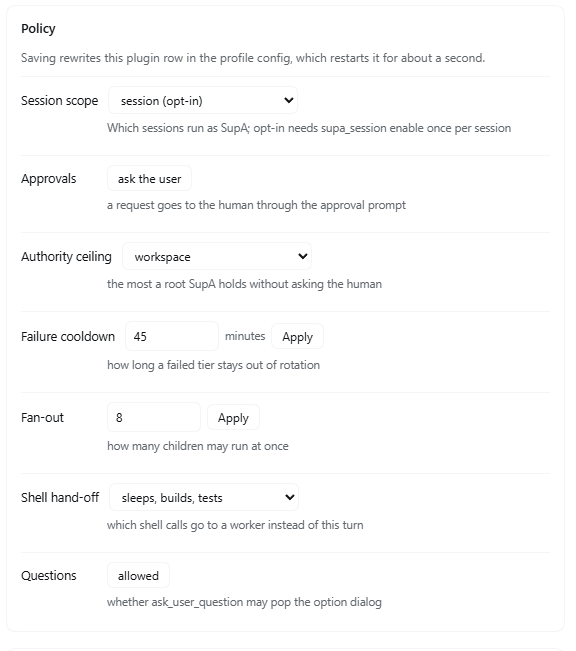
mode: session is the default, so nothing is enabled automatically. A session
becomes a SupA when you say so, and the setting is remembered per session:
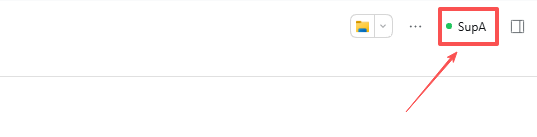
SupA control: a green dot
means this session is a SupA, grey means it is off. Click it to switch.supa_session enable does the same and
supa_session status reports where the session stands. ┌──────────── SupA (parent) ────────────┐
spawn ──▶│ inbound queue: one file, N lanes │
│ drained deliberately, not per-event │
└───▲──────────▲──────────▲─────────────┘
│lane A │lane B │lane C
child A child B child C (no A↔B, A↔C, B↔C edge)send_message), and the pack charter states it.supa_report appends a record to
<ledger>/inbox/<parent>.jsonl and injects one line into the parent's inbox
without waking it. The parent's supa_inbox drains the queue; ordering is
preserved per lane.coalesceMs window, with a pointer ("N reports across M lanes"), never one
wake per child event. A busy parent simply finds the reports in its next step.supa_spawn, and pending assignments wait in the parent's
queue. Without a cap every child is an independent lane with its own queue
and its own context, and nothing is shared between lanes except the ledger.What is already native and needs no plugin code: agent.inbox (durable
next-turn/next-step queue per session), adjacency on send_message, and
ctx.subagents activation management. What this plugin adds: the durable
per-lane queue, coalesced wake, and drain semantics the model can reason about.
Every session holds a level: workspace (default) or full.
permission record. The parent answers with supa_authority and
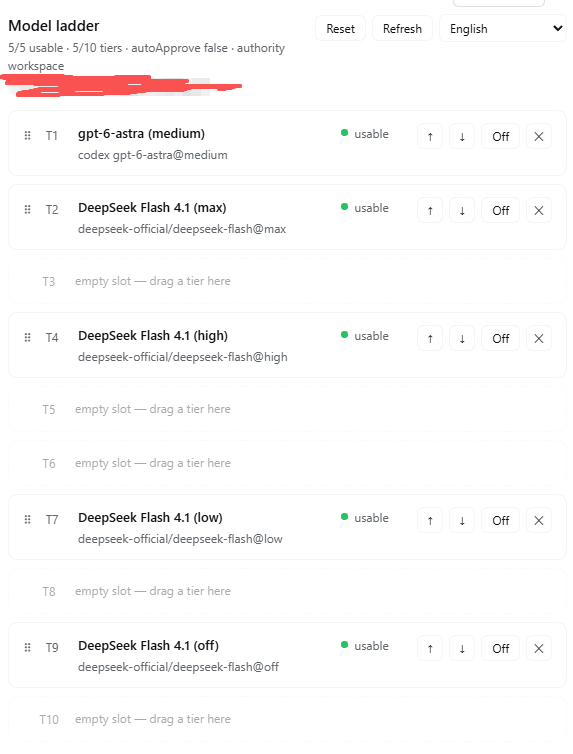
tells the child to retry; it can never grant more than it holds itself.The SupA scores a task 1-10; supa_spawn with difficulty: 7 picks the tier.
.dsh-supa/models.json: an ordered array, strongest
first, each entry { id, label, provider, model, reasoningEffort, ceiling, enabled }.ceiling is the hardest score that tier is expected to handle. The router
takes the weakest tier whose ceiling still covers the score — a 2-point
task never burns the strongest model — and falls back to the strongest
available tier only when nothing covers it.Flash MAX = 7, Flash high = 5, Flash low = 3,
Flash none = 1. The ranking stays one total order, so "which is stronger"
and "which is the third one" always have one answer.llm service (resolveCallConfig, cached 60s), so
an unavailable tier is skipped and the next one down is used — the
"degrade one step at a time" rule.tierAttempts) before it is
treated as a model problem: then the route is marked in
.dsh-supa/failures.json and the tier stays in the ladder disabled and
red. It is the user who deletes it, and Retry on that row probes it
once: green re-enables it, red keeps it out. When every route in the ladder
is marked, the weakest slot is replaced by the built-in
deepseek-official/deepseek-flash@high so the pool can still route. If a
user switched tiers off by hand instead, nothing is replaced — that is a
deliberate choice, not a broken route.kind: "codex"
runs codex exec as a child process, feeds the same context pack on stdin,
maps the authority ceiling to -s workspace-write | danger-full-access, and
queues the CLI's last message back as a result record on lane cli. It is
not a Harness session — no session id, no supa_context_request.supa_models scan reads every entry of the Codex catalog (codex debug models, no session created) and caches it in .dsh-supa/codex-models.json,
hidden models included — a hidden model can still be pinnable and a tier may
name it.supa_models pin tests configurations, not models: one real call per
(model, effort) pair, cached under model@effort. Pass a model to test every
effort it supports, or omit it to test the ladder's codex tiers. A cached
success is reused unless force is set. Every pin consumes that model's
tokens/usage, which is why scan and pin are separate actions.supa_models route difficulty 7 is a dry run; it costs nothing.The requested sidebar is the editor for exactly this file: reorder rows, toggle
availability, edit ceilings, add tiers. Until it exists, supa_models is the
same surface with the same validation.
A cli tier names a driver; the driver owns the flags, the plugin owns the
plumbing (spawn, stdin, timeout, result queue, degradation).
| driver | binary | non-interactive form | prompt |
|---|---|---|---|
codex |
codex (auto-discovered) |
codex exec |
stdin |
kimi |
kimi |
kimi -p "<prompt>" |
argument |
claude |
claude |
claude -p |
stdin |
gemini |
gemini |
gemini -p "<prompt>" |
argument |
qwen |
qwen |
qwen -p "<prompt>" |
argument |
cursor |
cursor-agent |
cursor-agent -p "<prompt>" |
argument |
opencode |
opencode |
opencode run "<prompt>" |
argument |
aider |
aider |
aider --message "<prompt>" --yes |
argument |
copilot |
copilot |
copilot -p "<prompt>" |
argument |
goose |
goose |
goose run -t "<prompt>" |
argument |
Exercised on the Windows machine that built this plugin: codex, kimi. The
rest are documented invocations, not run against an account — a wrong flag
fails loudly and can be fixed with the tier's command field.
.cmd shim, which spawn cannot
execute directly. The launcher detects .cmd/.bat and runs through the
shell with argument quoting. On macOS and Linux the binary is executed
as-is, so a #!/usr/bin/env node shim resolves.PATH with .exe/.cmd/.bat on Windows and the
bare name elsewhere, plus the install roots a GUI-launched Host does not
inherit: /opt/homebrew/bin and /usr/local/bin (Homebrew), /opt/local/bin
(MacPorts), ~/.local/bin, ~/.opencode/bin, ~/.cargo/bin, ~/.bun/bin,
~/.volta/bin, the asdf shims, the newest nvm or fnm node bin, and
~/Library/pnpm. The inherited PATH always comes first and a tier's
explicit command always wins; ~ in that command is expanded.PATH must have the executable bit, the way a
shell resolves it. A binary that is absent everywhere is reported as
… CLI not found rather than failing later with EACCES.LANG/LC_ALL/LC_CTYPE all unset, common
for an app opened from the Dock) gets a UTF-8 one, so non-ASCII output is
intact.cliTimeoutMs gets SIGTERM on its whole process group,
then SIGKILL two seconds later. The helpers a CLI started (codex exec,
claude -p) do not outlive the tier that timed out.%USERPROFILE%\.codex vs ~/.codex, %APPDATA% vs
~/.config). On Windows the codex binary is discovered from the Codex app
install root first; elsewhere PATH decides, so a Homebrew or npm install is
found without configuration.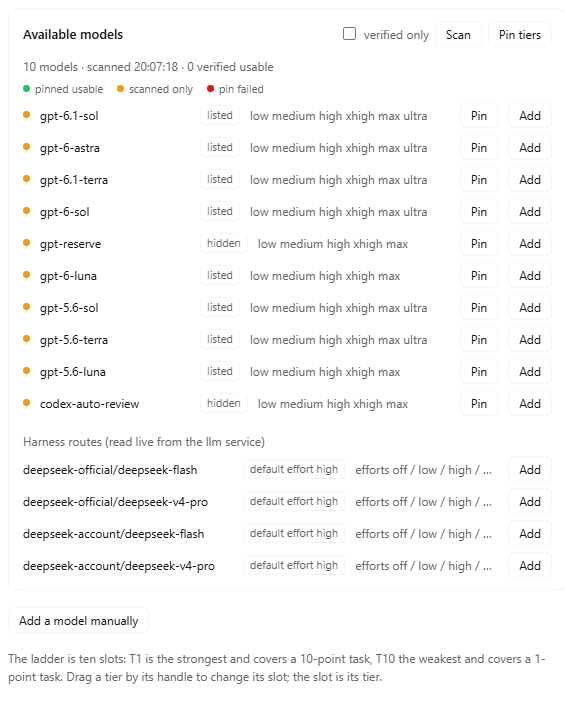
The bundle ships a Client half that registers a dsh-ladder-superagents page in the
Settings panel (settings.section, order 25). It shows the ladder of the
selected workspace — position, label, route, ceiling, per-tier availability —
and edits it in place: reorder with ↑/↓, enable/disable, remove, and add a tier
(llm route or cli driver). A workspace picker appears when the profile owns
more than one workspace.
The page has no host RPC dependency; it uses two same-origin routes the Host half registers:
| Route | Purpose |
|---|---|
GET /supa/state?cwd= |
Workspaces, ladder, availability, drivers, config summary |
POST /supa/action |
move, enable, remove, add — returns the new state |
Both operate on <cwd>/.dsh-supa/models.json, the same file supa_models
edits, so the tool and the page never disagree.
Below the ladder is the Codex catalog block. Scan reads every catalog entry
(hidden ones included) and costs nothing. Pin tiers tests the ladder's codex
tiers; each model row has its own Pin that tests every effort that model
supports. Both pinning paths send one real call per model+effort configuration
and cache the verdict as model@effort, so the warning beside the buttons is
literal: they consume each model's tokens/usage.
MIT — see LICENSE.
autoApprove: true
grants every approval request, including sandbox
escalation. That is what "never blocked" costs. Turn it off and the SupA
simply cannot escalate; it gets a deterministic rejection instead.codex tier is a plain child process, not a Harness session: neither the
approval system nor the authority bookkeeping governs it. The authority
ceiling is mapped onto codex's own -s flag, and that is the entire control.full authority disables that CLI's own guard. claude
gets --dangerously-skip-permissions, gemini and qwen get --yolo,
cursor-agent gets --force. Those processes run outside the Harness
approval system, so the authority ceiling is the only thing stopping them.
Leave CLI tiers on workspace authority unless you mean it..dsh-supa/) so it travels with the repo.
Add it to .gitignore if you do not want it committed.mode: 'all'. Use mode: 'session'
(the default) so a session opts in with supa_session enable.Bugs and reproductions are the most useful contribution. Read
CONTRIBUTING.md for the local loop and the rules this
codebase learned the hard way, then pick something from
ROADMAP.md — platform verification, the routing tests and the nine
unverified CLI drivers are all marked good first issue.
Release notes live in CHANGELOG.md.
Rebuilding this on another host — or porting it to Claude — is described in DESIGN.md: the four mechanisms, the three invariants, and the host capabilities each one needs.
CLASSIFICATION EVIDENCE
系统优先读取 GitHub Topics,再与站内分类词典和词根规则比对。当前命中: superagent。
volcengine
Self-evolving Context Database for AI Agents. Unify Agent Memory, Knowledge RAG and Skills.

mindscale-noah
该仓库暂未提供项目说明。

himovo
Turn DeepSeek Harness into a self-hosted enterprise Agent platform with knowledge, deep research, content generation, vibe coding, browser automation, governance, and admin controls.