文件与数据
插件

OpenViking
volcengine
Self-evolving Context Database for AI Agents. Unify Agent Memory, Knowledge RAG and Skills.

Arfrsa/dsh-sidebar-sections
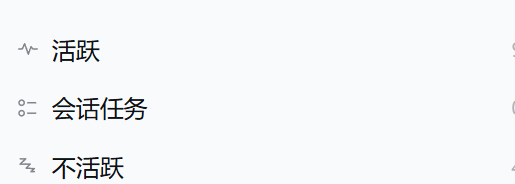
Unofficial DSH sidebar sections plugin: splits the workspace list into Active / Session tasks / Inactive, keeps the official search, menus and drag-and-drop, and switches back to the shipped list in one click.
PROJECT TOPICS
INSTALL REFERENCE
dsh plugin --profile web add github:Arfrsa/dsh-sidebar-sections
该命令指向仓库当前默认分支;尚无绑定当前 commit 的完整验证结果。
PROJECT README
Unofficial community plugin. This package is not published by, reviewed by or endorsed by DeepSeek. It reuses the MIT-licensed official
@deepseek-ai/dsh-client-ui-workspace0.2.1-rc.3 browser bundle and patch-builds its own copy of it. Where this documentation says "official", it refers to that upstream DeepSeek code (the shipped sidebar browser / its shipped view), never to this plugin.
Fork of the shipped DSH sidebar workspace browser. The official
@deepseek-ai/dsh-client-ui-workspace 0.2.1-rc.3 client bundle is vendored
byte-for-byte, and an ordered patch pipeline derives lib/client.js that adds a
three-section layout on top of it:
Active -> Session tasks -> Inactive, with the official search, archive filters, row menus, hover buttons/cards, workspace management, drag & drop, watermark rows, status dots and shortcuts kept intact because they are still the official code.
Status (0.2.8, tested on DSH Desktop 0.2.1-rc.3, Windows). The sectioned sidebar renders in the running app (
活跃header + count over the official project rows), the official child-slot registrations stay live (session menu rows, row hover actions, directory flow, hero picker, toast factory), and the native render path was exercised in the running app. Pointer interaction (opening menus, dragging, threshold buttons) is the remaining human walk-through; see docs/official-parity.md.
>=0.2.1-rc.3 <0.3.0 (declared as dsh.engines.dsh). The browser half
is generated from the 0.2.1-rc.3 official bundle; a newer DSH release needs the
baseline re-extracted and the patch anchors re-checked
(docs/upgrade-checklist.md).D:\files\history-tasks (title 会话任务). The plugin is therefore
Windows-oriented today: on another platform that literal path is not a normal
directory. Everything else is platform-neutral.ui-workspace loader row and
runs the official browser code itself; disabling or uninstalling the bundle
restores the shipped row unchanged. The official package files are never
modified.The official browser owns sidebar.workspaces and declares that region's child
slots (session "..." menu rows, row hover actions, directory flow, row
leading/hover cells). The slot ledger allows only one registration to declare a
given child slot, and the renderer only authorises a registration to render the
children it declared itself. A second, lower-priority occupant therefore cannot
reuse those slots - it would have to redraw the menus and dialogs, which is
exactly what this rewrite is meant to avoid.
So this bundle is a replacement: its cordis.patch.yml disables the shipped
ui-workspace loader row while the bundle is enabled, and the bundle runs the
official client code itself with the section patches. The official package in
app.asar is never modified. Disabling or uninstalling the bundle removes its
patch layer and the shipped row returns unchanged.
"Switch back to the official list" is a rendering mode of the same patched
component tree (sections.mode === "native" -> the official derivation and
render path), not a second registration; the full-screen list looks and behaves
exactly like the shipped one, keeps the official view state, and survives a page
refresh.
dsh-sidebar-sections/
|- package.json              plugin manifest (dsh.bundle.patch + dsh.client)
|- cordis.patch.yml          disables the shipped ui-workspace row, inserts this bundle's row
|- icon.svg / locale/*.json  plugin manifest icon + strings
|- lib/index.js              host half: mkdir -p D:/files/history-tasks
|- lib/client.js             GENERATED by scripts/build-client.mjs (never hand-edit)
|- vendor/                   byte copy of the official 0.2.1-rc.3 client.js
|- patches/manifest.json     baseline sha256/bytes + ordered patch list
|- patches/01..04,06-*.mjs   pure apply(source) -> source patch modules (05 retired)
|- scripts/build-client.mjs  verify -> apply -> node --check -> write lib/client.js
|- scripts/smoke-load.mjs    materialise the bundle against the frozen seed table
|- scripts/derive-selftest.mjs  unit tests for the section derivation rules
|- scripts/install.ps1       dry-run/install/uninstall runbook (no profile writes by default)
|- docs/ parity, upgrade checklist, patch referenceRequirements: Node.js 24 (this machine: C:\Program Files\nodejs\node.exe).
Run from the plugin directory (or pass the absolute path).
# Full build: verifies the vendored baseline sha256, applies all patches in order,
# runs node --check, then writes lib/client.js.
node scripts/build-client.mjs

# Apply + node --check only; lib/client.js is not written.
node scripts/build-client.mjs --check-only

# Verification suite.
node scripts/smoke-load.mjs        # frozen platform module table / bundle shape
node scripts/derive-selftest.mjs   # SPEC 2.1 derivation rules (22 assertions)
The build:
patches/manifest.json;BAFD2D6EEA2F8267); on mismatch it fails and prints the re-extract commands;apply(source);
every patch asserts its anchors and throws if an anchor is not unique;node --check;lib/client.js (unless --check-only) and prints per-patch byte
deltas, final bytes and the output SHA256.lib/client.js is a generated artifact - never hand-edit it. Every change
lands in vendor/ (baseline refresh) or patches/*.mjs.
Installing is a profile operation: the package declares dsh.bundle.patch, so
dsh plugin add links it into the profile and appends
dsh-sidebar-sections to dsh.profile.bundles. Use the profile you
actually run (the Desktop app uses desktop; dsh web commonly uses web).
# From npm (after the package is published):
dsh plugin --profile <profile> add dsh-sidebar-sections

# From the GitHub repository (no npm publication needed):
dsh plugin --profile <profile> add github:<owner>/dsh-sidebar-sections

# From a local checkout (development):
dsh plugin --profile <profile> add <path-to-this-repo>
On the Desktop app, quit the app before running the CLI (profile files are
locked), or use the in-app plugin manager. After the bundle is selected, the
browser half loads on the next client boot; a page refresh (or
disable -> enable) picks up a rebuilt lib/client.js.
dsh-sidebar-sections; orplugin_manager { "action": "set_bundle", "target": "dsh-sidebar-sections", "enabled": false } (then true
to re-enable); ordsh.profile.bundles.Disabling the bundle removes its patch layer, which re-enables the shipped
ui-workspace row - the official sidebar returns. Re-enabling mounts the
sections build again and is also the way to pick up a rebuilt lib/client.js
while the app is running (the client bundle reloads live when the profile
bundle list changes).
dsh plugin --profile <profile> remove dsh-sidebar-sectionsThis removes the dependency and drops the package from dsh.profile.bundles;
the official browser returns.
D:\files\history-tasks, titled 会话任务.
It is the fixed middle section, renders its sessions flat, and its section
header has a + that starts a new session there. The host half creates the
directory; the browser half registers + renames the workspace through the
official workspaces.create / workspaces.rename APIs (once).sidebar.footer.action) and switches back to sections.dsh.workspace.sections.v2 - mode,
activeDays, pins, sectionCollapsed. Remove it to reset to defaults.dsh.workspace.view.v5 is read/written only by the
official code path (now in this bundle), exactly as before; no schema change.defaultWorkspaceId
change.None beyond the web shell's frozen platform seed modules - react,
react/jsx-runtime, @deepseek-ai/cordis, @deepseek-ai/dsh-client-store,
@deepseek-ai/dsh-client-ui-primitives - all present in the frozen module table,
so no dsh.client.external declaration is needed. Proof and a re-verification
command: docs/upgrade-checklist.md section 2.
awesome-dsh-plugin / dsh-market)MIT for this package's patch pipeline, host half and docs. The vendored browser
artifact is the official MIT-licensed
@deepseek-ai/dsh-client-ui-workspace 0.2.1-rc.3 release (Copyright (c) 2026
DeepSeek); its license is included at
vendor/LICENSE.dsh-client-ui-workspace
and summarised in THIRD-PARTY-NOTICES.md. The icon is
original.
CLASSIFICATION EVIDENCE
系统优先读取 GitHub Topics,再与站内分类词典和词根规则比对。当前命中: rag、search。
volcengine
Self-evolving Context Database for AI Agents. Unify Agent Memory, Knowledge RAG and Skills.

mindscale-noah
该仓库暂未提供项目说明。

himovo
Turn DeepSeek Harness into a self-hosted enterprise Agent platform with knowledge, deep research, content generation, vibe coding, browser automation, governance, and admin controls.