
模型与 MCP
待识别

rea
morluto
Reverse engineer anything with agents, from app behavior down to native binaries.
PROJECT TOPICS
INSTALL REFERENCE
dsh plugin --profile web add github:zuosus/dsh-model-flatmap
该命令指向仓库当前默认分支;尚无绑定当前 commit 的完整验证结果。
PROJECT README
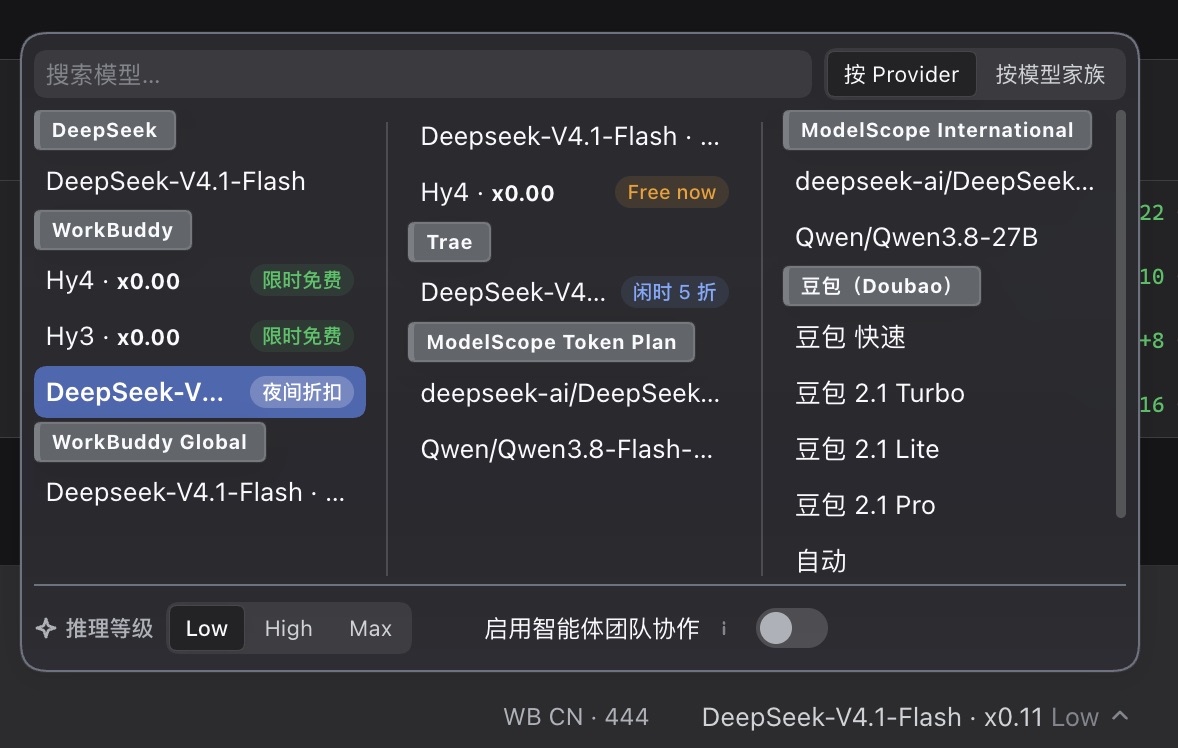
A flat, two-level-free model picker for the DeepSeek Harness (DSH) composer: every model and reasoning level on one surface, no second-level menus.
dsh-model-flatmap is a client-side DSH plugin that runs in both the Web GUI and the
Desktop app. It replaces the composer's conversation.input.model seat with a single flat
panel rendered in the client UI.
Instead of nested popovers, the whole catalogue is one searchable grid where the
model grid, the current model's reasoning levels, and the agent-teamwork switch
are all visible at once.
The plugin reads and writes through public Client APIs only — the per-Session
model directory, the teamwork setting, and the host's locale. The host half
(index.js) contributes no service, tool, or event; the UI lives in client.js,
which registers with a negative priority so it shadows the shipped ModelSelect
while active. Disabling the plugin restores the native control with no residue.
The host half has one job of its own: an anonymous daily heartbeat
(telemetry.js). It sends at most one request per machine per local day to
https://dsh.zuos.us/api/e — installation id, plugin id, plugin version,
platform, architecture, event kind and the protocol version — and nothing else:
no prompt, no session content, no model name, no path, no username, no IP. A
process that stays open across midnight re-checks every six hours, so a window
left running all night still counts for the new day rather than only for the day
it was launched.
The installation id is a random UUIDv4 created on first run and unrelated to any
account; deleting ~/.dsh/dsh-model-flatmap/analytics.json gives the machine a
new one. The heartbeat is void-ed and every failure is swallowed, so the picker
never waits for it and never fails because of it. It exists because npm download
counts cannot answer "how many machines actually run this, and how many ran it
today" (installs, CI and mirrors all count), and a Client-side counter cannot
either (a tab nobody reloads reports nothing).
You can switch it off. Settings → Model list carries an Anonymous usage
statistics toggle at the bottom of the panel, on by default. The choice is
opt-out, so a machine whose owner never opens Settings keeps reporting exactly as
before — the toggle is a genuine choice, not a disguised default. It lives in the
browser (localStorage) but the heartbeat sends from the Host, so flipping it
mirrors the choice to the Host through a trust-fenced route, which re-reads it
before every send: the next heartbeat (within the day, or on the next launch)
honours it with no restart. See DEC-035. Disabling the bundle still stops the
heartbeat with the UI.
The panel in action — a flat grid of models, the current model's reasoning levels, and the agent-teamwork switch on one surface:
conversation.input.model.label slot there, and connection plugins use it for
a promotion chip (夜间折扣), a rate, or a load mark (queued people / a rocket
when idle). This plugin renders that slot's winning component on its own
trigger and on every selectable row under By provider — with the seats
they need — so the two modes show the same content row for row. A missing or
crashing occupant falls back to the catalog name plus the model's own
model.badge. Under By family the row's primary text is the provider, so
the rows keep the quieter model tail and the slot stays on the trigger only.hy3 → HY3, hy4free / hy4std / hy4-preview → HY4, and a bare hy
→ HY. Unregistered brands still collapse their version tail; dictionary
families (GPT, Qwen…) are never split.Qwen3.8-27B under
Qwen reads 3.8-27B, and Deepseek-V4.1-Flash · x0.01 under DeepSeek
reads V4.1-Flash · x0.01 with the multiplier drawn smaller and bold. The
full model name and description stay in the tooltip.line-through on its row text until a later call for that same model returns
anything else, and until the mark has gone 24 hours without a new attempt —
whichever comes first. A balance is topped up and a quota resets daily, so a
strike nobody refreshed is stale information, not a warning. The strike
follows the model the failing request actually used, and covers the
Host's QUOTA / ACCOUNT_QUOTA codes, a provider 402, and a 429 whose
body reports an empty balance — a plain rate limit never strikes. Because a
balance is a property of the model route and its account, not of one
conversation, the marks are global: a failure seen in any Session strikes
the model in every Session and workspace, and the state is persisted to
localStorage so it survives a reload. Every mark keeps the time of the
observation that made it, so opening the list a day later draws that row
plain. Observations are ordered by that same time, so the newest one wins and
replaying older history cannot resurrect a strike that has already ended —
by a later call or by age.settings.section, so it sits in the app's own
settings panel beside the shipped pages) lists every provider with a switch,
and expanding a provider lists its models with one switch each. The provider
switch is a bulk action: it writes every one of that provider's models,
and the model switches stay live — so the useful workflow works, switch a
provider with dozens of models off and then switch the two or three you want
back on. Such a provider reports mixed and "N on"; one with every model off
dims and says "all off". The choice applies to the panel's grid, its search
index, its group headings and its model count at once, because the filter
runs on the single catalogue every one of them derives from. The
record stores what is hidden, not what is shown, so a provider or model
added by a plugin installed later appears without re-opening Settings. It is
kept in localStorage (dshmf:hidden) and shared by the settings page and
every panel in the page, so a switch flipped in Settings re-renders an open
panel immediately, with no reload. Hiding the model a conversation currently
uses is allowed: the grid obeys the switch, and the trigger still names the
current model. If everything is hidden the panel says so and points back at
Settings instead of claiming no models are available.
A model row names the model the way the picker does: a · x0.01 rate inside
the name is lifted into its smaller bold run, and the catalog's own badge
chip (a promotion like "Free Now", a load mark, a rate) follows the name. A
model the catalog badges nothing about draws no chip and keeps no gap.localStorage (dshmf:aliases), shared by Settings and every open
panel, so a save re-renders the picker with no reload. The Default style
picker is the host's own and keeps the catalog's names.Default style button sits a link
icon that opens this project's GitHub page in a new tab. The address is not
hardcoded: the Host reads the checkout's configured remotes with
git remote -v (origin first, then upstream, then the rest) and turns
every spelling git writes — git@github.com:owner/repo.git,
https://github.com/owner/repo.git, ssh://, git://,
github.com:owner/repo — into the same https://github.com/owner/repo page.
A remote on another host (GitLab, Bitbucket, a self-hosted server) is skipped
rather than rewritten to github.com: rewriting would open a different
repository with nothing on screen saying so. Renaming the repository, moving
it to another owner, or adding a fork upstream all change the destination
without touching this plugin. When the checkout has no usable GitHub remote
(an npm-installed copy ships no .git), the button opens this project's home
page and its tooltip says that is the fallback. The URL is prefetched when the
panel opens, so an ordinary click is a synchronous window.open that a popup
blocker will not eat; the tab opens with noopener,noreferrer, and only
http(s) addresses can reach it. Clicking it does not affect the
Default style button, whose look, aria-pressed meaning and disabled rule
are unchanged.Default style button hands the
composer's model seat back to the host's own picker — the real shipped
ModelSelect, not a reproduction of it. The plugin does this by stepping
aside: it disposes its own conversation.input.model registration, so the
host's entry underneath wins the slot and renders itself. Nothing is
imported, copied, or re-mounted, which means an upgraded DSH shows its own
newest picker and this mode can never drift out of date. The way back is a
separated action band at the bottom of that picker's own menu — it reuses the
conversation.input.model.options child slot the shipped ModelSelect
declares, so it belongs to the panel it acts on and renders nothing at all
while the flat panel is shown. It is drawn as an outlined button, not as one
more menu row: the rows above it pick a value, this one performs an action.
The choice is remembered across reloads. If the host ships no picker to hand
over to, the button stays disabled and the panel stays — the composer never
ends up without a model control.See docs/DETAIL.md for the full behaviour spec and
DECISIONS.md for the decision log behind the design.
This package is a DSH bundle. Install it from your DSH profile (the plugin
manager), or drop it into the profile's bundle directory so the dsh loader
picks up cordis.patch.yml.
# Example: install the bundle into a running profile (paths vary by install)
cp -r . "<profile>/bundles/dsh-model-flatmap"
Enable or disable the plugin from the profile's plugin list — no native control is touched when the bundle is off.
| Path | Purpose |
|---|---|
index.js |
Host half — bundle entry; starts the anonymous daily heartbeat. |
telemetry.js |
The heartbeat itself: pure day/decision functions, plus an injectable reporter. |
client.js |
Browser half — the entire flat picker UI, plus the Settings → Model list section. |
cordis.patch.yml |
Cordis patch applied by the dsh bundle loader. |
locale/en.json |
English copy and metadata. |
locale/zh.json |
Simplified-Chinese copy and metadata. |
docs/DETAIL.md |
Detailed behaviour specification. |
test/ |
Render-path tests driven through a minimal hook runtime. |
The plugin is plain ES modules with no build step.
# Run the render-path tests (no browser required)
node --test test/
Tests read client.js directly and drive the real component through a minimal
hook runtime to catch crashes, missing sections, and wrong column counts.
test/telemetry.test.mjs covers the heartbeat instead: the day boundary, the
once-a-day gate, the payload's field whitelist, degradation after repeated
failures, and the promise that a dead endpoint costs nothing. No test touches
the network — fetchImpl and the clock are injected.
Released under the MIT License.
CLASSIFICATION EVIDENCE
系统优先读取 GitHub Topics,再与站内分类词典和词根规则比对。当前命中: model。
morluto
Reverse engineer anything with agents, from app behavior down to native binaries.

deepseek-ai
DeepSeek Harness: Everything is a Plugin.

nexu-io
The 1st Collaborative AI Design Agent Workspace. Local-first and open source. Create motion, prototypes, websites, apps, dashboards, presentations, images, and videos with your team and AI agents. Share work, exchange feedback, and iterate together in one workspace.