
模型与 MCP
待识别

rea
morluto
Reverse engineer anything with agents, from app behavior down to native binaries.

zsw1363574747/hk-jobmatch-ai
香港求职匹配台 · Local-first Hong Kong job-match workbench: scrape JobsDB, score every posting against your CV, and explain the salary and skills the market actually asks for. Zero-dependency Node app, runs on 127.0.0.1 only.
PROJECT TOPICS
INSTALL REFERENCE
dsh plugin --profile web add github:zsw1363574747/hk-jobmatch-ai
该命令指向仓库当前默认分支;尚无绑定当前 commit 的完整验证结果。
PROJECT README
A local-first job-hunting workbench for Hong Kong. Paste your CV → scrape a job board → score every posting against you → understand the market.



Most job hunts are: open a board, read 80 postings, forget which ones you already read, and have no idea whether HKD 35k is good for someone with 3 years of experience.
jobmatch is a single Node process that turns that into a local web app:
No npm install. No account. No cloud. The only thing that leaves your machine is the job search query.
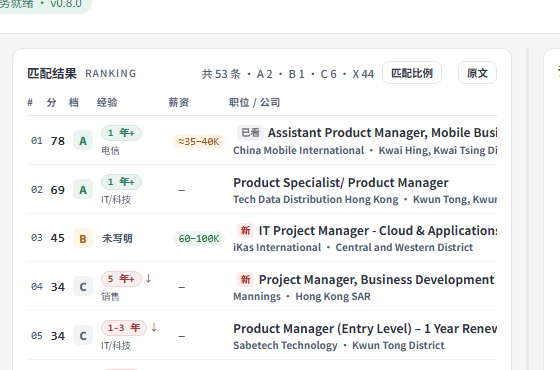 |
 |
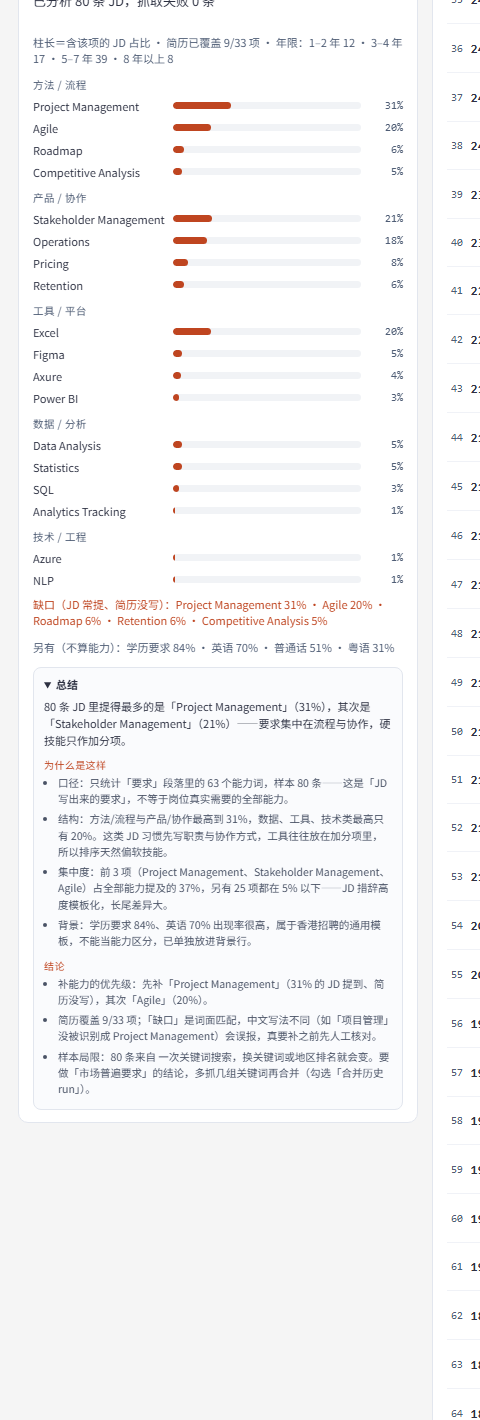 |
| Ranked postings, scored against your CV. 新 = posted in the last 3 days, 已看 = you already opened it. | Median pay per experience bucket, computed from disclosed salaries only, with an inferred fallback column. | What the JDs ask for, grouped by capability, plus a rule-based summary and your gaps. |
Job boards optimise for applications, not decisions. They will happily hand you a long list of postings, none of which tell you:
jobmatch answers those three, locally, and keeps the evidence (which JD, which sentence, which salary band) next to every number.
Matching
新 (posted ≤ 3 days) and 已看 (you opened it) badges, persisted in the browserData
data/), so re-opening a posting costs nothingMarket insight
≈ inferred column when the disclosed sample is emptyRequirements: Node.js ≥ 22 and a local Edge/Chrome (only needed for the experimental login-based features).
git clone https://github.com/zsw1363574747/hk-jobmatch-ai.git
cd jobmatch
Windows:
start.cmdmacOS / Linux:
./start.shOr run it directly:
node web/server.mjs # http://127.0.0.1:7790Or through the npm scripts (no dependencies, npm install is not needed):
npm start                    # same as node web/server.mjs
npm test                     # both offline test suites
Then, in the browser:
.pdf / .docx / .txt / .md) — it is parsed in-process and saved to data/profile.json.product manager), pick locations, pages and a posting-age window.Environment overrides:
| Variable | Default | Meaning |
|---|---|---|
JOBMATCH_PORT |
7790 |
HTTP port (auto-increments if busy) |
JOBMATCH_DATA_DIR |
./data |
All runtime data: profile, runs, caches |
JOBMATCH_BROWSER |
auto-detect | Path to Edge/Chrome for login-based features |
 resume.pdf ──parse──▶ profile {skills, titles, years}
                              │
 keyword ──search──▶ postings ──score──▶ A/B/C/X ──┬─▶ web UI (list + detail)
                              │                  └─▶ report.md
└─fetch JD──▶ experience ──▶ insight / salarysource:nativeId, and records per-source counts plus the reason when blocked.fetchDetail), records which strategy produced the text (graphql / html / search-api / teaser), and never pretends a teaser is a full JD.Tests (offline, no network):
node bundle/bin/selftest.mjs           # 36 checks: parsers, scoring, insight, salary maths
node bundle/bin/architecture-test.mjs # 10 checks: data invariants (runs, pages, dedupe)Sources are adapters behind one contract — the app, scoring, UI and reports never know which board a job came from.
bundle/lib/sources/
  index.js        # registry + searchAll + fetchDetail dispatch
  jobsdb.js       # enabled: JSON search API + GraphQL JD
  govhk.js        # legacy adapter, kept as a reference implementation
  browser.js      # zero-dependency CDP driver for browser-only boards
  sites.js        # browser-based site configs (CTgoodjobs kept but disabled)
An adapter exports:
export const descriptor = {
  id: 'example',
  label: 'Example Jobs',
  home: 'https://example.com',
  needsBrowser: false,        // true → driven through CDP instead of HTTP
}

export async function search({ keywords, pages }) {
  return { jobs: [...], totalCount: 123, warnings: [] }   // jobs[] use the shared Job shape
}

export async function fetchDetail(job) {
  return { ok: true, detail: { contentText, contentHtml, salary } }
}
Then:
CATALOG in bundle/lib/sources/index.js;id to ENABLED_SOURCE_IDS;selftest check so it stays verifiable offline.See docs/sources.md for the full contract, the browser-source lifecycle (persistent profile, manual challenge pass) and the rate-limit/backoff rules.
bundle/
  bin/            CLI entrypoints + offline tests + salary calibration
  data/           lexicon (skills/titles/languages) + offline fixtures
  lib/
    domain/       pure logic: scoring, experience parsing, salary parsing, locations
    sources/      job board adapters (the extension point)
    features/     one folder per capability: search, details, salary, insight, report…
    storage/      run / page stores (atomic writes, guarded projections)
    service.js    the only surface the web layer calls
web/
  server.mjs      static files + JSON routes
  routes/         thin handlers → bundle service
  public/         vanilla HTML/CSS/JS, no build step
docs/             architecture, source contract, salary methodology
start.cmd/.sh launchersdata/, which is git-ignored.127.0.0.1 only.n and marks thin buckets instead of hiding them.This is a personal job-search tool. It reads publicly visible job postings at a deliberately slow rate (≥1.2 s between requests) and does not bypass authentication. You are responsible for complying with each site's terms of service and robots policy in your jurisdiction, and for not redistributing scraped content. No warranty; use at your own risk.
Built as a zero-dependency Node project. Interface shapes were informed by public open-source work — see vendor/README.md for the list and what was (and was not) borrowed.
CLASSIFICATION EVIDENCE
系统优先读取 GitHub Topics,再与站内分类词典和词根规则比对。当前命中: deepseek-harness。
morluto
Reverse engineer anything with agents, from app behavior down to native binaries.

deepseek-ai
DeepSeek Harness: Everything is a Plugin.

nexu-io
The 1st Collaborative AI Design Agent Workspace. Local-first and open source. Create motion, prototypes, websites, apps, dashboards, presentations, images, and videos with your team and AI agents. Share work, exchange feedback, and iterate together in one workspace.