dsh-skins · Skin Center for DeepSeek Harness (DSH)
English | 中文



Theme & Personalization Engine for DeepSeek Harness (DSH) Web GUI & Desktop Client
Themes & Skins · Frosted Glass Blur · Custom Themes · Live Try-On · Wallpaper Engine via its dedicated plugin
@linxin666/dsh-client-ui-skin-center (cordis plugin id ui-skin-center) is the single skin package of the dsh Web GUI: it puts the skin list / try-on / apply into the real GUI as the first-level Skin Center settings section (settings → 皮肤中心, listing only installed skins), and it is the only loader and renderer for skins. A skin is a pure asset directory — no package.json, no npm publish, no cordis wiring — that couples only to the skin-center contract (contracts/); the skin center absorbs every official-DSH coupling behind that contract. The card carries its own enable switch (off disables try-on, apply and the background controls).
- List: shows "官方默认" (official default) plus every installed skin in the catalog with its name, tagline and accent color; the currently active target carries the Active marker. The catalog merges two sources: the default skin shipped inside this package (
skins/blue-fantasy/) and user skins dropped into $DSH_HOME/skins/<id>/ (a user skin with the same id shadows the built-in one). Every other skin of the collection is a market item: install it on demand from the DSH Market store (one-click install) into $DSH_HOME/skins/<id>/, where this same catalog manages it as a user skin — no restart, reopen the card or reload to pick it up. Skins whose skin.json fails validation are excluded fail-closed and reported as catalog diagnostics.
- Custom theme: the final card is a user-level theme derived from the official stock look, separate from both the official-default card and catalog skins. Light and dark profiles independently edit accent, background, foreground and contrast (0–100), with live try-on, apply, current-mode reset and reload persistence. Its generated CSS is limited to an audited official-token allowlist; it cannot accept selectors, arbitrary CSS or asset URLs. Catalog skin definitions are never modified, and an active catalog skin automatically suppresses the custom-theme layer.
- Try-on / Apply: both go through the same atomic switch engine (
src/client/runtime/skin-controller.ts). One switch is one new activation identity: fetch the scoped stylesheet, install it plus the background media and optional hooks, flip html[data-dsh-skin="<id>"], then dispose the previous activation (append-only effect ledger, idempotent teardown). The latest request always wins; a failed or superseded switch leaves the previous skin fully intact. Try-on is the same switch without persistence — "Exit try-on" restores the committed skin. Apply persists the selection (POST /api/skin-center/v2/active). No page reload, no cordis.patch.yml rewrite, no boot-graph regeneration.
- First paint: the host half registers one index.html transform (
webServer.tapIndex, single adapter module src/tap-index-adapter.ts) that stamps html[data-dsh-skin] and inserts the stylesheet links into every served document, so a reload boots straight into the active skin with no flash of the stock look. The tap fails closed to the stock look on any problem.
- Skin format (v2):
skin.json (validated fail-closed, v1 fields package/wiring/bodyAttr ignored with migration warnings), skin.css (L1 token remaps + L2 semantic selectors), optional patches.css (L3 free selectors, high sensitivity), optional hooks.mjs (trusted escape hatch, high sensitivity), assets/, preview/. All CSS passes the safety pipeline (src/core/css-safety/transform.ts): every selector is force-scoped under html[data-dsh-skin], @import / remote or protocol-relative URLs / escaping paths are hard errors. See contracts/README.md.
- Coverage contract: L1 remaps the official
--dsw-* design tokens; L2 styles the semantic attributes (data-dsh-surface / data-dsh-part / data-dsh-plugin, enumeration in contracts/semantic-attrs-v1.md) which a compat adapter (src/client/runtime/semantic-adapter.ts) stamps onto the official shell DOM from stable anchors (data-slot outlets, data-chat-flow-kind, etc.); L3 patches carry any selector at the skin author's own risk. Plugins that output the semantic attributes themselves get the full L2 coverage; plugins that do not only get L1. A shared shell-rendering adapter applies only while a catalog skin or a custom theme is active: it removes the workspace-list end fade, gives the composer placeholder an opaque theme-secondary text color, and reserves bottom clearance on conversation scrollports so messages remain readable above the sticky composer (#978), so individual skins do not need duplicate patches.
- Background priority: while a wallpaper renders, the skin and its background media stand down entirely (see "Wallpaper Engine"), so the wallpaper always has the backdrop to itself; otherwise the skin's manifest background media is the backdrop.
- Background controls: a background-occlusion slider (0–100%) veils the backdrop behind the panels for skins that paint one, two per-state Gaussian-blur sliders (0–20 px) control the backdrop for empty and populated conversations, an input-card blur slider (0–20 px) controls only the frosted area behind the composer, and a bubble-opacity slider (0–100%) drives translucent message bubbles for skins that expose bubble alpha. The active background blur uses a fixed
backdrop-filter element behind the shell; 0 disables it entirely (no element, no GPU cost). The input-card frost rides its own body-level fixed follower (the data-dsh-composer-frost element) sized to the composer card, never the card itself: a backdrop-filter on the card would make it the containing block for the shell's fixed tooltips inside it and jolt the conversation on every hover.
- Legacy migration: on the first boot after the v2 upgrade, a one-shot bridge (
src/legacy-bridge.ts) reads the retired dsh-skin managed section from the harness home cordis.patch.yml (where the v1 CLI wrote it; the active profile's cordis.patch.yml is probed as a secondary location), migrates the active skin id into the v2 selection store, and strips the legacy rows. The migration is idempotent and fails closed (the old state stays untouched on any error). It logs only when it migrated, cleaned, or failed — the nothing-to-migrate steady state stays silent (issue #788).
Core Capabilities & Scenarios
| User Goal & Scenario |
Stock DSH Web Limitation |
Skin Center (dsh-skins) Solution |
| Personalized aesthetics and eye-care dark theme |
Default single monochrome theme only |
Bundled Blue Fantasy dark theme + one-click install for dozens of curated themes from Workshop |
| Interactive dynamic wallpaper via Wallpaper Engine |
No dynamic video or animated wallpaper support |
Delegated to the dedicated dsh-wallpaper-engine plugin (video, web, and 2D/3D WebGL real-time scenes), which this card installs from and hands the backdrop to |
| Frosted glass blur & composer scrim controls |
Flat background with no visual depth or layering |
Background scrim (0–100%), adaptive conversation blur, follower frosted composer glass & bubble opacity |
| Custom brand palette & CSS token remapping |
Unable to tweak accent colors or contrast |
Independent light/dark accent, background, foreground and contrast tuning with audited CSS token coverage |
| Live theme try-on and zero-flash hot switching |
Theme changes require server restarts or reloads |
Atomic hot-switch engine for live preview, clean rollback, and instant boot without white FOUC flashes |
Most popular skins
The three most-liked skins in the Workshop's skin category on dsh-market.com, in the site's default popularity order:
| Skin |
Author |
Look |
Abyssal Maid Atelier (maid-atelier) |
Small-tailqwq |
Twin-maid atelier backdrop, deep-sea blue lace surfaces and a chibi sidebar |
Whale Song (whale-song) |
dsh-web |
Deep-sea whale goddess backdrop, ice-blue ocean palette and gold hairlines |
Blue Fantasy (blue-fantasy) |
powerdog996 (DreamSkin community), adapted by dsh-web |
Whale-illustration backdrop, periwinkle indigo palette and translucent panels |
| Abyssal Maid Atelier |
Whale Song |
Blue Fantasy |
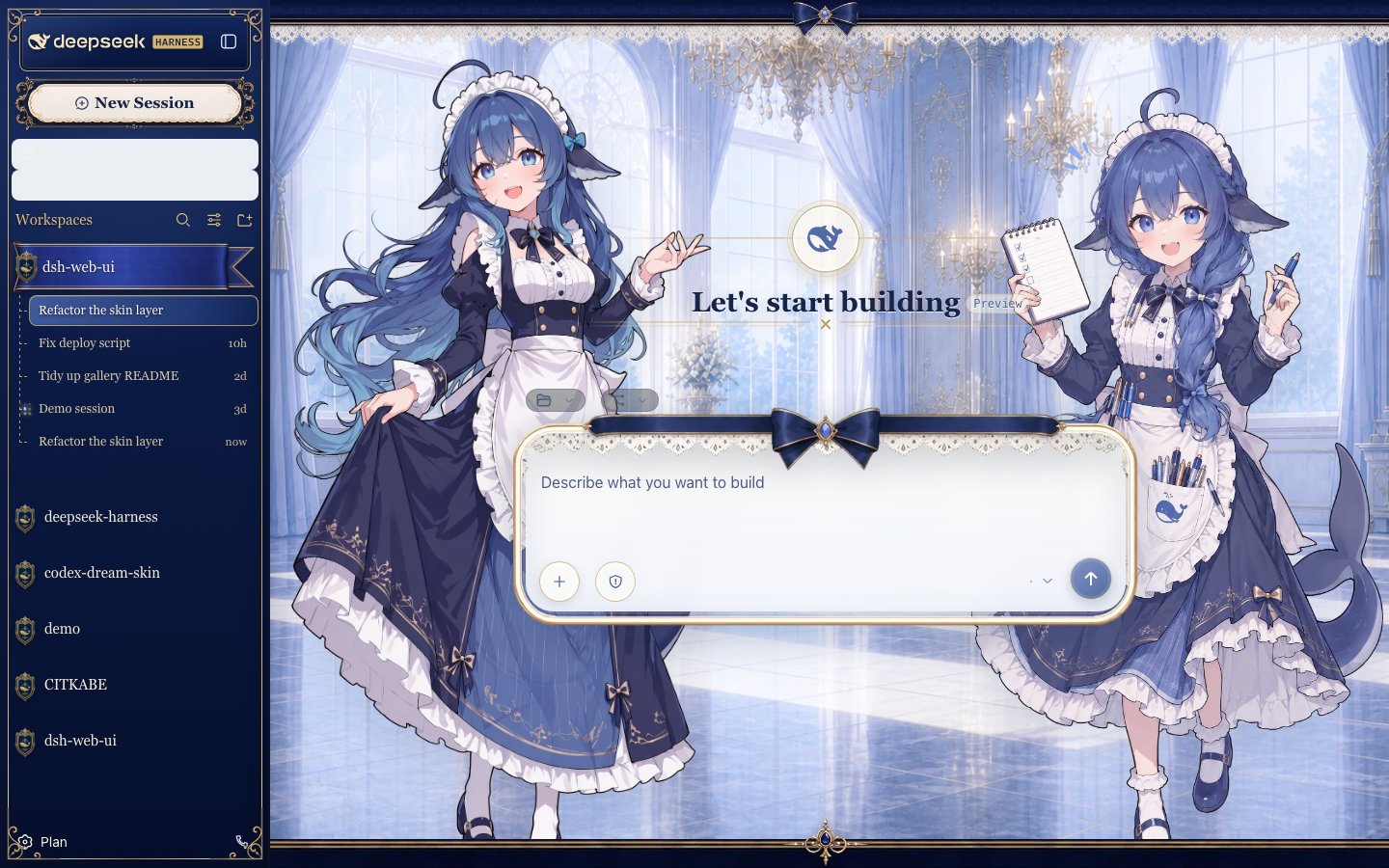 |
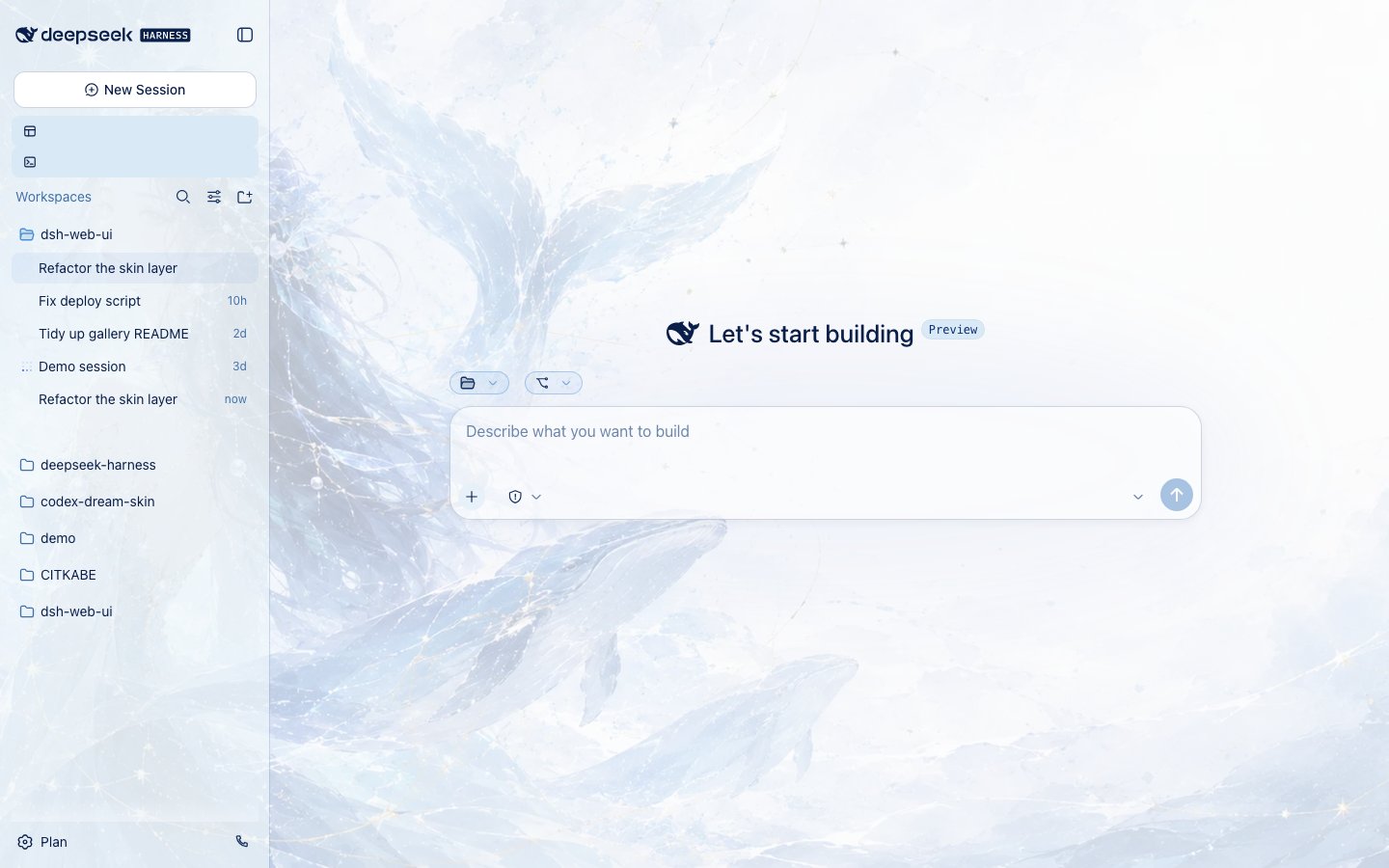 |
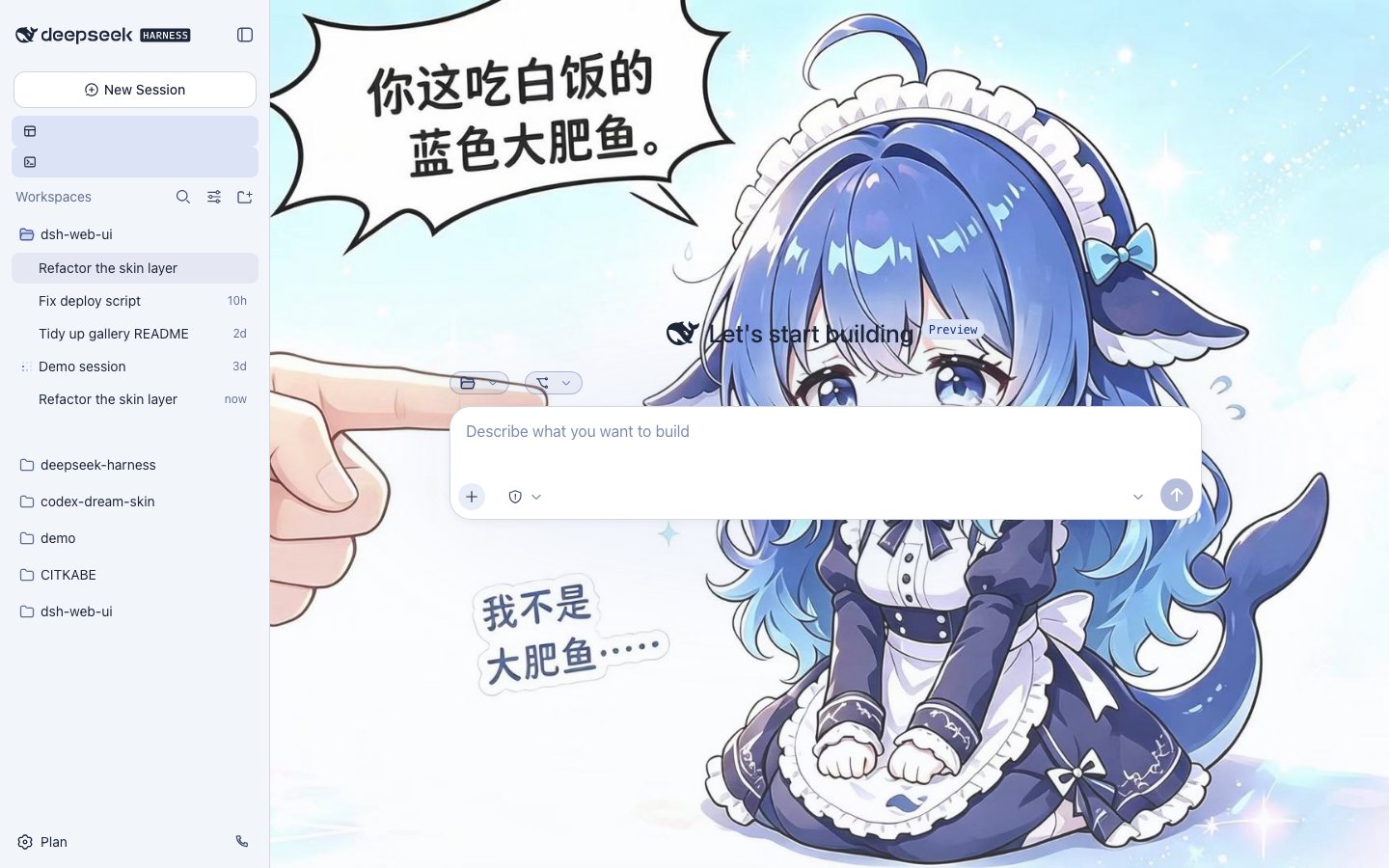 |
Install any of them from the Workshop in one click; blue-fantasy is also the skin this package ships as its built-in default.
Install
dsh plugin --profile web add @linxin666/dsh-client-ui-skin-center
# From the repo (dev): dsh plugin --profile web add link:$(pwd)/packages/skins/skin-center
$(pwd) is your clone of the dsh-web monorepo. Only the default skin (blue-fantasy) ships inside this package; every other skin installs on demand from dsh-market.com into $DSH_HOME/skins/<id>/, and community skins are plain directories in the same place (no install command, no restart — reopen the card or reload to pick them up). A fresh install activates blue-fantasy by default (host seed); an update whose active skin is no longer available falls back to the stock look. The package ships skins/blue-fantasy only; the remaining skins stay in the repository under skins/ as the market-build source and are never published in the package.
skin-center is a self-contained bundle meeting the official DSH plugin standard (dsh.bundle.patch points to cordis.patch.yml); it can also be installed via git: dsh plugin --profile web add github:<org>/dsh-web#<sha> (the prepare script builds lib/ in place). pnpm ≥10 requires authorizing allowBuilds before installing a git dependency; a local link: install has no such requirement.
Wallpaper Engine
Wallpaper Engine support is not bundled here. It lives in its own plugin, dsh-wallpaper-engine (dsh-plugin-wallpaper-engine), which owns the wallpaper library, the video / web / scene rendering paths, the wallpaper settings surface and the glass over the wallpaper. It is the recommended Workshop item for wallpapers, and the skin center card installs it for you.
One-click install: open 设置 → 皮肤中心 and press Install on the card's wallpaper notice. The install goes through whichever plugin-management face the running host publishes — the official in-process plugin manager when it is there (the same call the official Plugins page makes, and the only writer on the packaged Desktop client), otherwise the family plugin-manager face. A host that publishes neither keeps the copy-command fallback.
By hand, the equivalent is:
dsh plugin --profile web add dsh-plugin-wallpaper-engine
Restart the host afterwards (dsh web; DSH Desktop: fully quit the app and reopen it). The plugin adds its own settings page for choosing and tuning wallpapers.
How the two share the page
The two plugins take turns rather than overlapping, and the handoff is automatic:
- While a wallpaper renders, the plugin stamps the stable
body[data-we-wallpaper] attribute. The skin center reads that attribute and stands its own visual work down: no skin CSS, no skin background art, no hooks, no composer frost, and the html[data-dsh-skin] stamp comes off the page. Whatever you picked in the skin center is remembered but not painted — that plugin rewrites the same shell and paints its own glass, so anything else would fight it.
- When the wallpaper stops, the attribute clears and the remembered skin repaints on its own, with no reload and no re-applying.
- When you ask for a skin yourself, try-on and apply claim the stage once: the skin paints and
html[data-dsh-skin] flips even while a wallpaper renders, because that stamp is the signal the plugin watches to hand the page back. Re-applying the skin you already wear counts as an action too, so the stamp is written on every apply rather than only when the selection changes. The claim is one-shot — if nothing answers within a short hand-back window, the skin stands down by itself and waits for the wallpaper to stop.
- On the first screen, a remembered wallpaper wins before it renders. That attribute is written by the wallpaper plugin's own client chain, hundreds of milliseconds after the document was delivered — too late for the browser's first paint, which the delivered document decides. So the host reads the wallpaper plugin's persisted selection (
$DSH_WE_DATA_DIR/config.json, or ~/.dsh-wallpaper-engine/config.json) while serving the page, and a wallpaper selected there keeps the skin out of that first screen entirely: no html[data-dsh-skin] stamp, no skin stylesheet. The withheld document is marked, so the GUI boot that follows it stands its first activation down too — the switch that would otherwise refill the gap a few hundred milliseconds later. The skin is still yours: if the wallpaper turns out not to render, your selection is applied as soon as the attribute is gone, or when that short window closes, whichever comes first.
The card says so while it is standing down, so a paused skin reads as a state, not as a bug. Whatever you picked is always persisted, and a skin the wallpaper never sees takes effect when the wallpaper stops. The skin center never writes the plugin state, and the plugin never writes the skin center state.
Skins and wallpapers
Skin background art is part of a skin own look, so it is withheld together with the rest of the skin while a wallpaper renders. Skins that ship their own full-bleed plate (the ground-plate canvases in the catalog) additionally key their yield rules on body[data-we-wallpaper], so they step aside rather than compete for the backdrop.
Delegated plugin skins
Some looks are not asset directories at all: they ship as their own plugin and paint the whole
interface. The Claude Code Desktop theme is one — it lives in dsh-claude-style
(dsh-claude-style), which repaints the shell, sidebar, composer and conversation on its own. It is a
separate package: nothing here bundles it, versions it or ships its files.
Such a look is still a skin you can select. It gets its own full-width bar ABOVE the skin grid —
the same row shape as the custom-theme card below it — carries a Plugin theme badge, and behaves
like any other skin: try it on, apply it, and it is remembered across a reload. It does not take a tile
in the grid: a grid cell exists to show a preview image, and this package holds none for a look another
plugin paints. What it never does is paint from here — the plugin paints it, and this package keeps
the selection.
- The row exists before the plugin does. Press Install plugin on the row (the same
one-click path the wallpaper notice uses: the official in-process plugin manager when the host
publishes it, the family plugin-manager face otherwise, the exact command when it publishes
neither). A profile without the plugin is exactly where the prompt belongs.
- Selecting it hands the page over. The skin center stamps nothing, loads nothing and paints
nothing; the plugin's own client chain mounts its bundle. The selection persists like any other,
so the delegated look survives a restart.
- Any other skin, the stock look, or a running wallpaper takes the page back. That is the
reverse of the same handoff: this package stamps
html[data-dsh-skin] again, the plugin reads
it and stands its own visual down, and the skin paints over it. No reload, no re-apply.
- A build that cannot hand the page back is not offered. The plugin advertises that it can
yield with a body attribute; without it, the row says so and offers no try-on or apply, because
the two would otherwise paint the same shell at once. Update the plugin and the row becomes
selectable.
- Its settings page and preferences survive the yield. Standing down is a visual state, not an
uninstall: the plugin keeps its own settings page while another skin is on screen.
The skin center reads the plugin's markers and never writes them, and the plugin never writes
data-dsh-skin. Neither side can strand the other.## Configuration
- Enable switch: turns the whole card (try-on / apply / background controls) on or off; persisted in the v2 active-state document.
- Background sliders: occlusion (0–100%), two backdrop blur radii, input-card blur (0–20 px), and bubble opacity (0–100%); persisted in the same v2 document.
- Background persistence (remote-capable): background values live in the v2 active-state document (
$DSH_HOME/skin-center-active.json, the background section) and are read/written through GET|POST /api/skin-center/v2/active, so paired remote desktops — where the settings surface is loopback-only — load and keep them across sessions. The skin-background section of the plugin's own configuration stays as the settings page's input face: a customized section is migrated into the v2 store once at boot, and later page edits are forwarded by the client. Card edits do not write back to that page, so it may show stale values until its next edit.
- Custom theme: light/dark accent, background, foreground and contrast profiles plus the applied marker; persisted as a versioned contract in the
skin-custom-theme section of the plugin's own configuration.
- Wallpaper settings: not part of this configuration. They belong to
dsh-plugin-wallpaper-engine, which serves its own settings page; a retired skin-wallpaper section left in an older profile is ignored and never rewritten.
- Where these settings live: the two sections are one plugin configuration — the profile entry's own
Config. The Host derives that entry's settings page from the schema in the GUI, and the card writes the same values; there is no separate settings document.
- User skin directory:
$DSH_HOME/skins/<id>/; override precedence is DSH_SKINS_HOME, then DSH_SKINS_DIR, then $DSH_HOME/skins.
Security model
- All
/api/skin-center/* routes are same-origin only: writes reject cross-site requests (Sec-Fetch-Site / Origin fence), and asset reads are contained inside each skin directory (path escapes fail closed).
- Skin CSS is sanitized (whitelist) before serving;
patches.css (L3) is arbitrary CSS by design and disclosed as such — it runs with full page styling power and is not a security boundary.
- The custom-theme editor emits only fixed declarations from
CUSTOM_THEME_ALLOWED_TOKENS, each verified against the official token registry. User input is normalized color/contrast data and never becomes a selector, URL or free-form CSS payload.
hooks.mjs is trusted code that shares this repository's review and release; it is served same-origin only and its import/apply errors can never take the static skin down. Hooks run for built-in skins and for user-directory skins whose executable identity is byte-verified as reviewed official-market content: current Workshop installs use dsh-market.provenance.json, while legacy pre-provenance installs must match the generated src/reviewed-hooks.generated.ts identity for id, declared entry, complete skin.json, and hooks bytes (verified by src/provenance.ts, issue #1073). The fallback is read-only and offline; any modified, renamed, hand-dropped, or tampered directory keeps the hooks facet refused while the declarative parts still load.
Known limitations
- Inline styles written by plugins at runtime can only be overridden by L3
!important patches.
- Plugins that do not output semantic attributes (and have no stable DOM anchors) receive L1 token coverage only.
- Wallpaper pause-on-hidden, wallpaper blur, dimming and sound live in
dsh-plugin-wallpaper-engine's own settings; the skin center has no wallpaper controls and its card only reports the plugin's state.
Telemetry
The browser half sends one anonymous install heartbeat per UTC day to dsh-market.com: a random localStorage id plus this package's name, nothing else. The server stores only a salted hash of that id, never IP addresses, and exposes aggregate counts only. See docs/telemetry.md for the full contract.
Directory structure
skins/skin-center/
  contracts/                                # the skin-facing contract surface (schema, hooks API, semantic attrs)
  src/core/manifest-v2/                     # manifest v2 types + fail-closed validator
  src/core/css-safety/                      # lightningcss scoping + whitelist pipeline
  src/index.ts                              # host entry: routes, tapIndex adapter, legacy bridge
  src/skin-repo.ts                          # dual-source skin catalog (built-in + $DSH_HOME/skins)
  src/provenance.ts                         # official-market install provenance verification (hooks trust)
  src/routes-v2.ts                          # /api/skin-center/v2/* routes
  src/tap-index-adapter.ts                  # the single tapIndex adapter (anti-FOUC)
  src/active-state.ts                       # active-skin selection persistence
  src/legacy-bridge.ts                      # one-shot v1 → v2 migration
  src/http-utils.ts / harness-home.ts       # shared route helpers / DSH path resolution
  src/client/runtime/                       # effect ledger, decoration layers, semantic adapter, switch controller, boot store
  src/client/SkinCenter.tsx                 # the settings card
  src/core/custom-theme.ts                  # versioned palette contract + audited token-only CSS generator
  src/client/custom-theme-controller.ts / CustomThemePanel.tsx            # persistence/runtime owner + editor card
  src/client/background.ts                  # scrim + blur controls
  src/external-wallpaper.ts                 # read-only probe of the delegated wallpaper plugin
  src/client/runtime/external-wallpaper-engine.ts   # stands skins down while that plugin renders
  src/client/external-wallpaper-install.ts  # one-click install through the host's plugin-management face
  skins/<id>/                               # built-in skins (pure asset directories)
Acceptance checklist
- [x] The skin-center section appears in 设置 → 皮肤中心 without console errors
- [x] The list shows the official default plus every catalog skin; the active one is marked; invalid skins surface as diagnostics
- [x] Try-on takes effect immediately and Exit restores the committed skin; only one skin is ever on the page
- [x] One-click apply switches atomically with no reload; a later page load boots straight into the skin (no FOUC)
- [x] The custom theme keeps independent light/dark profiles, survives reload, and never overrides an active catalog skin
- [x] Background scrim and blur controls are unaffected by skin switches
- [x] While the delegated wallpaper plugin renders, no skin, glass or background art from this plugin is on the page, and the remembered skin returns when it stops


