
其他
完整应用

deepseek-harness
deepseek-ai
DeepSeek Harness: Everything is a Plugin.

zbc0315/dsh-synomega
Organic reaction prediction for DeepSeek Harness: retrosynthesis, forward prediction, route planning, SynScore, and multi-component evolution — with in-chat molecule, reaction, and route-tree visualisation. Runs entirely locally.
PROJECT TOPICS
INSTALL REFERENCE
dsh plugin --profile web add github:zbc0315/dsh-synomega
该命令指向仓库当前默认分支;尚无绑定当前 commit 的完整验证结果。
PROJECT README
English | 中文






Topics: dsh-plugin · deepseek-harness · retrosynthesis · cheminformatics · reaction-prediction
Organic reaction prediction for DeepSeek Harness, backed by SynOmega. Five model-facing tools — retrosynthesis, forward prediction, route planning, synthesizability scoring, and multi-component evolution — with molecules, reactions, and route trees drawn in the conversation, and a molecule editor in the composer so a structure can go out as a drawing instead of a hand-typed SMILES string.
Everything runs locally. There is no API key and no remote inference: the models are downloaded once and evaluated on your machine.
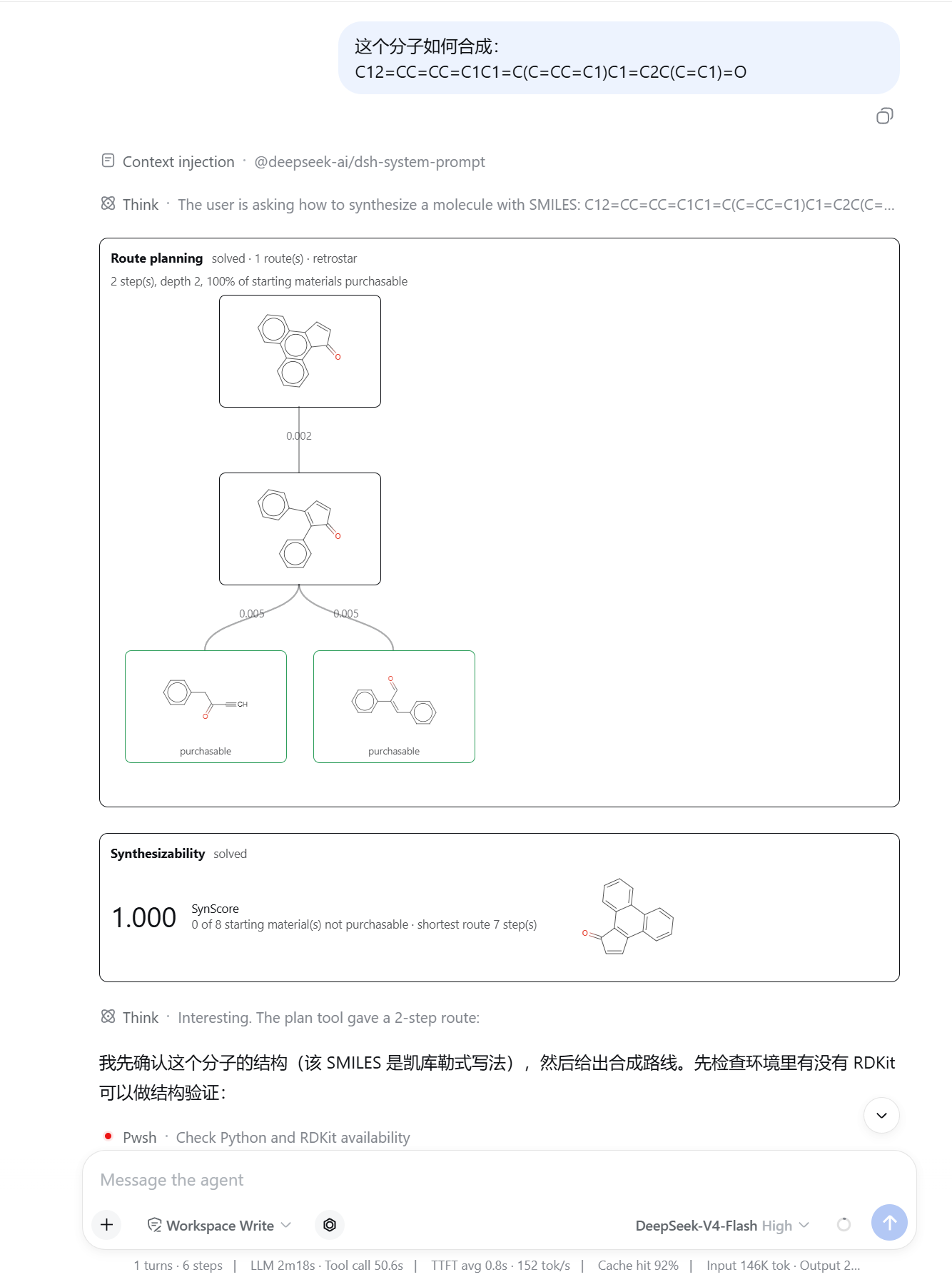
"How do I make this molecule?" — the model plans a route and scores it. Two steps, both starting materials purchasable, per-step scores on the edges, SynScore 1.000.
dsh plugin --profile web add github:zbc0315/dsh-synomegaweb is the profile to install into — a profile is one named composition of
plugins under $DSH_HOME/profiles/, and dsh web boots the one literally named
web. Use whichever profile you actually start; naming one that does not exist
creates it.
The built entry points are committed, so a git install needs no build step and no
allowBuilds approval. (Once this is on npm, dsh plugin --profile web add dsh-synomega will work the same way.)
Start the harness once afterwards. On first activation the plugin provisions its own
Python environment in the background — a Python 3.12 virtualenv under
$DSH_HOME/plugins/synomega, pip install synomega[gnn], then the retrosynthesis
model, the building-block stock, and the forward model (about 450 MB in total, once).
Nothing blocks the harness from booting; a tool called while setup is still running
reports the phase and asks the model to retry rather than failing.
Provisioning takes a cross-process lock, so a harness starting while you are running the setup script by hand waits for it instead of downloading the same files twice.
Python 3.10 or newer is required, and a machine's system python3 is frequently
older. Install uv and the plugin will fetch a suitable
interpreter itself; otherwise point the python config at an existing 3.10+ one.
To provision ahead of time instead of on first activation:
node node_modules/dsh-synomega/scripts/setup.mjs            # with the neural backend
node node_modules/dsh-synomega/scripts/setup.mjs --no-extras --no-assets # template backend only| Tool | Question it answers |
|---|---|
synomega_retro |
What reacts to give X? — ranked one-step disconnections of a product |
synomega_forward |
What do these reactants give? — ranked products of a reaction |
synomega_plan |
How do I make X? — a route down to purchasable building blocks |
synomega_score |
Can X be made, and how hard? — SynScore, a continuous 0–1 number for ranking |
synomega_evolve |
What can this mixture form? — a forward network from a reactant pool |
Each returns a structured canonical value (usable directly from Code Mode) plus a compact text rendering for the model. A prompt section teaches the model which tool answers which question, that every molecule argument must be a SMILES string, and that the first call after installation is slow because it downloads models.
SynScore is 1/(U+1)^U, where U is the number of starting materials in the best
route that cannot be bought: 1.0 when solved, 0.5 with one missing, 0.11 with two, 0
when no route is found. Use score to rank candidates and the separate solved
boolean to compare against published solve rates — they answer different questions.
Next to the composer's leading controls there is a benzene button. It opens Ketcher — the structure editor — over the conversation; Insert appends what you drew to the message as SMILES, leaving the rest of what you had typed alone.
This exists because the alternative is transcription. A SMILES string typed by hand
is easy to get subtly wrong, and a wrong one still parses: CC(=O)Nc1ccccc1O and
CC(=O)Nc1ccc(O)cc1 differ by one ring position and are different compounds.
The editor is fetched once, on the first click, from its own GitHub release
(about 35 MB, ~30 MB kept) into $DSH_HOME/plugins/synomega/ketcher/<version>/,
verified against a pinned SHA-256, and then served by this harness. Serving it locally
is what makes it same-origin — the dialog reads the drawn structure directly, and the
editor keeps working with the network off. Nothing is downloaded until someone opens it.
Set ketcher.prefetch: true to fetch it during activation instead, ketcher.url to
point at a mirror or a file:// copy, or ketcher.enabled: false to leave the button
out entirely. Compositions with no web server (headless, CLI) never register the route.
The browser half registers a view for each tool on the harness's keyed
tool.call.toolview slot, so results render as cards inside the conversation:
reactants → product with its scoreDepictions come from smiles-drawer; tree layout from d3-hierarchy. Both are bundled, so the page fetches nothing. A SMILES that will not parse falls back to its text rather than an empty box, and a truncated tree says so — a clipped route must never read as a complete one.
Cards are drawn purely from metadata persisted on the tool result, so reopening an old conversation reproduces the same picture. Deployments without the browser UI (headless, CLI) get the text rendering; no information is lost, only the drawing.
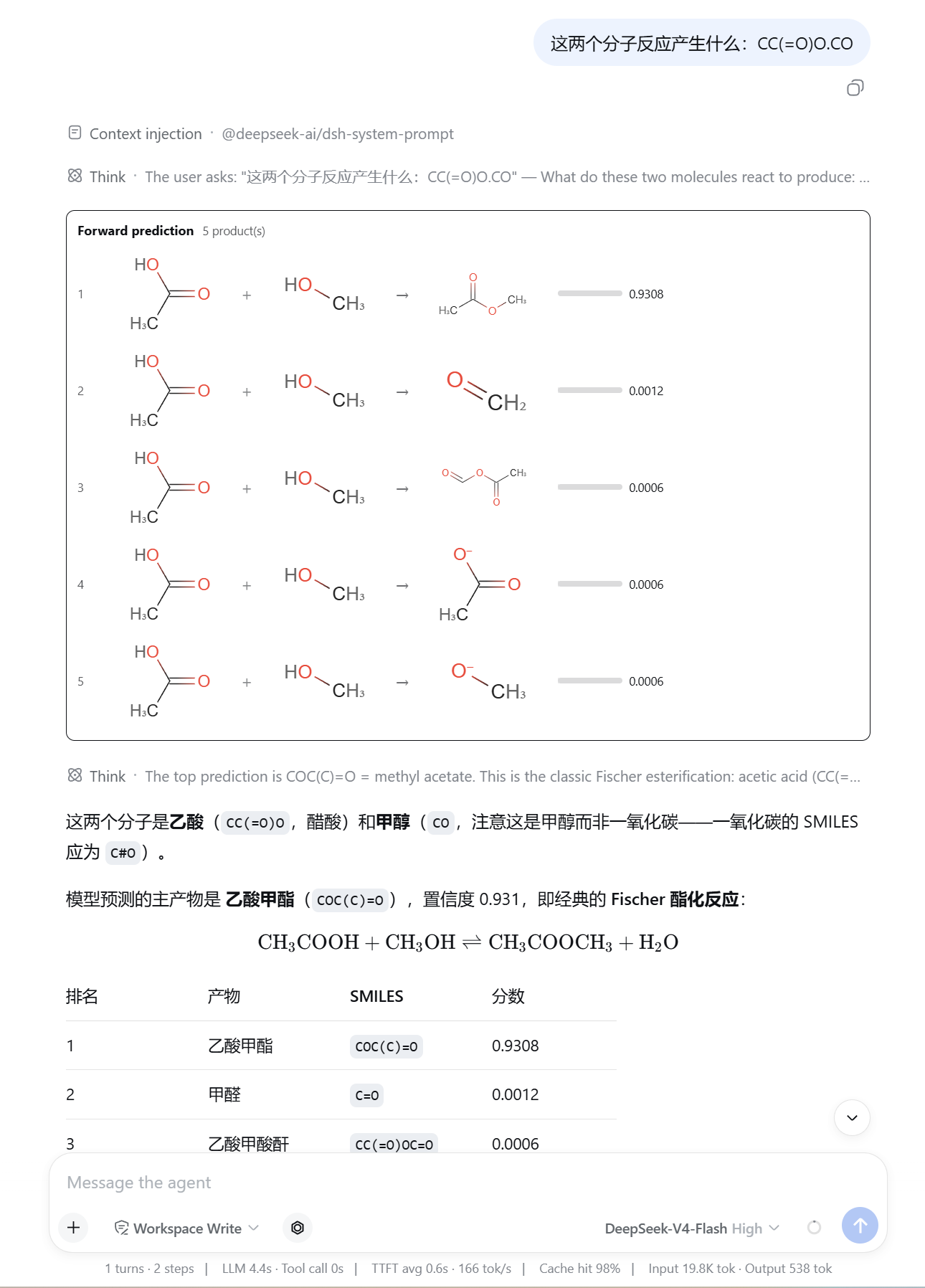
Acetic acid and methanol, ranked five deep. Methyl acetate takes 0.9308 and the rest are
three orders of magnitude behind — the model reads that as Fischer esterification and
says so. Note the disambiguation in its answer: CO is methanol, not carbon monoxide
(C#O), which is exactly the class of mistake the composer's molecule editor exists to
prevent.
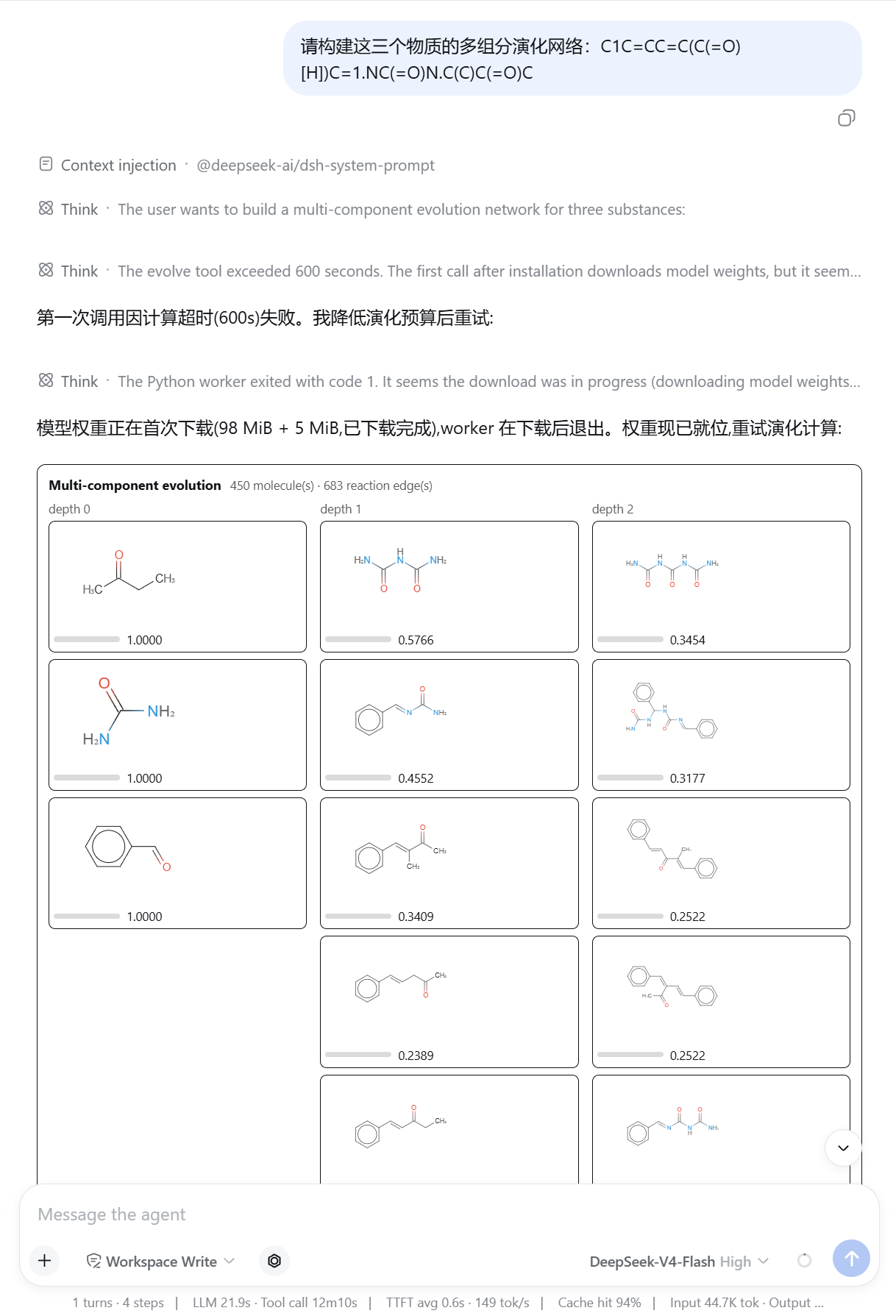
Butanone, urea, and benzaldehyde evolved forward into 450 molecules over 683 reaction edges, laid out by depth with each molecule's cumulative score. Depth 0 is what you put in; everything to the right is what the network reached.
All values are set in cordis.yml. The ones worth knowing:
| Key | Default | Meaning |
|---|---|---|
autoSetup |
true |
Provision Python on activation |
python |
— | Explicit interpreter path; set it and no virtualenv is created |
extras |
['gnn'] |
PyPI extras. [] installs the template-only backend: no torch, much faster, no neural prediction |
mirror |
'auto' |
Asset mirror (ustc / github) |
algorithm |
'retrostar' |
Search algorithm (retrostar / mcts / bfs) |
plausibility |
false |
Screen candidates with the plausibility model. Off by default: it does not improve top-k recall and adds latency |
search |
width 50, 60 s, 500 expansions | Search budget. Deployment policy, not a model-facing argument |
timeouts |
2 min / 10 min | Per-operation deadlines (single-step / search) |
visualize |
true |
Emit card metadata |
maxTreeNodes |
120 |
Node cap for a drawn route tree |
ketcher.enabled |
true |
Offer the molecule editor from the composer |
ketcher.prefetch |
false |
Fetch the editor at activation rather than on first use |
ketcher.version |
'3.17.0' |
Ketcher release to install |
ketcher.url |
— | Release archive location; file:// works, for machines with no network |
browser   card renderers on tool.call.toolview  (smiles-drawer, d3-hierarchy)
   ^        drawn from the tool result's persisted metadata
          a composer seat on conversation.input.left  (Ketcher, in a same-origin frame)
   ^        HTTP, /dsh-synomega/ketcher
host      one Cordis plugin: five tools + prompt section + provisioning + that route
   ^        ndjson over stdin/stdout
python    one resident worker holding the loaded models
The Python worker is resident because loading SynOmega's models takes seconds; paying that per call would make route planning unusable. Requests are handled one at a time — inference is not thread-safe, and concurrency would only make each caller slower.
hardKillMs, the worker is
killed and restarted.scripts/setup.mjs and treat the
download as an explicit opt-in.ketcher.url pointed at a local copy.MIT.
CLASSIFICATION EVIDENCE
系统优先读取 GitHub Topics,再与站内分类词典和词根规则比对。当前命中: 无有效分类标签。
deepseek-ai
DeepSeek Harness: Everything is a Plugin.

anywhere-labs
为 DeepSeek Harness (DSH) 插件生态打造的现代化桌面端解决方案。万物皆「插件」,桌面本身也是「插件」。

awesome-dsh-plugin
A curated list of plugins for DeepSeek Harness (dsh) · DeepSeek Harness 插件精选列表