
Agent 与会话
插件

nuwa-skill
alchaincyf
你想蒸馏的下一个员工,何必是同事。蒸馏任何人的思维方式——心智模型、决策启发式、表达DNA。Distill how anyone thinks.
PROJECT TOPICS
INSTALL REFERENCE
dsh plugin --profile web add github:yutingzhao1991/dsh-review
该命令指向仓库当前默认分支;尚无绑定当前 commit 的完整验证结果。
PROJECT README
English | 中文



Code review as a tool, not a single vendor. Hand your diff to a CLI coding agent, or to a subagent running a model from your DSH configuration — then read one merged report.
codex / claude / gemini / opencode /
cursor / any CLI you template yourself, or a DSH subagent running a model from your DSH
configuration.quick, balanced, deep, …) and reuse
it, instead of retyping review instructions every time.Clone it somewhere permanent, then install it into a profile:
git clone git@github.com:yutingzhao1991/dsh-review.git ~/code/github/dsh-review
dsh plugin --profile web add ~/code/github/dsh-review     # web → your profile name
Or ask your agent to run plugin_manager → install_bundle with that absolute path.
Restart the host afterwards. Updating works the same way: git pull, then restart.
Requires DSH 0.2.1 or newer. The plugin declares this as engines.dsh in its manifest, so an
older host refuses to install or activate it instead of failing later inside a review.
review()                                          // the reviewers you enabled, uncommitted changes
review({ reviewers: ["codex", "deep-dive"] })     // pick reviewers for this call
review({ mode: "deep" })                          // deep strength, several reviewers
review({ base: "main" })                          // working tree vs a branch
review({ commit: "abc1234" })                     // one commit
review({ instructions: "only concurrency and error handling" })
review({ timeoutMs: 600000 })                     // this call may run for 10 minutes
Reviewing takes minutes, so the call waits a little and then hands back a job id: read the
result with job_output, stop it with job_kill, or just wait — you are notified when it
settles.
Reviewers are opt-in: if nothing is enabled, a call with no reviewers fails and says so
rather than quietly running everything. timeoutMs caps a single call; it is combined with the
configured hardTimeoutMs by taking the smaller value, and the report attributes the timeout to
the limit that actually fired.
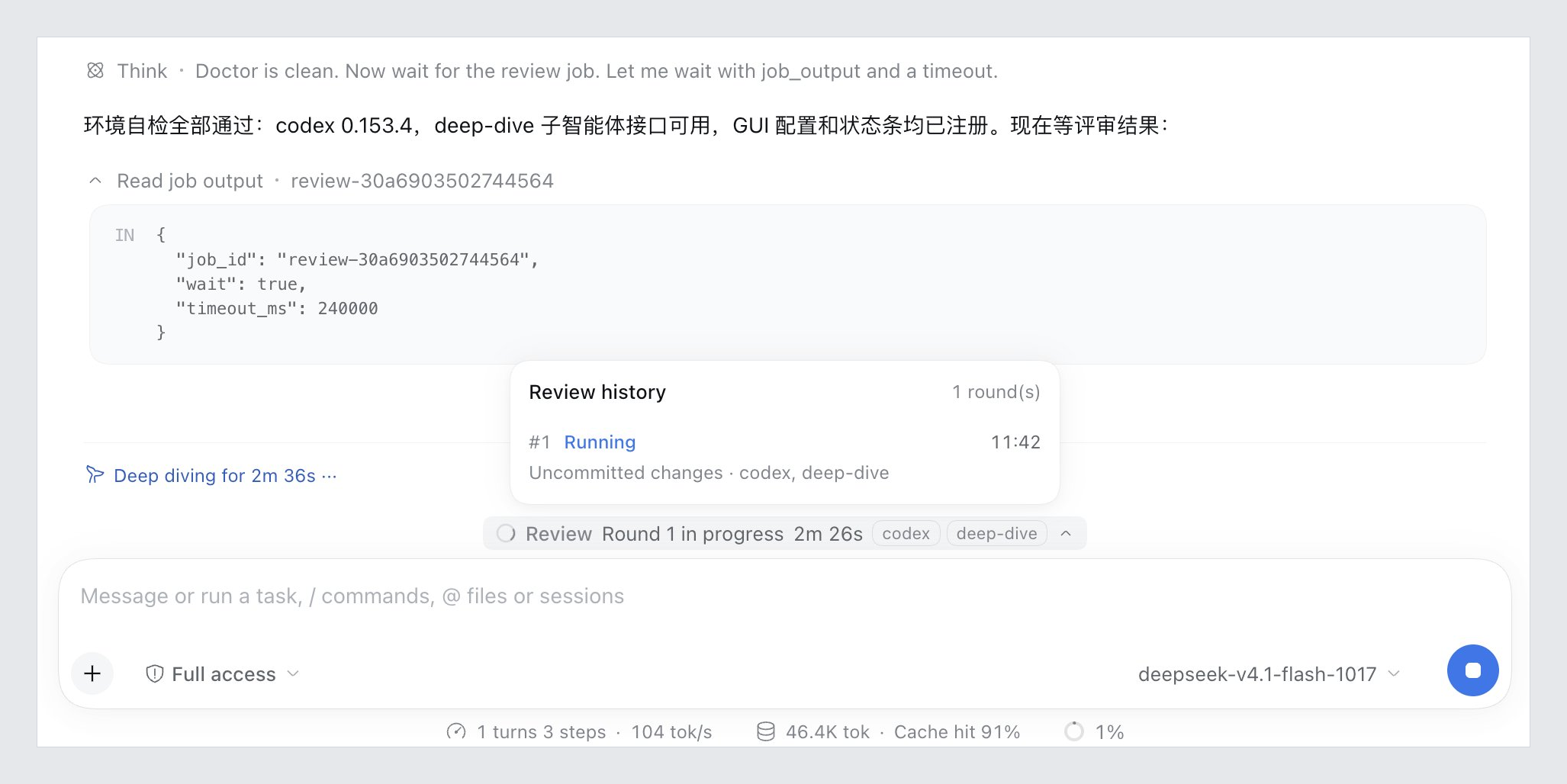
A slim status line sits between the conversation and the composer, no panel required:
| State | What it shows |
|---|---|
| Nothing reviewed | Review · Not reviewed yet |
| Running | Review · Round 2 in progress · 1m 05s + the running reviewers |
| Finished | Review · 3 round(s) reviewed + reviewer chips |
| Last round failed/interrupted | Review · Round 3 failed / Round 3 interrupted |
Click the line for the last 30 finished rounds (plus any still running): round number, time, scope (uncommitted changes / a base branch / a commit), reviewers, and outcome. The round count is not limited by the retained history.
The data is a session projection: each review job writes once on registration and once on
settlement, and the value is checkpointed with the session. Switching sessions, reloading, or
restarting the host keeps the history. A round left running by a previous host process is shown
as interrupted instead of ticking forever.
When it stays hidden:
@deepseek-ai/dsh-workspace-changes plugin:
its workspace/changes event is normally only appended for a turn that actually changed files, so the
status line does not run its own git status. It remains visible while a turn is in progress
or a review is running, so triggering a review does not make it vanish.workspace-changes, only the empty-conversation rule applies; a
missing capability never hides the line. Subagent sessions are exempt from the no-change rule
too, because the upstream plugin deliberately does not record them.workspace-changes, not to a second heuristic here.| Kind | What runs | Reads the code itself | Needs |
|---|---|---|---|
cli |
a coding agent you already trust | depends on the preset (codex reads the repo) | that CLI installed |
subagent |
a DSH child agent | yes, it has tools | a subagent service (default spawn) |
CLI presets: codex, claude, gemini, opencode, cursor, or custom with your own
command template.
Where the CLI lives. The plugin looks, in order, at: executable (a PATH name or a path) →
~/.local/bin, ~/.bun/bin, /opt/homebrew/bin, /usr/local/bin → the current profile's
dependencies (node_modules/.bin/<name>, plus the package's own bin entry when the preset
declares one, e.g. @openai/codex's bin/codex.js).
That last step is the recommended setup: install the CLI as a direct dependency of the profile
(dsh plugin --profile <name> add <package>). Do not keep pinning an absolute path in your
patch — that is the trap we hit locally: a dependency reinstall pruned
node_modules/@openai/codex, the pinned path silently went stale, and the tool description still
advertised the reviewer as usable while every call burned a full run. Absolute paths still work
(highest priority), but their lifetime is tied to the dependency graph.
When the configuration looks wrong, run the self-check instead of a real review:
review({ doctor: true })It checks, per reviewer, whether the executable resolves, which candidate found it, whether
--version runs, whether the subagent provider is registered, and whether the host exposes the
startActivation() interface this plugin uses. It also reports whether the GUI config schema
resolved (@deepseek-ai/schemastery) and where it came from. It reviews nothing, starts no
reviewer, and does not need a git repository. Model connectivity for subagents is out of scope —
that would need a real request.
One thing worth knowing: a subagent inherits the parent session's model unless you set
agentModel, so it is not automatically a second opinion — name the model explicitly if you
want one.
Subagents get a 30-minute wall-clock ceiling by default (timeoutMs per reviewer; hardTimeoutMs
still caps the whole call). Recursion is bounded by the host's delegation-depth budget (default 1),
so a reviewer normally cannot start another subagent. Progress is reported while they run, so a
long review does not look stuck.
DSH 0.2.1 moved persona and tool restrictions out of the subagent start request: configure them in
an Agent Preset and select it with agentPreset. The old persona / toolFilter keys are
ignored with a migration warning instead of silently doing nothing.
There is deliberately no "send the diff to a bare model" kind: a reviewer that can open the repository itself is worth more than one that only sees what it was handed.
codex's native exec review treats the range flags and PROMPT as mutually exclusive, so the
default codex reviewer has to choose one. If you really need to review a committed range with a
focus, add a second reviewer that runs codex exec — it gets the diff packet and the
instructions are delivered in the prompt:
reviewers:
  - id: codex-diff
    kind: cli
    preset: custom
    executable: codex
    label: Codex (diff)
    command: ["{exe}", "exec", "--sandbox", "read-only", "{model}", "{extra}", "{prompt}"]
    promptVia: argv
    needsPacket: true
    promptReplacesRange: false
This is codex exec, not the native exec review; the review behavior is not identical, so use it
only when you need scope + focus. Do not put {promptArg} in command (the plugin would treat
PROMPT and range as mutually exclusive), and do not put {range} there (codex exec does not
understand --base / --commit; the diff packet carries the range).
- id: review
  name: dsh-review
  config:
    agents:
      - preset: codex
        model: gpt-5.6-sol
      - preset: claude
    reviewers:
      - id: deep-dive
        kind: subagent
        provider: spawn             # subagent service, `spawn` by default
        agentProvider: bailian      # any provider from your DSH config
        agentModel: deepseek-v4.1-flash
A subagent's model comes from your DSH configuration (provider, key, context window), and the
GUI combines provider and model into one grouped picker — choosing an entry writes both
agentProvider and agentModel, and nothing is duplicated in this plugin.
provider is the subagent service implementation (default spawn), not the model provider.
The GUI hides it unless it is set to something other than spawn.
Add agentPreset: <preset-id> to run that reviewer under a specific Agent Preset. The preset owns
its persona and tool set; spawn supports an independent preset, while fork inherits the
parent's composition.
A mode bundles how hard to look, what to say, and who to use.
| Field | Meaning |
|---|---|
strength |
light / standard / deep — built-in review framing |
prompt |
extra instructions for this mode |
reviewers |
which reviewers this mode uses |
when |
always / complex / never — a review policy for the agent to follow |
config:
  defaultMode: balanced
  modes:
    balanced:
      strength: standard
      reviewers: [ codex ]
    deep:
      strength: deep
      reviewers: [ codex, deep-dive ]
With no modes configured the plugin adds no constraints at all — you keep steering the agent
with your own prompt. when only takes effect if you also set injectPolicy: true, and it is
stated in the system prompt, not enforced as a gate.
Everything can be set in the GUI; these are the same knobs in YAML. Only the ones worth knowing:
| Key | Default | Meaning |
|---|---|---|
defaultReviewers |
none | reviewers used when a call omits reviewers; empty means none are enabled |
defaultMode |
none | mode applied when a call omits mode |
language |
auto |
zh / en / auto report language (auto follows your instructions) |
injectPolicy |
false |
state each mode's when rule in the system prompt |
agents / reviewers |
[] |
define CLI and subagent reviewers (agents is the preset shorthand, reviewers the full form) |
modes |
{} |
named review modes |
waitMs |
0 |
how long a call blocks before handing back a job id. 0 returns immediately (reviews take minutes, so waiting rarely pays) |
hardTimeoutMs |
0 |
wall-clock ceiling; 0 = no limit — you decide when to stop it |
maxResultChars |
80000 |
report cap; longer reports are truncated with a path to the full file |
maxDiffChars |
160000 |
diff cap for reviewers that receive the diff |
base and commit are mutually exclusive. A range plus instructions works for
subagents but not for the codex CLI (its range flag and PROMPT exclude each other): if every
selected reviewer is such a CLI the call is rejected up front, otherwise the CLI ones are named
in the report footnotes. To keep both the range and the focus, add a subagent reviewer; putting
the focus in a mode's prompt does not help, since a mode prompt is skipped as well whenever a
range is given (next bullet).~/.codex/config.toml).base/commit fails before any reviewer starts, instead of running for minutes and
reporting a batch that reviewed nothing.language only controls the
reviewers' own instructions.$TMPDIR/dsh-review-*/report.md; other runs clean up after
themselves.git show -m --first-parent): that is
what the merge brought onto the current branch, not a combined diff.patchReload: live only
reloads the patch layer), so the description can lag behind disk. Use
review({ doctor: true }) for the current truth. For the same reason, plugin code changes need
a host restart.collectMaxBytes), the
report footnote says the tail may be missing and gives the spill path. When no executable can be
found, every candidate path and its failure reason is listed.node selftest.mjs # drives the plugin with a fake host: no DSH, no codex, no model callsCLASSIFICATION EVIDENCE
系统优先读取 GitHub Topics,再与站内分类词典和词根规则比对。当前命中: agent。
alchaincyf
你想蒸馏的下一个员工,何必是同事。蒸馏任何人的思维方式——心智模型、决策启发式、表达DNA。Distill how anyone thinks.

freestylefly
Prompt as Code | GPT Image 2 / 2.5 提示词与案例库,530+ 个案例、20+ 套工业级模板与可复用 Skills,新增 2.5 同提示词对比专区,附完整提示词与生成记录,持续更新。

titanwings
Distilly — Distill how they think into reusable Skills for any Agent or Bot. Formerly Colleague Skill(原同事 Skill).