
The context quality layer for AI agents.
Your AI remembers. Minta tells you when it remembers wrong — and what it's allowed to claim.
English · 中文 · 日本語





Real user reviews on 观猹 — what the people who run Minta actually say.
⭐ New (2026-08): open-core v2 — memory engine + research compliance engine + expert domain pack, now with DeepSeek Harness integration (verified).
Why Minta
Other memory systems store. Minta verifies what remains true.
Memory has three tenses: it was true, it is true, and it is still true today. Almost every memory system optimizes the first. Minta is built for the second and third.
| What others do |
What Minta does |
| "Here are your relevant memories" |
"2 of these conflict. 1 is stale. Here's the truth." |
| Store everything forever |
Detect what expired, flag it, decide with you |
| Treat all memories equally |
Type-specific decay: preferences last longer than project state |
| Hope the LLM figures it out |
Lifecycle scan + health score + staged gates (no over-claims) |
The same agent, with or without Minta
|
Without Minta |
With Minta |
| A fact expires |
Keeps using the old truth |
Marks it stale, archives it, shows you |
| Two memories conflict |
Returns both, glues them together |
Surfaces the contradiction; you decide |
| You correct the agent |
Forgets by next session |
Inbox → your confirm → becomes a rule |
| Context grows |
10,000 memories in one prompt |
Token-budgeted context pack |
Contents · Why Minta · Quick Start · Features · Open-Core · Benchmarks · DeepSeek Harness · Roadmap
Product UI
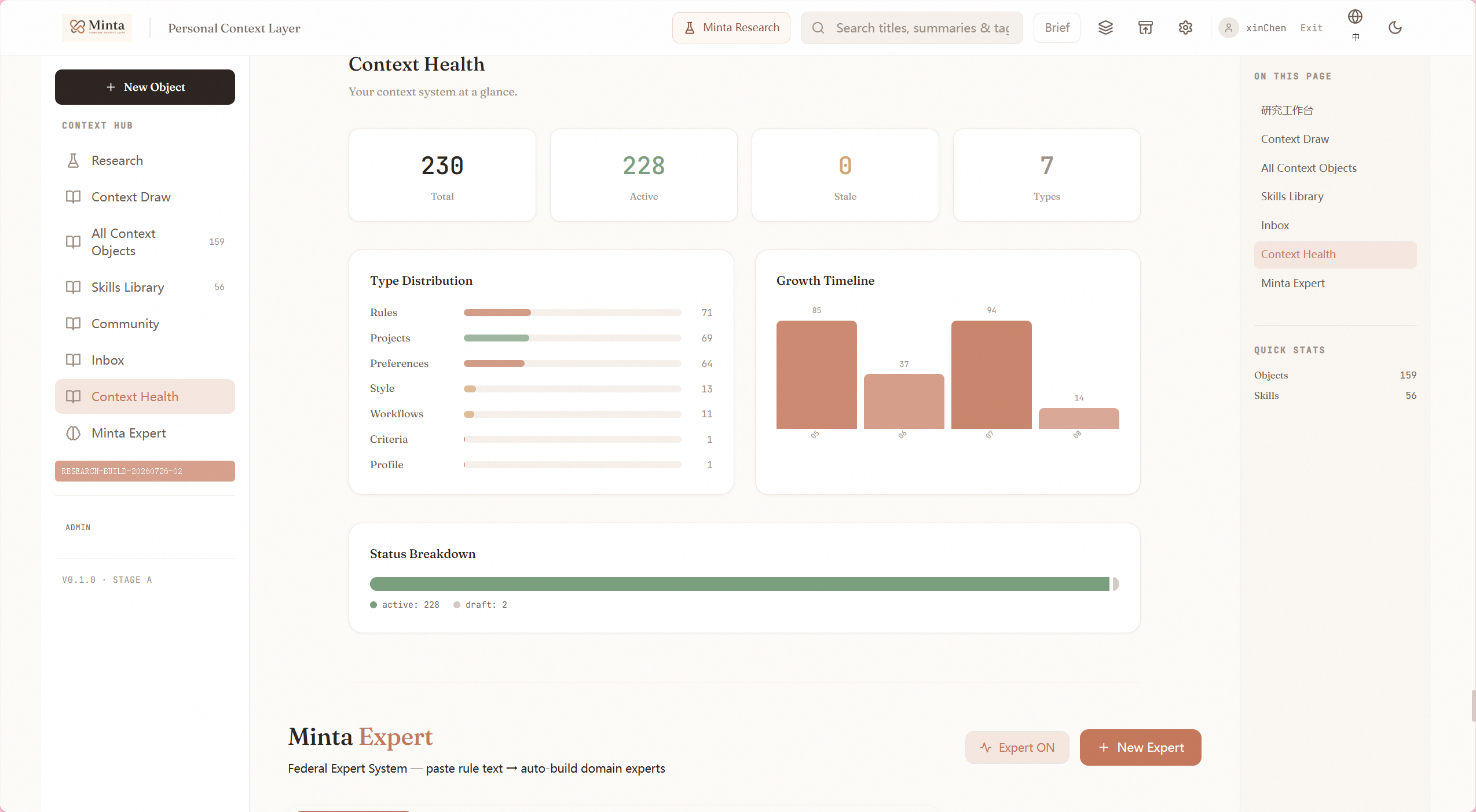
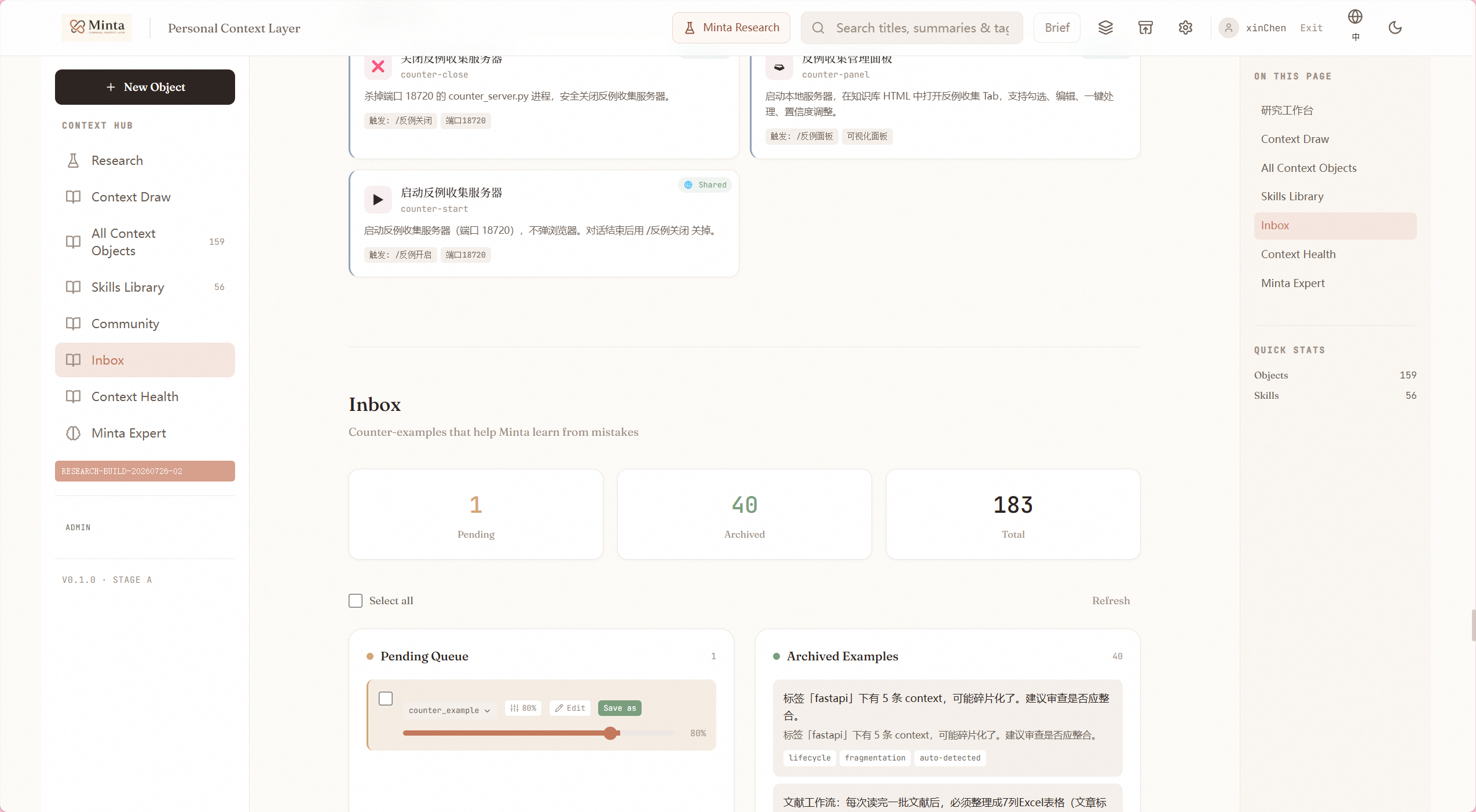
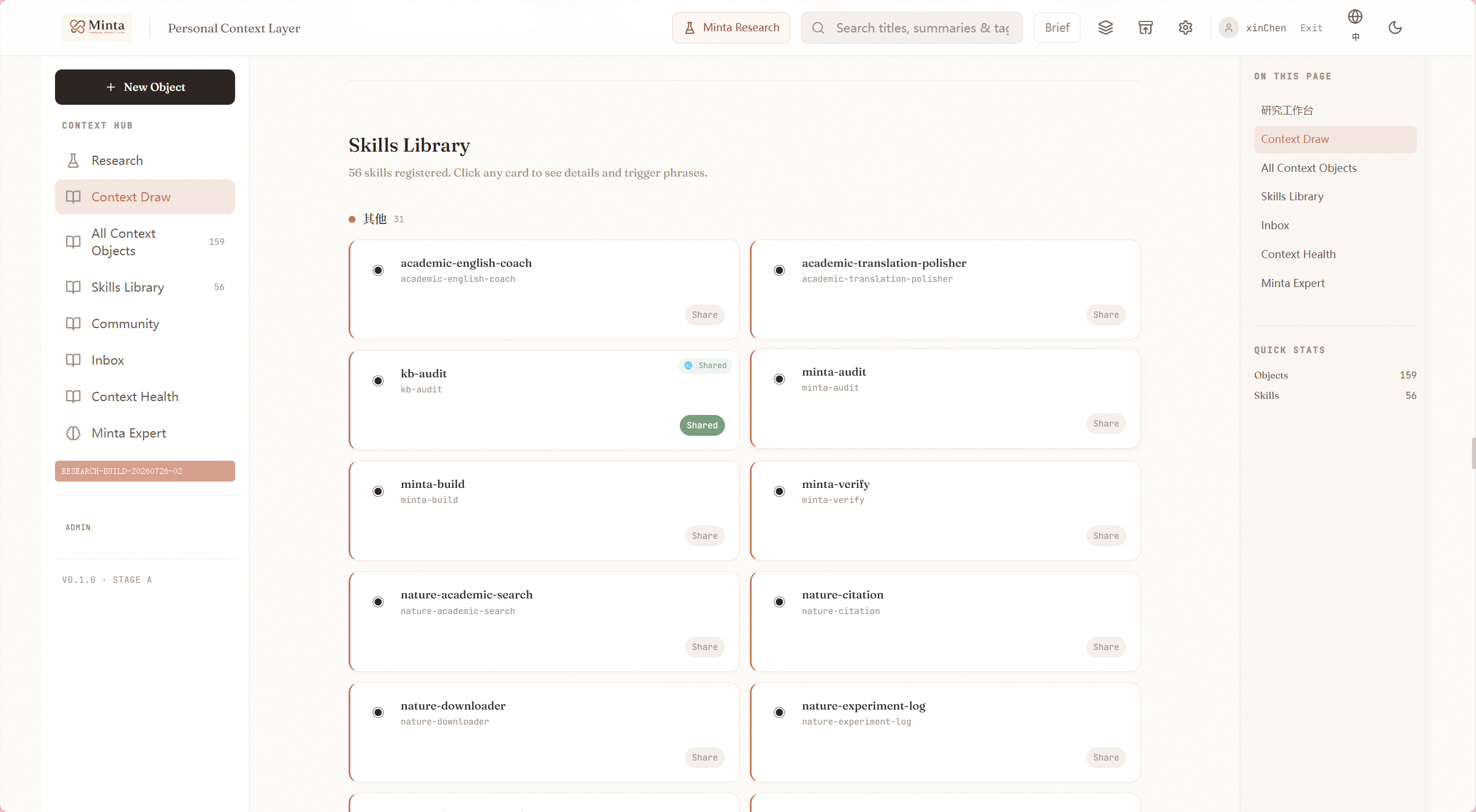
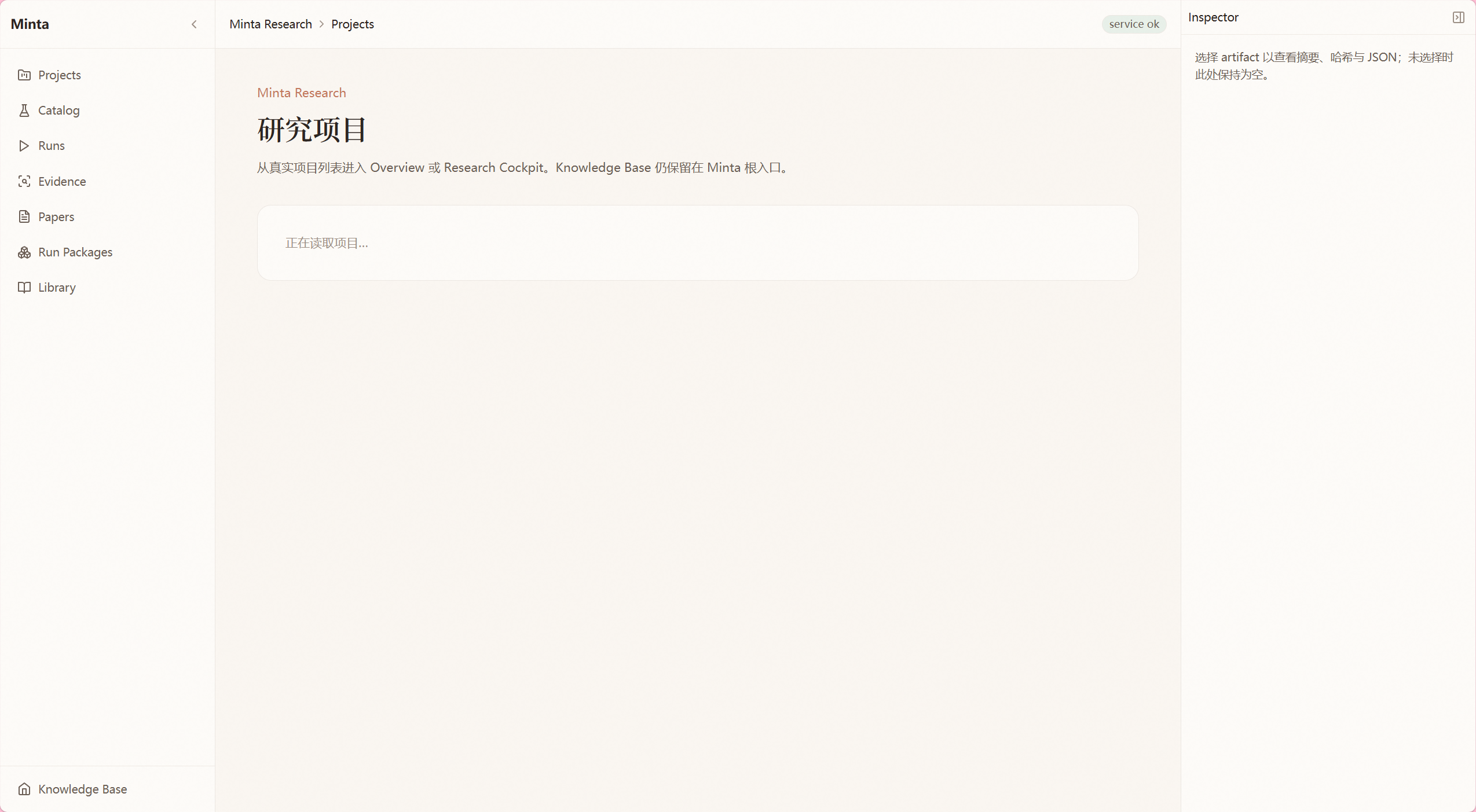
The full Minta workspace (Personal Context Layer, V8.3 engine UI). The layers you see — research cockpit, expert infer, memory health — map to the engine tiers below; the open-core dist ships the memory hub UI, and the rest activate through the same API.
|
|
|
 |
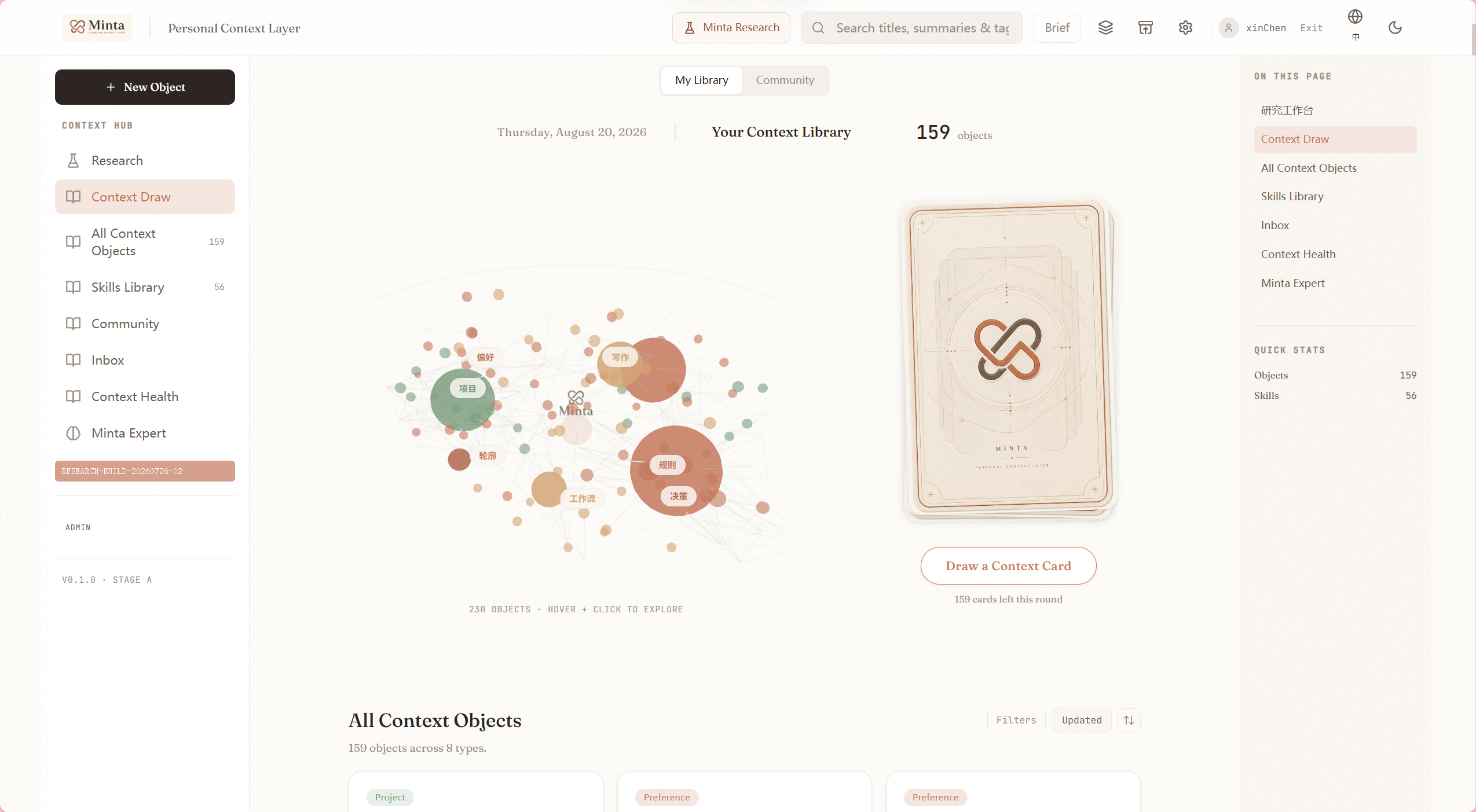 |
| Context Hub — "Stop re-onboarding your AI" |
Context Draw — 3D knowledge graph + card recall |
 |
 |
| Context Health — lifecycle dashboard (decay/conflict at a glance) |
Inbox — confirm/discard corrections, counter-example review |
 |
 |
| Skills Library — 50 registered workflows |
Research Workspace — projects, evidence, run packages |
Three layers, one engine:
L1 Memory governance   →  stale / conflict / redundant / fragile, found not stored
L2 Expert knowledge    →  rules promoted from your corrections, domain-typed
L3 Claim gates         →  the agent cannot claim a stage it never did (math-model
                          / research workflows) — with calibrated confidence
Quick Start
60 seconds. Local-first, no cloud, no API subscription for the open core.
git clone https://github.com/xinchen03/minta.git
cd minta
python -m pip install -r server/requirements.txt
python minta_cli.py start          # API :8772 · Autopilot :18730 · MCP :18721
Or Docker: docker compose up -d. Then connect your agent:
docker compose 固定构建 Dockerfile.web(业务服务:8772/18721);仓库根 Dockerfile 默认目标为 AMC 评测容器(见 README_AMC.md),两者互不影响。
# any MCP-capable editor/agent — Claude Code / Codex / Cursor / dsh
python minta_cli.py connect claude
# DeepSeek Harness: dsh plugin --profile web add @xxinchen/dsh-plugin  (or connect via MCP → docs/dsh-integration.md)
The web UI opens at http://127.0.0.1:8772 — memory health dashboard, 3D knowledge graph, inbox review, expert panels.
On first memory write/search, sentence-transformers loads the default embedding model (all-MiniLM-L6-v2, auto-downloaded). Point MINTA_EMBEDDING_MODEL at a local model path, or switch MINTA_EMBEDDING_BACKEND to an API backend.
💡 China-Mainland speedup: use a pip mirror (-i https://pypi.tuna.tsinghua.edu.cn/simple) and HF_ENDPOINT=https://hf-mirror.com for model downloads (or point MINTA_EMBEDDING_MODEL at a local model). With Docker, docker compose up -d ships all baked dependencies — no per-package downloads.
Configuration & Keys (first run)
cp .env.example .env    # then edit secrets
python -c "import secrets; print('MINTA_API_KEY=minta_'+secrets.token_hex(32))"  # generate a secure key
Register the key: the minta_ prefix alone is not enough — the API accepts a key only if it exists in the keys table. While the engine runs, create the record in the Web UI (Settings → API keys) or call POST /api/keys with a user token. Write-path tools (inbox, write_context) require a registered key; read tools do not.
| Variable |
Default |
What it does |
MINTA_DATABASE_URL |
sqlite:///./minta.db |
Zero-config SQLite; switch to MySQL in one line |
MINTA_JWT_SECRET |
(must set) |
Session signing secret — generate, don't copy |
MINTA_API_KEY |
auto-generated on first run |
Programmatic access + MCP (connect your editor → python minta_cli.py connect claude) |
Full variable reference, SMTP, CORS, feature flags → docs/configuration.md.
Agent integration per editor → docs/mcp-integration.md.
Features
| Layer |
Feature |
What you get |
| Memory |
Semantic search — POST /api/search (local-vector, per-user isolated, compact → full → pack disclosure) |
Auto-indexed on every write; finds your memory, not somebody else’s |
| Memory |
Lifecycle engine (decay/conflict/redundancy/fragmentation) |
Quality checks run on schedule, not on faith |
| Correction loop |
Inbox + counter-example capture (hooks: SessionStart → UserPromptSubmit → PostToolUse → Stop) |
What you correct becomes a rule — after your confirm |
| Expert domains |
Multi-domain rules (ankle/knee/c-spine injury, ISO9001, PRISMA…) + CUMCM staged workflow |
Domain-typed reasoning with trust metrics |
| Research |
Manuscript inventory + compliance rule evaluator |
"Does this draft meet the venue checklist?" — before submission |
| Metacognition |
Conformal confidence (calibrated, data-locked) |
The agent says what it knows with a coverage guarantee |
| Delivery |
Dist web UI + MCP (13 core tools; expert/dialogue layer enterprise-side) + DSH plugin verified |
Three entry points, one memory |
Open-Core: Open Code, Locked Assets
| In this repo (Apache-2.0, free) |
Via API key / Enterprise license |
| Memory engine — full, runnable |
Managed engine + monitoring |
| Quality-kernel algorithms (conformal, rule promotion, DGM, compiler) |
Full precision: auto-calibration, private domains |
| Research compliance engine + domain pack (CUMCM stages) |
Sports-medicine / clinical packs |
| Web dist · MCP · DSH integration · 12 guides |
Data flywheel: calibration sets, weights, rule bases |
The hosted tiers above are roadmap features — the open core is always a complete, runnable memory system.
Tool surface note: the open-edition MCP server exposes 13 working Community
tools. Expert/dialogue tools are registered only by deployments that include
their corresponding backends, so Community users never see dead tools.
Benchmarks
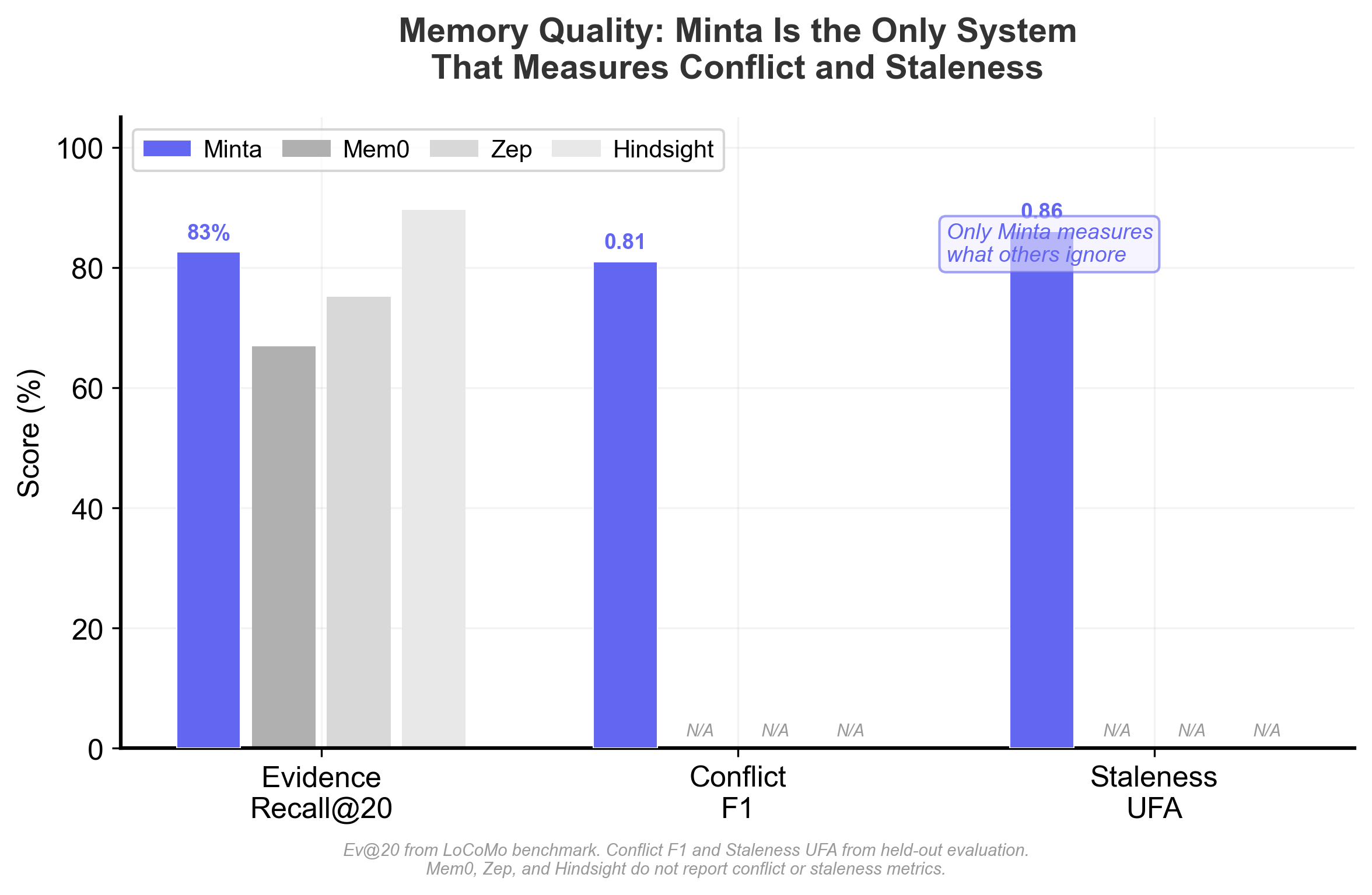
| Detection |
Metric |
Score |
Mem0 |
Hindsight |
| Conflict |
F₁ |
0.81 (held-out, 5 unseen domains) |
N/A |
N/A |
| Staleness |
UFA |
0.86 (12 fact-pair templates) |
N/A |
N/A |
| Redundancy |
Compression RR |
0.67 (25 clusters) |
N/A |
N/A |
| Fragmentation |
MCR |
0.746 (15 fragment sets) |
N/A |
N/A |
| Retrieval (LoCoMo) |
Recall@20 |
97.1% |
— |
— |
Research first
Minta started as the memory layer of a research workflow — literature notes, manuscript checklists, journal compliance, verdict-gated claim tracking. See runtime/compliance/ and docs/interaction-guide.md. Manuscripts describing the framework (memory quality; data governance) are in preparation.
Companion execution skills (Apache-2.0, separate repo): nature-skills — reading, figures, citations, polishing.
DeepSeek Harness
Verified integration (2026-08): dsh plugin --profile web add @xxinchen/dsh-plugin wires Minta into DSH in 2 minutes — the plugin composes the official dsh-mcp-client row for the locally-run engine (which provides 13 working Community tools). A manual cordis.patch.yml insert is also supported; see docs/dsh-integration.md. The plugin also ships the minta agent preset (per-turn memory protocol): copy dsh-plugin/presets/minta into ~/.dsh/.agent-presets/ and pick it in the session picker.
Building & contributing
python -m pytest server/tests/          # server test suite
python scripts/check_public_boundary.py # verify the public-source boundary
We welcome good-first-issue PRs: entity_linker English patterns, richer demo scenarios. More in CONTRIBUTING.md.
Guides
Interaction Guide · Startup Order · DSH Integration · Configuration · User Guide · MCP Integration
Data & Privacy
- Local-first: database, vectors and logs stay on your machine. Anonymous telemetry is off by default; explicit opt-in sends only install id, version, OS and event name—never memory content.
- Data export / delete:
GET /api/user/export-data · DELETE /api/user/delete-data (authenticated).
- Secrets: generated on first run into
.minta_api_key (never committed); privileged APIs are off by default unless explicitly configured.
- See
SECURITY.md for disclosure policy.
Vision: Where This Is Going
Memory is the easy part; truth is the product. The agent era already has plenty of
"remember more" systems. The bottleneck is the opposite — AIs confidently serve stale,
contradicted, or unearned claims. Minta's answer is a context quality layer:
the memory knows its own health (stale / conflict / redundant / fragile), the expert
layer knows its own limits (calibrated coverage), and the claim gates know what was
actually done. The long thesis:
- Personal: every AI assistant, every session starts from a context hub that
already understands you — stop re-onboarding your AI.
- Team / enterprise: memory, expertise, and compliance checks shared across a
research group or a clinical unit — with audit trails and governance reports.
- Vertical: sports-medicine, clinical-triage, and manufacturing expert packs
layered on the same engine, tuned by their users' corrections (data flywheel).
Roadmap
- 2026 Q4 — hosted API (full precision, monitoring), sports-medicine domain pack, npm plugin v1 release
- 2027 Q1 — enterprise private deployment + governance audit reports; SME (structure-mapping) engine public
- 2027 — multi-agent shared memory workspaces (team context layers)
Community & Contact
- 🐛 GitHub Issues — bugs, feature requests (we respond fast)
- 💬 GitHub Discussions — questions, RFCs, show-your-work
- 📧 Contact: xxinchen03@gmail.com (direct; research collaboration, consulting)
are the publishable signs of this repo's claims; HackerNews/DSH plugin discussions
welcome at every release.
Star Us
🔭 If Minta saved you an hour, give it a ★. One click, three seconds —
and it tells the next contributor, integrator, and journal reviewer that this
experiment deserves their attention.
References & Lineage
Where the ideas come from (and how Minta differs):
| Work |
What Minta took |
What Minta differs in |
| Mem0 / MemOS |
Memory store + hybrid retrieval |
They store; Minta verifies quality (decay, conflict, redundancy, fragmentation) |
| Vovk (2005), conformal prediction |
Distribution-free coverage guarantee |
Used as the metacognitive gate, not just an estimator |
| JEPA (LeCun) |
Predict in latent space, not raw space |
Domain rules > JEPA — predictions only fire when history exists |
| Ebbinghaus-inspired decay (MemoryBank et al.) |
Time-aware forgetting |
Type-specific half-lives: preferences > project state |
| Paperclip doc-maintenance |
Audit-driven maintenance |
Same discipline, now for AI memory, not files |
License
Apache-2.0. Upstream bundled resources retain their own licenses — see skills/ notes if added later.


