
模型与 MCP
待识别

rea
morluto
Reverse engineer anything with agents, from app behavior down to native binaries.
PROJECT TOPICS
INSTALL REFERENCE
dsh plugin --profile web add github:wk544863858/dsh-plugin-magic-context
该命令指向仓库当前默认分支;尚无绑定当前 commit 的完整验证结果。
PROJECT README


English | 简体中文
Anyone who has run long sessions knows the symptoms: the project details you worked out yesterday are gone today, so the same pit gets re-dug; tool outputs bloat the context window; and every compaction busts the cache prefix, so the expensive part re-runs.
Magic Context's answer: knowledge should persist, context should be managed. This plugin gives DeepSeek Harness (DSH) sessions a persistent, project-aware memory — knowledge distilled from your sessions survives restarts, is searchable with hybrid full-text + local vector search, and is re-injected right where the model reads it — while the context window itself is run as an asset: tool results become tagged, reclaimable history, digests come back as four-level summaries, and none of it ever breaks the live KV-cache prefix.
ctx_memory reads/writes/maintains it, and project
identity is auto-derived (git root or directory)./ctx-global approve); a user-profile layer
rides on top with read / collect / review as separate switches.ctx_reduce only queues; drops land as
[dropped §N§] placeholders and ctx_expand restores the original; history digests into
p1–p4 summaries published as range replacements — never a spontaneous prefix bust.compaction-basic engine stays in place unless
you explicitly opt in.Requires Node ≥ 22.19 and a DSH 0.2.x desktop host. The package ships compiled — install straight from the npm registry:
dsh plugin --profile desktop add dsh-plugin-magic-contextNew to the plugin? A five-minute tour follows in Quick start; configuration, tools and architecture are covered in full below. A complete Chinese translation is at README.zh-CN.md. Contributions are welcome — see CONTRIBUTING.md and SECURITY.md.
After installing, the plugin hot-loads (no restart). In your next session:
§N§ tags; a telemetry badge appears in the overlay showing live
context occupancy, with a panel of live metrics and an operation record behind it.ctx_reduce / ctx_expand / ctx_memory tools are registered for the agent;
project memory is on by default — facts distilled by the historian persist across
sessions and surface where the model reads them.Context reclaim, in one exchange (real parameter names):
you:   ctx_reduce {"drop": "4-7"}      # four tool outputs are no longer worth the tokens
agent: queued 4 item(s) — the drops land as placeholders in the next reclaim band
…later in the transcript…
[dropped §4§] [dropped §5§] [dropped §6§] [dropped §7§]
you:   ctx_expand {"tags": "5"}        # wait — what was in §5 again?
agent: the original text of §5 is restored in place
The only opt-in surface is the compaction takeover (registerCompactionEngine, off by
default — see Configuration).
Memory first, context management second — the first five rows are the memory system, the last five manage the context window (full design in Architecture and PARITY.md):
| Capability | Mechanism |
|---|---|
| Project memory (own corpus) | Plugin's own SQLite store (memories.db), hard-split from upstream — no shared storage, no compatibility duty. Project identity auto-derived (git:<root-sha> / dir:<hash>); injected into the m[0] baseline and served to ctx_memory for read/write; historian facts auto-promote; FTS 0.7 / vector 0.3 hybrid retrieval |
| Local vector lane | MiniLM embeddings run locally via the bundled onnxruntime-web WASM backend — no native build, no API keys; the model download is pinned by revision + sha256 (mirror fallback), cached in the plugin data dir; retrieval candidates get inline + maintenance-tick backfill; any failure fails open to full-text search |
| m[0]/m[1] memory baseline | A synthetic notice node carries the frozen baseline plus incremental lanes (<new-memories> / <memory-updates> / <user-profile>); each lane keeps its own watermark, so new memory never rebuilds the cached prefix — unchanged content produces zero diff |
| Global domains + user profile | machine/org domains: staging can be automated (maintenance tick, LLM classification), publishing is always human (approval cards, /ctx-global approve); the user profile's render / collect / review are separate switches |
| Maintenance tick (MC dreamer slice) | Every 30 min: TTL archiving → batched LLM verify (keep / update / archive) → vector backfill → global-domain candidate staging |
| Reversible context reclaim | Tool results get §N§ tags; ctx_reduce only queues — drops land in the execute band as [dropped §N§] placeholders referencing the originals; ctx_expand restores the original text. The cached prefix is never busted spontaneously |
| Pressure scheduling | Persistent usage (incl. cache reads/writes) → pressure score → execute/defer decisions (65% threshold, 5 min cache TTL, 85% force band); CONTEXT_WINDOW_EXCEEDED triggers emergency reclaim + retry; tiered reduce-guidance nudges |
| Historian (out-of-band digest) | One LLM call replays the real prefix (KV cache preserved) → four-tier p1–p4 summary + facts/events, writes the store only, never touches the wire; published in the execute band as a [compacted §C<n>§] range replacement; /ctx-recomp redoes compacted history in place |
| Compaction seam | registerCompactionEngine can take over ctx.compaction (real compaction/start\|summary\|replace\|end protocol); off by default — the host compaction-basic stays in place |
| UI integration | Settings card on the Plugins page (volatile fields, save = live); shell.overlay telemetry badge + capsule panel (live metrics + operation record); session-notice rows in the session stream; Chinese/English instant switching |
From the npm registry — recommended; the package ships compiled lib/ and vendor/, no
local build needed:
dsh plugin --profile desktop add dsh-plugin-magic-contextRegistry versions are published automatically by tag pushes (with npm provenance signatures); see the "Releasing" section of CONTRIBUTING.
git clone https://github.com/wk544863858/dsh-plugin-magic-context
cd dsh-plugin-magic-context
npm install
npm run build     # tsc → lib/ (multi-file ESM) + browser half copied to lib/client.js
dsh plugin --profile desktop add <path to this repo>   # the CLI ships with the app; the spec can be a Git URL, a local path, or a registry version
Installing does three things: pnpm add into the profile (link: for local paths),
appends the package name to dsh.profile.bundles, and the loader composes it. Desktop
has HMR → takes effect immediately (no restart; running sessions start tagging right
away).
@deepseek-ai/* in peerDependencies are declared "*" — the compatibility
precheck passes on any DSH 0.2.x; the host packages actually imported at runtime are
also listed as exact-version dependencies (resolved with the package; link: dev
installs are served by this repo's own node_modules).node:sqlite, no native
modules (the desktop host is an Electron RunAsNode process; ABI-compiled modules are not
portable).config.defineTool (host-injected, used by in-tree
glue) first, then dynamic import('@deepseek-ai/dsh-tools') (a hard dependency,
physically resolvable in every install shape). If both are unavailable the mount fails
loudly — the ctx_* tools are the only entry point for reclaim tags; no silent
half-boot.config.defineTool injection) and profile install (production: package-name line +
link dependency). The production path is the dsh plugin add above.Uninstall / disable: disable the bundle on the GUI Plugins page (writes disabled into
the profile patch), or dsh plugin --profile desktop remove dsh-plugin-magic-context.
Two ways to change configuration, with different semantics (see the config UI contract):
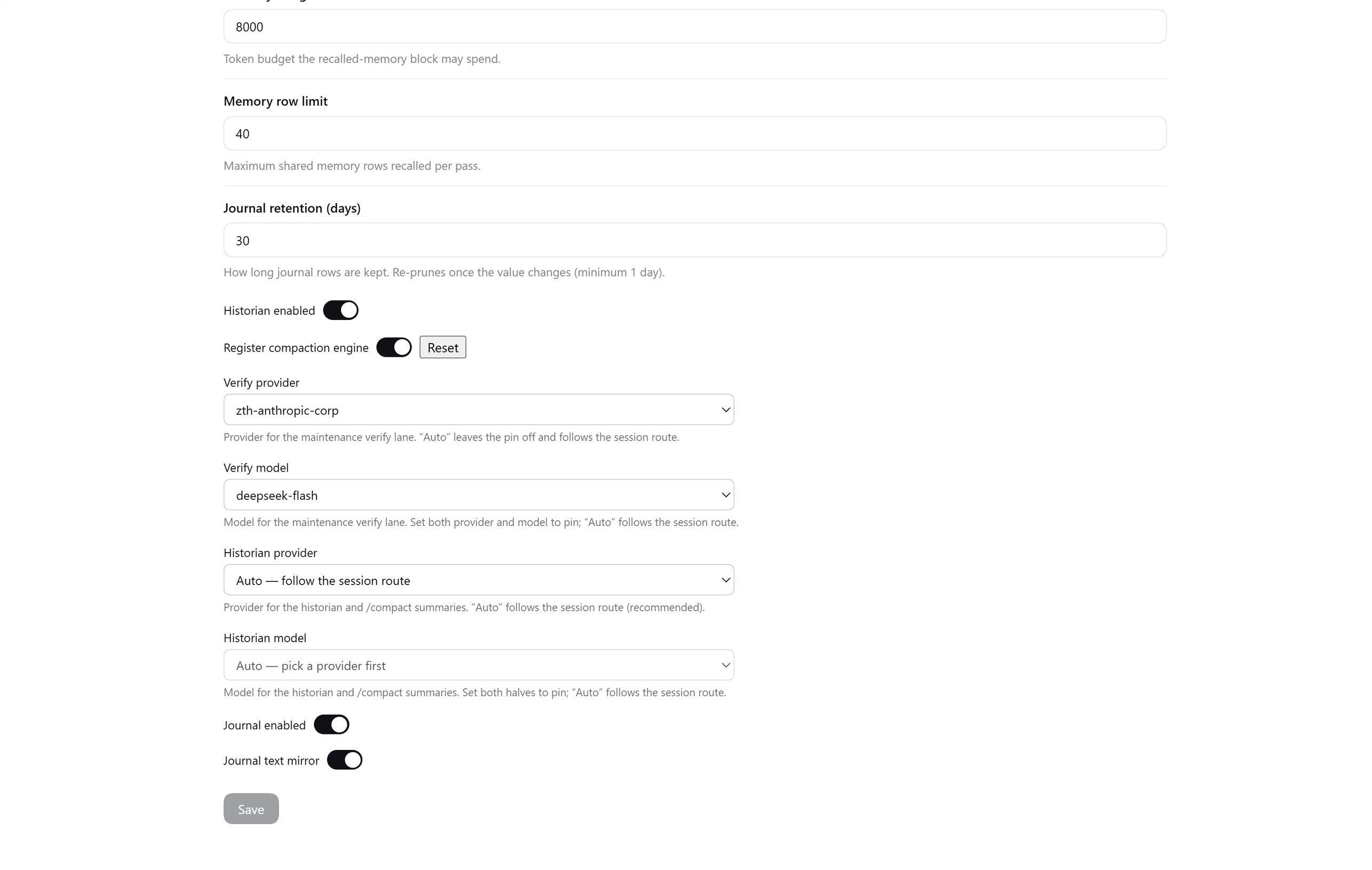
policy.* (incl. historian generation cap / ceiling /
timeout), historianEnabled, registerCompactionEngine, journal.*, maintenance.*,
historian.* and other volatile fields. The two provider/model route pins
(maintenance verify, historian generation) prefer a dropdown fed by the host's
configured model catalog (client remote.session.modelCatalog()), with
"Auto = follow the session route" and clearing; shells without that RPC fall back to
plain text (values remain hand-editable). Writes go through the settings chain:
non-volatile keys are preserved untouched, untouched fields never materialize into
override rows — saving takes effect immediately (the host side always reads through
liveNumber/liveBoolean/liveString/liveRoute at the decision point).config replaces the package patch's config
wholesale — it is not a deep merge. Writing only memory: erases
registerCompactionEngine: false. When hand-writing overrides you must spell out every
key you want to keep.The bundle's built-in config is one line: registerCompactionEngine: false — a
conservative first install that keeps the host compaction engine in place (memory, reclaim
and historian are on by default). To take over compaction:
- id: magic-context-dsh
  name: 'dsh-plugin-magic-context'
  config:
    registerCompactionEngine: true
- id: compaction-basic
  name: '@deepseek-ai/dsh-compaction-basic'
  disabled: true          # mutually exclusive; taking over requires disabling the host engine too
Configuration reference (full types in src/dsh/config.ts; all keys writable as profile override rows unless noted):
| Group | Keys (defaults) | Notes |
|---|---|---|
| Master switches | enabled (true) · registerTools (true) · registerStatusCommand (true) · sessionNotices (true) · reduceGuidance (true) · searchHint (true) |
enabled: false stays loaded but fully inert; sessionNotices controls the management notice rows in the session stream |
| Compaction seam | registerCompactionEngine (code default: mount when resolvable; ships false in the bundle) · compactionBase (host-injected base class) |
Taking over requires disabling compaction-basic too; pre-step reconcileEngine mounts/unmounts dynamically every step |
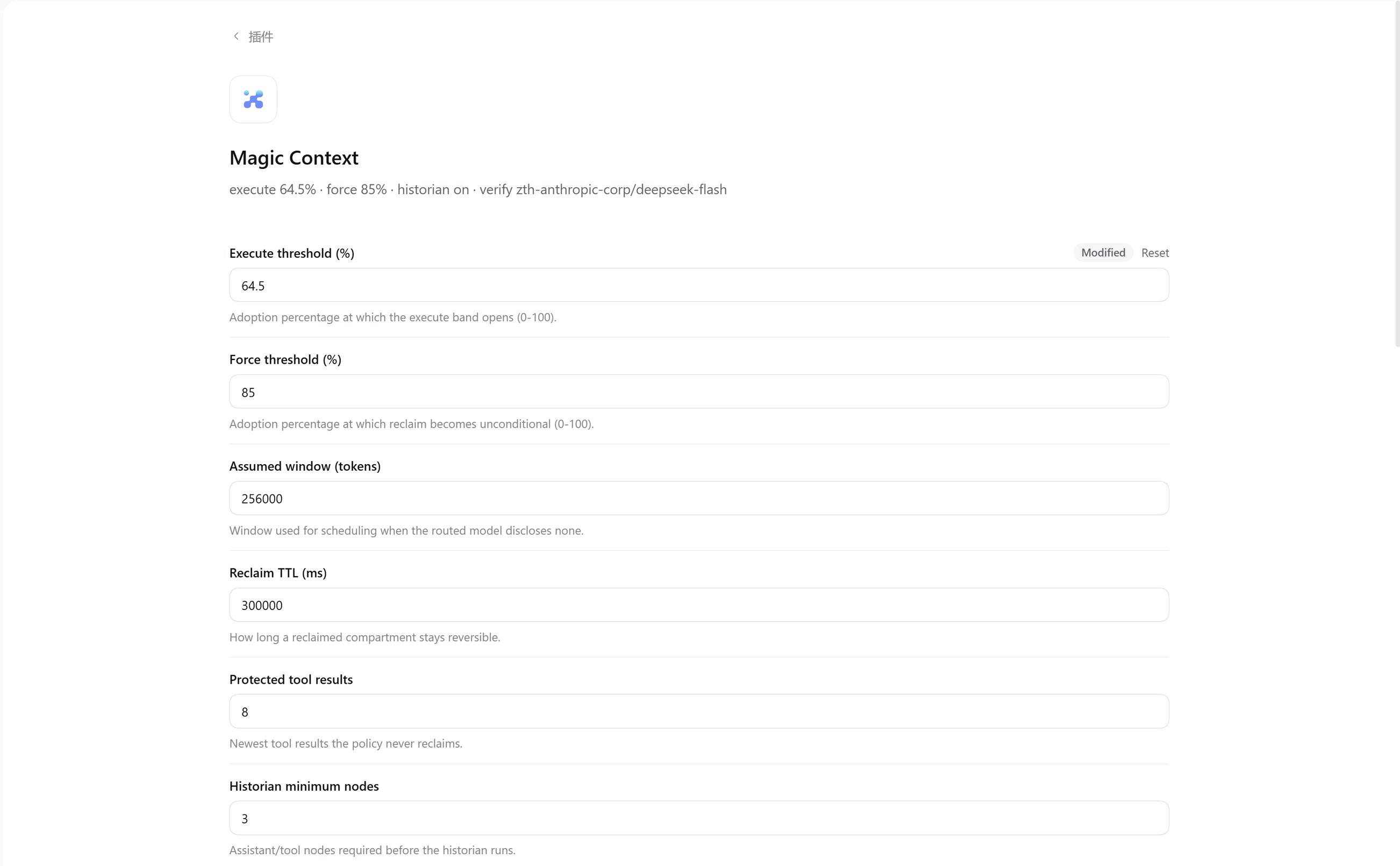
| Pressure policy | policy.*: executeThreshold (65) · forceThreshold (85) · ttlMs (5 min) · assumedContextWindow (256k) · protectedToolResults (8) · historianTimeoutMs (120 s) · historianMaxTokens (8192, raised to 8192 if set lower) · historianMaxTokensCeiling (32768) · baselineTokens (2000) · memoryBudgetTokens (8000) · memoryLimit (40) · forceWaitReadyMs (0) |
Thresholds take effect at the next decision point (incl. /ctx-status and the compaction-engine paths). compartmentGuardMode / compartmentEntrantTokens (publish guards) were retired and are no longer configurable |
| historian | historianEnabled (true) · historian.{provider, model} (pinned as a pair; empty = follow the session's last route) |
Generation route for out-of-band digests and /compact summaries; the GUI card has "Historian provider/model" dropdowns (Auto = follow session, recommended). The only LLM spend besides verify |
| Project memory | memory.{}: enabled (true, on by default since 0.9.0 — opt out with enabled: false) · dbPath · project (omitted = session cwd) · domainProjects · shareCategories · autoPromote (true) · write (true) |
write: false makes ctx_memory read-only |
| Retrieval / vectors | memory.embedBackfill (true, query-side inline backfill) · memory.vectorBackfill (true, maintenance-tick backfill) · memory.vectorBackfillLimit (24 rows/tick) |
Any vector-lane failure fails open to FTS |
| S(t) decay | memory.scoring.{enabled (true), alpha (0.4), beta (0.2), archiveThreshold (2), halfLives} |
Stats are always collected; the distribution default enabled=true takes over ranking; profile-JSON only, not on the settings card |
| Global domains | memory.global.machine.{enabled (true), excludeProjects, autoStage (true)} · memory.global.user.{render (true), collect (true), review (true)} · memory.global.review.batchLimit (50) |
Defaults all on: staging can be automated (≤3/pass, paused at ≥10 pending candidates), publishing is always human; LLM classification failure is fail-closed |
| User profile | memory.global.user.{render (true), collect (false), review (false)} |
Read / collect / review are independent halves; the two halves that write to the shared store are off by default |
| Domain resolution | memory.domains.source (adapter | contract) |
contract is a fallback pole for comparison, not a supported end state |
| Maintenance | maintenance.{enabled, intervalMs (30 min), verifyProvider, verifyModel} |
LLM verify needs an explicit route (unpinned = follow the conversation's latest route); the GUI card offers host-catalog dropdowns, Auto = unpinned (same picker for both pins) |
| Observability | journal.{enabled (true), level (info), retentionDays (30), mirror (true)} · tags.retentionDays (30) |
level/mirror apply to the next write; a journal that was off at mount needs a restart to turn on at runtime; retentionDays has a min(1) floor against accidental pruning |
Agent tools (registered at mount; registerTools: false turns them off):
| Tool | What it does |
|---|---|
ctx_reduce |
Parses MC range syntax ("3-5,8") → queues only; landing is a priced bust that waits for the reclaim band, never spontaneous |
ctx_expand |
Restores the original text from the source event referenced by a placeholder (what gets restored is the tagged original) |
ctx_memory |
The shared memory store's read/write port. Reads: list / search / get; writes: write / update / archive / merge (with MC's normalized content hashing, mutation log and authority guards in the loop throughout); review_global (surfaces machine/org domain candidates one by one as approval cards; publishes only on approval); promote (stages a single project memory instantly — a manual lane with no recurrence gate). Every action accepts project (absolute path or git root) to operate on another project |
Slash commands (registerStatusCommand: false disables only ctx-status):
| Command | What it does |
|---|---|
/ctx-status |
pressure / decisions / reclaim ledger / compartments / baseline / policy |
/ctx-recomp all | last:<n> | <startSeq>-<endSeq> |
re-runs the historian and replaces the stored digest in place (ranges snap to compartments, never split; identity and landed placeholders unchanged, the next pre-step rebuilds the baseline) |
/ctx-profile confirm | reject | retire |
confirm / reject / retire user-profile candidates; promotion into the shared profile happens at the next maintenance tick |
/ctx-global add | remove | status | promote | approve | reject |
the manual lane for global-domain membership and candidate approval (same gate→publish path as the approval cards, source_type=user) |
Both UI capabilities ride the same browser half (src/client/index.js, copied verbatim to
lib/client.js at build time):
Settings card on the Plugins page: visual editing of the volatile config above; saving takes effect immediately (see "Configuration").
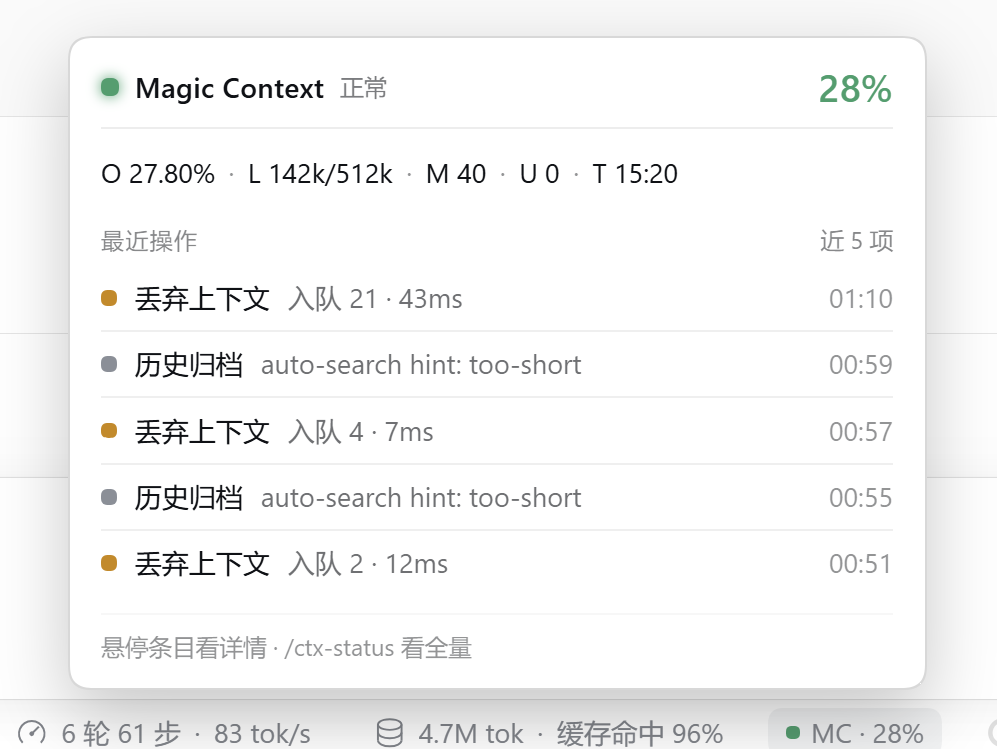
shell.overlay telemetry badge + capsule panel: collapsed state shows the occupancy
percentage; the panel holds two metric rows, the beat, and a live operation record
(up to 12 entries, adjacent identical operations folded as ×N): 🧠 memory write ·
🔎 memory load · 🗑️ reclaim queued · 🧭 original restored · ✂️ context compacted ·
🗑️ context dropped · 🧭 archived-stored · 🧰 maintenance sweep · ⚠️ failure. Clicking
outside the panel/badge, Esc, or window blur closes it.
Data comes from the plugin's own HTTP routes (the harness's Remote event whitelist is a
compile-time constant; the supported seam for third-party bundles is
ctx.webServer.register):
GET /mc-telemetry/summary — one-shot snapshot (adapter / project / health + recent
events)GET /mc-telemetry/events — SSE live tailSecurity: the routes are loopback-only with no token auth, so they emit counts and one-line summaries only — no message bodies, no file paths, no credentials.
Languages: browser-side magic-context namespace dictionaries (zh/en); Settings →
General switches instantly without a refresh; the session-notice rows written into the
session stream (model-visible) stay English constants (to avoid cached-prefix churn from
mid-session language switches). Mechanics in the
UI telemetry contract.
Desktop does not persist ctx.logger output, so the plugin writes its decisions and
outcomes into its own append-only journal:
~/.local/share/cortexkit/magic-context-dsh-poc/dsh-magic-context.db → journal table
(structured, SQL-queryable)~/.local/share/cortexkit/magic-context-dsh-poc/activity.log → single-line text mirror
(tail/grep friendly, auto-rotates to .1 past 5 MiB)Privacy: message bodies are never logged. Only counts, tag numbers, token
estimates, reasons and durations; strings truncate at 300 chars, arrays cap at 20 items
(redactData as the backstop).
Journal coverage (by group): lifecycle (boot / config-drift / session-first-seen);
reclaim & compaction (pass — every execute recorded, with tokensBefore→After
net-reclaim proof and defer reasons, drop-landed, compartment-published/-recomp/
-guard, force-path, emergency-reclaim, context-pressure); historian & baseline
(historian — start/done/failed pairs with LLM usage, baseline, session-notice,
wire-repair); memory (memory-recall / profile-recall / memory-promote /
memory-stats / vector-lane / search-hint / project-drift / global-review);
maintenance (maintenance); tools & engine (tool-call / engine / error — every
exception swallowed fail-open).
npm test               # vitest run
npm run gate           # full gate: typecheck + suite + build + acceptance + memory audit + records
npm run doctor         # read-only health report: corpus fence / event-lane heartbeat / dangling runs / embedding lane

node scripts/mc-report.mjs --days 7 [--json] [--session <id>]   # journal retrospective report
node scripts/mc-acceptance.mjs [--hours 72 --json]              # corpus acceptance, exit 1 on failure
npm run phase          # phase gate: run one phase's suite with verdict and blind spots
The retrospective report includes: stores and status, per-kind/per-day counts, key metrics (execute/defer ratio and reason distribution, net reclaim, historian failure rate and duration, emergency reclaims, tool calls), recent event details and health hints ("no execute pass in the window" / "historian never ran" / "errors present" / "latest journal event older than 24h", …).
scripts/ specialists: retrieval-weight A/B (retrieval-eval), S(t) ranking offline diff
(score-diff), dilution & fold dashboard (report-dilution), domain-hit stats
(report-hits), historian failure classification (report-classify), embedding-model
precheck (embedder-precheck), reference-seed rebuild (npm run build:seeds),
panel-category validation (mc-records-check), i18n check (npm run check:i18n).
src/
  dsh/     # ← the ONLY directory allowed to import @deepseek-ai/* (the
           #    anti-corruption layer). Event names, payload shapes and the
           #    surface vocabulary all live here; a DSH upgrade touches this
           #    directory only.
  core/    # Neutral logic and storage: policy/stores/journal/memory-*/domains.
           #    No DSH dependency.
  client/  # Browser half (settings card + telemetry badge), plain JS,
           #    copied verbatim to lib/client.js at build time.
  index.ts # Composition root: boot probe (fail-loud) → seam listeners →
           #    neutral stores.
Isolation discipline (DSH is in developer preview; breaking changes are expected — this package's structural answer):
probeDshSeams validates seam availability at boot and
throws when absent — never silently pretends to manage context;memories.db inherits the v95 starting
point (switched 2026-10-13, numbering owned by this plugin; MEMORY_SCHEMA_MAX_VERSION
guards the migration line) — beyond it, reads refuse and writes degrade to read-only
with a loud warning;src/dsh/;~/.local/share/cortexkit/magic-context-dsh-poc/dsh-magic-context.db
(tags / usage / pending_drops / compartments / baseline / domains / queues / journal…,
schema v10);~/.local/share/cortexkit/magic-context-dsh-poc/memories.db (project
memories + global-domain rows + profile + vectors; the legacy context.db is sealed
and unread — the 2026-10-13 hard split; the upstream relationship is feature-following
only, no storage-compat duty);(The linked documents are written in Chinese.)
Contracts: memory write · memory promotion · memory acceptance · config UI · UI telemetry · upgrade follow-up · hooks coverage
Design decisions: port feasibility (seam map) · platform takeover & global domains · dreamer vector decision · memory mechanisms inventory · upstream source analysis · global-domain source finding · memory architecture challenge
Retrospectives & runbooks: test design audit · operations runbook · surface write audit · local embedding runtime audit
Reports: dreamer token usage · memory solutions comparison
review_global approval cards must be raised inside an agent turn; headless without a
responder it refuses explicitly with zero state change;This repo uses npm as its only package manager (package-lock.json is the truth); CI runs
typecheck → test → build → check:i18n on Node 22.x / 24.x.
651c105a9); the adapter's own commits were
replayed verbatim from e34eda955 (2026-10-08) on the local dsh branch.1600d8a1e, npm dist-tag next; note their latest tag trails a
release line — exact pins are the devDependencies).vendor/onnx/ (onnxruntime-web WASM subset, MIT © Microsoft),
tests/helpers/mock-adapter.ts (DSH test tree, verbatim). Details in NOTICE;
license in LICENSE.CLASSIFICATION EVIDENCE
系统优先读取 GitHub Topics,再与站内分类词典和词根规则比对。当前命中: llm、deepseek、deepseek-harness。
morluto
Reverse engineer anything with agents, from app behavior down to native binaries.

deepseek-ai
DeepSeek Harness: Everything is a Plugin.

nexu-io
The 1st Collaborative AI Design Agent Workspace. Local-first and open source. Create motion, prototypes, websites, apps, dashboards, presentations, images, and videos with your team and AI agents. Share work, exchange feedback, and iterate together in one workspace.