
模型与 MCP
待识别

rea
morluto
Reverse engineer anything with agents, from app behavior down to native binaries.
PROJECT TOPICS
INSTALL REFERENCE
dsh plugin --profile web add github:wjw1-Evan/dsh-provider-usage
该命令指向仓库当前默认分支;尚无绑定当前 commit 的完整验证结果。
PROJECT README
A DSH plugin that shows the
quotas of OpenCode GO, Command Code and GLM Code Plan in one sidebar
widget. It is modelled on
@astervolans/dsh-opencode-go-usage
— same dual-half package, same-origin proxy, same sidebar slot, same Plugins
panel settings page — extended from one provider to three.
The package name is
dsh-multi-provider-usagebecause the unscopeddsh-provider-usagename is already taken on npm by a different plugin. The HTTP routes (/provider-usage/*) and chat command (/provider-usage) stay short and stable.
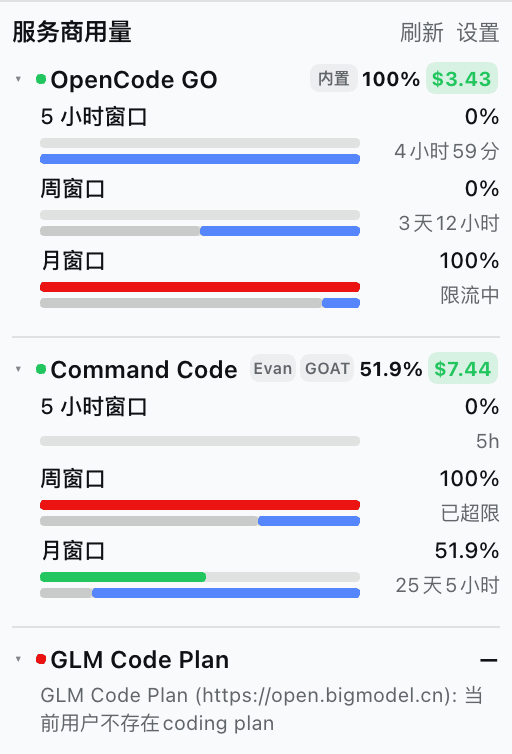
rolling). Prefers the live
dsh-opencode-go plugin's active account through its opencodeGoUsage
host service, then falls back to the official GET /v1/usage endpoint./alpha/billing/*,
/alpha/usage/summary).api.z.ai) or the China BigModel host (open.bigmodel.cn) at
/api/monitor/usage/quota/limit. auto probes both, the GLM card badges the
version that answered (International / China), and the plugin
settings can pin one version (or a custom endpoint). When neither version
answers, the failure names each version's result instead of only the last
probe./provider-usage text. The OpenCode
console token is auto-discovered from OPENCODE_CONSOLE_TOKEN, the OpenCode
CLI auth file, or its local opencode.db; the token never leaves the host.
When that token is missing, the balance slot becomes a clickable "Set up" chip
that opens the plugin settings, where the OpenCode GO card renders a
step-by-step setup guide, instead of silently showing nothing. Command
Code's tooltip breaks its amount into purchased + free credits; a credits
response without either pool renders a muted No top-up badge.link:/file: checkout
is fast-forwarded when it is on main, clean, and a strict fast-forward. An
npm / market / tarball copy updates itself: the release tarball is downloaded
from the first source that serves it (registry → mirror → GitHub, in turn) and
each packaged file (lib/, package.json, cordis.patch.yml, docs/) is
written to a temp file and renamed over the target, so pnpm's hardlinked store
is never edited in place. Either way the running Host keeps the old module
graph, so the widget/settings show "updated — restart DSH". The plugin never
restarts DSH by itself.-0.1) floats up and fades away. There is no popup and no turn-event
tracking, so the animation may appear up to one poll interval later.fetch failed, a timeout, HTTP 5xx/429) answers with the last successful
read (servedStale: true) instead of an error, so the widget keeps its
numbers while the host retries in the background. Actionable failures — a
missing or rejected key, a vendor { success: false } — still render their
error card and invalidate the remembered read./provider-usage/usage and
/provider-usage/settings; API keys stay in the host process.200 while any provider succeeds and 502 only when all
enabled providers fail. Partial endpoint failures that need attention keep
the provider's numbers but turn its health dot amber and name the failed calls
in the tooltip; transient ones are suppressed (see above).refresh=1, so a changed credential ref shows its own numbers immediately.
The GLM card also carries the referral link (Z.ai "Invite Friends, Get
Credits") as a clickable, copyable row. The URL is a bundle constant: it never
goes through the settings route and a settings save cannot overwrite it./provider-usage chat command — prints every enabled provider's numbers
as text.x-opencode-session fix — injects the real per-conversation harness
session id into OpenCode GO chat requests at runtime, without patching DSH.From npm:
dsh plugin --profile desktop add dsh-multi-provider-usageor, for the web profile:
dsh plugin --profile web add dsh-multi-provider-usageFrom a checkout (for development):
dsh plugin --profile desktop add /path/to/dsh-provider-usageThe package declares dsh.bundle.patch, so the CLI reconciles it into the
profile's bundle layer stack automatically. The widget and client bundle are
part of the profile's client-modules graph, so restart DSH once after
installing (a running host does not rebuild its window.__DSH_BOOT__ manifest
for a newly linked package).
For a local link: dependency pnpm prints a peer-dependency warning
(@deepseek-ai/schemastery, @deepseek-ai/dsh). That is expected: the linked
checkout resolves schemastery from its own node_modules in development; a
normal npm install resolves the peers from the DSH runtime.
All values are resolved through the DSH credentials domain (the process
environment, $DSH_HOME/.credentials.yaml and .env layers). They are never
returned by the settings route and never reach the browser.
| Provider | Default ref | Resolution order | Fallback source |
|---|---|---|---|
| OpenCode GO | OPENCODE_GO_API_KEY |
opencodeGoApiKeyEnv, the dsh-opencode-go active-account ref (only when that entry is enabled), OPENCODE_GO_API_KEY, OPENCODE_API_KEY |
GET {baseUrl}/v1/usage |
| Command Code | COMMANDCODE_API_KEY |
commandCodeApiKeyEnv, COMMANDCODE_API_KEY, then the CLI auth file |
~/.commandcode/auth.json (apiKey) |
| GLM Code Plan | ZAI_API_KEY |
glmApiKeyEnv, ZAI_CODING_CN_API_KEY, ZAI_API_KEY, ZHIPU_API_KEY, GLM_API_KEY, BIGMODEL_API_KEY |
— |
Set a ref in Plugins → dsh-multi-provider-usage → settings (or in the
auto-generated Settings → Plugins → Plugin configuration form). A ref is a
name such as OPENCODE_GO_API_KEY; the secret itself lives in DSH's credential
store.
The GO quota API does not include the account's prepaid balance. That comes from
GET https://opencode.ai/console/api/billing/status, which needs the OpenCode
console OAuth token (the GO API key returns 403 there). The host resolves it
in this order:
opencodeConsoleApiKeyEnv (OPENCODE_CONSOLE_TOKEN by default), resolved
through DSH credentials;credential table of ~/.local/share/opencode/opencode.db (read via
node:sqlite when available; this is where current OpenCode releases keep
the OAuth grant and rotate it);~/.local/share/opencode/auth.json ($XDG_DATA_HOME/opencode/auth.json when
set), provider opencode — the legacy location kept by older releases.The database is preferred deliberately: OpenCode migrated its grant there but
often leaves the old auth.json behind, and that stale token returns 401. Every
usable OAuth candidate is tried in turn (at most four), so one expired store
cannot hide the live one. Channel builds (opencode-beta.db, opencode-dev.db,
…) and $OPENCODE_DB are discovered too. The billing host comes from the grant's
metadata.server (so a self-hosted console works), falling back to the public
origin; opencodeConsoleBaseUrl overrides it.
An OpenCode API-key login (oc_sk_…, the service-account method) carries no
console session and is never sent to the billing endpoint. Such a login, a
missing token, or an expired/revoked grant renders a clickable Set up chip
(instead of a mute dash) that opens this bundle's page in the Plugins panel and
names the fix: run opencode auth login and choose the OpenCode Console
account, or store a console token as OPENCODE_CONSOLE_TOKEN.
When the balance is not configured (or the console login is fixable), the
OpenCode GO card in the plugin settings renders a step-by-step setup guide
in place of the static hint. The lead-in names the state-specific fix (nothing
configured, an API-key login, or an expired sign-in). Step ① shows the
opencode auth login CLI command with a Copy command button; step ② offers
a Re-check button that re-reads the sign-in state and forces one upstream
usage read, so a fresh login shows the balance without restarting DSH (unsaved
form edits are never discarded by the re-check). The /provider-usage command
gives the same state-specific guidance as text for all three fixable states.
The optional opencodeConsoleAuthFile overrides the auth file (and its
directory is used to locate opencode.db), opencodeConsoleOrgId supplies the
x-org-id header, and opencodeConsoleEnabled: false turns the whole balance
read off. Balance failures never hide the GO quota: the provider stays ok with
balance: null and a meta.balanceError (plus meta.balanceSetup when the
user can fix it). Any other balance failure renders a muted Balance — badge
whose tooltip carries the error. A balance call that only failed on the wire
(fetch failed, a timeout, HTTP 5xx/429) is not shown at all: it sets
meta.balanceTransient and the host keeps the last known balance, so an
auxiliary blip never blanks the slot or prints an error next to the quota.
Command Code's quota and balance share one API key and one billing family, so
they cannot diverge the way OpenCode's do: a missing key (COMMANDCODE_API_KEY
or ~/.commandcode/auth.json) fails the whole provider with an explicit
no API key message rather than blanking only the balance. Two narrower gaps
are reported instead of hidden:
/alpha/billing/credits fails, that request carries every window, so the
provider errors as well unless a previous successful read can stand in (see
the stale fallback below); its message now includes the underlying interface
and status instead of only "no usable quota windows", and meta.balanceError
lets the header show a muted Balance — badge carrying the cause;purchasedCredits nor
freeCredits, balance stays null with meta.balanceMissing: true and the
header shows a muted No top-up badge (a real 0 still renders $0.00).Interface failures and billing period (since 0.8.7): Command Code reports
rate-limit/permission failures as HTTP 200 with a { success: false } envelope;
those are now treated as errors and the envelope's reason reaches the message
(previously the response was parsed as data and only
no usable quota windows survived). When /alpha/billing/subscriptions fails,
the billing period comes from the summary's own periodStart / periodBasis,
and only period-scoped data feeds the monthly window.
Silent stale fallback (since 0.8.7): a refresh that fails only on the wire —
fetch failed, a timeout, HTTP 5xx or 429 — no longer replaces a provider
with an error card. When the host already holds a successful read for the same
account, it answers with that read (servedStale: true) and retries on the next
refresh, so the sidebar keeps its last known numbers instead of
Command Code: Command Code /alpha/whoami: fetch failed; …. The rule is
provider-wide, not Command Code-only. A transient partial failure is left out
of meta.errors as well, so the health dot and the tooltip stay quiet. Genuine
failures are never hidden: a missing key, a 401/403, a vendor
{ success: false } envelope, or any provider with no successful read yet still
renders its error card (and a real failure also invalidates the remembered
read). The classification follows each vendor's own status code — a rejected
OpenCode GO or GLM key is never mistaken for a blip even though those reads
re-wrap the original error — and it applies to the auxiliary OpenCode console
balance read too, where a wire failure keeps the previous balance instead of
showing Balance —.
Defensive GLM parsing (since 0.8.7): percentage accepts numeric strings
(common in the China deployment); a TIME_LIMIT without percentage derives it
from currentValue / usage; duplicate limits of the same type are suffixed with
-2 but keep the base window's label, hint and time-bar length (instead of
becoming an "Other window").
When opencodeGoSource is opencode-go (the default), the host probes:
opencode-go / dsh-opencode-go;ctx.get("opencodeGoUsage") exposes read();read() returns valid rolling / weekly / monthly data;apiKeyEnv + accounts[].If any step fails, the host reads the built-in endpoint and reports a fallback
object with one of: not-installed, entry-disabled, service-unavailable,
read-failed, invalid-response. The widget shows a Built-in badge with the
reason and message in its tooltip. opencodeGoSource: "builtin" pins the HTTP
path and never touches the other plugin.
No subscription (since 0.8.8): a 401/403 from /v1/usage whose body is
OpenCode's EntitlementError (for example OpenCode Go subscription required.)
is classified as no-subscription: the key itself was accepted, but its account
has no OpenCode GO subscription. The widget and the settings page show a
localized "check the subscription or disable the provider" line instead of the
gateway's raw JSON, and the unrelated
dsh-opencode-go: not-installed fallback note is no longer appended to it (the
fallback still travels in fallback / meta for diagnostics). The state is not
transient, so stale numbers never hide it.
| Provider | Windows | Window length |
|---|---|---|
| OpenCode GO | rolling, weekly, monthly |
5 h, 7 d, ~30 d |
| Command Code | five-hour, weekly, monthly |
5 h, 7 d, real billing period |
| GLM Code Plan | five-hour, weekly, mcp |
5 h, 7 d, monthly |
Percentages are used percentages and are clamped to [0, 100] for display.
Command Code's monthly bar tracks the plan credit pool only:
summary.totalMonthlyCredits / plan total (falling back to
planUsed + monthlyCredits when the plan total is unknown).
summary.totalCost also includes purchased and free credit spend
(totalCost = totalMonthlyCredits + totalPurchasedCredits + totalFreeCredits),
so it is no longer part of the plan bar — top-up credits only show up in
meta.monthly (used, purchased, free, extra) and the top-up balance
(balance.extra), and meta.monthly.planUsed carries the plan-scoped usage.
The 5-hour/weekly bars use windowLimits.fiveHour / weekly (used, cap,
resetAt, exceeded).
Tiny usage (since 0.8.6): right after a 5-hour/weekly window resets, usage is often below 0.05%, which is under one pixel of bar width — the green fill disappeared entirely, making the card look like it had a single (blue time) bar or like usage was zero. Now:
<0.1% instead of 0%;2px fill, so only a real 0% is an empty bar;Command Code's card therefore always shows two bars per row (green usage + blue time) for the 5-hour, weekly and monthly windows; a just-reset window only has a very thin green part, rather than a missing bar.
Token usage on a window row (since 0.8.2): a window may carry tokensUsed,
the vendor's absolute token count for that window, and the widget renders it as
Token: <number> right after the window label, with a compact unit (亿/万 with
a Chinese locale, B/M/K otherwise; full grouped digits below the smallest unit).
Only Command Code provides one today — its billing-period summary.totalTokens rides on the monthly
window (falling back to totalTokensIn + totalTokensOut when the vendor omits
the combined field). No vendor reports tokens for the 5-hour or weekly windows
(Command Code's windowLimits.used/cap count credits, not tokens), so those
rows show no token count.
Billing context (since 0.8.3): the monthly token count's tooltip carries
the billing-period in/out split (meta.totals.tokensIn / tokensOut) and the
request totals with success rate (meta.totals.requests / successRate); the
projected exhaustion date (meta.projection.runsOutInDays, Command Code)
renders right after the token count in the monthly row's label. MCP tool calls (since 0.8.3): GLM's monthly TIME_LIMIT
counts ride on the mcp window as used/cap and render as "123 / 1,000"
after its label. Recharge link (since 0.8.3): a low OpenCode prepaid
balance that the console marks purchasable links straight to
opencode.ai/console from the badge.
A GLM account without a Coding Plan answers HTTP 200 with
{ "success": false, "msg": ... }; the adapter surfaces that message and the
widget shows the provider in an error state.
The loader reads the exported Config schema; every field is .volatile(), so
the settings page and the auto-generated form hot-apply.
| Field | Default | Meaning |
|---|---|---|
opencodeGoEnabled |
true |
Show OpenCode GO |
opencodeGoSource |
"opencode-go" |
opencode-go or builtin |
opencodeGoApiKeyEnv |
"OPENCODE_GO_API_KEY" |
Credential ref |
opencodeGoBaseUrl |
"https://opencode.ai/zen/go" |
Gateway base |
opencodeConsoleEnabled |
true |
Read the Zen prepaid balance |
opencodeConsoleApiKeyEnv |
"OPENCODE_CONSOLE_TOKEN" |
Console token ref |
opencodeConsoleOrgId |
"" |
Optional x-org-id |
opencodeConsoleAuthFile |
"" |
Optional auth.json path; empty auto-discovers |
opencodeConsoleDbFile |
"" |
Optional opencode.db path; empty derives it |
opencodeConsoleBaseUrl |
"https://opencode.ai" |
Console origin |
commandCodeEnabled |
true |
Show Command Code |
commandCodeApiKeyEnv |
"COMMANDCODE_API_KEY" |
Credential ref |
commandCodeBaseUrl |
"https://api.commandcode.ai" |
API base |
commandCodeAuthFile |
"" |
Empty = ~/.commandcode/auth.json |
glmEnabled |
true |
Show GLM Code Plan |
glmApiKeyEnv |
"ZAI_API_KEY" |
Credential ref |
glmBaseUrl |
"" |
Optional base override |
glmRegion |
"auto" |
auto, zai, bigmodel, custom |
cacheMs |
30000 |
Per-provider host cache TTL |
updateCheck |
true |
npm update check (24 h) |
autoUpdate |
true |
Check npm, npmmirror and GitHub together; fast-forward a clean checkout, otherwise replace an installed package from the first source that serves the tarball |
autoUpdateCheckHours |
6 |
Hours between auto-update checks (1–168) |
injectSessionHeader |
true |
OpenCode GO session-header fix |
providerOrder |
all three ids | Provider display order in the widget; drag the cards in the plugin settings to reorder |
glmRegion: "custom" requires glmBaseUrl; auto probes
https://api.z.ai first and then https://open.bigmodel.cn, and the widget
badges the version that answered.
GET /provider-usage/usage?refresh=1 (or ?force=1) bypasses the host cache.
A 200 with providers: [] and enabled: [] means every provider is
disabled (a configuration state — the widget shows its localized hint); a
502 means providers exist but every one of them failed, and the body still
carries each provider's error.
{
  "ok": true,
  "enabled": ["opencode-go", "command-code", "glm"],
  "providerOrder": ["opencode-go", "command-code", "glm"],
  "providers": [
    {
      "id": "opencode-go",
      "name": "OpenCode GO",
      "short": "GO",
      "status": "ok",
      "account": { "ref": "OPENCODE_GO_API_KEY", "id": null, "name": "" },
      "plan": null,
      "source": "builtin",
      "requested": "opencode-go",
      "fallback": {
        "from": "opencode-go",
        "reason": "not-installed",
        "message": "dsh-opencode-go is not installed, or its profile entry is inactive"
      },
      "balance": {
        "amount": 5.01495352,
        "currency": "USD",
        "labelKey": "balance.zen",
        "source": "opencode-db",
        "details": { "billingMode": "prepaid", "mode": "pay-as-you-go" }
      },
      "windows": [
        {
          "key": "rolling",
          "labelKey": "window.five-hour",
          "hintKey": "window.five-hour.hint",
          "percent": 0,
          "status": "ok",
          "resetsAt": "2026-11-05T13:50:46.363Z",
          "windowMs": 18000000
        }
      ],
      "meta": {}
    }
  ],
  "update": { "current": "0.1.0", "available": false, "latest": null },
  "sessionHeader": { "active": true, "count": 0, "diag": {} }
}
Failed providers have "status": "error", code, error and windows: [];
their siblings are still returned. A body with providers: [] means no provider
is enabled. meta.balanceError carries a tolerated balance failure (the
provider still answers ok); meta.balanceSetup (no-credential, api-key or
expired) marks a failure the user can fix by signing in again;
meta.balanceMissing marks a Command Code credits response without
purchased/free pools. meta.errors lists partial Command Code endpoint
failures worth showing: the numbers stay, the health dot turns amber, and the
tooltip names the failed calls (transient ones — timeout, 5xx, 429 — are
not listed; see the stale fallback above). Error cards keep the plan they
already resolved.
Caching and refresh semantics (since 0.8.1): the host keeps a TTL cache per
provider (cacheMs, default 30 s). Once a provider's entry has expired, the
next request answers instantly with the last-known value (top-level and
per-provider servedStale: true) while a background read refreshes upstream —
a slow provider (up to its 15 s fetch timeout) can no longer stall the sidebar
widget or the /provider-usage command; the widget follows up automatically a
few seconds later. ?refresh=1 still blocks on a fresh read (manual refresh
and post-save behavior are unchanged); an account/source switch never serves
the previous account's data. A read that fails only on the wire answers with
the last good value instead of an error (see the stale fallback above), and a
failed background refresh never replaces a good document with an error one. A
settings save drops the cached reads (so the next poll re-reads with the saved
values) but keeps each provider's last good read as that fallback.
Responses carry an ETag; a request with If-None-Match gets 304 with no
body while the document is unchanged. The sidebar widget stretches its poll gap
while nothing changes (from 30 s up to 2 min).
GET /provider-usage/settingsReturns the settings descriptor (namespace, revision, value, base,
user) plus a non-network detection report:
{
  "ok": true,
  "namespace": "dsh-multi-provider-usage",
  "revision": 0,
  "value": { "opencodeGoEnabled": true },
  "detection": {
    "providerOrder": ["opencode-go", "command-code", "glm"],
    "enabled": ["opencode-go", "command-code", "glm"],
    "providers": {
      "opencode-go": { "configured": true, "entryFound": false, "fallback": { "...": "..." } },
      "command-code": { "configured": true, "source": "auth-file" },
      "glm": { "configured": true, "region": "auto" }
    }
  }
}
503 means the host has no settings service or the entry has no volatile
fields; the settings page explains how to fix it.
POST /provider-usage/settingsOnly the fields in the table above are accepted; anything else is ignored.
expectedRevision gets 409 on a concurrent change.
{
  "patch": { "commandCodeEnabled": false, "providerOrder": ["glm", "opencode-go", "command-code"] },
  "expectedRevision": 0
}
Cross-origin writes are refused with 403. The usage route is read-only.
| Half | File | Role |
|---|---|---|
| host (Node) | lib/index.js |
Config schema, routes, command, settings/detection, cache, session fix |
| host adapters | lib/providers.js |
Canonical window shape and the three vendor adapters |
| console balance | lib/opencode-console.js |
OpenCode console token discovery + billing status |
| session fix | lib/opencode-session.js |
globalThis.fetch wrapper + llm/stream ALS context |
| browser | lib/client.js |
Hand-authored window.__ModuleLoader__.load({ id, factory }) bundle: widget, settings page, locale dictionaries |
| bundle patch | cordis.patch.yml |
Inserts the profile entry |
The browser bundle is composed by DSH's official client-modules scan from
dsh.client + exports["./client"]; it registers into
sidebar.footer.action and plugins.bundle.config, exactly like the reference
plugin.
The session fix wraps globalThis.fetch once and only adds
x-opencode-session when the request URL starts with the gateway base carried
by the current llm/stream call. The base comes from
llm-pi-ai.providers.<route>.baseURL, falling back to opencodeGoBaseUrl.
0.1.7 and above, with no upper bound (future DSH lines included); verified on 0.2.1-rc.5.@deepseek-ai/schemastery ^3.18.4 (volatile fields / settings page).fetch, AbortSignal.timeout).dsh-opencode-go is optional; its absence is a normal fallback.COMMANDCODE_API_KEY is set.plugins.bundle.config loses only the
settings page; the sidebar widget and /provider-usage keep working. Set the
config fields in the profile patch or the auto-generated form instead.npm install
npm testThe tests are hermetic: a fake globalThis.fetch and a stub Cordis context, no
network and no real keys. They cover the schema, all three adapters, OpenCode
GO service integration/fallback, aggregation and error isolation, caching,
forced refresh, the transient-failure stale fallback and balance carry-over,
settings conflicts/whitelisting, the client bundle contract, top-up balance
discovery (credential and local auth.json) and failure isolation, and the
session-header injection. 164 tests, all offline.
MIT.
CLASSIFICATION EVIDENCE
系统优先读取 GitHub Topics,再与站内分类词典和词根规则比对。当前命中: deepseek-harness。
morluto
Reverse engineer anything with agents, from app behavior down to native binaries.

deepseek-ai
DeepSeek Harness: Everything is a Plugin.

nexu-io
The 1st Collaborative AI Design Agent Workspace. Local-first and open source. Create motion, prototypes, websites, apps, dashboards, presentations, images, and videos with your team and AI agents. Share work, exchange feedback, and iterate together in one workspace.