
模型与 MCP
待识别

rea
morluto
Reverse engineer anything with agents, from app behavior down to native binaries.
PROJECT TOPICS
INSTALL REFERENCE
dsh plugin --profile web add github:windrover/dsh-minimal-UI-panels
该命令指向仓库当前默认分支;尚无绑定当前 commit 的完整验证结果。
PROJECT README





All-in-one DeepSeek Harness UI panels — one bundle, one loader row: artifacts, memory, terminal and notes paired two per tab into right-Sidebar tab types, each with a draggable split inside.
dsh-minimal-UI-panels merges three formerly separate DSH plugins into a single package mounted as one loader row. The panels are paired into right-Sidebar tab types (ctx.sidebarRightTabs) on @deepseek-ai/dsh-client-ui-sidebar-right — Artifacts + Terminal and Memory + Notes — and each tab stacks its two panels with a draggable divider, so two Sidebar panes side by side show all four panels at once. It also ships the host-side tools/routes — plug and play.
DSH 0.1.5 changed the architecture: the third-party-occupiable
detailscolumn is gone, replaced byrightbarand owned by the shipped right Sidebar (docking kit + tab-type registry). 0.2.0 completed that migration; 0.3.0 then paired the panels, because one tab per panel could only ever show two of them.
data-chat-node-key → flowItem → text selection), and the Notes toolbar gains Add selection.usage.jsonl + /memory stats; opt-in per-prompt recall.Release notes: v0.6.3.
| Panel / capability | Description |
|---|---|
| Paired right-Sidebar tab types | One tab type = one pair of panels, stacked vertically with a draggable divider between them (the split is remembered per pairing; double-click the divider for 50/50). Docking, floating and splitting come from the shipped docking kit, so two panes side by side show all four panels. The way in is the strip's add control → the guide page |
| Artifacts panel | Scans workspace artifact files, groups/sorts by type/date/size/line count; syntax-highlighted code/config/data previews; inline base64 image previews (4 MiB cap); mp4/m4v/webm/ogv video streaming (Range requests) |
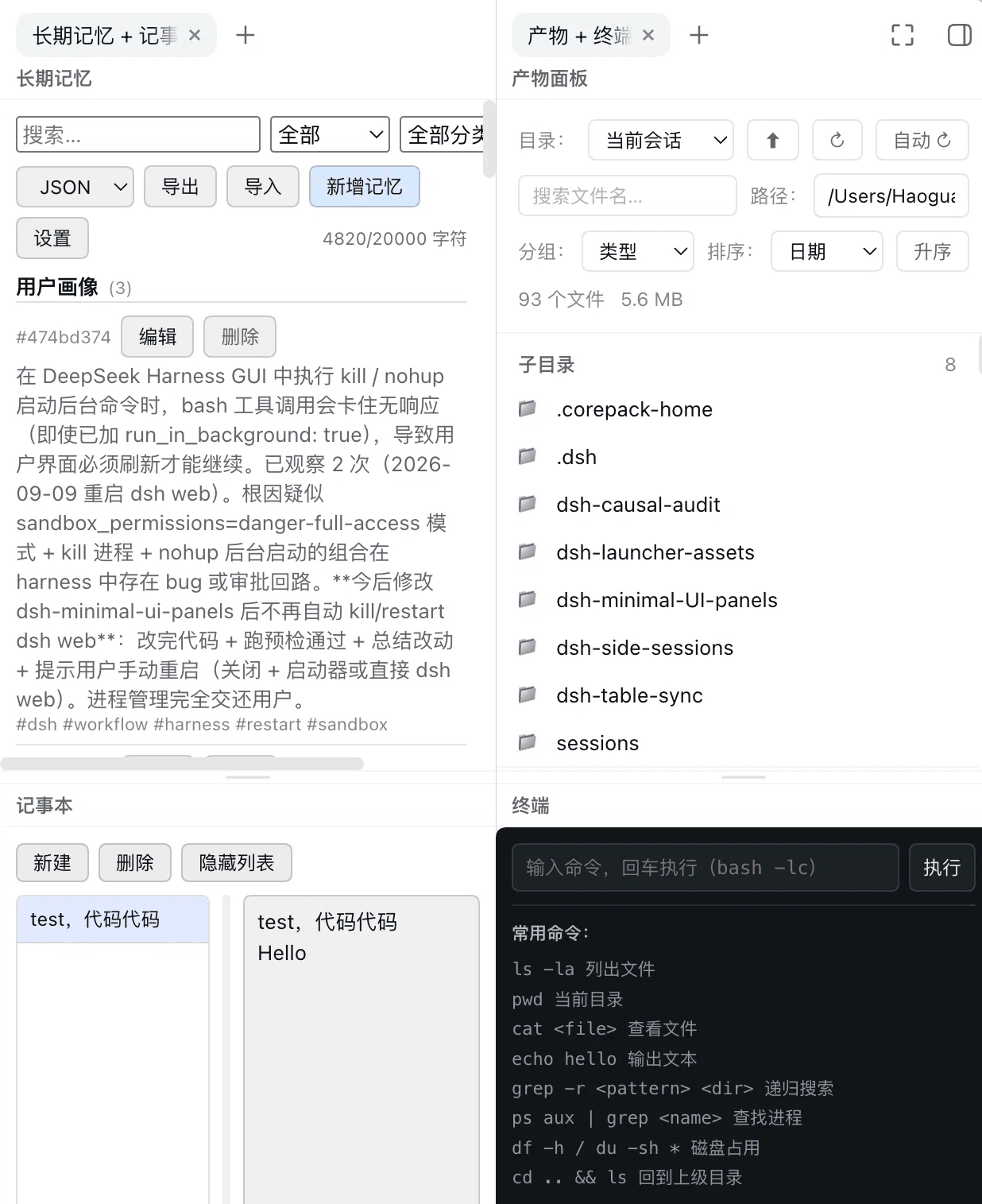
| Memory panel | View/add/search/edit memory across three scopes (user/global/workspace); tag grouping; content highlighting; write-approval queue and settings card; compression archives removed records instead of deleting them |
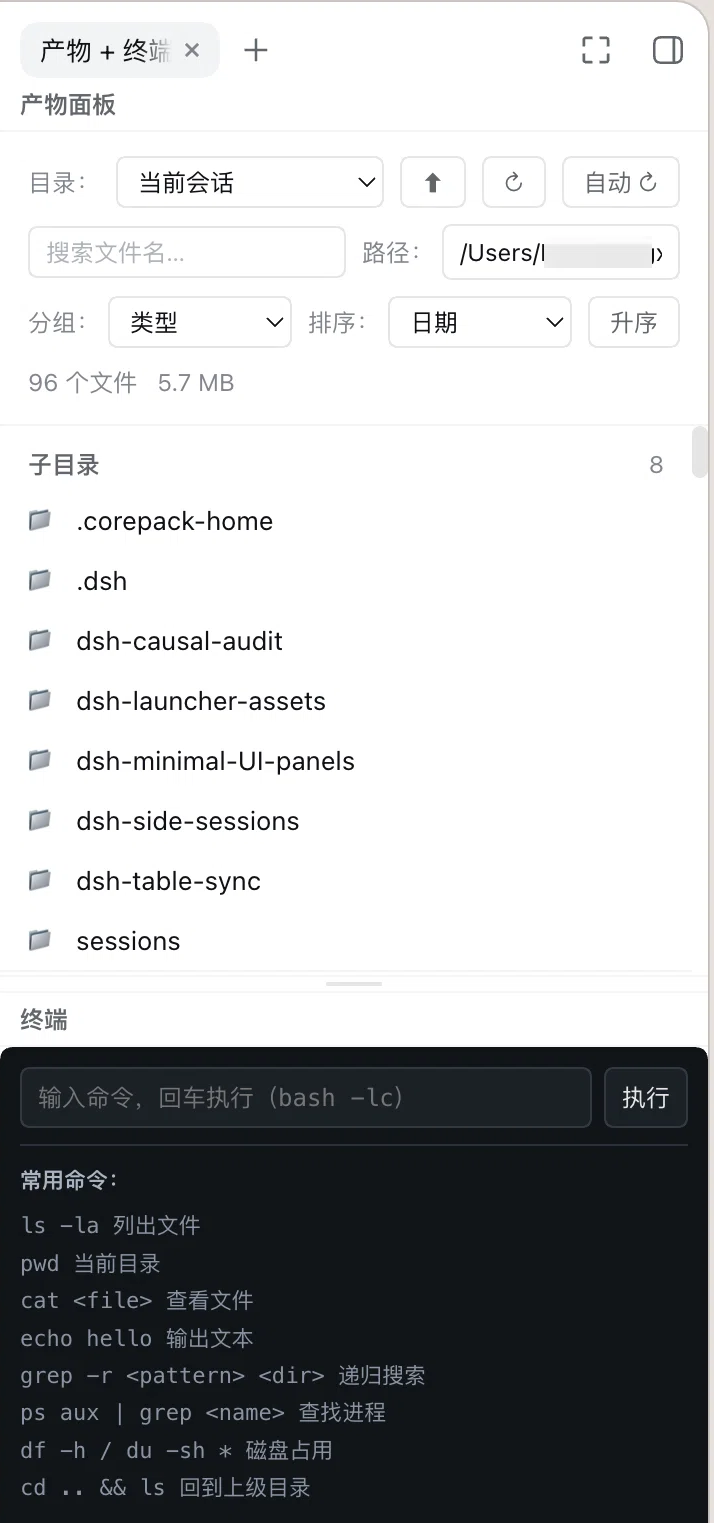
| Terminal panel | A dark-themed bash command runner (bash -lc), output collected and returned; common-command hints stay pinned below |
| Notes panel | Apple-Notes-style multi-note scratchpad: sidebar list + editor, create/delete, autosave (600 ms debounce), auto-title from the first line, stored at ~/.dsh/notes.json; right-click any conversation message → 添加到记事本 (selected text if any, else the whole message) |
The Artifacts + Terminal pairing open in the right Sidebar: the artifacts panel on top, the terminal below, and the draggable divider between them. The chip in the strip is the pairing's tab type.
Drag a tab to the left or right edge of a pane and it splits off a second pane — two panes side by side, all four panels on screen at once:
This plugin mounts as a local link dependency (consistent with other DSH local plugins).
Requires dsh 0.1.5 or newer, including the 0.2 series. The panels register as tab kinds of
@deepseek-ai/dsh-client-ui-sidebar-right, which first shipped in 0.1.5-alpha.1; earlier 0.1.x releases have norightbarat all, so the client bundle cannot resolve that dependency. The^0.1.0-rc.8inpeerDependenciescovers only the host services (dsh-home-paths,dsh-tools) and is not the real floor.
Pick a directory and clone it:
git clone https://github.com/windrover/dsh-minimal-UI-panels.git
# → <your-path>/dsh-minimal-UI-panelsEdit ~/.dsh/profiles/web/package.json. Set link: to your clone path (<your-path> is wherever you ran the clone):
{
  "dependencies": {
    "dsh-minimal-ui-panels": "link:<your-path>/dsh-minimal-UI-panels"
  },
  "dsh": {
    "profile": {
      "bundles": [
        "@deepseek-ai/dsh-base",
        "@deepseek-ai/dsh-web-app",
        "dsh-minimal-ui-panels"
      ]
    }
  }
}
Replace
<your-path>with the absolute path to the cloned folder, e.g.link:/Users/me/dev/dsh-minimal-UI-panels. The directory may keep its capitalised name (dsh-minimal-UI-panels) — the directory name does not matter; the identity that counts ispackage.json'sname.
cd ~/.dsh/profiles/web && pnpm installCtrl+C to quit → run dsh web again → refresh the browser. The loader scans profile bundles at startup, so the new code takes effect.
If you previously mounted the old plugins, remove them from
dsh.profile.bundles(this package supersedes them); also clean any stale rows in~/.dsh/cordis.patch.yml(e.g.- id: artifacts-panel) to avoidpatch: entry ... not foundwarnings.
bash -lc); output shows in the lower half; common-command hints stay pinned.flowItem class is captured as a whole. As a guaranteed entry point, the Notes toolbar has 收录选区 / Add selection, which appends the current selection from anywhere in the app./memory command (host side): /memory list|search|get|forget|export|stats.memory_* (write/recall/list/forget/export/import/correct/batch/diagnose) and artifacts_list.~/.dsh/dsh-memory/{user,global}.jsonl (plus user-archive.jsonl / global-archive.jsonl), workspace <cwd>/.dsh/memory.jsonl (plus memory-archive.jsonl), pending queue .dsh/memory-pending.jsonl, usage log ~/.dsh/dsh-memory/usage.jsonl.<store>-archive.jsonl with archivedAt and archiveReason. If the archive cannot be written, the deletion is aborted — memory stays over budget rather than silently losing facts. A dropped entry can be restored by importing that line as a v1 bundle.archiveReason: "superseded_cleanup") before the write, so a corrected scope cannot wedge the queue at usage == limit. If that still is not enough, the write is refused with the usage numbers.memory_write returns status: "existing" when the same content is already stored; a near-duplicate write is stored with a warning pointing at memory_correct. The pending-approve path and the 7-day auto-approve flush share the same classifier (lib/host/ltm/dedup.js).session.snapshotEvents() (DSH 0.2.x) and the legacy session.events, and only distils human prompts (source.kind === "user") — injected runtime-context snapshots are never fed back into memory.promptRecall: true (cordis config, or long-term-memory.promptRecall in settings.yaml) runs a local BM25 search with each new prompt and appends the top hits as a form: "recall" user message (promptRecallLimit 3, promptRecallMaxChars 600). Same text is never appended twice: the check reads the session history, so a fork or restart cannot stack copies. Default off — it trades tokens for relevance and can surface an irrelevant match.usage.jsonl (rotates at 2 MB), and /memory stats / memory_diagnose aggregate the last 7 days, including whether the last autoSummarize run succeeded.One conversation owns exactly one folder, so its products are findable from the path alone:
<workspace>/sessions/<YYYY-MM-DD>-<title-slug>-<session-id8>/
    README.md      index: what this conversation was about + every artifact
    docs/          md, txt, pdf, docx, pptx
    data/          csv, tsv, xlsx, json, yaml, sqlite
    images/        png, jpg, webp, svg, gif
    scripts/       py, sh, js, mjs, ts, ipynb
    media/         mp4, mov, mp3, wav
misc/ anything else, plus scratch<date>-<full-session-id>, so nothing is forked or scattered after an upgrade.<parent>/subagents/<slug>-<id8>/./api/artifacts/session-dir); until that folder exists it stays on the workspace root, and a directory you picked yourself always wins.artifacts_list with no dir scans this conversation's folder once it exists (otherwise the workspace root). The panel scans whatever directory you point it at — it never parses folder names, so any layout (including pre-existing folders) keeps listing and previewing.The host half injects the exact path as the tool:artifacts-session-dir prompt section; the rules live in lib/host/artifact-paths.js and are pinned by test/artifacts-naming.test.mjs.
dsh-minimal-UI-panels  (one loader row / one package)
│
├── lib/index.js  ── Host half 【thin composition entry】
│   └── import + invoke in order:
│       ├── lib/host/ltm.js               ← original dsh-long-term-memory (verbatim)
│       │     └── store.js / threats.js / llm.js / automation.js
│       ├── lib/host/artifacts.js         ← original dsh-artifacts-panel (verbatim)
│       │     └── artifact-paths.js       ← per-session folder layout (naming, reuse, subagent nesting)
│       └── lib/host/terminal-notes.js    ← original dsh-terminal-notes (verbatim)
│       inject = tools, systemPrompt, commands, settings, agents,
│                webServer, workspaceRegistry, subprocess
│
├── src/           ── Browser-half SOURCE 【edit panel UI here; version-controlled】
│   ├── composite/client.js          ← the pairing container: owns EVERY right-Sidebar registration
│   ├── artifacts/client.js          ← artifacts panel (contributes a component; registers nothing)
│   ├── long-term-memory/client.js   ← memory panel (same, plus the Settings card)
│   └── terminal-notes/client.js     ← terminal + notes panels (same)
│
└── lib/client.js  ── Browser half 【single merged bundle = scripts/merge-client.mjs; do not edit】
    ├── function artifacts(react, react_jsx_runtime, panels)      ← from src/artifacts/client.js
    ├── function ltm(react, react_jsx_runtime, panels)            ← from src/long-term-memory/client.js
    ├── function terminalNotes(react, react_jsx_runtime, panels)  ← from src/terminal-notes/client.js
    ├── function composite(react, react_jsx_runtime, panels)      ← from src/composite/client.js
    │     the three panel fragments only WRITE { Component, ns, titleKey, t } into `panels`;
    │     composite READS it to render
    └── function apply(ctx)   ← main entry: const panels = {} → apply in order (composite LAST)
        exports.inject = ["slots", "locale", "sidebarRightTabs"]

Right-Sidebar tab types (ONE PER PAIRING; each then registers a body under its own
id in the sidebar.right.pane.tab seat):
    dsh-minimal-ui-panels/artifacts-terminal  kind "artifacts-terminal"  top: artifacts  bottom: terminal
    dsh-minimal-ui-panels/memory-notes        kind "memory-notes"        top: memory     bottom: notes

Host tools/routes: memory_*(9) + artifacts_list, /api/artifacts/*, /api/terminal-notes/*
Merge pipeline (see scripts/merge-client.mjs):
src/artifacts/client.js        ─┐
src/long-term-memory/client.js ├─ extract factory body → rewrite react/react_jsx_runtime
src/terminal-notes/client.js   │   bindings, strip inner exports. statements
src/composite/client.js        ─┘  (merged LAST: it reads the `panels` registry the others fill)
                                           │
                                           ▼
                            lib/client.js  (single __ModuleLoader__.load bundle)
📌 The sources live in this repo, under
src/<fragment>/client.js. They used to be read from sibling checkouts of the three original plugin repos — all of which are now archived on GitHub (read-only,git push→ 403), leaving the source with no version control behind it. An edit made directly in the generatedlib/client.jswas destroyed by the next merge and could not be recovered from git. Vendoring them here is what makes the browser half reproducible from a clone.
⚠️ Key contract: three names must match byte for byte (here the lowercase
dsh-minimal-ui-panels)
insert.nameincordis.patch.yml- the
__ModuleLoader__.load({ id })inlib/client.jspackage.json'snameWhy:
dsh-client-modules'nearestPackage()walks up from the module path the Loader row resolved and only accepts thepackage.jsonwhosenamestrictly equals that specifier;arrive()then assertsfactories.has(row.id). A case mismatch anywhere in that chain makes the entire browser half silently misswindow.__DSH_BOOT__while the host half (tools/routes) keeps working — exactly the state that reads as "the plugin is running".That was the last hidden bug in 0.1.x:
package.jsonhad already gone lowercase, butcordis.patch.ymland the client bundle still saidUI. The directory's own casing is irrelevant;package.json'snameis the source of truth.
The old four plugins had to be merged because they all fought over the one details slot. After DSH 0.1.5 moved to rightbar, each panel registers its own tab kind and body key, so they no longer contend — the container role belongs to the shipped right Sidebar. This package therefore dropped dsh-details-tabs (~1100 lines) along with its self-drawn layout persistence and DockRail.
But one tab per panel has a practical ceiling: the Sidebar splits into at most two panes, so at most two panels can be on screen, and reaching the others costs a switch. Since 0.3.0 the panels are paired — a tab stacks two panels with a draggable divider between them. Two panes side by side then show all four panels, and dragging a divider down to 15% gives the single-panel view back. The pairings live in the PAIRS array in src/composite/client.js; regrouping is a change to that one array.
Unchanged from the originals:
| Method | Path | Description |
|---|---|---|
| POST | /api/artifacts/scan |
Scan a directory |
| GET | /api/artifacts/session-dir |
This conversation's artifact folder (?sessionId=&cwd=), so the panel opens on it |
| GET | /api/artifacts/read |
Read file preview |
| GET | /api/artifacts/media |
Video stream (Range support) |
| POST | /api/terminal-notes/exec |
Run a bash command |
| GET/POST | /api/terminal-notes/notes |
List / create notes |
| GET/POST | /api/terminal-notes/note |
Read / save one note |
| POST | /api/terminal-notes/note-append |
Append a captured conversation excerpt as a new note (atomic create+fill) |
| POST | /api/terminal-notes/note-delete |
Delete a note |
Always run the precheck after changing code (DSH plugin workflow):
bash ~/.dsh/dsh-plugin-precheck.sh web --testsIt runs: plugin-tree load (--dump-config) + node --check per plugin + client bundle mock-load contract assertions + this repo's unit tests. Restart only after it passes; if you're locked out, use ~/.dsh/dsh-safe-start.sh for a safe boot.
This repo's contract test test/client-contract.test.mjs goes further than the precheck: it actually runs apply(ctx) against a stub context and pins the two composite tab types (id/kind/priority/guide entry), the two sidebar.right.pane.tab bodies, and then renders each body to check that both halves draw their own title, that both panels are seated with embedded: true and with their own translator, and that the draggable divider is there:
node test/client-contract.test.mjstest/artifacts-scroll.test.mjs renders the artifacts panel for real with a minimal hook runtime and drives one preview round trip through its own state: the list offset must come back, and it must come back in a layout effect (before paint, so the return does not flash the top and then jump). It also checks that a directory change drops the remembered offset. Rendering the panel is what catches a temporal-dead-zone reference in an effect's dependency array — something node --check cannot see:
node test/artifacts-scroll.test.mjstest/artifacts-session-default.test.mjs renders the panel and pins what it opens on: this conversation's artifact folder when it exists, the workspace root when it does not (a scan of a missing directory is a 404, not an empty list), the same fallback when the host does not serve /api/artifacts/session-dir yet, and never overriding a directory the user pinned themselves:
node test/artifacts-session-default.test.mjstest/artifacts-naming.test.mjs pins the per-session folder layout: the local start date (with the old UTC off-by-one as an explicit counterexample), readable path-safe slugs, reuse of an existing folder including the legacy <date>-<full-session-id> shape, subagent nesting, the exact prompt text, and artifacts_list defaulting to this conversation's folder without creating one:
node test/artifacts-naming.test.mjstest/terminal-exec.test.mjs covers the host half: it applies the plugin against a mock context, captures the route registered at /api/terminal-notes/exec and invokes it, asserting that the spawn asks for stdin: 'ignore' (fd 0 on /dev/null), carries an abort signal, and that a command killed at the deadline comes back as a classified timeout with the output it managed to print:
node test/terminal-exec.test.mjsThe browser half is a generated artifact; its source is src/. Edit src/<fragment>/client.js, then regenerate:
node scripts/merge-client.mjs          # write lib/client.js
node scripts/merge-client.mjs --check  # verify only; exits 1 when stale (fine for CI/precheck)
The script extracts each factory body from src/{composite,artifacts,long-term-memory,terminal-notes}/client.js, rewrites the react / react_jsx_runtime bindings, strips inner exports. statements, and passes one shared panels registry into every fragment as its third argument (the panel fragments write, composite reads). composite must be merged last, or the registry is empty. A change made directly in lib/client.js is lost on the next run — the script prints a would change +N/-M warning before overwriting, and --check never writes at all.
Data locations: long-term memory ~/.dsh/dsh-memory/{global,user}.jsonl (+ *-archive.jsonl), workspace .dsh/memory.jsonl (+ memory-archive.jsonl), usage ~/.dsh/dsh-memory/usage.jsonl; notes ~/.dsh/notes.json.
requireApprovalForWrite on, memory_write does not commit: the record (including its tier) is queued in the memory panel's "pending" list and is written only when you approve it there (or when autoApproveAfterMs elapses, 7 days by default). Reason: on reconnect/replay the Host client can render the same approval request as a second card, so one write looked like two confirmations; the pending queue has exactly one confirmation surface and never touches that channel. memory_forget still asks through the Host approval seam, because a destructive delete deserves a blocking confirmation.node:fs (temp file + rename), not through ctx.fs: since DSH 0.2.1 that service is sandboxed and its workspace-write policy refuses mutations outside the workspace, which made ~/.dsh/notes.json unwritable (create/save/delete all 500). The path is fixed plugin state, not model input, and the memory half already persists the same way.bash -lc <the one line you typed> and the child's stdin is /dev/null, so commands that read stdin (bash, cat, read, python, an editor) get EOF and exit instead of hanging the panel. While a command runs, a Stop button appears (host route POST /api/terminal-notes/exec-cancel, addressing the child by the runId the panel generated for that run). Every command also has a 120-second deadline; past it the command is killed and the output it already printed is returned with the failure. The deadline is the host config terminalNotes.timeoutMs. A manual stop and the deadline are different outcomes (cancelled vs timeout), and both keep the output printed so far. For anything interactive or long-running, use the session's own bash tool.dsh-client-ui-sidebar-right docking kit. The only layout this package owns is the split inside a pairing. Upgrading dsh can no longer clobber a layout patch from this package, because there is no longer one to clobber.CLASSIFICATION EVIDENCE
系统优先读取 GitHub Topics,再与站内分类词典和词根规则比对。当前命中: deepseek-harness。
morluto
Reverse engineer anything with agents, from app behavior down to native binaries.

deepseek-ai
DeepSeek Harness: Everything is a Plugin.

nexu-io
The 1st Collaborative AI Design Agent Workspace. Local-first and open source. Create motion, prototypes, websites, apps, dashboards, presentations, images, and videos with your team and AI agents. Share work, exchange feedback, and iterate together in one workspace.