dsh-prompt-optimizer
English | 中文



One-click prompt polishing for the DSH composer: select nothing, just type a draft and press ✨ (or Alt+O) — the plugin rewrites it into a clearer, better-structured prompt. Zero-config by default: it follows the current session's model through the harness host services, so no API key is needed. A self-configured OpenAI-compatible endpoint is supported as an alternative.
Features
- One-click optimize — a ✨ button on the composer's right;
Alt+O while the composer is focused does the same
- True streaming preview — real SSE over the harness
webServer: every text-delta from llm.stream is pushed immediately and rendered token by token; reasoning is streamed first, so you watch the model think while it works
- Zero-config default — reuses the current session/agent default model (host
agentDefaultModel + llm services), no API key required
- Custom endpoint mode — uncheck "follow session model" and plug in any OpenAI-compatible
/chat/completions endpoint (base URL + key + model)
- Action row on completion — replace the draft in place, copy, re-optimize, or dismiss
- Bilingual UI — follows the DSH language (中文 / English) live, no reload
- Self-hosted config — settings persist in
~/.dsh/prompt-optimizer-config.json via a loopback RPC channel, independent of the host settings registry
- Dark-mode ready — all colors follow DSH theme variables; fixed brand blue + white text in deep-night mode
- Local-only credentials — the API key (custom mode only) lives in the local config file and goes only to the endpoint you configured
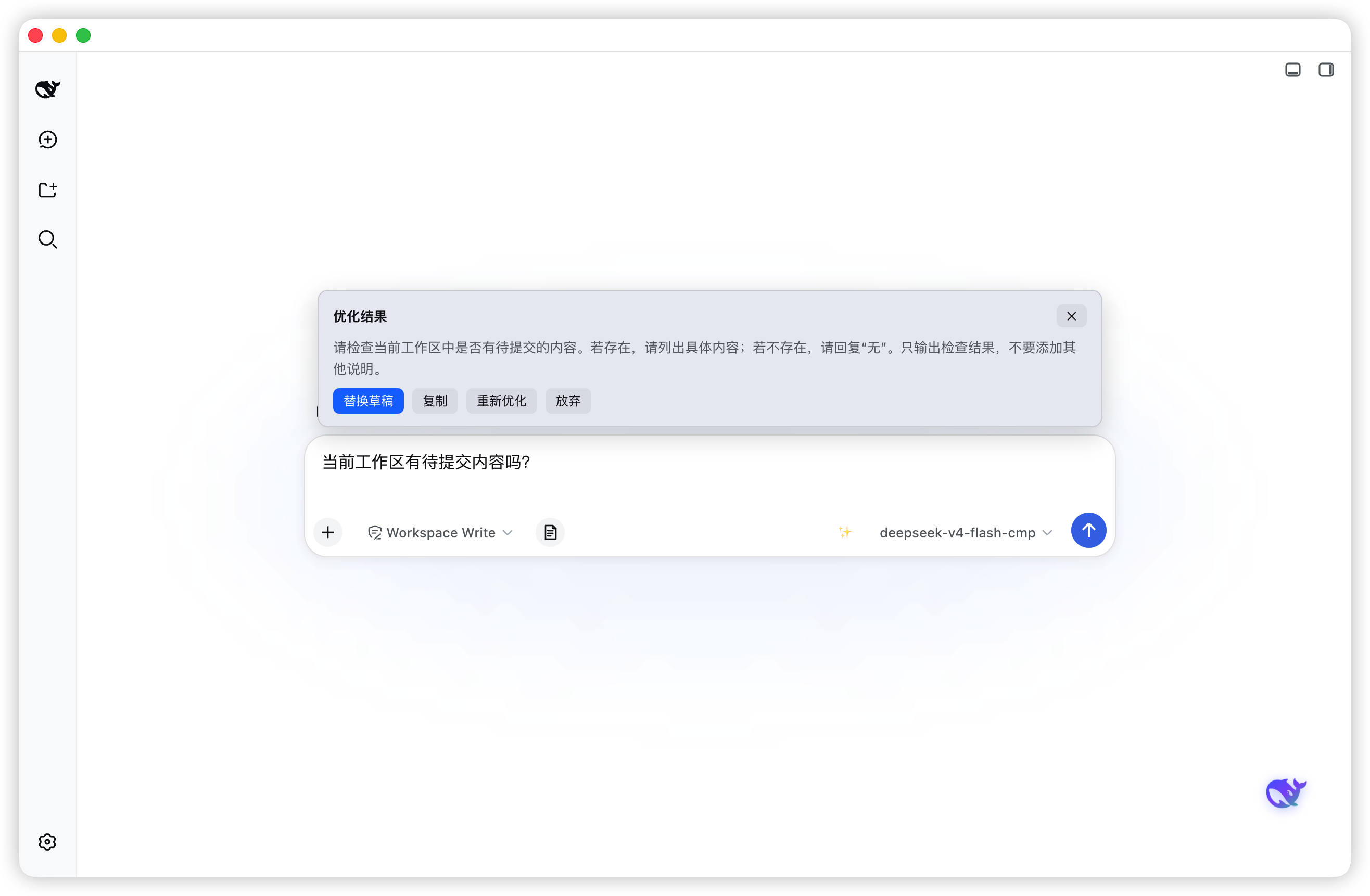
Screenshots
Requirements
- DSH with a
web or desktop profile
- Node.js
^22.19.0 or >=24.0.0 (only needed to build from source)
- pnpm is recommended when installing into a profile
Install
The bundle entry (id: prompt-optimizer) is self-declared by this package's cordis.patch.yml —
no manual patch file is needed.
From GitHub (recommended)
Install by repository identity so the market can match your package to
winditer/dsh-prompt-optimizer unambiguously (several unrelated plugins
share the npm name dsh-prompt-optimizer; a bare npm install hides the
GitHub link and description in dshmarket):
dsh plugin --profile desktop add github:winditer/dsh-prompt-optimizer
For a web profile, use --profile web. Restart DSH (quit fully and reopen), then a ✨ button appears to the right of the composer.
From npm
dsh plugin --profile desktop add dsh-prompt-optimizer
For a web profile, use --profile web. Restart DSH (quit fully and reopen), then a ✨ button appears to the right of the composer.
⚠️ The npm name dsh-prompt-optimizer is shared by several unrelated
plugins. Because the spec carries no repository identity, dshmarket cannot
disambiguate it and its Installed tab shows no GitHub link or description.
Prefer the github: install above.
From source (development)
git clone https://github.com/winditer/dsh-prompt-optimizer.git && cd dsh-prompt-optimizer
npm install
npm run build          # produces dist/client.js
dsh plugin --profile desktop add .    # links the workspace into the profile by package name
Or install by hand: in the target profile's package.json (e.g. ~/.dsh/profiles/desktop/package.json):
{
  "dependencies": {
    "dsh-prompt-optimizer": "link:/absolute/path/to/dsh-prompt-optimizer"
    // ...
  },
  "dsh": {
    "profile": {
      "bundles": [ /* ... */, "dsh-prompt-optimizer" ]
    }
  }
}
then pnpm install inside the profile directory and restart DSH.
Uninstall
Remove dsh-prompt-optimizer from the profile's dependencies and dsh.profile.bundles, clean up the installed package, and delete the config file ~/.dsh/prompt-optimizer-config.json if you no longer need it.
Usage
- Type a draft in the composer, click ✨ (or
Alt+O) — the preview card appears over the composer
- While optimizing: reasoning text scrolls in secondary color first, then the polished prompt streams in token by token
- When done: 替换草稿 writes the result into the composer in place · 复制 copies it · 重新优化 re-runs · 放弃 dismisses
- The preview belongs to the session where you started it: switching sessions hides it, switching back restores it
Configuration
Open 设置 → 通用设置 → Prompt 优化:
| Setting |
Default |
Meaning |
| 使用当前会话模型 |
on |
Follow the session/agent default model (zero-config). Off: enable the fields below |
| 接口地址 (base URL) |
https://api.deepseek.com |
Any OpenAI-compatible /chat/completions endpoint |
| API Key |
— |
Your key for the custom route (ignored in follow mode) |
| 模型名 |
deepseek-v4-flash |
Model name (ignored in follow mode) |
Settings are saved in ~/.dsh/prompt-optimizer-config.json (same directory as other DSH config; removed with the plugin).
Custom endpoints must support CORS and SSE streaming (official DeepSeek, OneAPI-style gateways work).
Architecture
Two halves, one package:
- Host half —
lib/index.js. Persists config over a loopback RPC channel (/dsh-prompt-optimizer, get/set), and registers an HTTP JSON API at /dsh-prompt-optimizer/api through the harness webServer service. Runs the session-default optimization via llm.stream; background streams live in an in-memory Map cleared on unload.
- Client half —
src/*.ts, bundled to dist/client.js (esbuild, wrapped in __ModuleLoader__.load({ id: "dsh-prompt-optimizer", … }); the id must equal the installed package name). Renders into the conversation.input.right button, conversation.input.overlay preview card and settings.general.item row; talks to the host with fetch POSTs.
Host API
All endpoints are POST /dsh-prompt-optimizer/api/<method>; every response is { ok: true, value } or { ok: false, error }.
| Method |
Body |
Returns |
sessionModel |
{} |
{ provider, model, reasoningEffort? } — the session's default model |
optimize.stream |
{ provider, model, text, system?, reasoningEffort? } |
text/event-stream — event: reasoning frames first, then event: delta per token, event: done at the end |
optimize.start |
{ provider, model, text, system?, reasoningEffort? } |
{ taskId } — background accumulation (fallback path) |
optimize.poll |
{ taskId } |
{ done, text, error? } — accumulated text while streaming |
optimize.abort |
{ taskId } |
{ ok } |
Protocol details: only POST is accepted (405 otherwise); the body is JSON with a 1 MB cap; unknown methods return 404.
Security notes
- Default route sends no credentials — it reuses the harness's configured provider.
- The custom-mode API key stays local (
~/.dsh/prompt-optimizer-config.json), and only goes to the endpoint you configured.
- Optimizations appear only in the preview card; the polished text reaches a session only if you press 替换草稿.
Development
npm run build   # esbuild: src/index.ts → dist/client.js (__ModuleLoader__ bundle)
npm test        # node runner over tests/entry.ts (state machines, channels, SSE parser)
Project layout
src/index.ts          Client entry — slot wiring, RPC/config glue, host probes
src/OptimizeButton.tsx / PreviewCard.tsx / SettingsRow.tsx
src/optimizer.ts      Config defaults, system prompts, OpenAI-compatible fetch/SSE client
src/session-optimizer.ts  Host channel: sessionModel + SSE stream + fallback poll
src/preview-state.ts  Preview card state machine (pure reducer)
src/preview-bus.ts    Module-level event bus shared by button / card / orchestration
lib/index.js          Host half — config persistence + HTTP JSON API (makeHandler + createApiRoute)
dist/client.js        Built client bundle (__ModuleLoader__ format, load id = dsh-prompt-optimizer)
cordis.patch.yml      Bundle entry declaration (insert: { id: prompt-optimizer, name: dsh-prompt-optimizer })
scripts/build.mjs     Build script (esbuild + bundle wrapper)
tests/entry.ts        Unit + integration tests (61)
assets/               Screenshot
Gotchas (learned the hard way)
-
Bundle id must equal the package name — arrive() throws bundle loaded without registering <id> otherwise. scripts/build.mjs hardcodes the correct id.
-
Profile bundles don't get the cordis timer service — use plain browser setInterval/setTimeout (disposed in React effect cleanup), exactly like the sibling dsh-elf bundle.
-
Do not use session.create/fork for generation — a background session never executes (the renderer's fabricated ids are silently rejected, forked sub-sessions don't trigger the model), which manifested as "optimizing forever". Drive the model from the host half via llm.stream instead.
-
Do not run the streaming protocol over connection.rpc.call — on desktop the renderer's rpc.call hangs on the second call within one flow (verified: sessionModel ok, next call never arrives). Host channels go over HTTP (webServer).
-
Prefer link: over file: when installing a workspace copy — file: copies files, so edits/rebuilds go stale.
-
Client changes go live on page refresh; host changes require a full DSH restart.
-
A broken build script silently keeps the old bundle — npm run build must print ✓ Built; if it only prints a Node version banner, the script is failing (a past regression left a stale dist/client.js that looked "current").
-
Fresh publishes can trip the profile's minimumReleaseAge policy — if the profile enforces pnpm's release-age supply-chain check, a version published less than ~24 h ago fails dsh plugin … add <pkg> with ERR_PNPM_MINIMUM_RELEASE_AGE_VIOLATION. Add the exact name@version to minimumReleaseAgeExclude in the profile's pnpm-workspace.yaml (and keep the entry current when you release a new version):
minimumReleaseAgeExclude:
  - dsh-prompt-optimizer@2.0.0
License
MIT


