
其他
完整应用

deepseek-harness
deepseek-ai
DeepSeek Harness: Everything is a Plugin.
PROJECT TOPICS
INSTALL REFERENCE
dsh plugin --profile web add github:winditer/dsh-paste-spill
该命令指向仓库当前默认分支;尚无绑定当前 commit 的完整验证结果。
PROJECT README
English | 中文
Inbound large-paste handling for the DeepSeek Harness composer: a 4–50 KB paste folds into one chip per paste (expand or delete it on its own), and a ≥ 50 KB paste becomes a real file attachment with a deliverable card in the turn tail.
dsh-spill covers the outbound direction — tool output leaving the model. This plugin covers the opposite half: a large log, diff, JSON dump or document pasted into the input box.
| Layer | Pasted size (UTF-8 bytes) | What happens |
|---|---|---|
| Fold | 4,000 – 50,000 | That pasted run leaves the editor and becomes one chip. One chip per paste — several coexist, and earlier chips are never overwritten. |
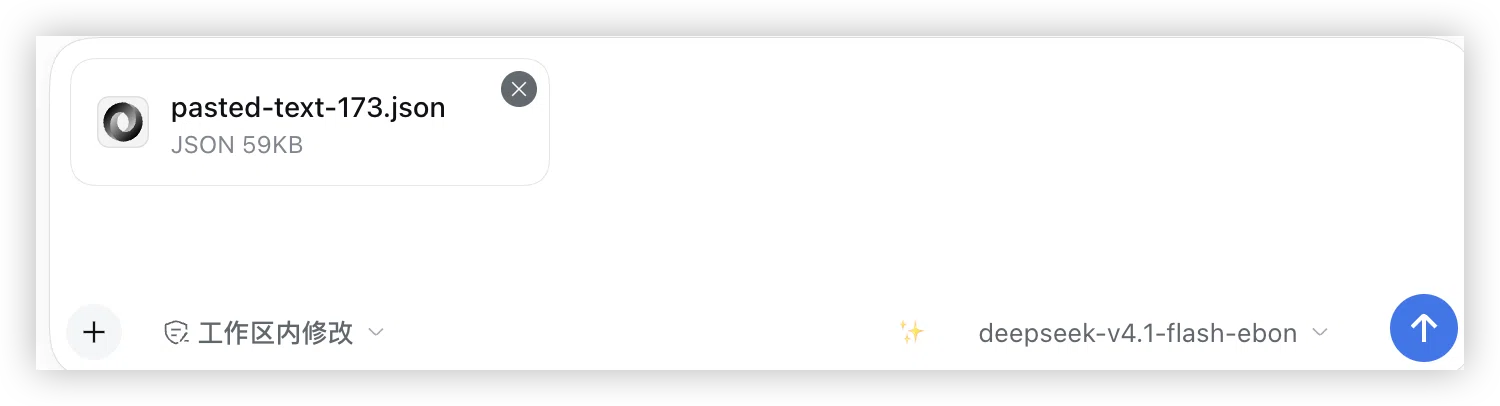
| Spill | ≥ 50,000 | The text is uploaded as a real attachment: the message carries a file block and the turn tail gets a clickable card that opens the file in the right sidebar. |
The two layers are independent and both measure the pasted text, not the draft: the fold layer changes what the composer looks like, the spill layer changes what the model receives. Pastes under 4,000 bytes are left entirely alone.
Pasting 4 KB–50 KB in one go moves just that pasted run out of the editor and into a chip held by the plugin. Text you typed, and chips from earlier pastes, are untouched.
Each chip shows:
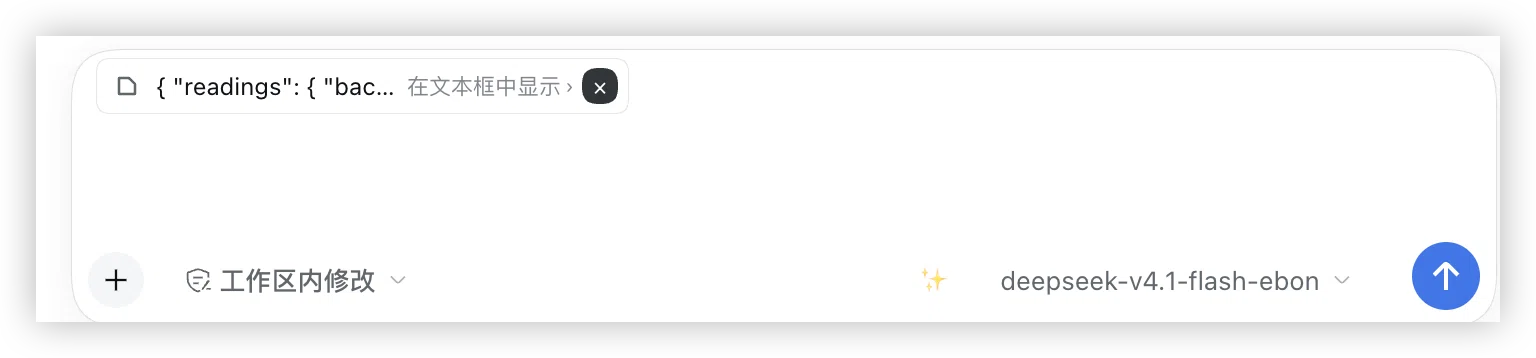
在文本框中显示 › / Show in text box › — click to write that chip's full text back into its position and release it;× — delete just that chip and release its text (删除这段文本 / Delete this text).The chip is a real editor node rather than a decoration, and it registers an inputTriggers source whose serialize(ref) returns the full original text. Sending therefore posts the paste itself — not a placeholder, and not an attachment.
Because one paste equals one chip, pasting a second 6 KB block appends a chip instead of replacing the first one: a chip is the only carrier of its text, so overwriting one would silently delete that paste.
The floating chip band measures itself and publishes its height as --dshps-chip-band on the composer card, which the card turns into padding-top. The chips sit above the first line of input instead of covering it, and reflow when several chips wrap onto a second line.
A paste of 50,000 bytes or more is turned into a File and sent through the composer's existing attachment upload path, with a content-sniffed name (pasted-text-<n>.json / .md / .py / .js / .html / .csv / .txt). The result is a legal file block in the message, so the model receives a read-only host path through the stock attachment handling — no session format change and no model-side change.
The host half watches agent/inbox/inserted for those paste files, resolves each one's host path from the attachment store, and publishes a deliverables/presented event on agent/pre-step, which the stock deliverables UI renders as a clickable card in the turn tail. Clicking the card opens the file in the right sidebar. The original text is then excised from the composer in place — the pasted run's own span is overwritten with "", never the whole draft, so other chips, typed text, the caret and undo history all survive.
The fold layer — a 4–50 KB paste becomes one chip: preview line, 在文本框中显示 › to write it back, × to delete just that paste.
The spill layer — a ≥ 50 KB paste becomes a real attachment (pasted-text-173.json, 59 KB) in the composer, so the model gets a file instead of a wall of text.
dsh-market shows these on the plugin card and in the detail view; they are declared in screenshots.json so their order and selection are curated here rather than guessed from this README.
From the DeepSeek Harness CLI, into the web profile — published on npm as dsh-paste-spill:
dsh plugin --profile web add dsh-paste-spillPrefer the source? The same package installs straight from GitHub:
dsh plugin --profile web add github:winditer/dsh-paste-spillOn DSH Desktop, install it from the in-app plugin manager (Settings → Plugins) or through the plugin market; the CLI refuses --profile desktop because that profile is owned by the application.
Working on the plugin from a local checkout? scripts/install-into-profile.sh links this repository into the desktop profile and adds the dependency entry that keeps the bundle row from being erased by profile reconciliation.
After install, the browser half is a page-level module: refresh the page (or relaunch) to pick it up.
package.json as engines.dsh: ">=0.1.7-rc.2 <0.2.0-0", so dsh-market can state the requirement on the plugin card. Verified on DSH 0.1.7-rc.2 (web and desktop).dsh.client.platform: "web"): the fold chip, the chip band and the attachment upload all live in the browser half. The host half runs anywhere the bundle loader does.inputTriggers source, the conversation.input.overlay slot, the existing attachment upload, and the agent/inbox/inserted / agent/pre-step session events.package dsh-paste-spill — one loader row, two halves
browser half lib/client.js (dsh.client, platform: web)
draft watcher + paste events
4000-50000 → register a chip source, replace the pasted run with a chip node,
hold the text by ref, render the chip band in the composer overlay
>= 50000 → synthesize a File and ride the stock attachment upload
host half lib/index.js (exports["."], dsh.bundle.patch)
agent/inbox/inserted → record the paste attachment's host path
agent/pre-step → session.append("deliverables/presented", ...)
→ stock deliverables card → right-sidebar previewOne package, one row: cordis.patch.yml declares dsh-paste-spill once, and the loader imports the host half through exports["."] while the web-modules scanner discovers the browser half from dsh.client plus exports["./client"] in the same package.json.
node --test # 108 tests: host half 17 (helpers 7 + plugin 10), browser half 91dsh.bundle check reads.localStorage["dsh.paste-spill.diag"] (bySession.<sessionId> for the per-session facts). build must equal the current BUILD_REV and applyRanAt must be fresh if a new build is really loaded.version in package.json, then pnpm publish. The files list keeps the tarball to lib, cordis.patch.yml, both READMEs, screenshots.json, assets and LICENSE; there is no build step, so a published version is exactly the source.已折叠 5.9 KB) is currently Chinese; the chip tooltip and the expand affordance are localized (zh / en).CLASSIFICATION EVIDENCE
系统优先读取 GitHub Topics,再与站内分类词典和词根规则比对。当前命中: 无有效分类标签。
deepseek-ai
DeepSeek Harness: Everything is a Plugin.

anywhere-labs
为 DeepSeek Harness (DSH) 插件生态打造的现代化桌面端解决方案。万物皆「插件」,桌面本身也是「插件」。

awesome-dsh-plugin
A curated list of plugins for DeepSeek Harness (dsh) · DeepSeek Harness 插件精选列表