


其他
完整应用

deepseek-harness
deepseek-ai
DeepSeek Harness: Everything is a Plugin.
PROJECT TOPICS
INSTALL REFERENCE
dsh plugin --profile web add github:waknow/dsh-web-icon-indicator
该命令指向仓库当前默认分支;尚无绑定当前 commit 的完整验证结果。
PROJECT README




⚠️ DSH version support — requires DSH ≥ 0.1.2-rc.1. One bundle serves both settings generations: modern (≥ 0.1.7-alpha.1: exported
Configschema +configForms+plugins.bundle.config) and legacy (≤ 0.1.6-alpha.1:settings.installSection+settingsScope+settings.plugin.item). Verified on DSH 0.1.5-rc.3 and DSH 0.1.7-alpha.1; on any older host the favicon still works even if the settings page is not reachable.
Browser tab favicon reflects the current DSH session state — idle / running / asking / done — so you can see at a glance whether a session needs your attention, even when the tab is in the background.
🎨 Live demo — https://waknow.github.io/dsh-web-icon-indicator/ · see the four states, the multi-agent counter and every effect rendered live in your browser, no install needed. The playground even drives the demo page's own tab favicon, exactly like the plugin does on a DSH page.
idle / running / asking / done (aggregate priority: asking > running > done > idle), so background tabs tell you at a glance what your agents are doing — including ask_user_question prompts and approval / sandbox-escalation waits, which pin the icon to asking.icons/base.svg); every state, color and frame is rendered client-side as a data:image/svg+xml URI. No per-color icon files.static, blink, breath, rainbow, heartbeat, bounce — all driven by JavaScript, since favicons don't play SVG CSS animations.settings.yaml — paths below).requestAnimationFrame is paused in hidden tabs, and the status poll self-heals across host restarts. Returning to a tab repaints immediately: a visibilitychange listener fires an instant status fetch, so a state that flipped while the tab was hidden (e.g. the done hold expiring) shows at once instead of waiting for the next — possibly throttled — poll tick. When the backend is stopped, the tab never loses its icon: the outage restores the shell's own favicon from an offline-safe data:-URI copy (or keeps the last painted frame), and the live icon returns on the first successful poll.asking / running / done), the favicon switches from the whale to a full-frame number block showing the live count (up to 99+), colored and animated exactly like the whale would be in that state; back to the whale when 0–1 agents are active. (Same visual language as the 满幅数字 channel in demo/badge.html.)| # | Step |
|---|---|
| 1 | Open the DSH Web GUI and go to Settings / 设置 → Plugins / 插件. |
| 2 | On ≥ 0.1.7: open the dsh-web-icon-indicator bundle and click Configure / 配置 on its dsh-web-icon-indicator row. On ≤ 0.1.6-alpha.1: open Plugin config / 插件配置 in that tab. |
| 3 | The Favicon indicator / 标签页图标指示器 page opens with the full form. |
| 4 | Set Default icon color / 默认图标颜色 for the idle whale (its only knob — idle paints one color and never animates), then expand a state row (running / asking / done) to edit Effect / 特效, Colors / 颜色 (each swatch is a native color picker) and Cycle (ms) / 周期(毫秒) (shown only for animated states — static states have no cycle); use Asking hold / 提问驻留 and Done hold / 完成驻留 for the two timings. |
Changes are saved through the settings transport into the profile patch and applied to the running tab within ~1 s — no reload, no restart. See Configure for the full key reference.
🐳 The Plugins page shows this plugin's own artwork — on DSH ≥ 0.1.7 the Plugins / 插件 page draws a 48 px icon on every bundle card (a 40 px one on every row) from
package.json→icon. This repo declares"icon": "icons/plugin.svg", so the card shows the whale instead of the generic placeholder. The icon is read by the host (readPluginMeta→iconOf) and shipped to the browser as a base64data:URL; a missing or malformed icon never blanks the card — it turns the plugin'smeta.erroron and the card shows a problem tag, so keep the path relative, inside the package, and ≤ 256 KiB. Addingiconneeds no settings, no code, and no host restart — only a new install or publish; see Plugin artwork on the Plugins page.
The four default states, exactly as they appear in the browser tab (the asking whale really blinks):
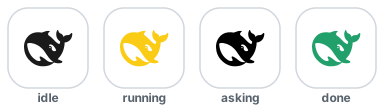
| State | Default color | Default effect |
|---|---|---|
idle |
#1a1a1a — deep whale (replaceable with defaultColor) |
static |
running |
#FACC15 — yellow |
static |
asking |
#E5484D ⇄ #FACC15 — red/yellow |
blink (400 ms) |
done |
#22A06B — green |
static, stays doneHoldMs, then back to idle |
With several agents running at once, the favicon itself becomes the counter:
while more than one agent is active (non-idle: asking / running / done,
including the short done hold), the whale is replaced by a full-frame count
block showing the live active count, filled with the aggregate state's color
and driven by the same effect — so it keeps blinking / breathing / cycling
exactly like the whale would. With 0–1 active agents it comes right back to
the whale.
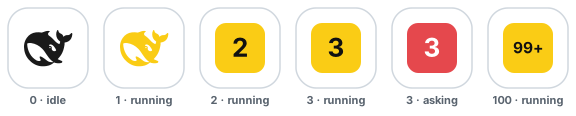
active (non-idle agents) |
Favicon |
|---|---|
0 |
dark idle whale |
1 |
that state's whale (running yellow, …) |
2–99 |
full-frame count block; digit height ≈31–52% of the icon (1 digit = 26, 2 = 20, 3+ = 15.5), readable at 16px and in pinned tabs |
100+ |
99+ |
State priority is unchanged, so asking still takes over with its red ⇄ yellow
400 ms blink (the count block blinks), done flashes its color for
doneHoldMs, and the count refreshes live through the status poll (~1 s).
Same visual language as the 满幅数字 channel of
demo/badge.html.
Every preview below is the real whale path, animated the same way the plugin renders it (the previews are self-contained animated SVGs — they play right in your browser):
| Effect | What it does | Preview |
|---|---|---|
static |
A single colored frame, no motion — uses colors[0] |
 |
blink |
Toggles colors[0] ⇄ colors[1] (a darker second color is derived if missing) over speed |
 |
breath |
Pulsates smoothly between colors[0] and colors[1] (derived if missing) over speed |
 |
rainbow |
Uses colors[0] as the starting hue, then cycles the color wheel over speed |
 |
heartbeat |
Scale pulses with a sharp lub-dub beat over speed — color is colors[0] |
 |
bounce |
The whale hops up and down over speed — color is colors[0] |
 |
Want to tweak colors and watch the tab favicon change live? Open the self-contained demo (demo/dynamic-color.html) — pick a state + effect, edit colors, and the favicon updates in real time (no build, no dependencies).
This is a standard DSH bundle plugin. Install it into the web profile (the GUI/TUI profiles pick it up automatically through the cordis patch layer).
From npm (recommended):
dsh plugin --profile web add dsh-web-icon-indicator@latestFrom the Git source:
dsh plugin --profile web add github:waknow/dsh-web-icon-indicatorOr from a local directory / tarball:
dsh plugin --profile web add <path-or-tarball>Or drop the directory into ~/.dsh/profiles/web/node_modules/<name>/ and ship a cordis.patch.yml that matches the one shipped here.
ℹ️ The official Plugins page reads the artwork from
package.json.iconof the installed package, so it appears only after an install (or a publish) — a page that was already open keeps its last snapshot until you reload it. See Plugin artwork on the Plugins page.
All keys are optional; defaults shown. statusPath and iconPathPrefix are
registration-time keys: set them in the composition entry only — they are
baked into the route table and the injected script when the plugin mounts, so
they are intentionally not part of the settings page's live form (they are
Config fields, but not .volatile()).
| Key | Default | Meaning |
|---|---|---|
iconsDir |
<package>/icons/ |
Directory holding the single base.svg |
statusPath |
/dsh-web-icon-status.json |
JSON status endpoint — registration-time (composition entry only) |
iconPathPrefix |
/dsh-web-icon-indicator |
URL prefix base.svg is served under — registration-time (composition entry only) |
askingHoldMs |
3500 |
Minimum visibility of the asking state |
doneHoldMs |
5000 |
Time the done state stays before falling back to idle |
defaultColor |
(unset) | Default icon color (the idle whale's primary) — tell multiple DSH instances apart. Warns when it is too close to another state's color |
states |
see below | Per-state visual config |
The Plugins-page artwork is not a config key — it comes from
package.json.icon(see Plugin artwork on the Plugins page).iconsDironly tells the favicon routes wherebase.svglives.
Each entry in states is one object per state: { effect, colors[], speed? }:
config:
  states:
    idle:    { effect: static,    colors: ['#1a1a1a'] }
    running: { effect: static,    colors: ['#FACC15'] }
    asking:  { effect: blink,     colors: ['#E5484D', '#FACC15'], speed: 400 }
    done:    { effect: static,    colors: ['#22A06B'] }
effect — one of static | blink | breath | rainbow | heartbeat | bounce.colors — an array of hex colors (#rgb / #rrggbb; a malformed entry is ignored, and the state's built-in colour applies when none survives). colors[0] is the primary. Multi-color effects read more entries: blink uses colors[0]⇄colors[1], breath breathes colors[0]⇄colors[1] (each derives a darker second color if omitted), rainbow uses only colors[0] as the starting hue.speed — optional per-state cycle length in ms (also the blink toggle interval). Default 1200.idle is special: its color is the defaultColor key, and the settings card
offers no per-state entry for it (one color, no animation, no cycle). A
states.idle entry is still honored when it arrives from the composition entry
or the settings document's user layer — backward compatibility only; it is
simply not editable from the page.
Entries are shallow-merged over the defaults, so you can override only a few states. Example:
- id: dsh-web-icon-indicator
  name: 'dsh-web-icon-indicator'
  config:
    states:
      running: { effect: breath,    colors: ['#FF9900', '#FFD9A0'], speed: 900 }
      asking:  { effect: rainbow,   colors: ['#FF0000'] }
done: { effect: heartbeat, colors: ['#2ECC71'] }defaultColor)Running several DSH instances at once (different projects, profiles or ports)? Give each one its own default icon color and the browser tabs become immediately distinguishable — no need to touch the per-state palette:
- id: dsh-web-icon-indicator
  name: 'dsh-web-icon-indicator'
  config:
    defaultColor: '#5B8DEF'
defaultColor is the idle whale's primary color. It is folded into
states.idle.colors[0], so the idle state keeps its effect and any second
color you configured; the other states keep their signal colors. Unset (the
default) means "the idle state's own color", i.e. today's behavior.dsh web --port 3081) can use a different color.base layer, which an unset cannot
reach), the card writes the idle state's own color instead — so "Reset to
defaults" really returns the icon to the plain whale color, and the entry's
value stays reachable through the clear-override control.warnings on the status endpoint — but the value is still
applied (the warning never blocks saving). Distance is CIE76 ΔE in
CIELAB: ΔE < 25 warns, ΔE < 12 is reported as nearly identical
(ΔE 2.3 is the just-noticeable difference). Every fill a state actually
paints is considered: the asking blink covers both of its colors,
breath its interpolation, and a rainbow state is flagged for any
chromatic default because it sweeps every hue. The shipped running and
asking colors deliberately share #FACC15, so states are never compared
with each other — only the default color against them. A malformed value is
ignored (and reported) rather than painted.The plugin exports the whole config surface above as its Cordis Config
schema (a schemastery schema in lib/index.js) and registers the same
schema through the legacy settings service when the running host still exposes
it — the two paths are feature-detected at mount, so one bundle serves both.
The namespace differs by generation: ≥ 0.1.7 keys every live form by
profile entry id, so it is dsh-web-icon-indicator (the row id the bundle
patch declares); ≤ 0.1.6-alpha.1 uses the plugin-chosen
web-icon-indicator, the same string 0.5.x used, so an existing section keeps
resolving:
settingsScope but already renders the bundle slot.
The
Favicon indicator page edits the same keys: asking/done hold, the default icon color (with a
live palette preview and the similarity warning), and the per-state effect /
colors / cycle for running / asking / done. Each of those states is a
collapsible row whose header shows one color chip per state — split in two
for a multi-color state, so asking shows red | yellow at a glance — plus a
one-line summary of the effect and cycle (Blink · 400ms). Clicking a chip
opens the native color picker, which is where the hex value is shown/typed;
the card prints no colour codes itself, except in the similarity warning,
which names the offending hex to be actionable (e.g. … Running color #FACC15 (ΔE 0)). The expanded row lists one chip per
color the chosen effect actually uses: blink / breath get a + chip while
there is still room for a second color (it opens on the darker shade the
browser would derive anyway, and never appends a color the state already has),
every color after the first can be removed, and a single-color effect shows —
and saves — only one chip, so an unused second color can never linger
invisibly. rainbow carries no color list: its field and its chip show the
hue wheel, next to an optional chip for the starting hue (the stored
colors[0]). idle deliberately gets no row — it paints one
color and never animates, so the default-color field is its whole
configuration. Everything is staged and saved through the settings transport.~/.dsh/profiles/<profile>/cordis.patch.yml) under the
dsh-web-icon-indicator row's config: block; on ≤ 0.1.6-alpha.1 they land
in ~/.dsh/settings.yaml as a web-icon-indicator: section. In both cases
the composition entry stays the base layer; resolution order is schema
defaults → composition entry → user layer.loader/volatile-update — the loader does not restart the plugin); on the
legacy line the service calls the registered onChange hook. Either way
askingHoldMs / doneHoldMs apply host-side immediately and per-state visual
config (effect / colors / cycle) is synced into the running tab through the
status poll within ~1 s. Only code-level default changes in lib/index.js
need a tab reload (or a DSH web rebuild).statusPath / iconPathPrefix are
validated by Config but deliberately not .volatile(), so they are
absent from the live form: they are baked into the route table and the
injected script at registration time, and honoring an edit there would point
the browser at a path the server never serves. They are composition-entry
only (see the table above); changing them re-applies the plugin.askingHoldMs, doneHoldMs, iconsDir,
defaultColor and states. iconsDir has no schema default, so it is
omitted from the resolved form until a user sets it.lib/client.js (ModuleLoader factory
format — no build step, no runtime deps beyond the shell's react). It
registers on the slot the running host declares — plugins.bundle.config
on ≥ 0.1.7 (so the Plugins list's card opens straight onto the form), else
plugins.row.config; both gated on the served namespace — plus the legacy
settings.plugin.item — and resolves whichever
settings provider the host exposes (configForms or settingsScope) at
render time, so neither is a hard dependency of the module. The DSH client
scanner picks a new dsh.client declaration up on the next profile start.DSH ≥ 0.1.7 renders a per-plugin icon on the official Plugins page: 48 px on
each bundle card, 40 px on each row (PackageArtwork in
@deepseek-ai/dsh-client-ui-plugin-manager, which falls back to a generic
placeholder when a package declares none). The artwork comes straight from the
package manifest, so shipping one is pure metadata — no code, no settings, no
host restart:
// package.json
{
  "name": "dsh-web-icon-indicator",
  "icon": "icons/plugin.svg"   // relative to package.json, and inside the package
}
The host reads it before evaluating any plugin code
(readPluginMeta → iconOf in @deepseek-ai/dsh-app-boot):
| Rule | Value |
|---|---|
| Field | top-level package.json.icon (a sibling of name/version — not under dsh) |
| Path form | relative to the manifest's directory; absolute paths, Windows drive letters (C:\…) and URLs are rejected |
| Containment | must stay inside the manifest directory after realpath resolution (.. escapes are rejected) |
| Formats | .svg → image/svg+xml, .png → image/png, .jpg / .jpeg → image/jpeg, .webp → image/webp |
| Size | ≤ 256 KiB (checked both on stat and on the bytes actually read) |
| Delivery | read as bytes and shipped to the browser as a base64 data: URL on the wire (PluginLocalizedMeta.icon) |
⚠️ A bad icon is worse than no icon. Any violation is a metadata error, not a silent fallback: the reader returns
meta.error, the host surfaces it, and the card shows a problem tag for the plugin. Keep the file in the package (filesshipsicons/) and make sure it is standalone — a rawicons/base.svgwould be invalid, because its#p { fill: __COLOR__ }placeholder is not a colour. This repo therefore ships the pre-filledicons/plugin.svg(base.svgwith__COLOR__→#1a1a1a) and asserts the whole contract intest/verify.js(F62–F65).
Because the icon is read from the installed package, a local edit takes effect only after reinstalling the plugin (`dsh plugin --profile web add
webServer — the status JSON endpoint, a static /dsh-web-icon-indicator/base.svg (the whale template), and one tapIndex that injects a small browser script into every served index.html. The config surface is the plugin's exported Config schema, which the DSH settings service projects into a live page keyed by the dsh-web-icon-indicator entry id (see above).agents.list() with priority asking > running > done > idle. The aggregation runs a reconcile() step on every request to detect running → idle transitions, because agent/status's idle delivery is not guaranteed at turn end. The status endpoint also reports active — the number of non-idle agents — and while that count is > 1 the injected script renders a full-frame count block (the 满幅数字 channel of demo/badge.html: a rounded block filled with the same per-frame state color/effect as the whale, bold white count sized 31%–52% of the icon, capped at 99+) instead of the whale, so the tab shows how many agents are busy at once even in a pinned 16px tab.ask_user_question tool calls (via tools/pre-execute / tools/result) flip the session into asking with a configurable minimum-hold so the icon stays visible even when the user answers immediately.asking: when the agent hits a sandbox denial and escalates (sandbox_permissions + justification), or any other tool asks for approval, the approval service appends an approval/asked session event and blocks the agent until you decide. The plugin watches session/event (with an authoritative fold over the live session log as a fallback) and pins the session into the asking state for that whole wait, clearing it on approval/decided./dsh-web-icon-status.json once a second (the interval is fixed at 1000 ms in the injected script — it is not a config key), fetches base.svg once, and then on every requestAnimationFrame tick rebuilds the favicon as a data:image/svg+xml,… URI — replacing the __COLOR__ placeholder with the state's configured color and applying the state's configured effect. The status response also echoes the current per-state visual config, so a settings save reaches the running tab on the next poll (~1 s) without a reload. Browsers don't play favicon SVG CSS animations, so all motion is JS-driven. Because browsers pause requestAnimationFrame in hidden tabs, the poll also repaints a wall-clock frame for animated states, so background tabs keep animating (coarsely) instead of freezing; full-speed animation resumes when the tab is visible again. Returning to a tab also triggers an immediate status fetch and repaint (visibilitychange), so a state that flipped while the tab was hidden shows at once instead of on the next — possibly throttled — poll tick. The poll also survives host restarts — and a stopped backend never blanks the tab: at startup the script caches an offline-safe data:-URI copy of the original favicon, and on a fetch failure it restores that copy (or, if none could be captured, keeps the last painted frame) — it never writes the original server URL back, which would be unreachable exactly while the host is down. It retries every tick, and the live icon returns on the first successful poll (the SPA reconnects in place, so no manual refresh is needed).The favicon is a plain image, so browsers never run the SVG's own CSS/JS animation inside the tab UI — every frame is rendered here in JavaScript. How well a changing favicon is displayed differs by browser:
| Browser | SVG favicon | Live per-state color/effect | Why |
|---|---|---|---|
| Chrome / Edge | ✅ | ✅ smooth | Re-reads <link rel=icon> live; data:-URI SVGs are fine. |
| Firefox | ✅ | ✅ smooth | Renders SVG favicons well (and honors their prefers-color-scheme, unused here). |
| Safari (macOS) | ✅ rendered static | ⚠️ best-effort | Ignores in-SVG CSS; aggressive icon caching. |
| Safari (iOS) | ✅ rendered static | ⚠️ rarely | Unlikely to refresh without revisiting the tab. |
Known limitations (current as of Safari 26.3):
favicons.sqlite, and Safari a system-level icon cache — none of which a normal clear cache touches, and WebKit even caches the "no icon" case. That is why a changed icon can linger for an existing tab. The plugin already mitigates this: it serves base.svg and the status endpoint with Cache-Control: no-store, bundles a freshness query (?t=Date.now()) on its fetches, and replaces the <link rel=icon> node on each state change.index.html ships two rel=icon links — favicon-dark.svg for prefers-color-scheme: dark and favicon.svg for light — because up to 0.1.6-alpha.2 there was exactly one. A browser resolves the favicon to the last connected link whose media matches, so repainting only the first one left the tab showing the shell's icon no matter what the session did. The plugin now normalizes the set to a single always-matching link at startup (keeping the variant your scheme selects) before painting. If you are on a version before 0.5.2 and the tab icon simply never changes, this is why.@media, no prefers-color-scheme, no CSS animation. So all recoloring must be baked into each frame's markup (which the plugin does) rather than driven by CSS variables.data:-URI SVG favicons are unreliable in Safari (WebKit bug 236616, still open; reproduced on Safari 17.6). The plugin currently builds each frame as a data:image/svg+xml URI, so on Safari the tab icon may not render at all — the biggest known gap.<link rel="mask-icon">) uses its own cache, separate from the regular favicon, and is a single-colour silhouette tinted by the color attribute — macOS + pinned-tab only, read at page load, not live.Full mechanics with sources (WebKit bugs, Stack Overflow, browser-engineering blogs) and a recommended path toward smoother Safari colour changes live in docs/safari-favicon-research.md.
__COLOR__ placeholder in the #p { fill: … } rule; the browser replaces that token to color each frame.fs service with the configured iconsDir as cwd. Make sure that path is readable under your deployment's sandbox policy.MIT
CLASSIFICATION EVIDENCE
系统优先读取 GitHub Topics,再与站内分类词典和词根规则比对。当前命中: 无有效分类标签。
deepseek-ai
DeepSeek Harness: Everything is a Plugin.

anywhere-labs
为 DeepSeek Harness (DSH) 插件生态打造的现代化桌面端解决方案。万物皆「插件」,桌面本身也是「插件」。

walkinglabs
Harness engineering beginner tutorial, from 0 to 1