
模型与 MCP
待识别

rea
morluto
Reverse engineer anything with agents, from app behavior down to native binaries.
PROJECT TOPICS
INSTALL REFERENCE
dsh plugin --profile web add github:usamoilov/dsh-model-settings
该命令指向仓库当前默认分支;尚无绑定当前 commit 的完整验证结果。
PROJECT README
Two plugins for DeepSeek Harness (DSH) that put every model choice of DSH on one settings page: the default model of every profile, a switch that turns DeepSeek off completely, the web search provider, and the model that subagents run on.
| Package | What it does |
|---|---|
dsh-model-defaults |
The Default model page in DSH Web settings and the host routes behind it. |
dsh-web-search-extra |
Extra providers for the web_search tool: SearXNG (with an optional short answer written by a DSH model), Claude through a Claude Code subscription, and Auto. |
The page works without the search plugin; the extra search options then show as not installed.
DSH has no single "default model" setting:
web profile only;dsh --profile headless: CLI jobs, bots, schedulers) keep their own default, which the UI cannot change;web_search calls the DeepSeek API whatever model you use.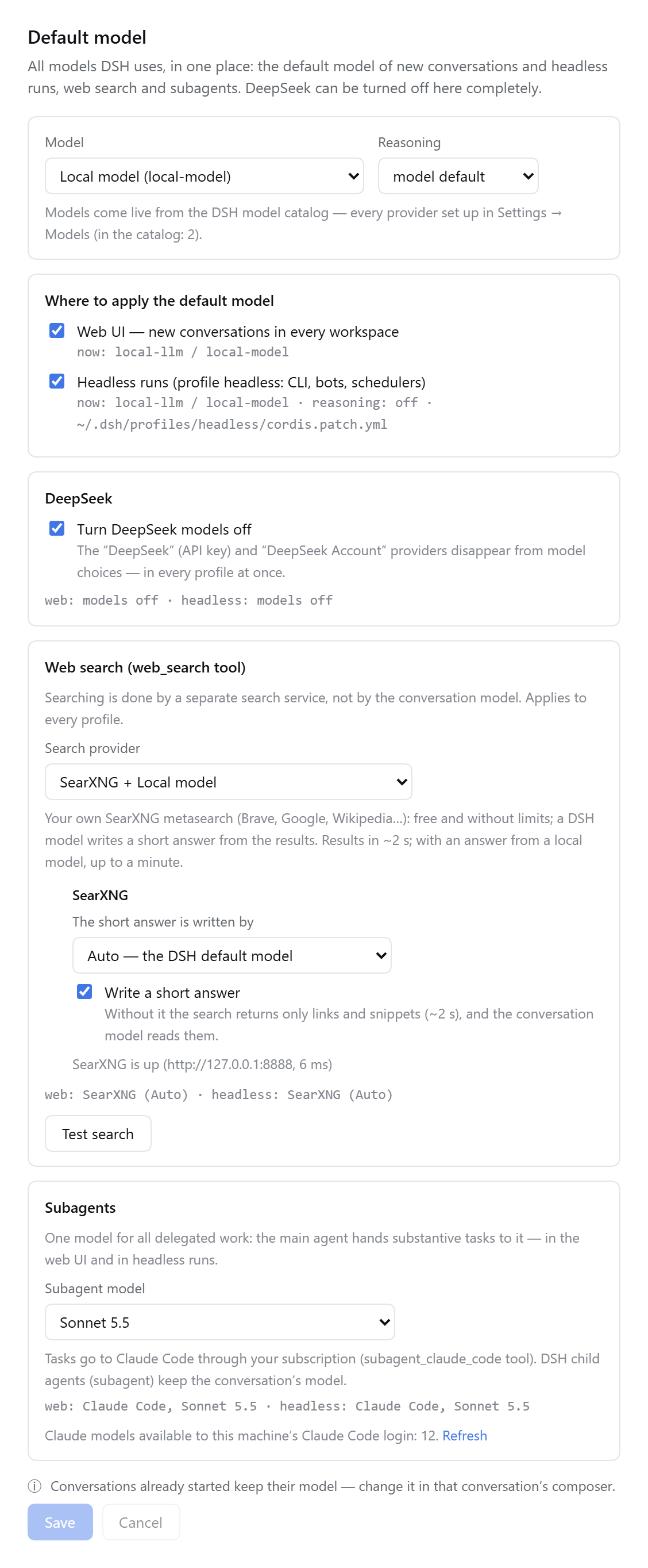
Settings → Default model:
headless profile. The current model of each is shown.sessionController.modelCatalog()), so a provider added in Settings → Models appears on the page at once.supportedModels() of the local Claude Code login. The probe sends no message, so no tokens are spent; it is cached for an hour, and the Refresh link asks again. Without the SDK or a login the page falls back to the aliases opus, sonnet, haiku and says so.English, Chinese and Russian. The page follows the DSH language setting (Settings → General → Language) and falls back to English. DSH versions without a Russian UI language get one added by the plugin; untranslated DSH texts then show in English.
pnpm on PATH when running dsh plugin add (it forwards to pnpm).@deepseek-ai/dsh-subagent-claude-code plugin and a Claude Code login on the machine.git clone https://github.com/usamoilov/dsh-model-settings ~/src/dsh-model-settings
# the page, in the profile DSH Web runs on
dsh plugin --profile web add link:$HOME/src/dsh-model-settings/packages/dsh-model-defaults
# the search providers, in every profile whose agents should use them
dsh plugin --profile web add link:$HOME/src/dsh-model-settings/packages/dsh-web-search-extra
dsh plugin --profile headless add link:$HOME/src/dsh-model-settings/packages/dsh-web-search-extra
# then restart DSH Web the way you run it (running conversations are interrupted),
# e.g. as a systemd user service: systemctl --user restart <your-unit>.serviceTo update: git pull in the clone and restart DSH Web. link: installs read the plugin from the clone.
Both plugins work without configuration. Optional settings go into the plugin's row in
~/.dsh/profiles/web/cordis.patch.yml:
- id: model-defaults
  config:
    # profiles the page manages (default: the running one and headless, if present)
    profiles: [web, headless]
    # your systemd --user unit of DSH Web, if it runs as one; enables the Restart button (off by default)
    webUnit: dsh-web.service
    # extra --patch files that restate the Claude subagent model (for a service run as
    # `dsh --profile headless --patch base.patch.yml --patch extra.patch.yml`)
    overlays:
      - path: ~/svc/extra.patch.yml
        label: My service
        profile: headless
        patches: [~/svc/base.patch.yml]   # patches applied before it, for the compose check
    # SearXNG address for the health line on the page
    searxngURL: http://127.0.0.1:8888
Search provider settings are described in dsh-web-search-extra.
Any SearXNG instance with the JSON output format works. A private one in Docker, bound to localhost:
mkdir -p ~/searxng/config
docker run -d --name searxng --restart unless-stopped \
  -p 127.0.0.1:8888:8080 -v ~/searxng/config:/etc/searxng \
  --memory 400m --cpus 1 searxng/searxng:latest
The first start writes ~/searxng/config/settings.yml. In it, set search.formats to
[html, json], server.limiter: false (the instance is private) and a random
server.secret_key, then docker restart searxng. Keep settings.yml out of git — it holds the secret key.
POST routes also require
the header x-dsh-model-defaults: 1 and a JSON body, so another site cannot send them as a form.yaml library (comments and !!js expressions survive),
under DSH's profile lock, with an atomic write and a backup (cordis.patch.yml.bak-model-defaults-*,
last 5 kept). After each write dsh --profile <name> --dump-config must succeed and contain the chosen
provider, otherwise the file is rolled back.systemctl --user --no-block restart <webUnit> only when webUnit is configured.On a machine with DSH installed (the plugins borrow yaml and the profile lock from the DSH install; it is found through the running DSH, dsh on PATH, or DSH_ROOT):
cd packages/dsh-model-defaults
node test/unit.test.mjs      # reading and editing profiles
node test/modules.test.mjs   # messages, config, Claude model list
node test/client.test.mjs    # renders the page in every language (no browser needed)
node test/live.test.mjs      # real profiles are only read; writes go to a temp copy

cd ../dsh-web-search-extra
node test/unit.test.mjs
node test/live.test.mjs            # needs SearXNG
node test/live.test.mjs --claude   # plus one Claude search (uses your Claude limits)
client.test.mjs and the search plugin's unit.test.mjs need nothing but Node.js.
dsh plugin --profile web remove dsh-model-defaults dsh-web-search-extra
dsh plugin --profile headless remove dsh-web-search-extra
# and restart DSH Web
Changes made through the page stay in the profiles. Before removing, switch web search back to
DeepSeek and untick "Turn DeepSeek models off" if you want DSH's defaults back, or delete the rows
marked # dsh-model-defaults: … from cordis.patch.yml.
CLASSIFICATION EVIDENCE
系统优先读取 GitHub Topics,再与站内分类词典和词根规则比对。当前命中: llm、deepseek-harness。
morluto
Reverse engineer anything with agents, from app behavior down to native binaries.

deepseek-ai
DeepSeek Harness: Everything is a Plugin.

nexu-io
The 1st Collaborative AI Design Agent Workspace. Local-first and open source. Create motion, prototypes, websites, apps, dashboards, presentations, images, and videos with your team and AI agents. Share work, exchange feedback, and iterate together in one workspace.