
Agent 与会话
插件

nuwa-skill
alchaincyf
你想蒸馏的下一个员工,何必是同事。蒸馏任何人的思维方式——心智模型、决策启发式、表达DNA。Distill how anyone thinks.
PROJECT TOPICS
INSTALL REFERENCE
dsh plugin --profile web add github:uos1231234/dsh-plugin-virtuoso-layout
该命令指向仓库当前默认分支;尚无绑定当前 commit 的完整验证结果。
PROJECT README
An AI agent that drives Cadence Virtuoso to draw layout — packaged as a DeepSeek Harness plugin.
12 host-side tools, zero runtime dependencies, driving Virtuoso 6.1.7-64b inside a
RHEL 6.5 VMware guest. Verified end to end on a real SMIC 0.18 µm process: the layout it
produced passes Calibre DRC with zero geometry violations and passes LVS as a
recognised <model> device.
Not a script that clicks menus. Commands are SKILL expressions evaluated inside the running Virtuoso CIW:
host (this plugin, Node.js)
  │  SSH / SCP
  ▼
guest (RHEL 6.5)
  │  virtoso-bridge daemon on :65452  ◄── SSH tunnel to 127.0.0.1:65453
  ▼
ramic_bridge.il inside the CIW
  │  evalstring("(progn …)")
  ▼
Cadence database API  →  dbCreateRect / dbSave / cv~>shapes
Because it goes through the database API rather than the GUI, the agent can state facts about the layout — "18 rectangles, bbox ((0.2 −1.0) (2.2 1.68)), gate length 0.18 µm" — instead of opinions about a picture.
XTEST key/mouse injection exists, but only to unwedge a modal dialog. It is never the primary channel.
| Tool | Purpose |
|---|---|
virtuoso_status |
four-layer readiness: VM → sshd → tunnel → CIW answers 1+1 |
virtuoso_vm |
VM + tunnel lifecycle; up is the one-call repair |
virtuoso_config |
persisted settings, applied on the next call |
virtuoso_recover |
repair the guest GUI, then prove it with a real eval |
virtuoso_windows |
SKILL window list + X11 window ids |
virtuoso_screenshot |
capture one Virtuoso window to a PNG the model can look at |
host_window |
enumerate / raise / capture Windows host windows (the VMware console) |
virtuoso_eval |
arbitrary SKILL over stdin |
virtuoso_run |
a long guest command as a background job |
virtuoso_drc |
parse Calibre DRC output into structured JSON |
workspace_create |
register a workspace |
context_usage |
this session's token budget (read-only) |
Full parameter/output schemas: TOOLS.md — generated from the live tool
definitions, so it cannot drift from the code.
lib/guard.js installs a single global tool guard that denies mutating
virtuoso_eval / virtuoso_run calls unless they carry a stateless, sha256-derived
confirm token.
The contract was read out of the harness, and it shaped the whole design: a guard is synchronous (it cannot wait for a human), it runs after the pre-execute waterfall, it can only deny — it can never force a call through. So the design is:
dbOpenCellViewByType(… "r"), cv~>shapes,
sleep; echo pass untouched — otherwise the gate trains you to paste tokens without
looking.confirm: true is deliberately rejected. That is a rubber stamp, not consent.danger-full-access abstains, because the user already granted full write
authority — and virtuoso_status reports enforcedNow so the gate is observable.Verified live in four cases: deny → token → allow, wrong token, read-only exempt, and abstain under full access.
For the illustrated version — the screenshots, and the full list of what is still
unverified — see RESULTS-SHOWCASE.md.
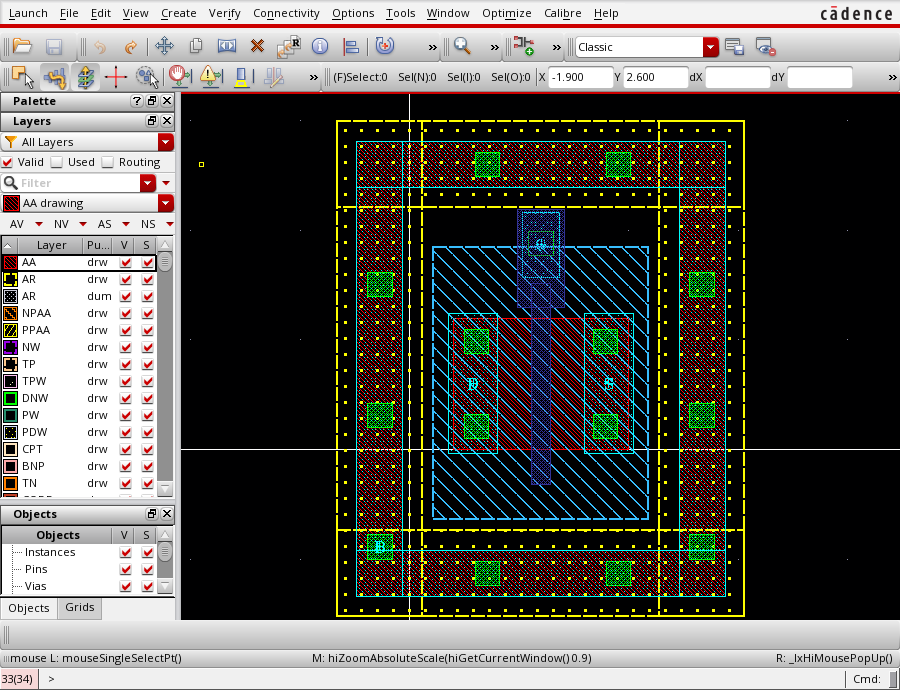
The DSH_NMOS/dsh_nmos15 cell, on the real smic18ee SMIC 0.18 µm technology:
| Result | |
|---|---|
| DRC | 393 checks, 6 violations — all density rules, zero geometry violations |
| LVS | CORRECT — N=4 EP=4, M0 S G D B <model> L=0.18um W=1.2um |
| Guard ring | four-sided P+ frame, closed loop proven by rasterising and counting holes |
| Iterations | 22 → 24 → 35 → 36 → 18 → 16 → 13 → 7 → 6 |
The 6 remaining are density rules (PD.*, MIM_8a): an isolated 3.7 × 4.5 µm device
cannot satisfy a <rv> metal-density target. Density compliance in a full chip is
unverified. These remain six unmet checks — not an exemption — and nothing here
is claimed to be DRC-clean or ready for tape-out.
Not achieved, and documented as such:
PEX-STATUS.md. A control experiment with the unmodified
deck rules out editor error.This project is as much a record of what went wrong as of what works. The failures are the interesting part.
| Document | Contents |
|---|---|
RESULTS-SHOWCASE.md |
start here for the outcome: what was achieved, the screenshots, and what is still unverified |
HISTORY.md |
timeline, bug ledger, and the judgements that were retracted |
AGENTS.md |
project memory: paths, environment facts, troubleshooting order |
LAYOUT-AUDIT.md |
hand-written geometry audit → discovering DRC is the authority |
DRC-RESULTS.md |
first real Calibre run: 393 checks, 22 violations |
SKILL-FIXES-AND-LVS.md |
three SKILL method errors, first LVS pass |
NMOS-FINAL.md |
converging the device to density-only violations |
WELLS.md |
well experiments: P-well is derived, N-well needs a pickup |
RING-AND-CONNECTIVITY.md |
measuring connectivity: 8 islands, a ring fixes 1 of 3 |
RING-CLOSED.md |
closing the ring; why only a screenshot revealed it was a solid bar |
PEX-STATUS.md |
why parasitic extraction does not run here |
A guard ring that was a solid bar. Four rectangles overlapped in y and filled in. No DRC rule says "a ring must have a hole", and connectivity analysis counted one component and passed it. A screenshot showed it immediately. The fix was to rasterise the shapes at 10 nm and count enclosed holes — a check the eye can make, now automated.
Prefix arithmetic is unavailable in Virtuoso 6.1.7. (- x d) fails with a load
error that reports the end of the wrapper, pointing nowhere near the fault. Infix
(x - d) works. Six diagnostic rounds were spent on this.
procedurep cannot probe built-in functions here. It returns nil for geOpen,
which demonstrably works, and errset collapses "no such function" and "refused"
into the same nil. Every conclusion drawn from those probes had to be re-derived.
npm install)Without Virtuoso and a PDK this plugin has nothing to drive. It is published because the technique — turning an opaque EDA tool into a programmable, verifiable, documented interface — transfers to any tool with a scripting layer.
# from the DSH checkout
node tools/virtuoso.mjs config-set vmrun="C:\path\to\vmrun.exe"
node tools/virtuoso.mjs config-set vmx="D:\path\to\guest.vmx"
node tools/virtuoso.mjs config-set guestIp=192.168.1.50
node tools/virtuoso.mjs config-set sshUser=youruser
node tools/virtuoso.mjs health      # proves the CIW answers
Then copy dsh-plugin-virtuoso-layout/ into your DSH profile's node_modules/ and
restart DSH. lib/*.js changes require a restart (HMR only watches patch files).
node .validate/plugin-test.mjs     # registers all 12 tools against a mock ctx
node .validate/guard-test.mjs      # the write gate: classification / policy / registration
node .validate/context-test.mjs    # token-meter contract, 50 checks
node .validate/job-test.mjs        # background-job payload, 8 checks
node .validate/hint-test.mjs       # error-message mapping
node .validate/paren-check.mjs f.il # SKILL paren balanceThis project would not exist without the RAMIC Bridge SKILL layer, and that comes from Tsinghua University.
virtuoso-bridge-lite (MIT) is by
Zhishuai Zhang, Xintian Li, Nan Sun and Lu Jie — the work of Professor Nan Sun's
group at Tsinghua University, whose research spans analog and mixed-signal IC design
and the EDA automation around it. The ramic_bridge.il file that lets a socket evaluate
SKILL inside a live CIW — the single mechanism this whole plugin stands on — is theirs.
Sincere thanks to Tsinghua University and to that group for releasing it. 清华大学,谢谢。
That project is not vendored here; it is a dependency. Install it from its own repository.
Calibre, whose DRC and LVS decks made it possible to check the layout rather than merely look at it. The verdicts quoted in the documents are Calibre's, not this project's.
Virtuoso, and the SKILL language and database API the plugin drives.
No foundry PDK, rule deck, or Calibre output containing rule text is included in this repository. Foundry decks are confidential material and are distributed only by the foundry to licensed customers.
What the documents here do contain: the decks' rule identifiers (GP_11a,
SP_1, M1_6) and the reasoning behind each geometry decision — which rule pinned
which edge, and what changing it broke. What they do not contain: the decks' own
wording, and any statement of a rule's limit. Where a limit would otherwise appear it
is written X (in the Python solver scripts) or <rv> (in prose and tables), and the
PDK's device model name is written <model>.
Two limits of that redaction, stated plainly rather than implied:
solve-*.py is a template, marked as one at the top of each
file: it records which rule drives which edge and is not runnable until you fill
the values in from your own deck. That is the intent, not a defect.This is therefore not an out-of-the-box reproduction package. Running it needs a
licensed Virtuoso, a licensed Calibre, a PDK obtained from your foundry, and DRC/LVS
invocation scripts written against your installation. The scratch/drc/*.sh scripts
here are the temporary ones actually used, carrying local paths and deck names; at
least one of them was not kept. Reproducing the result means supplying those pieces
yourself — not obtaining private parameters from us.
Obtain the decks from your foundry.
MIT — the full text is in LICENSE, and the package manifest says the same
thing in dsh-plugin-virtuoso-layout/package.json.
Third-party notices that must not be folded into the MIT text — the
virtuoso-bridge-lite attribution, and what foundry material is deliberately absent —
are in THIRD-PARTY.md. That split is not fussiness: GitHub identifies
a licence by template-matching the file, so appending paragraphs to LICENSE makes the
repository report NOASSERTION instead of MIT.
CLASSIFICATION EVIDENCE
系统优先读取 GitHub Topics,再与站内分类词典和词根规则比对。当前命中: ai-agent。
alchaincyf
你想蒸馏的下一个员工,何必是同事。蒸馏任何人的思维方式——心智模型、决策启发式、表达DNA。Distill how anyone thinks.

freestylefly
Prompt as Code | GPT Image 2 / 2.5 提示词与案例库,530+ 个案例、20+ 套工业级模板与可复用 Skills,新增 2.5 同提示词对比专区,附完整提示词与生成记录,持续更新。

titanwings
Distilly — Distill how they think into reusable Skills for any Agent or Bot. Formerly Colleague Skill(原同事 Skill).