
模型与 MCP
待识别

rea
morluto
Reverse engineer anything with agents, from app behavior down to native binaries.
PROJECT TOPICS
INSTALL REFERENCE
dsh plugin --profile web add github:tu1918/dsh-git-plugin
该命令指向仓库当前默认分支;尚无绑定当前 commit 的完整验证结果。
PROJECT README
A resident git panel for the DSH Web GUI's right sidebar: see the session workspace's changes, grouped the way git groups them, with the branch's state against its upstream — without leaving DSH and without a modal overlay covering the conversation.
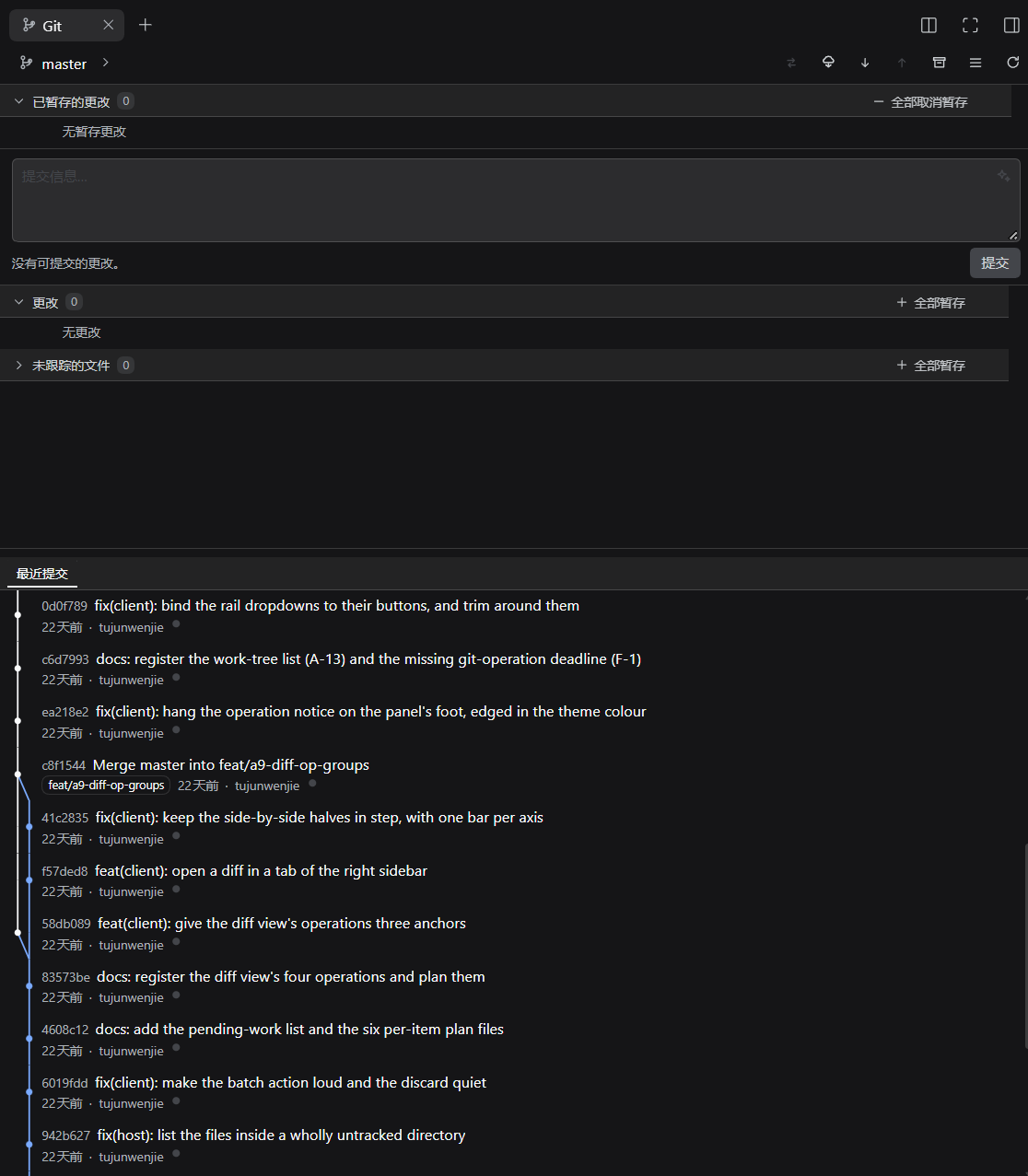
Released as v1.0.0: the foundation, a read-only panel, the commit loop (stage → commit → push), the diff view, branch management with the merge state, an AI-written commit message, a commit detail — then M5a's discard / undo / stash, M5b's commit-file drill-down, copy entries, the commit graph, multi-repository workspaces, the history row's rewriting operations (revert, cherry-pick, reset, squash, drop), and the release pass itself, which closed the one defect left open (a git operation could leave the panel spinning for good). Every item of the original M5 list — discard, stash, the commit graph, undo, multi-repository — has shipped. Since then the diff view has gained the one operation its three anchors were waiting for: the lines git left out between two hunks can be opened, one run at a time (A-12).
| File | What it is |
|---|---|
docs/TODO.md |
The open-items list — only what has not shipped, each entry with why it is not done and where its plan lives. An entry is deleted once it ships. |
docs/plan.md |
The execution plan: milestone status against the original acceptance criteria, what each completed milestone delivered and where, every deliberate deviation from the original requirements with its reason, and the next milestone's task list. |
| Area | State |
|---|---|
Change list: staged / changes / untracked / conflicts. Each row leads with a glyph for what the file IS (code, markup, stylesheet, data, image, prose, shell, settings, or a plain page), and its own right-hand column carries the status letter, which is the English initial of the state (U for untracked) with VS Code's ! for a conflict, plus the meaning as a tooltip |
✅ |
| That list as a file tree — directories fold, single-child chains compact into one row, each directory carries its subtree's file count — or as a flat list; the choice is remembered per user | ✅ |
| Branch rail: name, detached / unborn / upstream-gone, ↑ahead ↓behind | ✅ |
| Recent commits: paged by look-ahead, pushed/unpushed marker, read only while its tab is showing | ✅ |
Each history row is decorated with the refs pointing at that commit — local branches, remote-tracking branches (upstream/main) and tags (v0.2.9) as badges on its second line, three inks for the three kinds, at most three plus a +N that names the rest. Read from the ref namespaces rather than from git's decoration string, which cannot tell a local branch with a slash from a remote-tracking branch |
✅ |
Auto-refresh from filesystem events — one recursive watch on the work tree, one on the git directory — pushed over SSE with what moved (refs / index / worktree); a file an agent writes shows up without touching .git at all |
✅ |
A state-file poll as the fallback when events are unavailable (network drives, platforms without recursive watch), and a stat of the same files when even that fails |
✅ |
Live git status/branches/log over /git-panel/* |
✅ |
| Stage / unstage, one file or a whole group | ✅ |
| Commit box with an explicit scope: the index only, or every tracked change (the button says which, and how many) | ✅ |
| Pull ↓ / push ↑n / sync ⇅, with the upstream set on the first push | ✅ |
| Fetch every remote — a cloud with a ↓ under it, beside Pull — updating the remote-tracking branches without touching the working tree, the index or the current branch, so the ↑/↓ counts and the ○/● markers learn what the remote has and a merge can never be the side effect. A repository with no remote is told so rather than shown a silent success | ✅ |
| A git operation is bounded end to end. The host's deadline escalates SIGTERM → SIGKILL and settles on the process ending, so a helper that ignores the polite signal (or holds the pipes open after its parent dies) can no longer leave a request pending; the request carries a deadline of its own in the host and one more in the browser. A mutation that runs past it says the result is unknown — git may still be running — and the panel re-reads the repository instead of lying about what happened | ✅ |
The two prompts that are not git's are named rather than reported as a bare timeout: a commit configured to be signed (commit.gpgsign) that waits on pinentry, and an SSH remote waiting for a passphrase or a host-key confirmation. GIT_TERMINAL_PROMPT=0 cannot reach either, so both used to end as "git did not finish in time". The host reads the cause from what was being run plus the repository's own configuration — on the timeout path only, so no ordinary call pays for it — and answers gpg-prompt / ssh-prompt (a hang, outcome unknown, with the fix: check gpg-agent/pinentry, load the key into ssh-agent, trust the host once from a terminal). gpg and SSH answering and refusing are their own codes too (gpg-failed, ssh-failed), with git's own words kept as the detail |
✅ |
Remote-tracking branches in the branch picker, as a read-only section (origin/feature plus its tip's subject), read while the picker is open and so refreshed by the same fetch. The rows are labels, not buttons on purpose: checking a remote branch out needs the rebase-onto-origin / drop-local-commits decision and can land in a conflict, which belongs with the conflict view |
✅ |
Multi-repository workspaces (FR-8): when the session's directory is a container rather than a repository, one level below it is scanned for repositories (skipping dot-directories, node_modules, dist, build) and the rail grows a picker — only when there is a choice, so a single-repository workspace looks exactly as before. The default is the repository whose git state moved most recently, and the choice is remembered per container. The browser may only choose among roots the host itself found there, so naming a path of its own gets a refusal |
✅ |
HTTPS credentials. A remote that wants one and has none is named as such (auth-required, with the origin git itself printed), and the same failure notice grows a username / password form. "Save and retry" stores the pair through the harness's own credential seam — ctx.credentials, so the provider owns where the value lives, and this profile's local provider writes its own 0600 document rather than us inventing a store — and then retries the very operation that failed. Every later push/pull/fetch/sync resolves the stored credential and hands it to git through GIT_ASKPASS, with GIT_TERMINAL_PROMPT=0 unchanged so nothing can ever hang on a prompt. The value never reaches a log line |
✅ |
| Push refused as non-fast-forward → points at Sync instead of git's hint text | ✅ |
A pull whose tracked upstream was deleted on the remote says so and names the way out (git branch --unset-upstream, or repointing it) — instead of forwarding git's "no such ref was fetched", which never says the branch is gone |
✅ |
| UI in zh + en | ✅ |
| Change groups fold away individually, and stay folded (the count stays visible) | ✅ |
| A resident staged drawer directly above the commit box: it is what that box commits, and its empty state says so | ✅ |
| Changes and Untracked are sections of ONE scrolling list rather than drawers of their own: the panel has a single resize grip (the dock's), and each section's header pins itself to the top of that scroller, so a partially scrolled list still says which section you are in | ✅ |
| A clean working tree is stated by the sections themselves: Changes and Untracked stay on screen counting zero (the paragraph that used to say "no uncommitted changes" is gone), and only the staged drawer needs a note, because its header alone does not say why it is empty | ✅ |
| A group with no rows offers no bulk action — except the staged drawer, which keeps its button on screen, disabled, with the empty note as the explanation | ✅ |
| One bottom pane, one strip of tabs — recent commits, plus one tab per open diff — opening on the history tab by default and folded/opened by the tabs themselves (clicking the tab that is showing puts the pane away), sized by a drag handle, keeping every open tab's content loaded; the fold and the height are remembered. Any number of diffs may be open at once, a tab is marked by the same rule as the history tab, and hovering (or focusing) a diff tab reveals that tab's own × — closing one file is not closing the pane | ✅ |
| Diff view: click a change row → the diff opens as a tab of the bottom pane (beside the commit history, never a modal), half the screen tall and drag-resizable, inline or side-by-side, remembered; the diff's own header carries its operations only (layout, reload, and — in the dock — open in a new tab of the right sidebar, which moves the reading out of the dock and into a tab of its own so it gets the column's full height), and a long file name is ellipsized in the tab and in the diff header, with the directory giving way first (FR-1.2) | ✅ |
Diff operations have three anchors rather than one toolbar, because the three kinds cannot share a place: the header's labelled group carries the VIEW operations (layout, open-in-tab, reload — data-op-group="view"), the row between two hunks is where BETWEEN-LINE operations live (the expand control below — data-op-group="gap"), and every line's tail reserves a slot in CSS for an operation on that line (data-op-group="line"). The tail is the one end still without a control, and nothing is drawn there: a clickable box with no action behind it is worse than none |
✅ |
A hunk's band carries git's function context (describe('stashing (FR-6.2)', () => {) and deliberately NOT its @@ -a,b +c,d @@ address: that address is an offset the reader would have to add up, while every row already prints its own number in the gutter beside it — so "where in the file is this" is answered by looking left, and the band is left to answer the one thing a gutter cannot, which function or section the block sits inside. A hunk git could infer no heading for gets no band at all rather than an empty separator. The address stays on the band as data-hunk-range (invisible), which is what a test pins when it asserts that opening a run did not move the diff's own numbers |
✅ |
The lines git left out between two hunks (A-12) are reachable. A diff prints three lines of context around each change, so two changes far apart arrive as two hunks with an unprinted run between them; the row that stands where those lines are is a band reading Expand the N hidden lines, and one click reads THAT run — and no other — and draws it in place as ordinary context. The run's size is arithmetic on the two hunks (core/diff-gap.ts), so nothing is fetched until the click, and its text comes from the diff's own OLD side over GET /git-panel/fileLines — the index for a worktree diff, HEAD for an index diff, the first parent for a commit diff, and stage 2 for an unmerged path, which has no stage 0 — which is always a git object and so never reads the file system. A run opens, closes and re-opens on its own and costs one read; a run past the host's |
ceiling, or one the file moved out from under, is stated ("too large to read") with a
retry rather than drawn half-way, because the lines below a run are numbered by position
and part of one would mis-number every following line — and a read that FAILED says what
the failure was (the host's own refusal, verbatim) rather than blaming the run's size. A
side-by-side diff draws the run in BOTH halves, opening one closes none of the others, and
+N −M never moves: opening a run adds context, not changes | ✅ |
| Side-by-side diff is a fixed split: each half is half of the pane whatever the lines are, and each half is its own scroller — a line too long for its half is reached with the split's shared horizontal bar, and the two halves are kept in step on both axes so a paired line stays paired. Two independent scrollers cannot share a native scrollbar, so the halves hide theirs and the split draws one bar per axis at its own edges: the vertical one down the right edge, the horizontal one across the bottom. The halves are separated by a 16px lane (outside both scrollers, so nothing a half scrolls can push it around), with a hairline down the divider. A per-line action does not live in that lane — the halves have nothing per-row between them — but in the tail of the line's own row. The inline layout is the single-scroller one, where the full width is the reading width | ✅ |
| Word-level highlighting inside a changed line, from VS Code's own diff engine | ✅ |
| Diff of the index vs HEAD (--cached) or the worktree vs the index, untracked as all-new | ✅ |
| Binary files, conflicts' combined diffs, and >5000-line diffs each stated rather than mis-drawn | ✅ |
| Branch picker: switch, create (from HEAD or a chosen branch), delete — with the unmerged case asking for a second, forced click | ✅ |
| That picker as a real dropdown: it floats over the panel (hanging off the branch button and lined up with it, capped at the room left) instead of pushing the staged drawer, the commit box and the change list down; an outside press or Escape closes it | ✅ |
| A blocked switch shows git's own multi-line refusal, verbatim | ✅ |
| An interrupted operation's own bar: a merge, a revert, a cherry-pick or a rewrite that stopped on conflicts (or on a pick that became empty) says which one it is and offers the moves that operation really has — continue, abort, and (for a rebase) skip. The state comes from stat-ing the markers in the git directory (MERGE_HEAD, REVERT_HEAD, CHERRY_PICK_HEAD, rebase-merge/), not from the conflict list: once every conflict is staged the list is empty while the operation is still open, and a stopped rebase may have no conflict at all. Continue and skip wait until no unmerged path is left, abort takes two clicks | ✅ |
| A conflicted row's + is labelled as marking it resolved — the same git add it always was | ✅ |
| Commit message written by the deployment's default model from the staged diff, truncated to a budget and said so, landing in the box as editable text | ✅ |
| A history row IS one real button — both of its lines, so the clickable area is exactly the hover band — and selecting it splits the pane: the entries stay on the left, that commit's information opens on the right (metadata, then its file list with per-file churn and git's own binary answer) | ✅ |
| One height budget for the whole column (ui/panel-layout.ts): every region is bounded, the change list is the only one that grows (a zero flex basis keeps its content out of the arithmetic, so a thousand changed files cannot squeeze the drawers or the dock), the staged drawer is content-sized with no floor — a collapsed one leaves no blank band, so the commit box sits tight against it — and the dock's drag, plus any height it remembers from a taller window, is clamped at what the other regions leave it | ✅ |
| Section headers pinned to the top of the list they scroll in: a partially scrolled change list still says whether it is showing changes or untracked files | ✅ |
| A change row's toolbar: right-click it (or Shift+F10 / the menu key on the focused row) for that row's own action — stage, unstage, or mark a conflict resolved. Two groups, one hairline: git's actions first, the copying entries after them, and nothing painted red — §4.3's warning is the second click and the sentence the entry reads out between the two. Every entry carries a mark, and the card opens at the pointer, only as wide as its own words, pulled back inside the panel and flipped above a pointer that sits too low. Deliberately NOT the rail's dropdown: a right-click used to open the branch list's full-width strip | ✅ |
| Discard a change (FR-6.1): a working-tree row gains a third button — and its toolbar a third entry — that takes two clicks and says "cannot be undone" between them. It restores a tracked file from the index (never from HEAD, so it also works before the first commit) and deletes a file the index has never seen; a staged or conflicted row offers it nowhere | ✅ |
| Undo the newest commit (FR-3.8): the newest history row's toolbar carries one armed entry whose confirmation says which undo is coming — an unpublished commit is reset (--mixed, its changes return to the working tree), a published one is reverted (a new commit; history is never rewritten). The host re-resolves HEAD and re-asks the pushed question at execution time, so a stale row is refused rather than silently undoing a commit nobody pointed at | ✅ |
| The stash (FR-6.2), opened from the rail like the branch list: save the working tree (with an optional label, and untracked files only if you ask for them), read the stack, apply or pop an entry, or drop one. Entries are addressed by commit id rather than by stash@{n}, so a stack another window shifted cannot be acted on at the wrong position; dropping is the one irreversible action here and takes two clicks | ✅ |
| A switch git refuses because the working tree is in the way (FR-4.4) shows git's multi-line refusal and offers "stash, then switch to …": one click stashes (untracked files included, because those are exactly what git sometimes names) and retries the very switch that was blocked | ✅ |
| Drill into one file of a commit (FR-7.2): every row in a commit's file list is a button that opens that file as the commit changed it, in the same bottom diff tab a change row uses — git show <hash> -m --first-parent -- <path>, read against the revision rather than the working tree, so an uncommitted edit to the same file cannot appear in it. The reading follows moved refs only, and it is not swept away when the file is absent from the change list | ✅ |
| Commit graph (FR-7.1): every history row carries its own swimlane strip — a first parent continues straight down, an extra parent opens a lane, and a line rejoins when the branches meet. The assignment is one pass over all loaded commits, so loading the next page extends the diagram without redrawing it (pagination cannot break the lines); the strip's width is one number shared by every row, so a merge cannot shift the hashes | ✅ |
| Rewriting a commit from its row's toolbar, every entry armed (two clicks, the second one named): Revert this commit (a new commit that reverses it — any commit, and history is never rewritten), Cherry-pick this commit (apply it to the current branch as a new commit; a pick whose change is already here is cleaned up and refused rather than left as an operation with nothing to do), Squash into the previous commit (folds it into its parent, keeping that commit's message), Drop this commit (removes it and replays what followed), and Reset to this commit…, which opens into soft / mixed / hard — the hard one says it discards uncommitted work. Squash and drop are git rebase under the hood, so the panel refuses the cases where that would change more than asked: a merge commit as the target, a target outside this branch, a merge commit anywhere after it (the panel does not linearise a branch on your behalf), a detached HEAD, or an operation already in progress | ✅ |
| The v1.0 release pass | ✅ v1.0.0 |
The whole M2 loop runs without a terminal: change → stage → commit → push, with
the panel's own end-to-end test driving it against a real repository and a real
bare remote (test/host-mutations.test.ts).
/git-panel/* accepts loopback clients only. DSH's own frontend
authentication does not cover routes a third-party plugin registers on
ctx.webServer — verified against a running server, where / answers 401 while a
plugin route answers normally — so the plugin carries its own gate. A deployment
that binds wider than loopback is refused rather than silently exposing every
session's repository state; a trusted-authority or paired-device escape hatch
belongs with the mutations in a later milestone.
Mutations add two more rules on top of that gate: they require POST, they must
come from this origin (Origin ↔ Host), and their body is capped at 1 MiB. A
loopback fence alone would not stop another page on this machine from posting to
them.
src/core/      pure TypeScript: types, ports, git parsers, argument validation,
               the commit-scope decision, the unified-diff parser, the runs git
               left out between two hunks, the change list as a file tree,
               credential addressing (an origin → a record
               id), and the AI commit message's prompt/truncation/cleaning
  diff-engine/ word-level marks, from VS Code's diff engine (`vscode-diff`)
src/host/      git runner, git service, git state probe (filesystem events with a
               polling fallback), git directory lookup, repository discovery,
               askpass helper, sequence editor for rewrites
  adapter/     the only place the host names DSH (webServer, sessions, logger,
               the credential seam, and the model services
               `llm` + `agentDefaultModel`)
src/client/    browser half
  adapter/     the only place the browser names DSH (slots, tabs, locale) or a URL
  ui/          pure React over ports; no DSH import at all
test/          node --test; real git repositories, real sockets, real jsdom
The dependency direction is not a convention here — test/dependency-direction.test.ts
fails the suite if src/core gains an import, or if a DSH package is imported
outside an adapter/ directory. One bare specifier is allowlisted in src/core:
vscode-diff, VS Code's diff engine extracted into a zero-dependency MIT package,
which is what FR-2.3 asks for by name (see docs/plan.md D12).
The host bundle carries two runtime @deepseek-ai/* imports, both behind an
adapter. host/adapter/llm.ts uses the harness's own BlockAssembler and
createUserMessage rather than reimplementing stream assembly
(@deepseek-ai/dsh-llm, D23) — and declares this plugin's own message source
into the harness's MessageSourceMap, which is where DSH 0.2 expects a producer
to name itself. host/adapter/credentials.ts stores HTTPS
credentials through the harness's credential seam, ctx.credentials, rather
than a store of this plugin's own (@deepseek-ai/dsh-credentials, D44). Both
are peer dependencies; a composition that mounts neither still mounts the panel,
and the features that need them explain themselves instead of failing silently.
npm install
npm run check # tsc --noEmit && 669 tests && buildRequires DSH >= 0.2.0-rc.2 (the right-sidebar tab-type registry this builds on, and the merge-extensible message source map this plugin declares into) and git >= 2.20.
# the newest release, prebuilt — nothing is compiled at install time
dsh plugin --profile web add https://github.com/tu1918/dsh-git-plugin/releases/latest/download/dsh-git-panel.tgz
# then restart `dsh web` — a NEW bundle is composed at startup
The release asset is deliberately not version-named, so that URL keeps
working across releases; latest/download/ resolves the tag at request time but
takes the filename literally, and a versioned asset name would 404 the day after
it was published.
To run from a checkout instead — which is what you want while editing the
plugin — point at the directory. lib/ is a derived artifact and is not
committed, so the build must have run at least once:
git clone https://github.com/tu1918/dsh-git-plugin.git
cd dsh-git-plugin && npm install     # the `prepare` script builds
dsh plugin --profile web add link:"$PWD"
The panel appears through the right sidebar's + control as "Git changes".
The two @deepseek-ai/* packages the host half names at runtime (dsh-llm,
dsh-credentials) are declared as peer dependencies, not dependencies, so a
composition that mounts neither still mounts the panel. Their ranges carry an
explicit || branch — ^0.2.0-rc.2 || >=0.2.1-0 <0.3.0 — because node-semver
only lets a prerelease build satisfy a range that carries a comparator on the
same major.minor.patch tuple, itself tagged as a prerelease. A bare
^0.2.0-rc.2 silently excludes the harness's next prerelease and hands users an
ERESOLVE to work around by hand. @deepseek-ai/cordis needs no branch: it is
published as a plain 4.x.
Each change row leads with a glyph for what the file IS: nine built-in kinds
(code, markup, stylesheet, data, image, prose, shell, settings, or a plain page).
A deployment can replace any of them per extension with its own SVG, by writing a
small map at $DSH_HOME/git-panel-icons.yml (or wherever
config.fileIconsPath points):
# extension: path to an SVG file
ts: ~/icons/typescript.svg
.tsx: /home/me/icons/tsx.svg   # the leading dot is optional
md: ~/icons/markdown.svg
Rules, all of them deliberate:
Dockerfile keeps its
built-in glyph.~/… is expanded). A relative path is refused,
because there is no meaningful base to resolve it against.icon for .md is not an SVG document: …) — a
silently missing icon is the one failure that is hard to debug.data: URL), never injected into
the panel's DOM, so a configured file cannot run or fetch anything.Lines may be commented with #; quote a value ('…' or "…") when the path
itself contains a # or leading/trailing spaces.
None of the following needs a DSH process:
npm testtest/git-parse.test.ts — parsers against byte-level fixtures taken from real gittest/validate.test.ts — every argument shape §5.5 forbids, refused before git runstest/commit-scope.test.ts — FR-3.4's decision table, including the conflict casetest/git-integration.test.ts — parsers against repositories git just wrote:
unborn, detached, divergent upstream, conflicted merge, renames, unicode pathstest/host-mutations.test.ts — the M2 loop against real repositories: staging,
the unborn unstage, committing, commitAll's tracked-only promise, first push
setting the upstream, a refused push, a conflicting pull, sync, and the full
改→暂存→提交→推送 flow verified against a bare remote's refstest/diff-parse.test.ts — the diff model from real git diff output: hunks and
line numbers, word-level marks asserted by the text they cover, a whole-line
replacement earning none, binary and combined (diff --cc) output, truncation,
and the 5000-line fold gatetest/diff-gap.test.ts — the runs between two hunks (A-12): the arithmetic
(adjacent hunks produce nothing, a six-line run, the offset the changes above it
introduced, a diff whose two sides disagree about the run), the segment walk a
renderer uses, the blob-to-lines reading with its trailing-newline rule, the
numbering of both sides, and the rule that refuses a run that came back short or
cuttest/change-tree.test.ts — the change list as a tree (FR-1.3): nesting,
directories before files in git's own byte order, the compaction of a
single-child chain and where it must stop, and the per-directory counttest/commit-graph.test.ts — the swimlanes (FR-7.1): a linear chain in one
lane, a merge opening a lane its second parent's line rejoins, a first parent
that merges back into an existing lane, an unrelated tip claiming its own lane,
and the property the pagination rests on — a prefix of the history is a prefix
of the graphtest/commit-message.test.ts — the AI message's pure halves: the truncation
budget and its line boundary, the prompt's language and its "the diff was cut"
sentence, and the cleaning rules for what models answer anywaytest/llm-adapter.test.ts — the one file that names the harness's model
services, driven with a stand-in context: the route comes from the deployment's
default selection, several text blocks are joined (reasoning is not), and a
missing model, a failed stream, and an empty answer each become a stated failuretest/host-service.test.ts — the git service and the /git-panel routes over a
real socket: envelopes, 400/404/405/413, the same-origin refusal, the diff read
(worktree vs index, untracked, unborn, binary, clean), the between-hunk read from
each of the three old sides (the index, HEAD, a commit's first parent) and from an
unmerged path's stage 2, the range and path refusals, and the SSE
ready / changed / unavailable framestest/git-probe.test.ts — the git state probe over real repositories and real
filesystem events: a file an agent writes (which moves nothing inside .git), an
empty commit and an update-ref (which move only the reflog or a ref), a burst
coalesced into one report, a strategy that fails at start and one that gives up
while running (both handing over to the next), a released subscription going
quiet, and the polling fallback's two signalstest/host-auth-flow.test.ts — the credential path end to end: a real
git fetch against a real HTTP server that answers 401 until Basic
credentials arrive. Without a stored credential the failure is auth-required
with the origin git named; storing one in the map makes the same fetch succeed
and really move refs/remotes/origin/<branch>. Also the store's checks — an
origin the repository does not have, a remote that is not a bare origin, and a
deployment with no credential provider — and the audit line's refusal to carry
the valuetest/git-exec.test.ts — the process seam against a stand-in git that
ignores SIGTERM or leaves a child holding its pipes: the deadline still settles
(and a surviving helper no longer delays the result), the output cap cuts and
says so without pretending to be a timeout, and a missing binary is its own
outcometest/git-client.test.ts — the browser transport's deadlines: a host that
never answers becomes a timeout, a closed tab is not reported as one, and a
rewrite is given the long boundtest/host-hang-hints.test.ts — the hangs a deadline alone cannot name, each
one real: a signed commit waiting on a sleeping gpg.program (gpg-prompt),
gpg refusing (gpg-failed), a fetch over an ssh:// remote whose
core.sshCommand sleeps (ssh-prompt) or refuses (ssh-failed), and a hang
with neither cause configured — core.fsmonitor sleeping through a
git status — staying an ordinary timeouttest/host-mount.test.ts — apply() from the plugin entry to the wire, the
panel mounting in a composition with no language model at all, and a
gitTimeoutMs that would switch the deadline off being ignored out loudtest/client-panel.test.ts — the panel rendered in jsdom: groups, badges, path
splitting, clean and failure states, lazy history, the commit box's four scopes
and its Ctrl+Enter, per-row and per-group staging, the sync buttons' enabled
states, in-place operation errors, what one reported change re-reads (the panel,
but the history only for refs and nothing at all when the reading came back the
same), the diff pane (opening, folding, layout
memory, the operation anchors — the header's view group, and every row carrying
the per-line one — a hunk's band carrying git's function context rather than its
@@ address, binary placeholder, the list→box→diff DOM order, and the dock's
height default and drag clamp), the between-hunk rows (the band and its count,
one read per run and no second one for a run already read, each run opened on its
own, the run drawn in both halves of a split, a cut run stated rather than
half-drawn and read again on request, a refused read reported as the refusal rather
than as an oversized run, and every run closed when the pane is
pointed at another file), the branch picker (listing, switching, creating from
HEAD or a base, the two-click delete, the forced second ask for an unmerged
branch, Escape), the branch dropdown's floating layer (absolute, measured from
the rail, dismissed by a press outside but not by one inside it or on the
trigger that owns the toggle), the merge bar (continue held while conflicts remain, abort
armed), the sparkle (offered only with a staged diff, the message landing in the
box, the truncation note, no-llm), the conflict row's label, the commit detail
(files, churn, binary, remembered across folds), the file tree (nesting,
compaction, the directory caret actually turning, folds remembered per group,
the mode switch and its memory, and staging/opening a diff from inside the
tree), and the two-stage registrationvscode-diff — VS Code's own diff engine, extracted
into a zero-dependency MIT package — behind core/diff-engine/marks.ts. The
line-level hunks do not: git produces those and core/diff-parse.ts reads
them, so the engine never sees a whole file (see docs/plan.md D13).spawn, not execFile, and the difference is the whole
point of the deadline: execFile's timeout sends SIGTERM and its callback
waits for the close event, so a child that ignores the signal — or a helper
that keeps the pipes after its parent dies — leaves the promise pending
forever. Here the deadline escalates to SIGKILL, the result is ready once the
process has ended, and a child in uninterruptible sleep is left behind
rather than waited on. Exit codes come from the exit event, where a
signal-killed process reports code: null; a git diff --no-index that finds
differences is an ordinary exit 1 and must stay distinguishable from that.GET /git-panel/fileLines (git show :<path>, HEAD:<path>, <hash>^:<path>).
One side is all that is needed — a run between two hunks is unchanged by
definition — and the old side is the one that is always a git object, so that
route never reads the file system, a property the plugin has held since the
untracked case went through git diff --no-index. An unmerged path has no stage
0, so a worktree read falls back to stage 2, which is the side the conflict view
itself draws as the old one.GitRunner.run takes optionalLocks as a third argument, defaulting to
false, which stops git status from rewriting .git/index. That is
load-bearing: the git state probe watches that file, so a read that wrote it would
refresh the panel forever. Every mutation passes true explicitly.git restore --staged
restores from HEAD, and an unborn repository has none. unstage probes with
rev-parse --verify --quiet HEAD and falls back to git rm --cached.git pull is invoked as pull --no-rebase --no-edit. Both flags are about not
waiting for a terminal that is not there: a divergent pull creates a merge
commit, and without --no-edit git waits for an editor until the deadline kills
it.src/client/adapter/git-client.ts and
src/host/adapter/routes.ts; the ports do not change if it moves.ctx.get('llm') / ctx.get('agentDefaultModel')
and are deliberately NOT in inject: a deployment without a model still mounts
the panel, and only FR-3.5's button answers no-llm. src/host/adapter/llm.ts is
the single file that names them.RepoStatus.operation comes from stat-ing the markers in the git directory
(MERGE_HEAD, REVERT_HEAD, CHERRY_PICK_HEAD, rebase-merge/ — the same
gitDirOf the watcher uses), not from the conflict group: once every conflict
is staged the group is empty while the operation is still open, and a rebase
stopped on an empty pick shows no conflict at all. It is an enum rather than a
boolean because continue / skip / abort each need to know WHICH operation is
running — merge --abort is not the way out of a stopped cherry-pick.-m and a revert
--no-edit, but a rewrite drives git rebase -i: the host writes a static
sequence-editor helper into a private temp directory (as it does for the
askpass helper), names it in GIT_SEQUENCE_EDITOR, passes the intent through
the environment, and sets GIT_EDITOR=true for calls that could otherwise open
a message editor. The variables are cleared when a call does not ask for them,
so a launching shell cannot inject an editor either.git restore --staged
restores from HEAD, and an unborn repository has none. unstage probes with
rev-parse --verify --quiet HEAD and falls back to git rm --cached.CLASSIFICATION EVIDENCE
系统优先读取 GitHub Topics,再与站内分类词典和词根规则比对。当前命中: deepseek-harness。
morluto
Reverse engineer anything with agents, from app behavior down to native binaries.

deepseek-ai
DeepSeek Harness: Everything is a Plugin.

nexu-io
The 1st Collaborative AI Design Agent Workspace. Local-first and open source. Create motion, prototypes, websites, apps, dashboards, presentations, images, and videos with your team and AI agents. Share work, exchange feedback, and iterate together in one workspace.