English | 简体中文
dsh-generative-ui
Let the AI output interactive HTML components (Generative UI) directly in
the DSH chat flow.
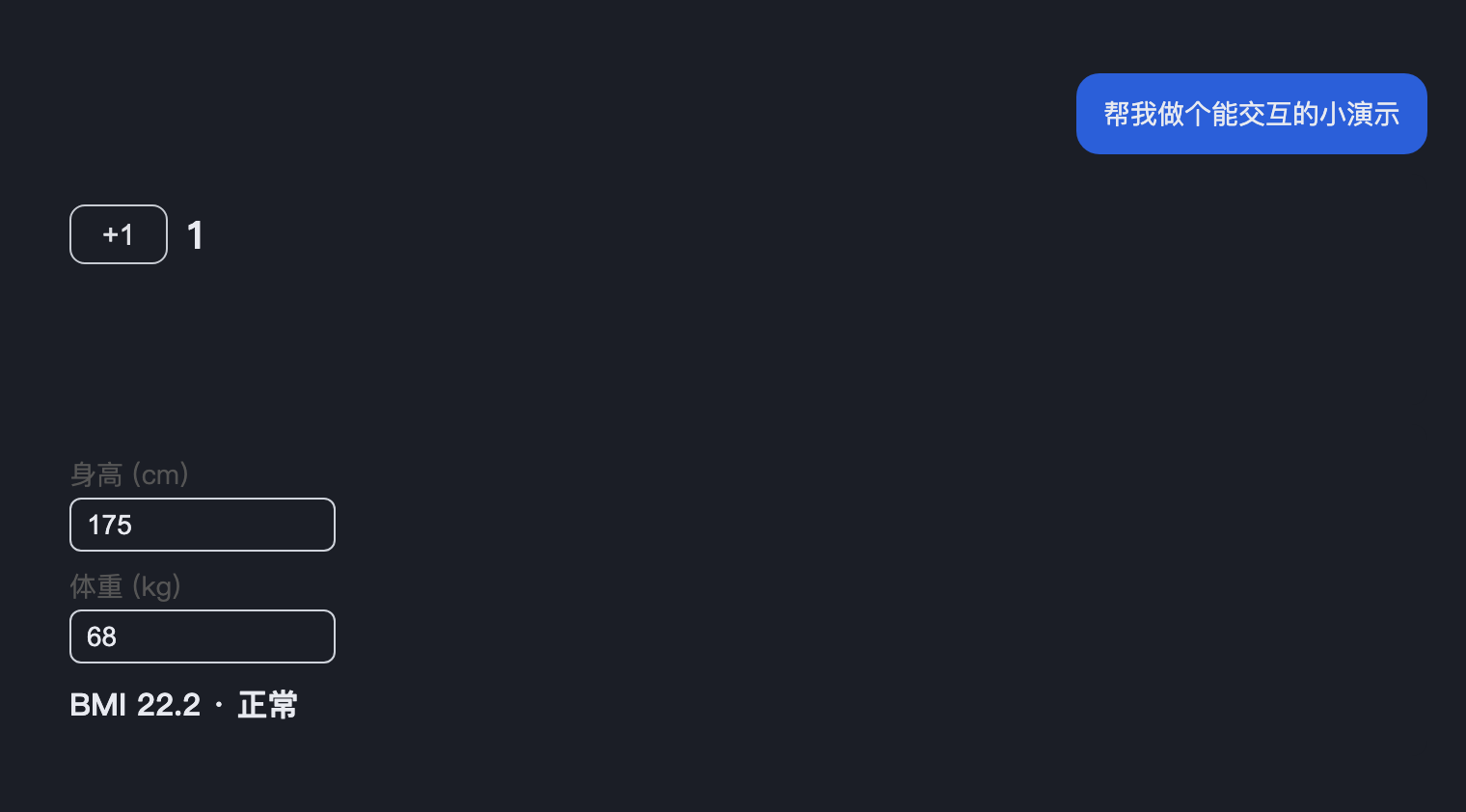
The agent writes a fenced code block in its reply:
```generative-ui
<!-- title: Example: counter -->
<button id="plus">+1</button> <span id="n">0</span>
<script>let n=0;plus.onclick=()=>{n++;n.textContent=n}</script>
```
The plugin extracts every artifact from that turn and renders it as a sandboxed
card below the message: an <iframe sandbox="allow-scripts"> (no same-origin)
— the artifact is fully interactive, but can never touch the host page,
cookies, or local storage.
Design
- Pure client-side: no backend, no storage. Artifacts live in the session
message text — the session is the store; there is no second copy of state
and nothing to sync.
- The host half does one thing: broadcast the fenced-block convention to every
agent via
systemPrompt.section.
- The browser half uses a
uiConversation.events accumulator to extract
artifacts from assistant/message events (the same turn-accumulator pattern
as dsh-taskboard), projects them onto the turn location, and renders the
cards through the conversation.chat.turnTail slot.
- Adaptive height: a bootstrap injected into each artifact reports its height
to the parent via ResizeObserver + postMessage; cards are clamped between
120–600px and scroll internally beyond that.
Layout constraints
An artifact is a bare iframe document: no font, no spacing reset, no surface. Every artifact document therefore gets a design system inlined into <head> (DESIGN_SYSTEM_CSS), so constrained generation is enforced at runtime rather than merely requested in the prompt:
- Separate regions with surfaces, not borders.
--gui-surface-1/2/3 is a three-step surface ramp; --gui-tint / --gui-tint-strong are accent washes.
- Three type sizes, no more.
--gui-fs-title(18) / --gui-fs-body(14) / --gui-fs-caption(12); hierarchy comes from weight and --gui-fg-dim, not from 1.08-ratio size steps.
- Spacing and radius are tokens only.
--gui-gap(12) / --gui-pad(16), radius --gui-radius(12) / --gui-radius-sm(8); chips stay fully round.
- Outer spacing is reset.
html,body{margin:0!important;padding:0!important} keeps artifacts flush with the message column; inner blocks own their spacing.
- A typography baseline. System font stack, 14px/1.7, an 11–17px size scale — no browser-default serif.
- Utilities:
.gui-stack .gui-section .gui-section--tint .gui-card .gui-tint .gui-chip .gui-chip--on .gui-label .gui-title .gui-desc .gui-note .gui-grid.
- Interaction and motion built in.
button ships with the primary style, :active scale, :focus-visible ring and 44px touch height; motion stays on transform/opacity under 200ms with --gui-ease, plus a prefers-reduced-motion fallback.
- Audit:
auditArtifactSource(source) reports violations (border / shadow / gradient / blur / body-spacing / comment / em-dash / buzzword / pure-color) without blocking the render.
The same rules travel to the model as text in GENERATIVE_UI_GUIDANCE.
Install
dsh plugin --profile desktop add link:<this-directory>
# and add @ttmouse/dsh-generative-ui to dsh.profile.bundles in the profile
# package.json; restart the desktop app (the host half registers the prompt
# section; client.js is read from disk per request)
Develop
npm install && npm run build       # produces lib/client.js + lib/index.mjs
npm test                           # unit + e2e (headless Chromium)
npm run screenshot                 # regenerate screenshot.png from the real client
Client changes take effect on page refresh; host-half changes (the
system-prompt text) need an app restart.
License
MIT


