
模型与 MCP
待识别

rea
morluto
Reverse engineer anything with agents, from app behavior down to native binaries.
PROJECT TOPICS
PROJECT README
dsh plugin --profile web add github:subeichen1/dsh-mcp-switch
English | 中文简介
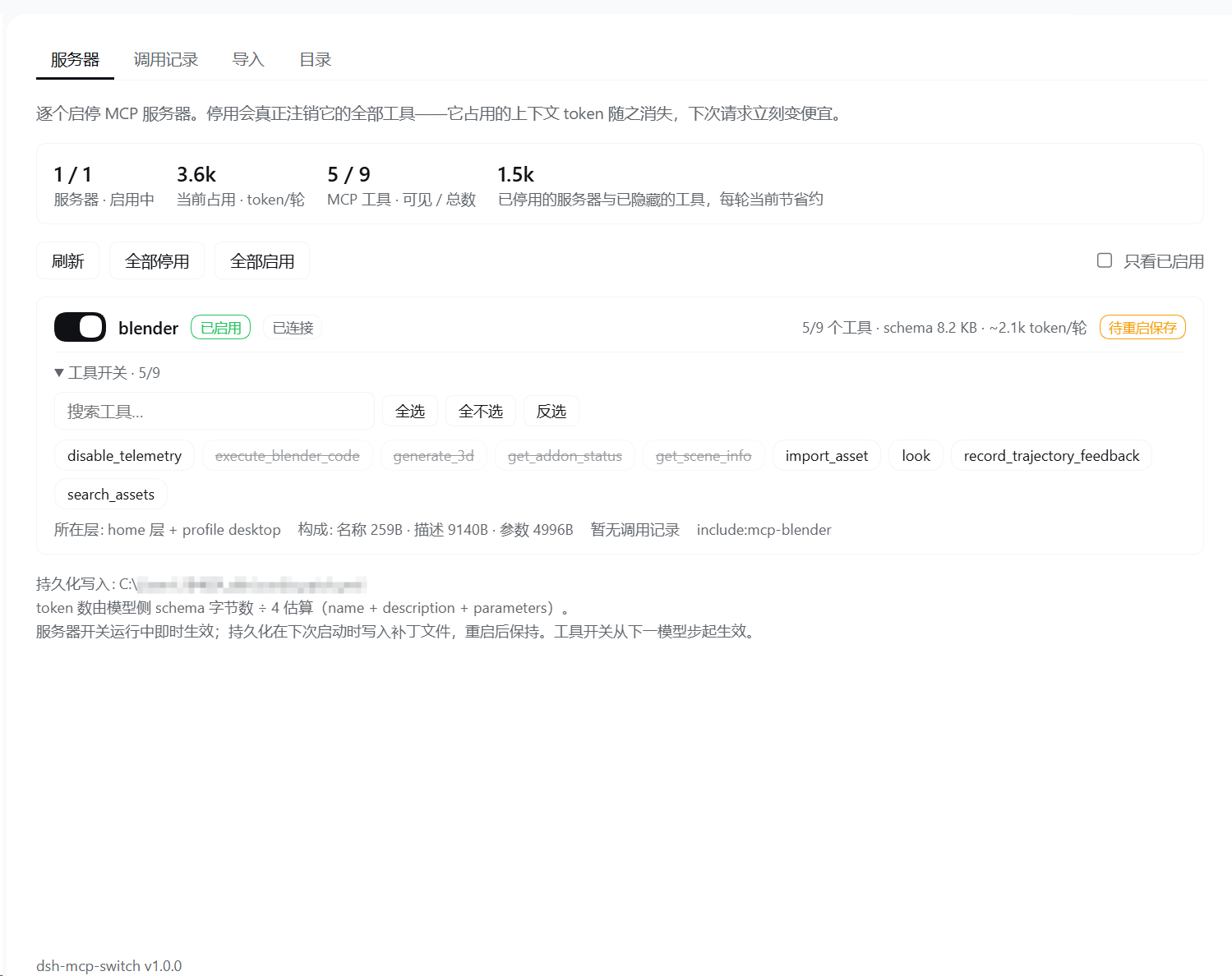
An MCP server in DSH is a resident cost. Once connected, the schema of every one of its tools — name, description, parameters — enters the stable prefix of every single request. The heavier the server, the more it costs:
| Server | Tools | Model-facing schema bytes | Per turn |
|---|---|---|---|
rea (measured on this machine) |
207 | 766,054 B | ~191K tokens |
That is not an estimate; it is what the panel reads back from ctx.tools.schemas().
Inside a 320K-token prefix, one server owns three fifths of it — which decides whether
a request can carry anything else at all.
The plugin adds one panel that does seven things:
$DSH_HOME/cordis.patch.yml,
so it survives a restart.The panel lives in Settings → MCP Switch by default, and can move to the left sidebar instead — see Panel entry.
DSH 的 MCP 开关面板:可以随时关闭整个 MCP 服务器,也可以只隐藏单个工具,并直观看到每一项选择在上下文中消耗多少 token。服务器开关会真正注销工具,立即省下完整 schema;工具开关在下一步模型调用生效,无需重连。面板默认位于“设置 → MCP Switch”,也可以移到左侧栏。欢迎在 GitHub Issues 提交建议与反馈。
$DSH_HOME/cordis.patch.yml and survive restarts; tool switches are written to $DSH_HOME/dsh-mcp-switch/state.json and are re-applied when DSH starts.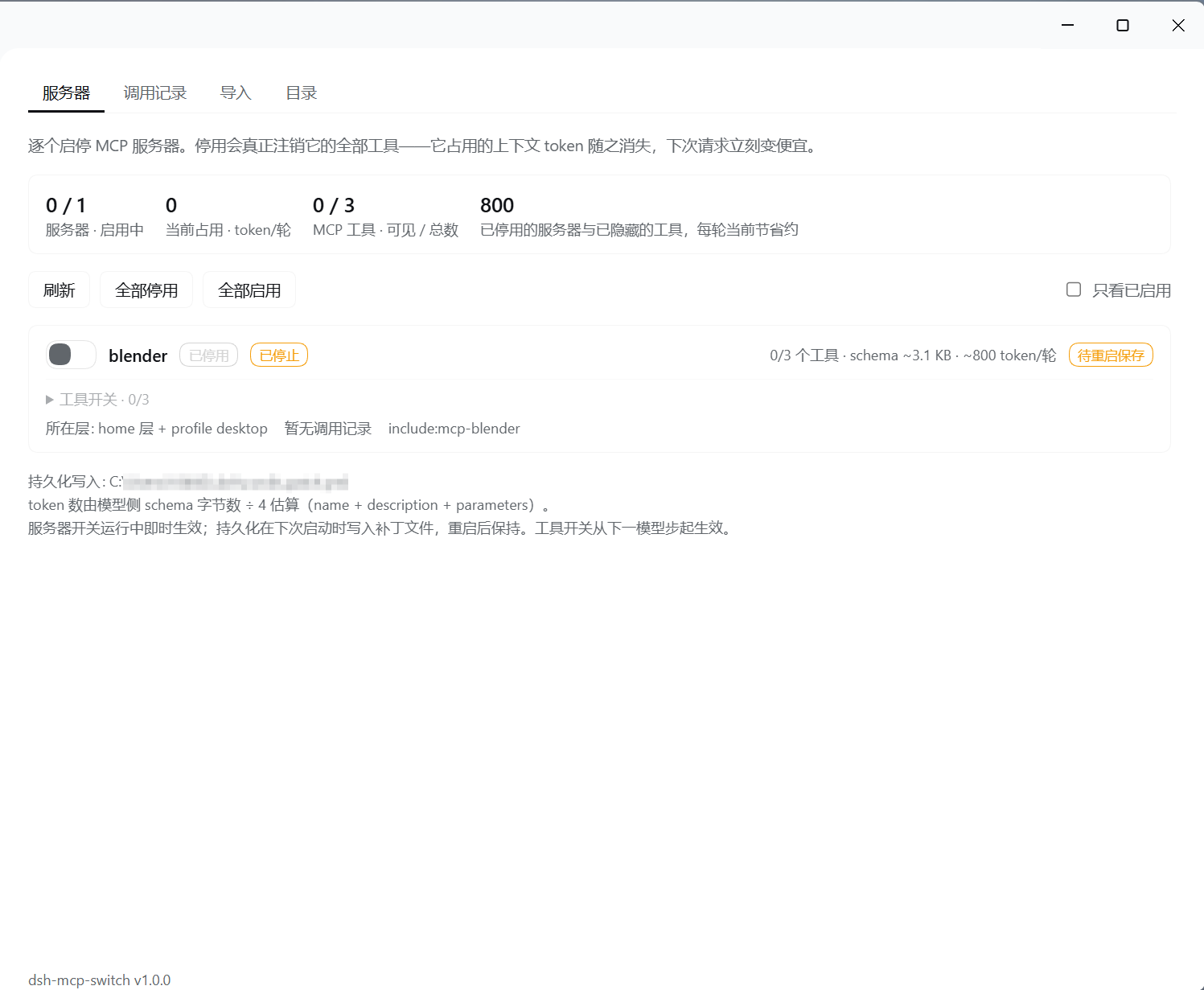
One page, two seats: a page inside Settings, or a row of icons in the left sidebar. The default is the settings page, because an upgrade should never move a panel nobody asked to move.
To move it, open Settings → Plugins → dsh-mcp-switch; the "Panel entry" card there changes it at any time:
| Choice | The panel appears as |
|---|---|
| Sidebar only | one icon row in the left sidebar (the settings section unregisters) |
| Settings only | one page inside Settings (the sidebar row unregisters) |
Only one seat exists at a time — the seat being unregistered is deselected first, so
no icon is left pointing at nothing. The preference lives in
$DSH_HOME/dsh-mcp-switch/state.json and is never written into
cordis.patch.yml: a patch states composition, no composition reads this value, and
putting it there would wake the patch watcher to replay composition on every click.
git diff shows it, uninstalling removes it
cleanly, and a restart keeps it.index.js + client.js + lib/.Only if you have MCP servers that are numerous enough or heavy enough to be worth switching. The test:
Whether disabling an MCP entry actually saves tokens has exactly one test: do the tools really disappear from the registry?
The chain below was verified line by line in the DSH sources and then measured live:
loader: Entry#update({disabled:true})
  → the entry's fiber is disposed
    → @deepseek-ai/dsh-mcp-client's ctx.effect cleanup runs
      → the stdio transport is closed
      → and the disposer it registered per tool is called
        → the ctx.tools.register registration is withdrawn
The load-bearing fact: dsh-mcp-client has no lazy registration path. There is one
route only — syncTools → listTools({cacheMode:"refresh"}) → ctx.tools.register
per tool. So "disabled" necessarily means "unregistered". There is no intermediate state
where the entry is off but the schemas are still around.
Writes use entry-level Entry#update only, never EntryTree.update — the latter
flattens every patch into cordis.yml and destroys the patch layer.
Measured on this machine (desktop profile, server rea):
| Step | Result |
|---|---|
| Before | enabled: true, fiberPhase: active, tools: 207, estTokens: 191514 |
| After disable | enabled: false, fiberPhase: null (fiber disposed), tools: 0, estTokens: 0 |
| After re-enable | enabled: true, fiberPhase: active, tools: 207, estTokens: 191514 |
tools: 0 is the point: it comes from ctx.tools.schemas(), the table of what is
actually registered right now. It is not this plugin's own accounting — it is the
tool service's answer.
Consequently this plugin does not implement a "hide but keep registered" mode. Such a mode saves nothing while making you believe it did — this repository refuses to ship that (see
DECISION.md).
Keep the server, switch off a few of its tools. This is not the same mechanism as the server switch, and the difference is worth stating plainly:
| Server switch | Tool switch | |
|---|---|---|
| Written to | an override row in $DSH_HOME/cordis.patch.yml |
$DSH_HOME/dsh-mcp-switch/state.json |
| Connection | closed: the fiber is disposed and every tool unregisters | kept: the tools stay registered, just invisible to that agent |
| Takes effect | after the write, replayed by the patch watcher | on the next model step |
| What it saves | the full schema bytes, plus a connection | only those tools' schema bytes |
| After a restart | applies by itself (declarative) | re-applied by the plugin at startup |
The mechanism is ctx.tools.restrict({deny}): a scope-local mask, not an
unregistration. DSH refuses a context-global restriction outright when there is no
agent.ctx ("a context-global restriction would mask every agent"), so the plugin
applies it per agent and again on agent/created — a newly opened session is never
missed.
Three consequences follow:
tools/list,
no re-registration, no patch write.knownTools) and labels it as cached. Those numbers
carry a ~ prefix, because they are what it used to cost, not what it costs now.baselineOf), so switching a server off
entirely never reads as "saves 0".In one line: the server switch saves connections, the tool switch saves context. Only switching both saves both.
DSH composes patches in this order:
bundle → profile cordis.patch.yml → $DSH_HOME/cordis.patch.yml → overlaysThe HOME layer outranks the per-profile layer. MCP rows are typically split across both (REA, for instance, lives in HOME). Write the override into the profile and the HOME row shadows it — you get a panel that changed something and had no effect.
So the override goes to $DSH_HOME/cordis.patch.yml (honouring the DSH_HOME
environment variable, defaulting to ~/.dsh/cordis.patch.yml). The panel also lists
every candidate layer it checked and whether each one exists.
The panel never rewrites the MCP row it finds. That row normally sits inside an
insert: list written by the official installer.
What it does instead is append a separate override row:
- insert:
    - id: rea-mcp
      name: "@deepseek-ai/dsh-mcp-client"
      config:
        serverName: rea
        # ...

- id: rea-mcp          # ← the only line this plugin added
  disabled: true
That works because DSH's built-in patch applier, applyEntryPatches, has three
properties:
upsertDisabled() guarantees;name skips the name assertion → the override needs
only id + disabled;disabled cannot disturb config, so your server
configuration is untouchable.All three are pinned in test/patch-contract.test.mjs, which reimplements that
semantics independently and then asserts the YAML this plugin emits satisfies it.
That test is a canary, not a leftover.
The write is line-wise: one top-level override row per id, ever; the disabled:
line is rewritten in place; nothing is reordered, the file is never rewritten wholesale,
rows inside an insert: list are never touched, and CRLF-vs-LF plus the trailing newline
are preserved. If the file is already in the target state, not one byte changes.
The panel's second tab records what was actually used: which MCP tools were called, how many times, how slowly, and how often they failed.
The data comes from the host's session/event stream — tool/call and tool/result,
paired by callId. Only mcp__<server>__<tool> and skill calls are recorded;
native read / bash are not, or the log would drown in ordinary work.
| Field | Meaning |
|---|---|
| Today / total | dates are cut in the local time zone, not UTC |
| Success rate | only settled calls count; running ones stay out of the denominator |
| Average time | same rule — a call that has not settled has no duration to average |
| Retention | 7 days, at most 20 000 lines ($DSH_HOME/dsh-mcp-switch/calls.jsonl) |
Each record is written only when it settles. Writing a "running" line too and merging on read looks cheaper, but a process killed between the two writes leaves an orphan row forever marked running — a call that appears to have been running for a week. This plugin does not do that.
Servers already configured in another MCP client can be moved into DSH in one click. Scanning is whitelist-based: exactly the ten paths below, never recursive.
%APPDATA%/Claude/claude_desktop_config.json   Claude Desktop
~/.claude.json                                Claude Code
~/.claude/settings.json                       Claude Code
%APPDATA%/Code/User/mcp.json                  VS Code
%APPDATA%/Code - Insiders/User/mcp.json       VS Code Insiders
~/.cursor/mcp.json                            Cursor
%APPDATA%/Windsurf/User/mcp_config.json       Windsurf
~/.codeium/windsurf/mcp_config.json           Windsurf
~/.gemini/settings.json                       Gemini CLI
~/.codex/config.toml                          Codex CLI
Three JSON schemas are recognised (mcpServers / servers / mcp.servers), plus
Codex's [mcp_servers.<name>] TOML section (a minimal extractor, so no TOML library
is pulled in). sse transport is not importable — dsh-mcp-client does not
support it, and the panel says so instead of pretending otherwise.
Search hits the official MCP registry (registry.modelcontextprotocol.io), because of
the other two sources one measured a 500 and the other is just links inside a README.
Opening the Catalog tab loads the first page straight away — you do not have to think of a keyword first. The registry returns one row per version, so the same server shows up two or three times; entries are collapsed by name, newest version kept. "Next page" appends to what you already see instead of replacing it.
Installing means appending a whole - insert: block to
$DSH_HOME/cordis.patch.yml. No runtime state is kept elsewhere: the file is written
and DSH's HMR — which is already watching it — picks it up.
| Action | What lands where |
|---|---|
| Install | one more - insert: block in the patch file; the live tree mounts it |
| Remove | only the block this plugin wrote; rows the host wrote are byte-identical |
| Roll back | every write is backed up first; backupPath points at it |
Before installing, the spec is validated: serverName must match
/^[A-Za-z0-9_-]{1,32}$/ (dsh-mcp-client's own rule), and a duplicate id is
refused rather than overwritten — overwriting would silently rewrite a server
that is currently running.
No backup is the weakest link. One bad edit to a shared patch file can break every profile, so this plugin backs it up before every write.
cordis.patch.yml.backup-<ISO timestamp>-<nn> in the same directory, and the response
reports backupPath. The sequence suffix is not decoration: the timestamp has only
millisecond resolution, so a second write in the same millisecond used to overwrite
the first backup — CI on Linux really did lose four copies that way.backupError — it never
pretends the backup succeeded.persisted: false plus persistError: the runtime state is real and the on-disk
state is not, and the two are reported separately.include, cordis:include, dsh-mcp-switch are always 403.disabled: alone; install and remove touch the - insert: block this plugin
appended and its matching top-level override. A server definition written elsewhere
is never modified, and cordis.yml is never touched.To roll back: copy the file that backupPath points at back over cordis.patch.yml.
# from GitHub (web profile — the profile this GUI uses)
dsh plugin --profile web add github:subeichen1/dsh-mcp-switch

# or from a local directory (use this while developing; re-run add after each change)
dsh plugin --profile desktop add "<absolute path to this directory>"mcp-switch, not the package name — the short id is what
cordis.patch.yml inserts.client.js,
hard-refresh the page. The host's HMR watches only its own patch files and
does not watch sources inside this plugin's directory; changing index.js or
client.js needs another add before it is projected into the profile.GET|POST http://127.0.0.1:<port>/mcp-switch/api.npm testtest/unit.test.mjs pure functions (every upsertDisabled branch, CRLF, quoted ids)
test/patch-contract.test.mjs emitted YAML must satisfy real DSH patch semantics (canary)
test/patch.test.mjs install/remove row editing: quoting, indentation, three delete guards
test/calls.test.mjs call log: classification, pairing, and the counting rules
test/scan.test.mjs config import: three schemas, TOML, the whitelist privacy boundary
test/catalog.test.mjs catalog search: package choice, spec generation, id normalization
test/write-path.test.mjs write-path contract: backups, idempotence, no fake success
test/tool-state.test.mjs tool-granularity state: versioned schema, atomic writes, corrupt fallback
test/known-tools.test.mjs known-tool cache: complete snapshots only, survives disconnects
test/package-contract.test.mjs version consistency, files whitelist, no runtime @deepseek-ai dep
test/docs-parity.test.mjs zh/en README section parity, bilingual release-note structure
test/release-consistency.test.mjs every version has a release note
test/panel-entry.test.mjs panel seats, state-file round trip, slot register/unregister, scrolling owner
test/servers-view.test.mjs servers view: pending rows, per-server call counts
test/catalog-view.test.mjs catalog view: loads on open, paging appends, search replacesZero dependencies, using Node's built-in node:test.
GET /mcp-switch/api → a snapshot:
{
  "ok": true,
  "servers": [{
    "entryId": "include:rea-mcp",
    "rawId": "rea-mcp",
    "serverName": "rea",
    "enabled": true,
    "fiberPhase": "active",
    "toolCount": 207,
    "schemaBytes": 766054,
    "estTokens": 191514,
    "breakdown": { "nameBytes": 6148, "descriptionBytes": 92265, "parameterBytes": 667641 },
    "tools": [{ "name": "mcp__rea__search", "toolName": "search", "enabled": true,
                "schemaBytes": 4096, "estTokens": 1024 }],
    "visibleToolCount": 207, "hiddenToolCount": 0,
    "visibleBytes": 766054, "visibleEstTokens": 191514,
    "knownTools": [], "knownToolCount": 0, "knownSchemaBytes": 0, "knownEstTokens": 0,
    "pending": null,
    "layer": "home",
    "inFile": true,
    "calls": { "calls": 42, "failed": 1, "avgMs": 310 }
  }],
  "orphaned": [],
  "totals": { "servers": 1, "enabled": 1, "disabled": 0, "mcpToolCount": 207,
              "mcpSchemaBytes": 766054, "mcpEstTokens": 191514,
              "activeEstTokens": 191514, "visibleToolCount": 207, "hiddenToolCount": 0,
              "visibleEstTokens": 191514,
              "baselineToolCount": 207, "baselineEstTokens": 191514, "savingsTokens": 0,
              "bytesPerToken": 4, "calls": 42, "callsToday": 5, "okRate": 97.6 },
  "patchPath": "C:\\Users\\<you>\\.dsh\\cordis.patch.yml",
  "callsPath": "<DSH_HOME>/dsh-mcp-switch/calls.jsonl",
  "layersReadable": true,
  "panelEntry": "settings",
  "panelEntryFile": "<DSH_HOME>/dsh-mcp-switch/state.json",
  "stateFile": "<DSH_HOME>/dsh-mcp-switch/state.json",
  "stateError": null,
  "stateMissing": false,
  "stateBackupUsed": null,
  "stateBrokenPath": null,
  "stateMoveError": null,
  "stateDamage": null
}(panelEntryError appears only when the state file exists but cannot be read.)
(stateDamage is the damage this process remembers: the file watcher usually reads the broken
file first and moves it aside, so by the time the panel reads it everything looks fine — this is
the only trace left.)
(orphaned lists rows the patch file has but the live tree never mounted.)
(known* is the tool cache from the last connection: a disabled server's live schema is
empty, so only the cache remembers what it cost.)
(baseline* is the cost with nothing switched off; savingsTokens = baselineEstTokens − visibleEstTokens.)
Add ?view= for three more views:
| view | Returns |
|---|---|
| (default) | the server snapshot: per-row cost, call count, still in the patch file |
calls |
the latest 200 call records, the statistics, and the log path |
scan |
the whitelist scan, each entry carrying an installable suggested |
catalog&q=&cursor= |
official catalog results, each carrying a suggested |
POST /mcp-switch/api, one of seven shapes:
{ "entryId": "include:rea-mcp", "disabled": true }
{ "action": "disable-all" }
{ "action": "set-panel-entry", "entry": "sidebar" }
{ "action": "set-tool", "serverName": "rea", "toolName": "search", "enabled": false }
{ "action": "install-server", "spec": { "id": "mcp-fetch", "serverName": "fetch", "transport": "stdio", "command": "uvx", "args": ["mcp-server-fetch"] } }
{ "action": "remove-server", "rawId": "mcp-fetch" }
{ "action": "clear-calls" }
Server-toggle response: { ok, entryId, rawId, serverName, disabled, fiberPhase, pending, statePersisted, stateFile, patchDeferred }.
Tool-toggle response: { ok, action: "set-tool", serverName, toolName, enabled, persisted, persistError?, statePersisted, stateError?, stateFile, backupPath?, backupError?, restrictionError? }; a disabled server returns 409 without changing state.
A failed state write is still 200 with persisted: false — the switch took effect in
this session, it just will not survive a restart.
Panel-entry response: { ok, action: "set-panel-entry", panelEntry, panelEntryFile }.
An entry that is neither sidebar nor settings is 400 — refused rather than
substituted for a valid one; a failed write is 500, leaving the state file as it was.
Install response: { ok, action: "install-server", id, serverName, patchPath, backupPath? }.
The loader is not called — the written patch file is handed to DSH's HMR. An id that
already exists is 409; an invalid spec is 400. Remove response:
{ ok, action: "remove-server", rawId, removed, patchPath, backupPath? }; not found is
404, a locked entry is 403.
| Status | Meaning |
|---|---|
| 400 | malformed body / disabled is not a boolean / target is not an MCP row / invalid spec |
| 403 | empty entryId / entry is locked |
| 404 | unknown entry / the id to remove is not in the patch |
| 405 | method not allowed |
| 409 | the id being installed already exists (refused rather than overwriting a live server) |
| 500 | the loader threw / the write failed |
| 502 | the catalog service is unreachable |
| 503 | the loader service is unavailable |
One: estTokens is a division, not a tokenizer. It is bytes / 4. Mixed scripts,
JSON structure, and repeated fields all push it away from the true value, typically by
±15%. Its job is ranking and order of magnitude — is this server worth keeping
resident — not exactly how many tokens did this turn cost. Trust the bill for
absolutes.
Two: it measures the model-facing projection, not the raw MCP payload. The plugin
counts only name + description + JSON.stringify(parameters). If an MCP tool
advertises an outputSchema, it does not enter the model context (DSH forwards only
parameters), so this plugin does not count it. That is exactly why roughly 73% of
REA's raw 3.0 MB payload is excluded — the panel's 785 KB is the part that actually
enters the context, far smaller than the raw tools/list, and far more honest.
Found a bug or have a suggestion? Please open an issue at https://github.com/subeichen1/dsh-mcp-switch/issues.
index.js          host half: route + enumeration + cost accounting + persist (line-wise upsert + backups)
client.js         browser half: four views (hand-written ModuleLoader CJS closure, no build step)
lib/patch.js      install/remove: validating, generating, and precisely deleting patch rows
lib/calls.js      call log: classification, pairing, counting rules, trimming
lib/scan.js       config import: ten whitelisted paths, three JSON schemas, minimal TOML
lib/catalog.js    official catalog search: package choice and spec generation
cordis.patch.yml  inserts the plugin row mcp-switch
locale/           en.json / zh.json — title and description in the plugin list
icon.svg          plugin icon
AGENTS.md         the maintenance contract (read this before changing the repo)
DECISION.md       why an override row, why no "fake saving" mode
DESIGN.md         tool granularity: state schema, mechanism choice, failure modes
SECURITY.md       security model and threat boundaries (English)
SECURITY.zh.md    the same, in Chinese
docs/             release notes
test/ zero-dependency tests (node:test)MIT. See LICENSE for the full license text.
CLASSIFICATION EVIDENCE
系统优先读取 GitHub Topics,再与站内分类词典和词根规则比对。当前命中: mcp、mcp-server、deepseek-harness。
morluto
Reverse engineer anything with agents, from app behavior down to native binaries.

deepseek-ai
DeepSeek Harness: Everything is a Plugin.

nexu-io
The 1st Collaborative AI Design Agent Workspace. Local-first and open source. Create motion, prototypes, websites, apps, dashboards, presentations, images, and videos with your team and AI agents. Share work, exchange feedback, and iterate together in one workspace.