
其他
完整应用

deepseek-harness
deepseek-ai
DeepSeek Harness: Everything is a Plugin.
PROJECT TOPICS
PROJECT README
English | 简体中文
DeepSeek Harness LLM adapter plugin for a locally deployed Qwen model (e.g. Qwen3.8-27B) served by vLLM behind its OpenAI-compatible /v1/chat/completions endpoint.
v0.4.1 · exact compatibility target: DSH
0.1.2-rc.1· MIT · community-maintained and not a DeepSeek or Qwen product.
✨ New in v0.4.1 — settings-page fixes;
maxRequestImageBytesroute cap removed
- No more focus loss while typing a reasoning-effort id (or a model id) — list rows now key off a stable row identity instead of the id text, so typing no longer remounts the row.
- Shorter, uniform field labels — long explanations moved into input placeholders; model-card columns are width-aligned.
maxRequestImageBytes(the per-request total image byte cap) is removed from config, schema, and the settings page. Every image is inlined once it fits its per-image budget (imageMaxPixels/imageMaxBytesare unchanged); an oversized request is refused by the backend LLM service against its own input limits. A leftover value in an existingsettings.yamlis silently ignored — no migration needed.- "Discover models from endpoint" now probes with the key currently in the API Key field — a freshly typed key works without saving first.
- The model list can be emptied —
modelsno longer requires at least one entry: save an empty list and the route stays mounted but dormant (no selectable models), then re-populate via "discover models from endpoint" or a manual add.
✨ New in v0.4.0 — zero runtime
@deepseek-aidependenciesThe published plugin no longer depends on any
@deepseek-aipackage at runtime — noschemastery,dsh-llm,dsh-settings,dsh-attachment,dsh-launch-environment, orcordis. Its only runtime dependencies are the MIT-licensedeventsource-parserand Node.js builtins.Why: the plugin now reproduces every DSH seam it touches (adapter contract, failure snapshots, brand ids, API-key/attribution/launch-env helpers, the settings-namespace
Configsurface) as small local modules undersrc/harness/plus a frozen, hand-owned configuration surface. It loads against the host's live services without importing the packages that define them — the same dependency posture as thedsh-llm-ollamareference implementation.What does not change: external plugin behavior is identical — provider route
qwen-local, settings namespacellm-qwen-local, the settings page, model discovery, and the wire dialect. The DSH compatibility target stays0.1.2-rc.1. The@deepseek-aipackages remain dev-only type pins (theirimport typereferences are erased from the build), so existing installs keep working as-is.Upgrading: drop-in — just
dsh plugin --profile web add dsh-llm-qwen-local@0.4.1(or your pinned snapshot tag). No configuration changes required.
dsh plugin --profile web add dsh-llm-qwen-localTwo deployment-specific knobs are first-class:
multimodal: true/false) — declares whether the deployment serves the model with vision.reasoning_effort wire spelling, the default level, and how off is expressed on the wire all come from configuration, matching whatever vocabulary your vLLM build accepts.- id: llm-qwen-local
name: dsh-llm-qwen-local
config:
baseURL: http://127.0.0.1:8000/v1
models:
- id: qwen3.8
name: Qwen3.8 (local)
multimodal: true
reasoning:
efforts:
- { id: off, wire: none }
- { id: low, wire: low }
- { id: medium, wire: medium }
- { id: xhigh, wire: xhigh }
defaultEffort: xhigh| English | 中文 | |
|---|---|---|
| Installation & usage | (this README) | (此 README) |
| Configuration reference — every field | docs/configuration.md | docs/configuration.zh.md |
| Design notes — wire dialect, model parameters, framework compatibility, error paths, limitations | docs/design.md | docs/design.zh.md |
dsh (the CLI) 0.1.2-rc.1 or newer, and a vLLM instance serving your Qwen model with the OpenAI-compatible API.fetch (18+).@deepseek-ai/dsh-attachment — the standard web and headless profiles do, via dsh-base.| DSH version | Status |
|---|---|
| 0.1.2-rc.1 and newer | ✅ Supported — the version the plugin is built and tested against. |
| 0.1.1-rc.2 and older | ⛔ Not supported — the web app fails to boot (see below). |
The plugin's settings page talks to the host through DSH's 0.1.2 "remote-namespace" client model (ctx.remote.settings / ctx.remote.credentials / ctx.remote.llm). Those typed namespaces are host-provided services that only exist on DSH 0.1.2 and newer — earlier releases (e.g. 0.1.1-rc.2) expose the older shared api/connection client instead, so the page cannot find them.
If you install the plugin on an unsupported DSH, the web app aborts at startup with:
web boot: 1 entry did not activate
dsh-llm-qwen-local: pending (waiting for services: remote.credentials, remote.llm, remote.settings)
This is expected on DSH < 0.1.2 — the plugin is not compatible with that version. Fix: upgrade dsh to 0.1.2-rc.1 or newer, or remove the plugin on the older build:
dsh plugin --profile web remove dsh-llm-qwen-localRequired vLLM serve flags (per the official vLLM recipe): --reasoning-parser qwen3 is effectively mandatory — without it the whole reasoning block lands in message.content — plus --enable-auto-tool-choice --tool-call-parser qwen3_coder for tool calling and --max-model-len 262144 (or higher).
# install from npm (recommended — prebuilt, no build step on install):
dsh plugin --profile web add dsh-llm-qwen-local

# install from git (the prepare script builds lib/ on install):
dsh plugin --profile web add github:starefinger/dsh-llm-qwen-local

# or from a local checkout (same prepare build runs on install):
dsh plugin --profile web add ./path/to/qwen3.8-LLM-plugin

# or from a packed tarball (prebuilt — no build step on install):
dsh plugin --profile web add ./dsh-llm-qwen-local-0.4.1.tgz

# verify the contributed layer, then start:
dsh --profile web --dump-config
dsh --profile webEach compatibility snapshot is tagged with the dsh version it targets. Snapshots published since 0.3.1 use dsh-<dsh-version>-plugin-<plugin-version> (dsh version first, plugin version as suffix); earlier snapshots use the bare dsh-<dsh-version> form. For a given dsh version, several tags may exist — use the one with the newest plugin-version suffix: it is the latest snapshot that supports your dsh. To install a specific snapshot, append #<tag> to the git URL — pnpm resolves the tag to the exact commit, so the install is reproducible and independent of main's current state:
# install the latest snapshot for dsh 0.1.2-rc.1 (plugin 0.4.0):
dsh plugin --profile web add "git+https://github.com/starefinger/dsh-llm-qwen-local.git#dsh-0.1.2-rc.1-plugin-0.4.0"
Pick the tag matching your dsh version (dsh --version) — when several tags share the same dsh version, take the newest plugin-version suffix. After upgrading dsh, remove and re-add with the tag for the new version:
dsh plugin --profile web remove dsh-llm-qwen-local
dsh plugin --profile web add "git+https://github.com/starefinger/dsh-llm-qwen-local.git#dsh-<new-dsh-version>-plugin-<plugin-version>"
Tags are immutable snapshots: a fix for an already-published tag ships as a new tag (a newer plugin-version suffix for the same dsh version), never by moving an existing one.
Git and local-path installs run the package's prepare script (→ pnpm build) to produce lib/ during install. pnpm v10 blocks dependency build scripts until they are allowed: if the first install fails with a "blocked build scripts" notice, add the exact key pnpm printed under allowBuilds in the profile's pnpm-workspace.yaml, then re-run the same dsh plugin add command. The tarball install is prebuilt and never needs this.
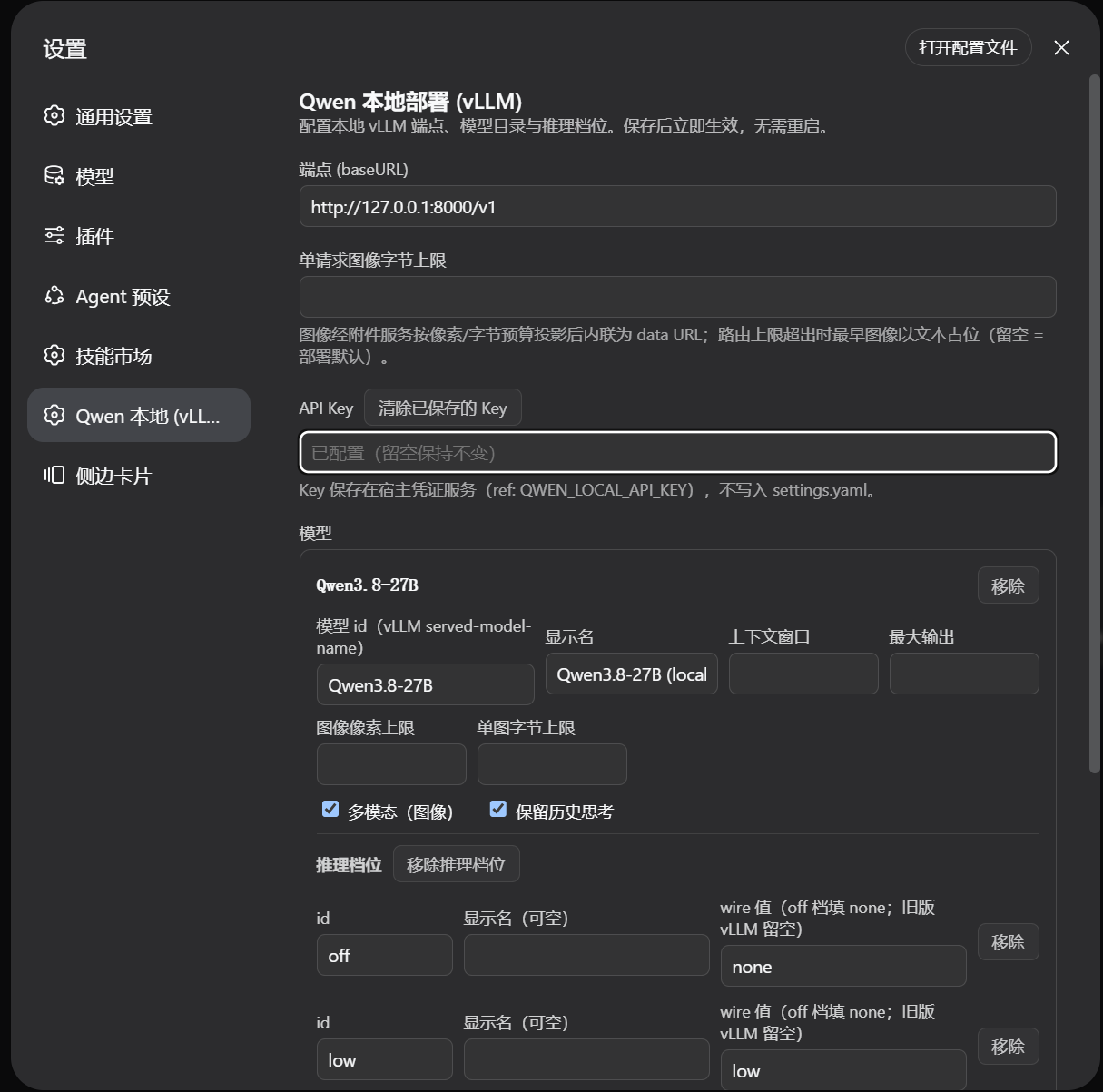
The bundle's cordis.patch.yml inserts a baseline llm-qwen-local line (model qwen3.8, multimodal: true, off/low/medium/xhigh efforts, default xhigh). Open Settings → Qwen 本地 (vLLM) to edit it: endpoint, optional API key (stored in the host credentials service, never in settings.yaml), and one card per model — id, display name, context window, output cap, image budgets, the multimodal switch, thinking preservation, and the reasoning-effort table:
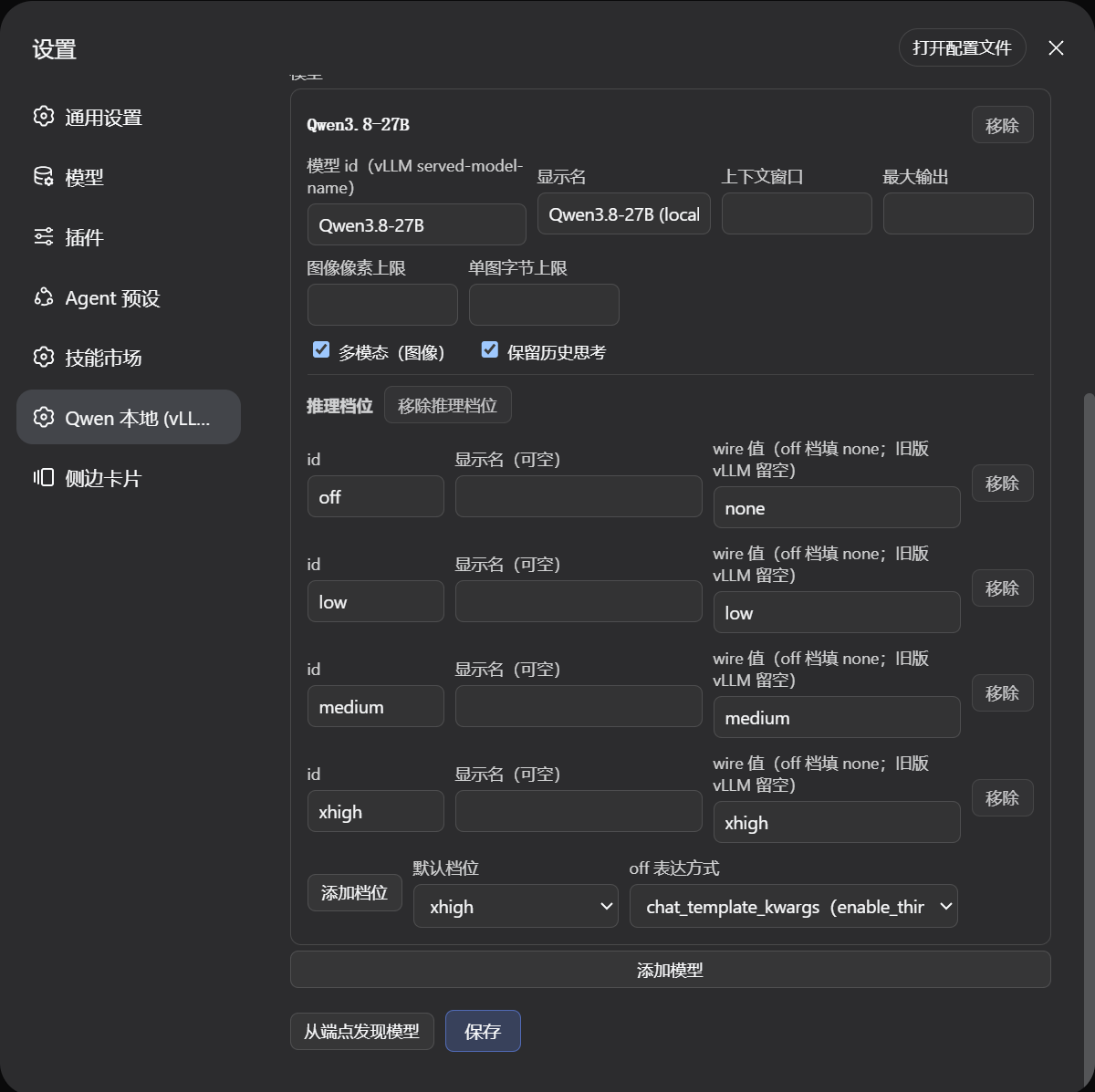
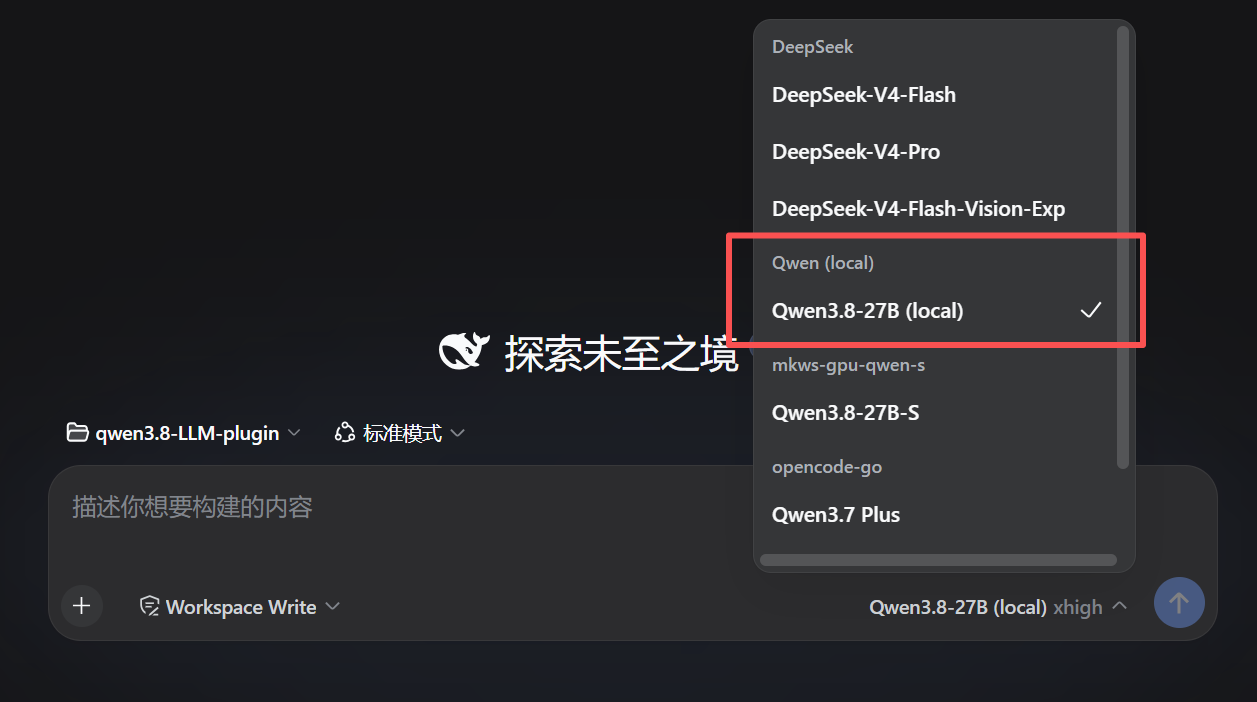
{baseURL}/models and merges the ids it finds.cordis.patch.yml by id: llm-qwen-local — a patch replaces the target line's entire config (no deep merge), so restate every key you keep.In the Web UI's model selector, the baseline qwen3.8 entry appears under its Qwen (local) provider group:
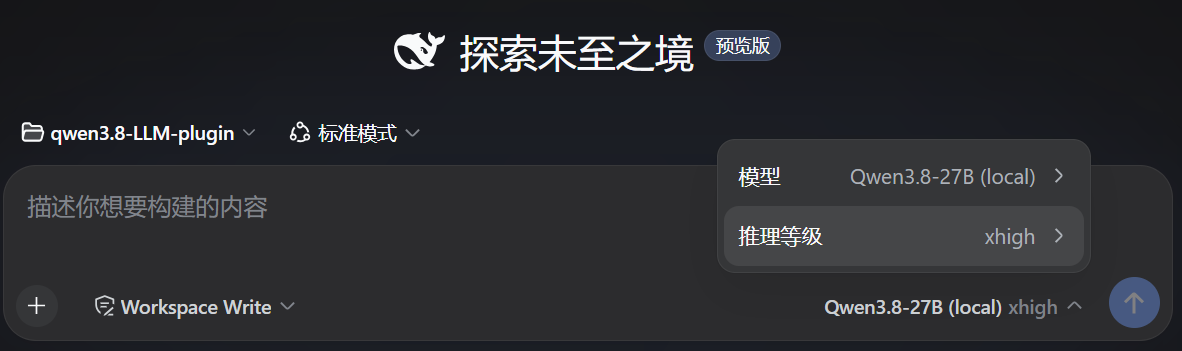
Click the input footer (model name + effort, e.g. Qwen3.8-27B (local) xhigh) to switch the session model or the per-request reasoning level (the levels your config declares, e.g. off / low / medium / xhigh):
All fields are optional; schema defaults fill the rest.
| Field | Default | Meaning |
|---|---|---|
baseURL |
http://127.0.0.1:8000/v1 |
Endpoint base; /chat/completions is appended. |
apiKeyEnv |
— (no auth header) | Env-var name holding an optional bearer token, read per request. |
models |
[] |
Model entries (see below). Empty = the route is mounted but dormant (no selectable models). |
defaultContextWindow |
262144 |
Context capacity used when a model has no exact value. |
maxTokens |
32768 |
Per-request output cap fallback. |
There is no route-level image cap: every image is inlined once it fits its per-image budget; an oversized request is the backend LLM service's to refuse.
Model entries: id (required), name, contextWindow, maxTokens, multimodal (the vision switch — set true for Qwen3.8-27B), preserveThinking, imageMaxPixels, imageMaxBytes, and reasoning (absent = no selectable efforts).
Full field-by-field reference, the multimodal switch semantics (over- vs under-claiming), and the reasoning-effort details: docs/configuration.md · 中文.
multimodal: true on a text-only endpoint fails mid-turn after the image message is durable; multimodal: false on a vision endpoint is silent (images become text placeholders).role: 'tool', so for a multimodal model an image inside a tool result is split into a follow-up role: 'user' multimodal message.The complete list (thinking-replay shape, projection caveats, deferred work) and what this plugin does not claim: docs/design.md · 中文.
pnpm install
pnpm build     # tsc → lib/ + client bundle
pnpm typecheck
pnpm test      # vitest: serialization, translation, e2e against a mock vLLM
Tests run against a scripted in-process vLLM (SSE) mock — no real model or endpoint is required.
The published plugin carries no runtime dependency on any @deepseek-ai package (no schemastery, dsh-llm, dsh-settings, dsh-attachment, dsh-launch-environment, or cordis). Its only runtime dependencies are the MIT-licensed eventsource-parser and Node.js builtins. The DSH seams it touches — the LlmAdapter contract, the LlmError failure snapshot, brand identity functions, API-key validation, attribution headers, the launch-environment reader, the content/image helpers, and the settings-namespace Config surface — are reproduced as small local modules under src/harness/ and a frozen, hand-owned configuration surface in src/config.ts, so the plugin loads against the host's live services without importing the packages that define them.
The @deepseek-ai packages remain dev dependencies: they pin the type-level contract (the import type imports are erased from the build) and let the test suite boot a real LlmRuntime. If a host changes a seam's runtime shape, the local module must be updated to match — the tests/boot.test.ts regression drives the real Cordis load-time validator against the frozen Config to catch a drift in the one seam that is validated at plugin load.
Regenerating the frozen settings envelope after a Config shape change: node scripts/extract-envelope.mjs --check (diffs the frozen constant against the reference schema in scripts/envelope-source.ts; run the plain mode on a pre-refactor tree to re-capture).
This repository is licensed under MIT.
The plugin's only runtime dependencies are MIT-licensed (eventsource-parser, plus Node.js builtins); it has no runtime dependency on any @deepseek-ai package. Its development toolchain includes TypeScript (Apache-2.0) among other MIT-licensed tools, and the @deepseek-ai packages remain available as dev-only type pins. No DeepSeek Harness or Qwen source is vendored into this repository. The Qwen3.8-27B model weights and the DSH product remain subject to their own upstream terms; this plugin is a community project and is not an official DeepSeek or Qwen/Alibaba product.
CLASSIFICATION EVIDENCE
系统优先读取 GitHub Topics,再与站内分类词典和词根规则比对。当前命中: 无有效分类标签。
deepseek-ai
DeepSeek Harness: Everything is a Plugin.

anywhere-labs
为 DeepSeek Harness (DSH) 插件生态打造的现代化桌面端解决方案。万物皆「插件」,桌面本身也是「插件」。

awesome-dsh-plugin
A curated list of plugins for DeepSeek Harness (dsh) · DeepSeek Harness 插件精选列表