
模型与 MCP
待识别

rea
morluto
Reverse engineer anything with agents, from app behavior down to native binaries.
PROJECT TOPICS
INSTALL REFERENCE
dsh plugin --profile web add github:stairclimber/dsh-english-prompt
该命令指向仓库当前默认分支;尚无绑定当前 commit 的完整验证结果。
PROJECT README
Translate every prompt into English for the model, and keep the answer in the language you wrote in — one answer, rendered natively.
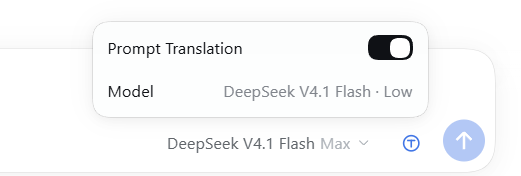
The circled-T control sits between the model selector and Send. It is blue while prompt translation is on and black while it is off; clicking it opens the settings panel above the composer, with the Prompt Translation switch and the model and reasoning effort the translation request actually uses.
Paste this sentence into any DeepSeek Harness session:
Install the DSH plugin from https://github.com/stairclimber/dsh-english-prompt into my current profile: clone the repository, install its package directory as a plugin bundle with the plugin manager, and enable it.
The repository must be reachable by the installing account — make it public or sign in to GitHub before cloning.
Prompts → English. Before a prompt enters the model request — and before it
becomes the durable user message of the Turn — the Host half asks your own
configured model (ctx.llm, on the Session's model route) for an English
rendering. Markdown, fenced code, inline code, commands, URLs, file paths, and
identifiers are preserved. The same call identifies the language you wrote in,
and the result is cached per message.
The answer stays in your language. A short language rule rides in the prompt's runtime context, which the loop re-reads after the prompt has been translated. It tells the model to write its answer in that language, so the answer is produced in your language from the start. The harness renders that one answer with its normal Markdown renderer: no second copy, no translation card, no English answer shown first.
No language drift. The rule names the language of the current prompt in every turn, so an English prompt in a Chinese conversation is answered in English and the next Chinese prompt is answered in Chinese.
Composer control and settings panel. A circled-T mark sits immediately to the right of the model selector, between it and Send. It is drawn as a blue line mark while prompt translation is on — using the same fill token as the composer's send button — and as a black line mark while it is off; there is no dimmed state. Clicking it opens a small settings panel above the composer, styled like the model-selection menu:
| Row | Kind | Value |
|---|---|---|
| Prompt Translation | switch (default on) | Enables prompt translation for this Session |
| Model | display | The model and reasoning effort the plugin actually uses: the Session's route plus the lowest effort the route advertises (DeepSeek V4.1 Flash · Low) |
The Model value is computed by the Host from the session environment (the
Agent's current model selection resolved through ctx.llm.resolveModelInfo()),
not copied from the composer's model selector, so it shows the auxiliary
request's real effort rather than the Session's.
The plugin's own UI text — the button's tooltip, the panel rows, and the Plugin Manager title and description — is fixed English and does not follow the interface language.
Only text the plugin itself sends is translated; tool arguments, files, and other Session events are never rewritten. Every auxiliary request carries the Session identity (routes such as OpenCode require it) and the lowest reasoning effort the model offers.
agent/pre-step translates the human message that enters the step, so English
is what the model reads and what the Session commits.ctx.systemPrompt.context({ name: 'english-prompt:response-language', order: 1000 })
contributes the language rule. Runtime context is re-read by
refreshContext() after agent/pre-step, which is why the rule always matches
the language detected for this turn. Chat does not render runtime context, so
the rule is invisible in the transcript.GET /english-prompt/state?sessionId=… and
POST /english-prompt/toggle?sessionId=…&enabled=0|1. state also returns the
resolved route (provider, model, display name, and the effort the
auxiliary call will request), which the settings panel shows. Cross-site browser
requests are refused.cordis.patch.yml carries the row's config:
| Field | Default | Meaning |
|---|---|---|
translatePrompts |
true |
Translate prompts into English. |
answerInUserLanguage |
true |
Make the model answer in the prompt's language. |
maxTextChars |
12000 |
Longest prompt text translated in one request. |
timeoutMs |
45000 |
Deadline for one auxiliary translation request. |
CLASSIFICATION EVIDENCE
系统优先读取 GitHub Topics,再与站内分类词典和词根规则比对。当前命中: deepseek-harness。
morluto
Reverse engineer anything with agents, from app behavior down to native binaries.

deepseek-ai
DeepSeek Harness: Everything is a Plugin.

nexu-io
The 1st Collaborative AI Design Agent Workspace. Local-first and open source. Create motion, prototypes, websites, apps, dashboards, presentations, images, and videos with your team and AI agents. Share work, exchange feedback, and iterate together in one workspace.