


模型与 MCP
待识别

rea
morluto
Reverse engineer anything with agents, from app behavior down to native binaries.
PROJECT TOPICS
PROJECT README

DeepSeek Harness 的跨会话长期记忆
聊过的项目 · 提过的偏好 · 做过的决定 —— 关掉窗口,它还记着

中文 · English
Mneme(Μνήμη)是记忆女神 Mnemosyne 的名字。希腊人把记忆交给她,也把梦交给她——名字落在插件上是同一个意思:白天记住,夜里整理。
autoDream就在你空闲时做这件事,把常看的留在热区,把陈旧的压成摘要、归档。
每次新开对话,AI 都像第一次认识你。你重新讲一遍项目背景,重新交代偏好,重新说服它别改那个已经定下来的决定。
dsh-mneme 给 DeepSeek Harness 一份跨会话的记忆:对话结束,值得留下的部分自动蒸馏进本机;下次开口,相关的几条自己浮上来。记忆不是锁在向量库里的一堆浮点数——它落在本机的一份 SQLite,旁边配一份 Markdown 镜像,你随时能打开、能改,改了不会被机器盖掉。
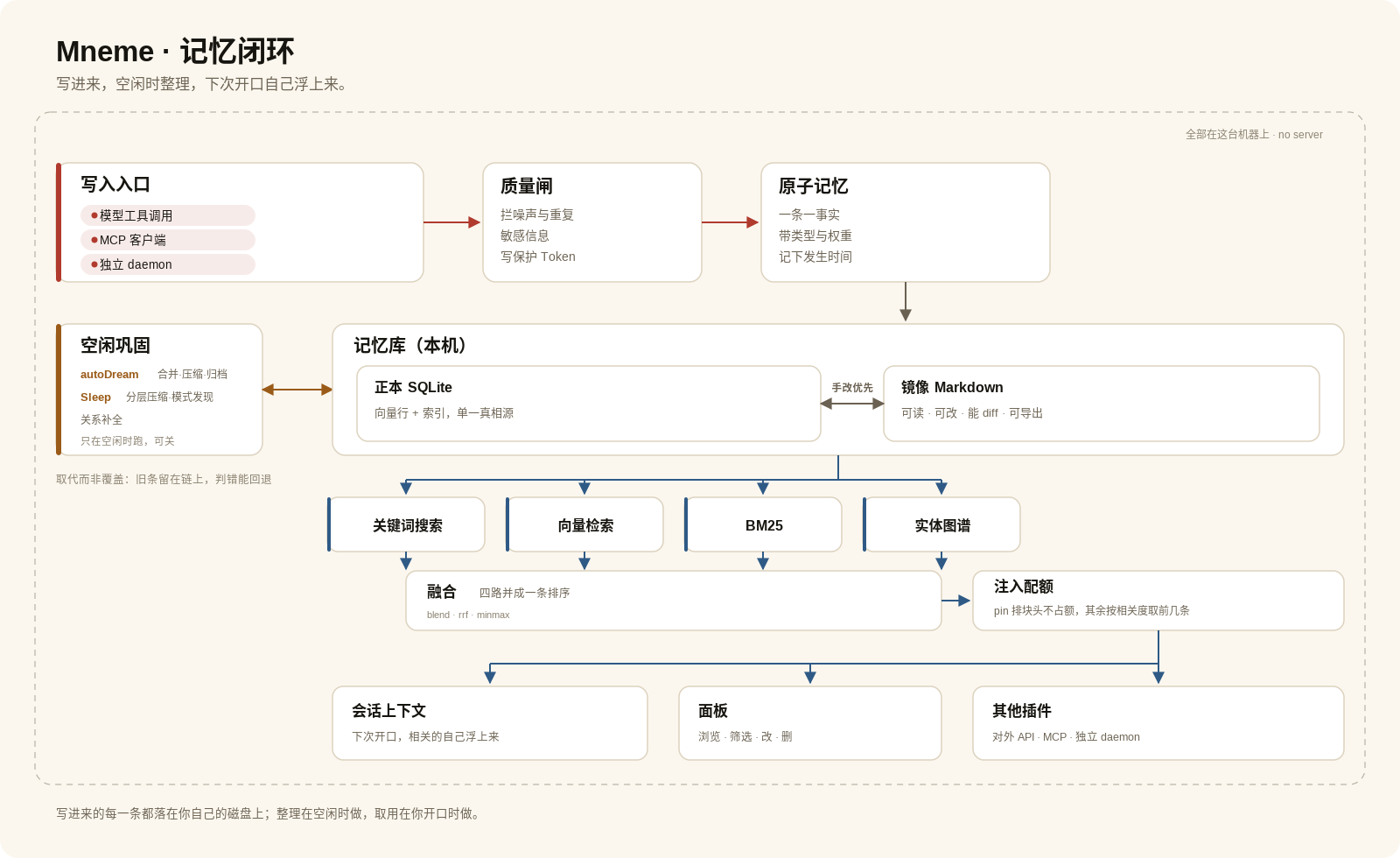
写进来 → 本机存着 → 空闲时整理 → 四路取回 → 送进会话。
dsh plugin --profile web add @modusensus/dsh-mneme
dsh web
两条硬要求,不满足装不上:
node:sqlite,Node 22 起不来库。本仓库是单仓多包:可安装的本体在
dsh-mneme/,根目录那份package.json只是仓库壳(private、无dsh字段)。走 Git 或 tarball 时路径必须指到子目录,否则装到的是壳本身。四种安装来源的写法见完整文档。
它落在你机器的哪几个地方:
| 目录 | 是什么 |
|---|---|
~/.mneme/memory |
记忆库本体:SQLite 正本,加十份可手改的 Markdown 镜像(老 ~/.dsh/memory 有库就继续读;两边都有库按体积判,误建的空库不会顶掉主库) |
~/.mneme/{models,runtime} |
本地嵌入模型与运行时缓存,删掉会自动重下(旧 ~/.dsh/mneme 存在就继续用,那个「旧」的位置跟着 DSH_HOME 走) |
~/.dsh-mneme |
CLI / MCP 的连接配置(url 与 token) |
想卸掉:
dsh plugin --profile web remove @modusensus/dsh-mneme插件目录没了,记忆还在(默认 ~/.mneme/memory,老用户是 ~/.dsh/memory)——想清干净就自己把用过的每一个记忆库目录都删掉,包括自定义 memoryDir / MNEME_MEMORY_DIR 指到的地方。新旧两个目录可能同时存着库:解析器两个都留在盘上,只删当前选中的那个,另一个还在,以后还可能被重新选中。三个目录名字很像,别认错:目录说明。
autoDream 在你不用的时段合并重复、压缩陈旧、归档过期。越用越精炼,不是越堆越大。对比 Zep / Mem0 / Letta / Hindsight 的 11 行逐项表(存储、检索、写入时抽取、离线巩固、冲突处理、遗忘、作用域、可审计性、多宿主、离线、许可证):能力对比。「—」不等于「差」。
一块面板装在设置页里:记录、浏览、筛选、搜索、改、删,外加实体关系图谱与状态审计。界面截图单独放在 docs/PANEL.md —— 面板一改,只有那一页需要跟着更新。
| 方式 | 你能得到什么 |
|---|---|
| MCP | 一个零依赖 stdio server(独立包 mneme-memory);Claude Code / Cursor / Codex / OpenCode 等任何 MCP 客户端都能挂上六个记忆工具 |
| 独立 daemon | dsh-mneme-serve 让记忆库常驻:DSH 关着时,脚本、网页端、你自己的面板读写同一份记忆 |
| 外部 API | HTTP 接口,别的插件想把记忆写进来,走 API 就行 |
| Melete | slow-stack/melete:DeepSeek 官方 chat-demo 的 fork,接进同一个库——本地伴随服务回合前注入 /context、回合后蒸馏写回,聊天源码零改动 |
| 社区适配器 | 如 Mneme-Bridge,把 DeepSeek 网页版接进同一个库 |
autoDream / autoSummarize 默认开)。dreamProvider / dreamModel 与 summarizeProvider / summarizeModel(配了这两组会绕过宿主直连,只换宿主不生效),或直接关掉这两个开关。| 想找什么 | 去哪 |
|---|---|
| 完整参考:全部配置项、CLI、外部 API、架构 | dsh-mneme/README.md |
| 每个配置键的默认值与含义 | docs/CONFIGURATION.md |
| 和别的记忆系统的能力对照 | docs/COMPARISON.md |
| 每个版本改了什么 | CHANGELOG · Releases |
| 三个目录到底谁是谁 | docs/DIRECTORIES.md |
| 致谢与相关研究 | 完整文档 · 致谢 |
"记忆不是把对话存下来,是让下一次对话从上次继续。"
© 2026 MODUSENSUS · MIT
Long-term, cross-session memory for DeepSeek Harness
projects · preferences · decisions — still there after you close the window
Mneme (Μνήμη) is the name of Mnemosyne, the goddess of memory — and of dreams. The name means the same thing here: remember by day, tidy up at night.
autoDreamdoes that while you are idle: hot memories stay hot, stale ones compress into summaries, old ones archive.
Every new chat, the AI meets you for the first time. You explain the project again, restate your preferences, and re-argue a decision that was already settled.
dsh-mneme gives DeepSeek Harness memory that outlives a conversation: when a chat ends, what is worth keeping is distilled into your machine, and the relevant pieces surface on their own next time. The memories are not a pile of floats locked in a vector store — they live in a local SQLite file with a Markdown mirror beside it: open it, read it, edit it, and your edits are not overwritten.
The whole loop in one picture (labels in Chinese): docs/memory-loop.svg.
dsh plugin --profile web add @modusensus/dsh-mneme
dsh web
Two hard requirements — without them it will not install:
node:sqlite; on Node 22 the database will not open.This repository is a multi-package repo: the installable plugin lives in
dsh-mneme/, and the rootpackage.jsonis only a repo shell (private, nodshfield). Git and tarball specs must point at the subdirectory, or you install the shell itself. All four install sources are in the full docs (Chinese).
Where it lands on your machine:
| Path | What it is |
|---|---|
~/.mneme/memory |
The store itself: the SQLite original plus ten hand-editable Markdown mirrors (an existing library under ~/.dsh/memory keeps being used; when both exist, size decides, so a stray empty library cannot take over) |
~/.mneme/{models,runtime} |
Local embedding model and runtime cache; delete it and it refetches (a legacy ~/.dsh/mneme keeps being used, and that legacy path follows DSH_HOME) |
~/.dsh-mneme |
CLI / MCP connection settings (url and token) |
To remove it:
dsh plugin --profile web remove @modusensus/dsh-mnemeThe plugin directory goes away, the memories stay (default ~/.mneme/memory, or the legacy ~/.dsh/memory) — check every memory directory you have ever used, including a custom memoryDir / MNEME_MEMORY_DIR, and delete them yourself if you want them gone. Both the new and the legacy path can hold a database at once: the resolver keeps both on disk, so deleting only the currently selected one leaves the other behind and it may be picked up again later. The three names are easy to mix up: directories.
autoDream merges duplicates, compresses what went stale, archives what expired. The store gets leaner, not fatter.How does it compare with Zep / Mem0 / Letta / Hindsight? An 11-row table — storage, retrieval, write-time extraction, offline consolidation, conflicts, forgetting, scoping, auditability, multi-host, offline, license: capability comparison (Chinese). "—" does not mean "worse".
One panel in the settings page: record, browse, filter, search, edit, delete — plus an entity graph and an audit view. Screenshots live in docs/PANEL.md: when the panel changes, only that page needs updating.
| Way in | What you get |
|---|---|
| MCP | A zero-dependency stdio server (standalone package mneme-memory); Claude Code / Cursor / Codex / OpenCode and any other MCP client can mount the six memory tools |
| Standalone daemon | dsh-mneme-serve keeps the store running: with DSH closed, scripts, web bridges and your own panels read and write the same memories |
| External API | An HTTP surface, so another plugin can write memories in through the API |
| Melete | slow-stack/melete: a fork of DeepSeek's official chat-demo wired to the same store — a local companion service injects /context before each turn and distills and writes back after it; chat source stays untouched |
| Community adapters | Such as Mneme-Bridge, which brings the DeepSeek web chat into the same store |
autoDream / autoSummarize, on by default).dreamProvider / dreamModel and summarizeProvider / summarizeModel (if set, they bypass the host), or turn the two switches off.| Looking for | Where |
|---|---|
| Full reference: every setting, CLI, external API, architecture | dsh-mneme/README.md |
| Defaults and meaning of each config key | docs/CONFIGURATION.md |
| How it compares with other memory systems | docs/COMPARISON.md |
| What changed in each version | CHANGELOG · Releases |
| Which of the three directories is which | docs/DIRECTORIES.md |
| Credits and related work | full docs · credits (Chinese) |
CLASSIFICATION EVIDENCE
系统优先读取 GitHub Topics,再与站内分类词典和词根规则比对。当前命中: mcp、model-context-protocol、llm、mcp-server、deepseek-harness。
morluto
Reverse engineer anything with agents, from app behavior down to native binaries.

deepseek-ai
DeepSeek Harness: Everything is a Plugin.

nexu-io
The 1st Collaborative AI Design Agent Workspace. Local-first and open source. Create motion, prototypes, websites, apps, dashboards, presentations, images, and videos with your team and AI agents. Share work, exchange feedback, and iterate together in one workspace.