
模型与 MCP
待识别

rea
morluto
Reverse engineer anything with agents, from app behavior down to native binaries.
PROJECT TOPICS
INSTALL REFERENCE
dsh plugin --profile web add github:sakthiveltofficial/dsh-gmail-plugins
该命令指向仓库当前默认分支;尚无绑定当前 commit 的完整验证结果。
PROJECT README
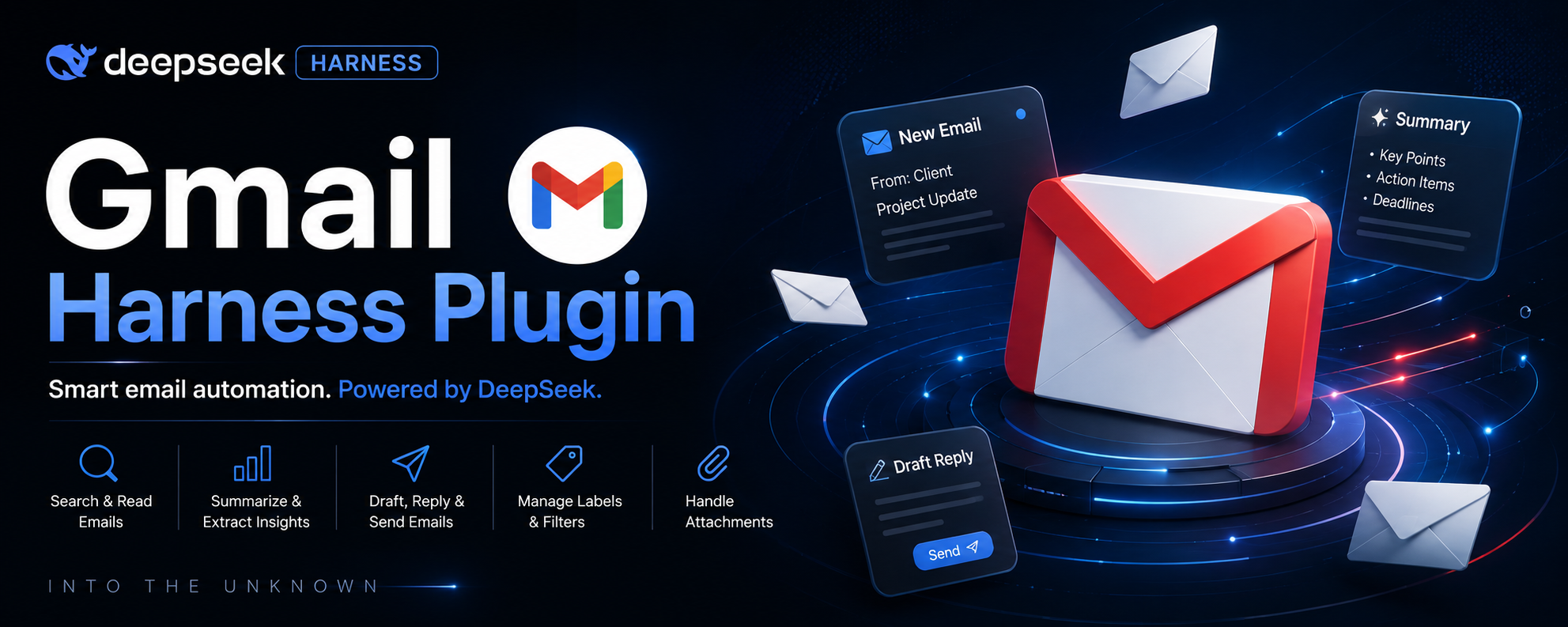

A complete, production-ready Gmail plugin for DeepSeek Harness (DSH). It gives the agent typed, policy-aware access to Gmail over the official Gmail and People REST APIs — 63 model-facing tools (send, search, draft, label, filter, thread, settings, contacts) and 2 polling triggers — with automatic OAuth2 token management.
Official ecosystem keyword: this is a
dsh-plugin— add thedsh-pluginGitHub topic to this repository.
gmail_* tools + 2 polling triggers.dsh plugin --profile web add github:sakthiveltofficial/dsh-gmail-plugins, then add one row to your profile patch (or agent preset) — see Install.gmail_send_email, gmail_fetch_emails, gmail_fetch_message_by_message_id, gmail_fetch_message_by_thread_id, gmail_list_threads, gmail_reply_to_thread, gmail_create_email_draft, gmail_send_draft, gmail_forward_message, label/filter/trash/settings/contacts tools — the full list is in the tool table.gmail.modify, gmail.settings.basic, gmail.compose, gmail.send, contacts.readonly scopes). Credentials are never stored in config — env-var references resolved per operation via ctx.credentials. gmail_authorize runs the interactive Google sign-in and captures + stores the refresh token automatically; only GMAIL_CLIENT_ID / GMAIL_CLIENT_SECRET need to be set.gmail/message-received (new mail) and gmail/message-sent (sent mail) — poll-based, seeded on first activation so the mailbox is never replayed.fetch), and a Google Cloud OAuth client with the Gmail (and People) API enabled.gmail_delete_message, gmail_batch_delete_messages, gmail_delete_thread, gmail_delete_label) are clearly labeled and require explicit user confirmation; the agent is prompted to prefer trash over permanent deletion unless the user asked for irreversible removal.In-Reply-To/References threading).gmail_authorize opens the Google consent page in your browser and captures + stores the refresh token automatically; no manual token generation.GmailErrors with HTTP status preserved.# DeepSeek Harness running (a profile, e.g. the default web profile)
# Node.js >= 20 (the host's Node — plugins run in-process)
# A Google Cloud OAuth client (see "Configure credentials" below)dsh plugin --profile web add github:sakthiveltofficial/dsh-gmail-pluginsThis installs the @google-workspace/dsh-gmail plugin package into the profile (the repo root is the package — no build step needed).
The plugin publishes no services — it only registers tools into the host tools registry (plus the optional timer service for triggers) — so it mounts as a plain loose row, with no isolate realm required.
Option A — profile patch (host plane, tools visible to every agent). Append to your profile's cordis.patch.yml:
- insert:
    - id: gmail
      name: '@google-workspace/dsh-gmail'
      config:
        clientIdRef: GMAIL_CLIENT_ID
        clientSecretRef: GMAIL_CLIENT_SECRET
        refreshTokenRef: GMAIL_REFRESH_TOKEN
        defaultUserId: me
        timeoutMs: 30000
        enableReceivedTrigger: false
        enableSentTrigger: false
Option B — agent preset (tools only for agents on that preset). Add the row to the preset's agent.cordis.yml:
- id: gmail
  name: '@google-workspace/dsh-gmail'
  config:
    clientIdRef: GMAIL_CLIENT_ID
    clientSecretRef: GMAIL_CLIENT_SECRET
    refreshTokenRef: GMAIL_REFRESH_TOKEN
Restart the profile (or the DSH process).
dsh --profile web --dump-config | grep -i gmailThen ask the agent: "what gmail tools do you have?" — it should list the gmail_* tools (63 in total).
Gmail requires OAuth2 — there is no API-key path. Config carries only env-var references, never literal tokens; values are resolved per operation through DSH's credential service (process env → provider store → .env).
| Env var | Used for |
|---|---|
GMAIL_CLIENT_ID |
OAuth client ID (e.g. ....apps.googleusercontent.com) — required |
GMAIL_CLIENT_SECRET |
OAuth client secret (e.g. GOCSPX-...) — required |
GMAIL_REFRESH_TOKEN |
long-lived refresh token — optional; when unset, run gmail_authorize and it is captured + stored automatically |
Copy-paste this redirect URL — the plugin's OAuth callback listens on it:
http://127.0.0.1:8765/oauth2callback(configurable via the plugin's
redirectPortsetting; keep the two in lockstep)
dsh-gmail) + your support email → Save. Keep it in Testing (add your Google account as a test user) or Publish it; both work for your own account.http://127.0.0.1:8765/oauth2callback→ Create → copy the Client ID and Client secret.
ctx.credentials sources for the same names):export GMAIL_CLIENT_ID='....apps.googleusercontent.com'
export GMAIL_CLIENT_SECRET='GOCSPX-...'The refresh token does not need to be exported — see the two options below.
With GMAIL_CLIENT_ID and GMAIL_CLIENT_SECRET set, ask the agent to run gmail_authorize (or run it yourself): the plugin opens the Google consent page in your default browser, you sign in, and the refresh token is captured and stored automatically through the harness credential service — no manual token generation. One-time per account. gmail_auth_status reports whether a credential is stored and the state of any in-flight sign-in.
The plugin requests these scopes at consent time:
| Scope | Needed by |
|---|---|
https://www.googleapis.com/auth/gmail.modify |
read/write mail, labels, trash (most tools) |
https://www.googleapis.com/auth/gmail.settings.basic |
settings tools (IMAP/POP/forwarding/vacation/language/send-as) |
https://www.googleapis.com/auth/gmail.compose |
drafts |
https://www.googleapis.com/auth/gmail.send |
send/reply/forward |
https://www.googleapis.com/auth/contacts.readonly |
contacts tools |
Google OAuth Playground with your client id/secret: pick the scopes above, authorize, and copy the refresh token, then export it:
export GMAIL_REFRESH_TOKEN='1//0...'Access tokens are minted from the refresh token on demand and cached for their lifetime; 401s invalidate the cache and retry once with a fresh exchange. Do not add gmail.metadata alongside content scopes (gmail.readonly/gmail.modify/mail.google.com) in the same consent request — Google treats it as a restricted scope and rejects the combination.
All tool names are snakecase `gmail*(e.g.gmail_send_email,gmail_fetch_emails`), with the full parameter surface and the important warnings preserved: hexadecimal message IDs, label IDs vs display names, irreversible deletes.
| Area | Tools |
|---|---|
| Auth | gmail_authorize (interactive Google sign-in — captures + stores the refresh token), gmail_auth_status |
| Read | gmail_fetch_emails, gmail_fetch_message_by_message_id, gmail_fetch_message_by_thread_id, gmail_list_threads, gmail_list_messages (deprecated), gmail_get_draft, gmail_list_drafts, gmail_get_attachment |
| Compose | gmail_send_email, gmail_create_email_draft, gmail_update_draft, gmail_send_draft, gmail_forward_message, gmail_reply_to_thread |
| Organize | gmail_add_label_to_email, gmail_batch_modify_messages, gmail_modify_thread_labels, gmail_list_labels, gmail_get_label, gmail_create_label, gmail_patch_label, gmail_update_label, gmail_delete_label, gmail_remove_label (deprecated), gmail_create_filter, gmail_list_filters, gmail_get_filter, gmail_delete_filter |
| Delete/trash | gmail_move_to_trash, gmail_untrash_message, gmail_delete_message, gmail_batch_delete_messages, gmail_move_thread_to_trash, gmail_untrash_thread, gmail_delete_thread, gmail_delete_draft |
| Ingest | gmail_import_message, gmail_insert_message |
| Admin | gmail_get_profile, gmail_list_history, gmail_get_imap_settings, gmail_update_imap_settings, gmail_get_pop_settings, gmail_update_pop_settings, gmail_get_auto_forwarding, gmail_list_forwarding_addresses, gmail_get_vacation_settings, gmail_update_vacation_settings, gmail_get_language_settings, gmail_update_language_settings, gmail_list_send_as, gmail_get_send_as, gmail_patch_send_as, gmail_update_send_as, gmail_list_smime_info, gmail_list_cse_identities, gmail_list_cse_keypairs, gmail_stop_watch |
| Contacts | gmail_get_contacts, gmail_get_people, gmail_search_people |
Two tools are intentionally omitted:
GMAIL_CREATE_PROMPT_POSTandGMAIL_UPDATE_USER_ATTRIBUTES_VALUES, which target the Sanity Content Agent rather than Gmail.
19b11732c1b578fd) — never UUIDs, thread IDs, subjects, or dates. Obtain them from gmail_fetch_emails / gmail_list_threads.INBOX, UNREAD, STARRED, SPAM, TRASH, CATEGORY_UPDATES, ...); custom labels use their internal ID (Label_123, from gmail_list_labels).r99885592323229922) differ from message IDs; gmail_send_draft sends a draft exactly as-is and cannot add recipients.{ name, mimetype, base64 }; total message size must stay under ~25 MB after base64 encoding.gmail_delete_message, gmail_batch_delete_messages, gmail_delete_thread, gmail_delete_label, gmail_delete_draft) bypass Trash — prefer the trash tools unless the user explicitly asked for permanent removal.Enable in config:
config:
  enableReceivedTrigger: true   # poll in:inbox → emit gmail/message-received
  enableSentTrigger: true       # poll in:sent   → emit gmail/message-sent
  triggerIntervalMinutes: 5
While the plugin is mounted, each poll emits a Cordis event on the plugin's scope with the trigger payload shapes (sender, subject, message_id, thread_id, message_text, message_timestamp, attachment_list, ...). The first poll only seeds the seen-set, so activation never replays the mailbox. Triggers run only while the session is live (agent-plane polling), like the harness schedule service.
ctx.on('gmail/message-received', (payload) => { /* ... */ })
ctx.on('gmail/message-sent', (payload) => { /* ... */ })| Symptom | Cause / fix |
|---|---|
GMAIL_AUTH_FAILED (401) on tool calls |
Access/refresh token invalid: user revoked access, changed password/2FA, a Workspace admin policy changed, or Google's ~50-refresh-token-per-account limit was hit. Re-authenticate with gmail_authorize (or refresh GMAIL_REFRESH_TOKEN manually). |
| "App is blocked" / unverified-app screen at consent | The OAuth client is requesting scopes Google hasn't verified. Remove extra scopes, or create your own OAuth app and submit scopes for verification. |
| "Gmail API has not been used in project" | The Gmail API is not enabled in the Cloud project owning the credentials. Enable it under APIs & Services, wait a few minutes, retry. |
Error 400: invalid_scope |
Scope values are incorrect/misformatted in the authorization URL. Verify against the Google OAuth scopes docs. |
| Consent screen shows the wrong app name | Default consent uses the shared app. Create your own OAuth app and set a custom redirect URL (white-labeling). |
GMAIL_RATE_LIMITED (429/403) |
Google enforces per-minute/daily quotas; a shared OAuth app shares its quota. Use your own client for a dedicated quota and apply exponential backoff (the client already retries 429/5xx up to 4 times). |
GMAIL_API_ERROR (400) "Invalid id value" |
A non-hexadecimal ID (UUID, thread ID, subject, fabricated value) was passed as message_id. Use IDs from gmail_fetch_emails/gmail_list_threads. |
| Labels silently not applied | A display name was passed instead of a label ID. Run gmail_list_labels and use the returned Label_N IDs. |
| Trigger feels slow | Triggers poll on triggerIntervalMinutes (default 5); reduce the interval, or use Google Pub/Sub webhooks for sub-minute latency. |
GMAIL_CLIENT_ID / GMAIL_CLIENT_SECRET / GMAIL_REFRESH_TOKEN), resolved per operation through ctx.credentials (process env → provider store → .env). Literal config values are supported for quick setups but are not recommended for production.permanent, no recovery possible) and the agent is instructed to confirm with the user before permanent deletes and to prefer trash for reversible workflows.gmail.settings.basic or contacts.readonly if unused — an over-scoped client can trigger the "App is blocked" verification requirement).lib/
├── index.js # plugin entry: name / inject / Config / apply
├── auth.js # OAuth2 credential resolution + token refresh
├── authorize.js # interactive Google sign-in (loopback OAuth flow)
├── client.js # Gmail + People REST client (401-refresh, backoff)
├── mime.js # RFC 2822 MIME builder + payload parsers
├── tools.js # tool factory over @deepseek-ai/dsh-tools
├── tools/ # 63 tool definitions in 9 modules
│ ├── messages.js # 14 tools
│ ├── drafts.js # 6 tools
│ ├── threads.js # 6 tools
│ ├── labels.js # 7 tools
│ ├── filters.js # 4 tools
│ ├── settings.js # 20 tools
│ ├── people.js # 3 tools
│ ├── attachments.js # 1 tool
│ └── authorize.js # 2 tools (gmail_authorize, gmail_auth_status)
├── triggers.js # polling triggers
├── cordis.yml # profile-patch row (host plane)
├── examples/ # agent.cordis.yml preset row
└── docs/assets/ # banner imageThe plugin uses only Node built-ins plus four optional @deepseek-ai/* peer dependencies; no build step is required. Runtime requirements: Node.js ≥ 20 (global fetch), DeepSeek Harness.
node --check lib/index.js && for f in lib/*.js lib/tools/*.js; do node --check "$f"; doneA registration smoke test (import → Config({}) → apply on a stub ctx.tools → assert all 63 tools, no duplicates, no overlap with the expected tool set) is run before each release.
CLASSIFICATION EVIDENCE
系统优先读取 GitHub Topics,再与站内分类词典和词根规则比对。当前命中: model、deepseek。
morluto
Reverse engineer anything with agents, from app behavior down to native binaries.

deepseek-ai
DeepSeek Harness: Everything is a Plugin.

nexu-io
The 1st Collaborative AI Design Agent Workspace. Local-first and open source. Create motion, prototypes, websites, apps, dashboards, presentations, images, and videos with your team and AI agents. Share work, exchange feedback, and iterate together in one workspace.