dsh-desktop
DeepSeek Harness in a native desktop window — built the way the harness
itself is built: as a plugin, not a fork.




dsh-desktop is a DeepSeek Harness
profile that composes the standard bundles (dsh-base + dsh-web-app) with a
small plugin — this repo's dsh-desktop-shell — which opens the harness web
surface in a native Tauri window: custom title bar, tray icon, native
notifications, a real file-manager panel, and one-click updates.
The idea: desktop as a plugin
DeepSeek Harness is built on the principle that everything is a plugin:
models, tools, sandboxes, session storage, the UI — even the agent loop
itself. The desktop experience should follow the same rule.
This project adds a native window without forking or repackaging the
harness. The profile is plain composition:
dsh --profile desktop → dsh-base + dsh-web-app + dsh-desktop-shell
That one decision buys a lot:
- Always in sync. The harness keeps updating; so do you. There is no fork
to rebase and no bundled copy to refresh — upstream releases land in your
profile exactly the way they always do.
- Composable. The shell is one row in your profile's bundle list. Keep
your other bundles, swap the web app, add plugins — the desktop layer stays
a layer, not a replacement.
- Small. The native client is a Tauri binary, not a bundled browser plus a
full runtime. Your dsh stays your dsh.
- Honest trade-off. The plugin approach assumes you already run
dsh. If
you want a single installer with zero prerequisites, a standalone app that
bundles its own runtime is the better fit. If you want the desktop to be
part of your harness — same config, same workspaces, same plugins — this
is the one that fits.
Features
- Native window with an app icon in the dock/taskbar and a custom title
bar (drag region, minimize/maximize/close) drawn by the web surface,
matching the app theme on every platform. The window title follows the
chat open in the UI right now (
DeepSeek Harness — <chat title>), not
the last started agent.
- Explorer panel — a real file manager. Browse any folder (not just the
workspace) with breadcrumbs, back/forward, name filter and recursive
search, sort by name/size/date. Right-click or keyboard (F2 rename, Del to
trash, arrows) to create, rename, copy, cut, paste, delete, open
externally. Files changed or created since your last look are marked live
(auto-refresh). A Preview tab renders markdown with the app's own
renderer (headings, tables, task lists, syntax-highlighted code with a
copy button, math — and relative images resolved from the local disk),
renders mermaid diagrams (bundled with the app, works offline) and
CSV/TSV tables with line/bar charts, opens local
.html pages in a
sandboxed frame, shows images (click to zoom, dimensions),
syntax-highlights source code files (shiki, the app's own highlighter),
and falls back to a hex dump for binary files. A URL bar in the preview
opens any web page (external links land in the system browser). Previews
re-render automatically when the file changes on disk (text 1 MiB /
images 8 MiB caps).
- Wired into the harness. Right-click a file → Send path to agent
inserts its workspace-relative path into the composer; images can be
attached to a message — or just drag an image file into the window:
it lands in the composer as a real attachment (any other file inserts its
path). The workspace picker (hero + sidebar + settings) is the panel in
"choose a folder" mode instead of an OS dialog.
- Links that work. Every
http(s)/mailto link in the chat and in
markdown previews opens in your system browser — no more dead
target="_blank" clicks inside the webview.
- Chat search (Ctrl/Cmd+F). A quick-search bar over the conversation:
live case-insensitive highlighting, Enter/↑/↓ to jump between matches,
Esc to leave. Highlights are painted over the text without touching the
message DOM, so streaming re-renders never corrupt the chat.
- Tray + close-to-tray. Closing the window hides it; running agents keep
working. The tray menu carries a live agent monitor: every running
agent with a refreshable log tail and a Stop agent action, plus a
badge on the tray icon when an agent finishes (cleared from the menu).
- Native notifications on agent finish, error, and question events.
- One-click updates. Download, apply, restart. Nothing is applied
automatically; background checks are opt-in (off by default).
- Workspace selection via the OS folder dialog, or drag-and-drop a folder
into the window.
- A
dsh-desktop tab inside the harness Settings for desktop
preferences.
Screenshot
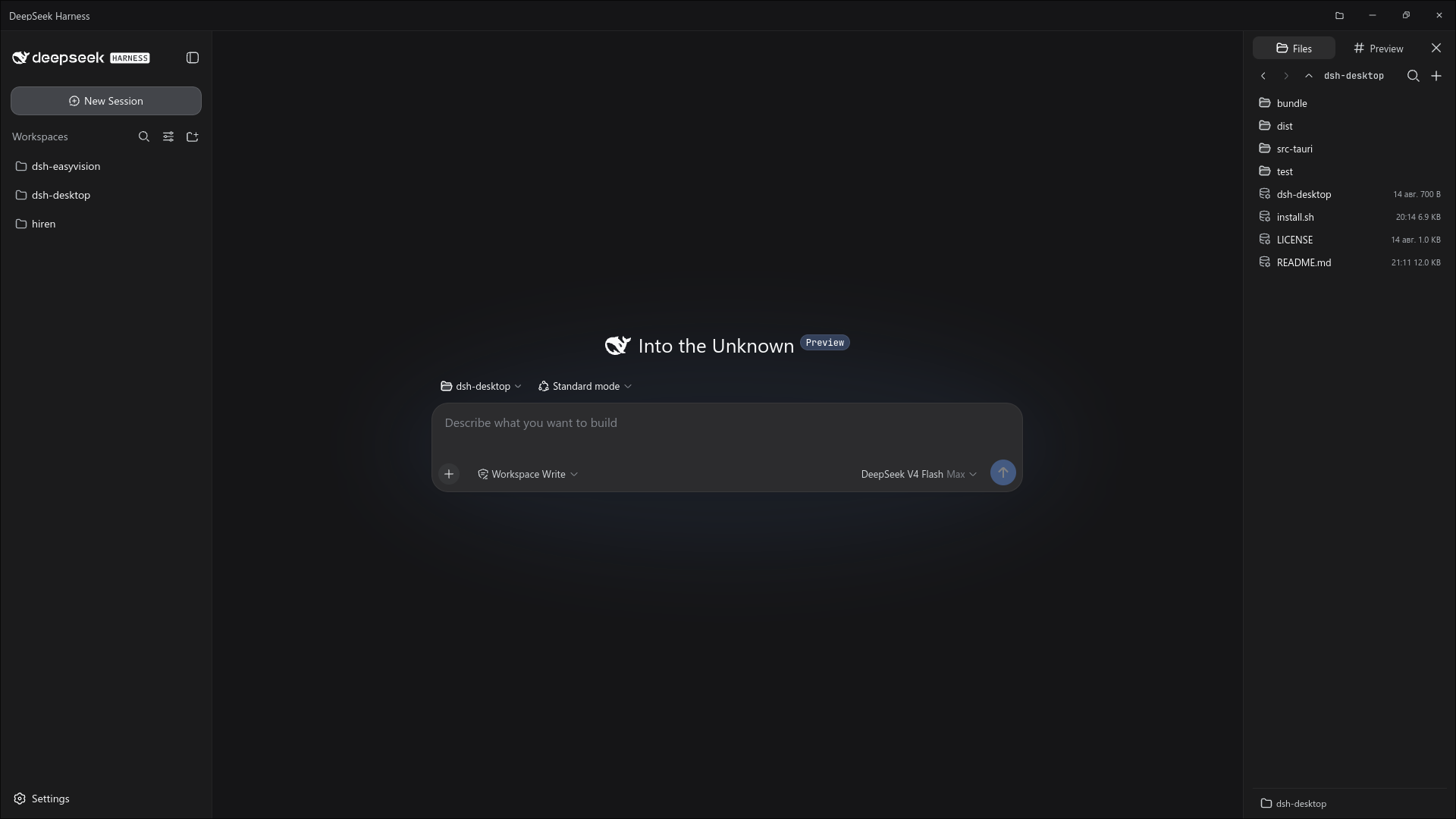
DeepSeek Harness in a native window: the harness web surface with the
custom title bar and the explorer panel.
Install
Requires the dsh CLI. Rust is needed only for the first build from
source — prebuilt client binaries skip it.
Pre-built installers per platform — .deb (Linux), .dmg (macOS), NSIS
.exe (Windows) — are published on the
releases page. One
installer places the client binary and registers an app-menu entry; the
first launch bootstraps the desktop profile into dsh and opens the window.
From source (Linux/macOS dev path):
git clone https://github.com/s3yf1337/dsh-desktop && cd dsh-desktop
./install.sh              # full bootstrap (builds the client if needed)
./install.sh --no-build   # use an existing client binary, never build
./install.sh --rebuild    # force a client rebuild
dsh-desktop
The client binary itself is also a plugin installer:
dsh-desktop-shell install              # bootstrap the profile + install client/launcher
dsh-desktop-shell install --prefix /usr  # OS-package layout (menus under /usr/share)
dsh-desktop-shell                      # install, then boot the profile
dsh-desktop-shell --version
Runs on Linux, macOS, and Windows.
Technical details (for contributors)
How it works
dsh --profile desktop            (or the `dsh-desktop` menu launcher)
  └─ dsh-base + dsh-web-app      the whole web surface: server, /api, SPA
       └─ dsh-desktop-shell      this repo's plugin bundle: after the server
            binds, spawns dsh-desktop-shell <url> and watches it
                 └─ dsh-desktop-shell        (native client, src-tauri/)
                      opens a native WebView on http://127.0.0.1:<port>
                      window closed → exit 0 → plugin shuts the harness down
dsh-desktop is a profile for the DeepSeek Harness, composed from the
standard bundles (dsh-base + dsh-web-app) plus this repo's
dsh-desktop-shell plugin. The plugin spawns the native Tauri client on the
served loopback URL; the WebView loads the exact same 127.0.0.1 origin a
browser would, so the whole SPA works unchanged and same-origin. The client
exposes window.__TAURI__ to that origin (withGlobalTauri), and the plugin
pipes agent-lifecycle notifications to the client over a stdin control
channel ({"event":"notify", ...} JSON lines). The window title follows the
chat open in the UI right now: the browser half reads the active session
from the harness's sessions service and mirrors it into the native window
and the custom title bar.
Install options
One installer per platform (from the releases
page): .deb on Linux, .dmg on macOS, .exe (NSIS) on Windows. The
installer places the client binary and registers an app-menu entry; the first
launch of the installed app bootstraps the plugin profile into dsh and opens
the window. The client binary is also a plugin installer:
dsh-desktop-shell install            # bootstrap the profile + install client/launcher
dsh-desktop-shell install --prefix /usr  # OS-package layout (menus under /usr/share)
dsh-desktop-shell                    # same as install, then boot the profile
dsh-desktop-shell --version
From source (Linux/macOS dev path), install.sh works as before:
./install.sh            # full bootstrap (builds the client if needed)
./install.sh --no-build # use an existing client binary, never build
./install.sh --rebuild  # force a client rebuild
install.sh creates $DSH_HOME/profiles/desktop (bundle copied and linked,
no pnpm/registry needed), builds the client if missing, installs
dsh-desktop-shell + the dsh-desktop launcher to ~/.local/bin, installs
the icon into the hicolor theme, and registers a desktop menu entry.
Idempotent: re-running refreshes the bundle copy and never touches your
profile's cordis.patch.yml user layer. The binary's own install mode is
the cross-platform equivalent (it embeds the bundle, so one artifact installs
everything).
Release artifacts (CI-built)
Every v* tag builds, bundles, and publishes per platform:
- Installers —
DeepSeek Harness_<tag>_amd64.deb (Linux),
.dmg + .app (macOS), NSIS .exe (Windows)
- Update tarballs —
dsh-desktop-<tag>-linux-x86_64.tar.gz,
-macos-aarch64.tar.gz, -windows-x86_64.tar.gz (client binary + bundle/)
The in-app one-click update downloads its platform tarball, swaps the
client binary, refreshes the plugin bundle, and restarts. Nothing is ever
applied automatically; background checks are opt-in (off by default).
Configuration
The dsh-desktop launcher resolves the dsh CLI: $DSH_DESKTOP_DSH →
$DSH_BIN → dsh on PATH. DSH_HOME is inherited (defaults to
$HOME/.dsh).
The native client honors:
DSH_DESKTOP_NO_SINGLE_INSTANCE=1 — skip the single-instance guard so a
second harness can run side by side (development/debugging)DSH_DESKTOP_BIN — an explicit client binary path
Client binary resolution in the bundle plugin: config.bin → DSH_DESKTOP_BIN
→ $DSH_HOME/bin/dsh-desktop-shell → dsh-desktop-shell on PATH →
~/.local/bin/dsh-desktop-shell. With no binary found the harness still
serves the web UI (degrades to browser use).
The window is frameless; the web surface draws the title bar (drag region,
minimize/maximize/close, resize edges) and the right-hand explorer panel
(Files/Preview tabs). The shell exits with code 0 when the user is done and
code 11 after a one-click update (the plugin relaunches the profile).
Layout
bundle/                  the dsh-desktop-shell plugin package (bundle contract)
  cordis.patch.yml       inserts the desktop-shell row
  lib/index.js           spawn/watcher plugin (webServer, appExit, stdin control,
                         loopback-only /dshd-file route: local files for the
                         preview panel — markdown images, .html pages, assets)
  lib/client.js          browser half: title bar, explorer panel (markdown /
                         web / image / hexdump previews), settings tab
dist/                    repo-root tauri frontendDist: dist/index.html loading
                         page the WebView shows while it boots. Build-time/CI
                         only — not part of the install.sh bundle, which ships
                         bundle/ (lib/ + cordis.patch.yml), not dist/.
dsh-desktop              launcher wrapper: exec dsh --profile desktop
install.sh               one-command bootstrap (profile + client + icons + menu entry)
src-tauri/               the native render client (the actual app)
  src/main.rs
  src/lib.rs             arg dispatch (url | install | no-arg), frameless window,
                         tray, close-to-tray, single-instance, stdin control
  src/install.rs         plugin installer mode (embedded bundle, cross-platform)
  src/fs.rs              explorer commands (list dir, read file, stat, hexdump,
                         home, parent)
  src/commands.rs        desktop_* commands the settings tab invokes
  src/settings.rs        persisted desktop preferences (dsh-desktop.json)
  src/tray.rs            tray icon + menu (show/hide, updates, quit)
  src/update.rs          update orchestration (check, emit, notify, apply, restart)
  src/updater.rs         GitHub releases API client (assets, suggest + one-click)
  src/log.rs             file + stderr logging (dsh-desktop.log)
  Cargo.toml
  tauri.conf.json
  capabilities/default.json
test/client-smoke.mjs    renders client.js (title bar module + explorer + settings)
                         and exercises the preview helpers (markdown image
                         rewrite, TOC, URL normalization, path resolution)
The installed profile lives at $DSH_HOME/profiles/desktop/:
profiles/desktop/
  package.json           dsh.profile.bundles: base + web-app + dsh-desktop-shell
  cordis.patch.yml       your patch layer
  packages/dsh-desktop-shell/   a copy of bundle/ (refreshed by install.sh)
License
MIT


