
其他
完整应用

deepseek-harness
deepseek-ai
DeepSeek Harness: Everything is a Plugin.

robiteame/dsh-session-tree-extension
dsh-session-tree-extension Append-only, multi-branch conversation trees for DeepSeek-Harness — a PI-Agent-style SessionTree. The agent's history becomes a tree of immutable nodes, forkable at any historical node, with standard LLM message reconstruction, versioned JSON snapshots, and a WebUI tree panel embedded in the existing chat composer (no sta
PROJECT TOPICS
PROJECT README


Append-only, multi-branch conversation trees for DeepSeek-Harness — fork any historical node, clone a branch into a new session, and browse the whole lineage as one merged WebUI graph. Old history is never edited or deleted.
Three commands:
| Command | What it does |
|---|---|
/tree |
Open the merged lineage graph: every non-subagent session and node, clickable and bindable |
/fork |
Branch from any historical node — the fork appears in the graph and as an inline menu under its source session |
/clone |
Duplicate the current conversation into an independent new session under the same project |
Tree panel (light and dark) with the sidebar's inline fork-branch menu:
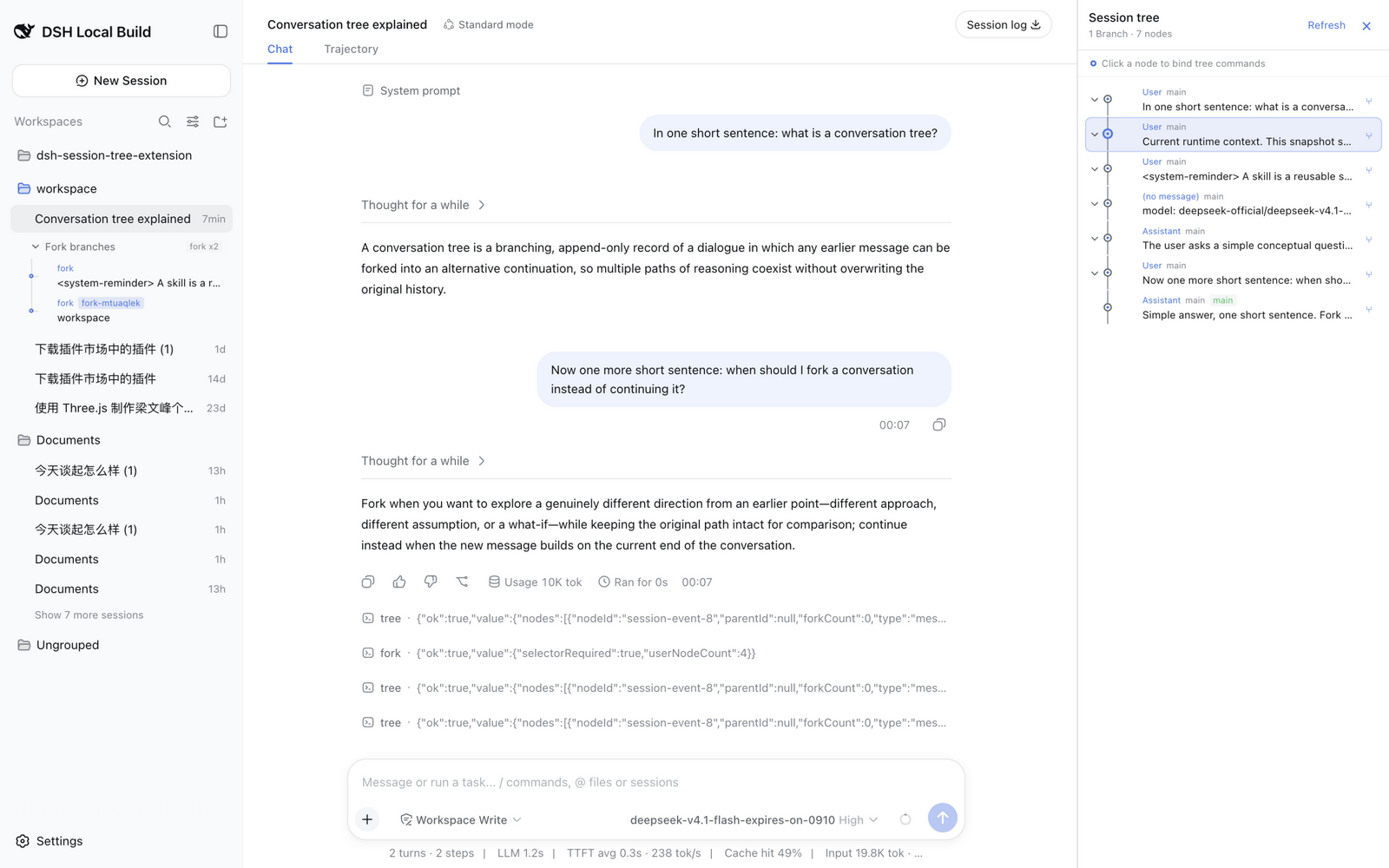
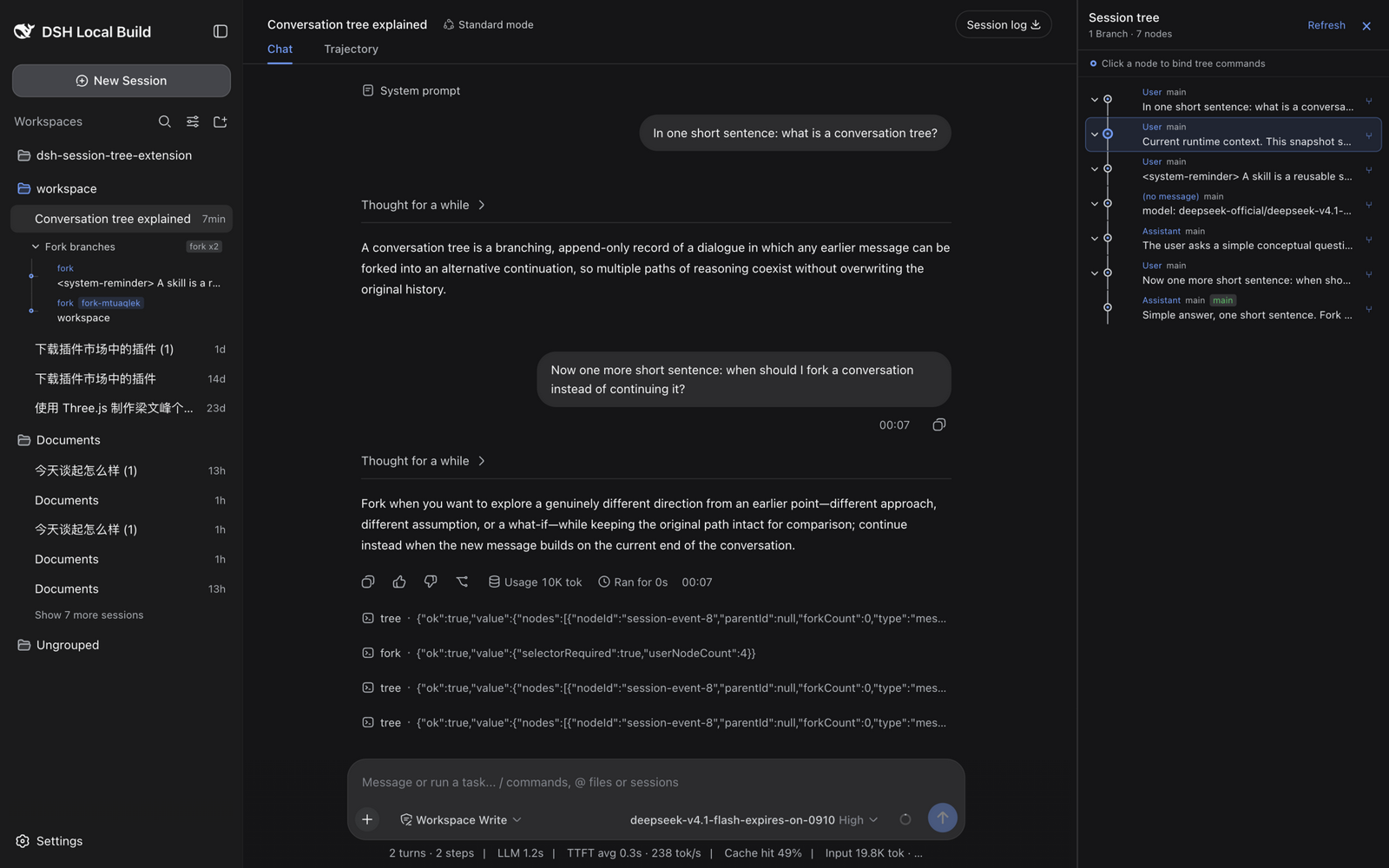
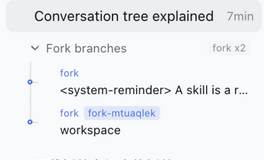
The inline /fork branch menu beneath its source session:
Published as four npm packages under the @robiteame scope:
| Package | Role |
|---|---|
@robiteame/dsh-session-tree |
Carrier Bundle: one install mounts everything below through its composition layer |
@robiteame/dsh-pi-agent-session-tree |
Host domain service: the SessionTree/SessionTreeStore domain model and the sessionTree Remote |
@robiteame/dsh-tool-session-tree |
Command surface: the /tree /fork /clone commands |
@robiteame/dsh-client-ui-session-tree |
WebUI tree panel: additive right-side overlay on official builds, native details dock on patched builds |
One command — from the plugin market UI, or from a Harness checkout's CLI:
dsh plugin --profile <profile> add @robiteame/dsh-session-treePrebuilt tarballs install the same way and need no build scripts:
dsh plugin --profile <profile> add robiteame-dsh-session-tree-0.3.0.tgzAfter installing, restart the profile. The composition gains three rows
(pi-agent-session-tree, tool-session-tree, ui-session-tree) that load the
Host service, the commands, and the browser panel. Verify the composed layer:
dsh --profile <profile> --dump-config # should list the three session-tree rowsRequires DeepSeek-Harness 0.1.5-rc.2 (or a compatible 0.1.5 build) and
Cordis ^4.0.2; the target installation provides those peers. No install
scripts run — the tarballs ship prebuilt lib/ artifacts.
/tree — open the tree panel/tree opens the right-side panel as one merged graph for the current
session's lineage: ancestors, forks, and clones appear in a single git-style
view, with user messages, assistant replies, tool calls, and model switches
shown as connected nodes. Shared copied prefixes are deduplicated, fork points
carry session badges, and the current session's path stays highlighted. Click
a node to bind it; clicking a node owned by another session opens that session
first. Collapse individual subtrees or whole session branches to focus the
graph.
/fork — branch from any historical node/fork picks an earlier user prompt and grows a new branch from there: the
conversation continues along the new path while the original one stays intact.
The fork is created through the official native fork API, so it appears in the
session list with real parent linkage. The plugin adds the new branch to the
merged graph and also renders it as an inline collapsible menu directly beneath
its source session's row. Both views follow the official reactive session list,
so new branches appear without a refresh.
/clone — duplicate into a new session/clone copies the current conversation — through its root path — into an
independent Session under the same project. The source history stays
read-only; the clone is yours to continue separately.
The plugin never modifies Harness core files. It capability-detects the optional branch-selection engine API at runtime:
dev/session-branch-surface.patch
(Session.selectMessageSurface()), jump/fork switch the model-visible
history directly: the next turn genuinely starts from the new branch.replace surface event) plus a
plugin-owned sidecar under $DSH_HOME/storages/session-tree/ for durable
branch state. The log stays resume-valid.Every mode is honest about itself: the Host log prints a one-time notice when
a session runs in a non-native mode. Move the raw session.jsonl.zstd between
machines together with the matching sidecar file.
nodeId and a parentId (root is null). A node may have multiple
children — that is the fork.messages array
for the root→cursor path only.The repository is a pnpm workspace building the three implementation packages standalone (no Harness checkout needed):
pnpm install
pnpm verify      # build + typecheck (host & client) + pack dry-run + vitest
pnpm pack:all    # produce the four tarballs
Tests run against the published Harness packages (0.1.5-rc.2) — the
stock-mode paths — with vitest from the repository root. The browser spec in
packages/client/ui-session-tree needs the Harness client test runtime and
runs inside a source-integrated checkout.
For debugging against Harness source (native mode, native details dock):
dev/install.sh /path/to/deepseek-harness     # applies both dev patches + copies packages
cd /path/to/deepseek-harness && pnpm install && pnpm run build
See dev/README.md for what each patch does. This flow is
for contributors only — user installs never touch a Harness checkout.
MIT.
CLASSIFICATION EVIDENCE
系统优先读取 GitHub Topics,再与站内分类词典和词根规则比对。当前命中: 无有效分类标签。
deepseek-ai
DeepSeek Harness: Everything is a Plugin.

anywhere-labs
为 DeepSeek Harness (DSH) 插件生态打造的现代化桌面端解决方案。万物皆「插件」,桌面本身也是「插件」。

awesome-dsh-plugin
A curated list of plugins for DeepSeek Harness (dsh) · DeepSeek Harness 插件精选列表