
模型与 MCP
待识别

rea
morluto
Reverse engineer anything with agents, from app behavior down to native binaries.
PROJECT TOPICS
INSTALL REFERENCE
dsh plugin --profile web add github:robert-krzeminski/retire-this-session
该命令指向仓库当前默认分支;尚无绑定当前 commit 的完整验证结果。
PROJECT README
Retire a DSH session together with its forked and subagent descendants: archive the tree now, move the log directories into the Session-Time-Vault at the next start.
Nothing is deleted. Work still running in the tree is cancelled, not killed, and
no systemd unit hook is involved, so the plugin behaves identically on Linux,
macOS, and Windows.
Tell the session to retire itself.

Choose Retire in the confirmation.
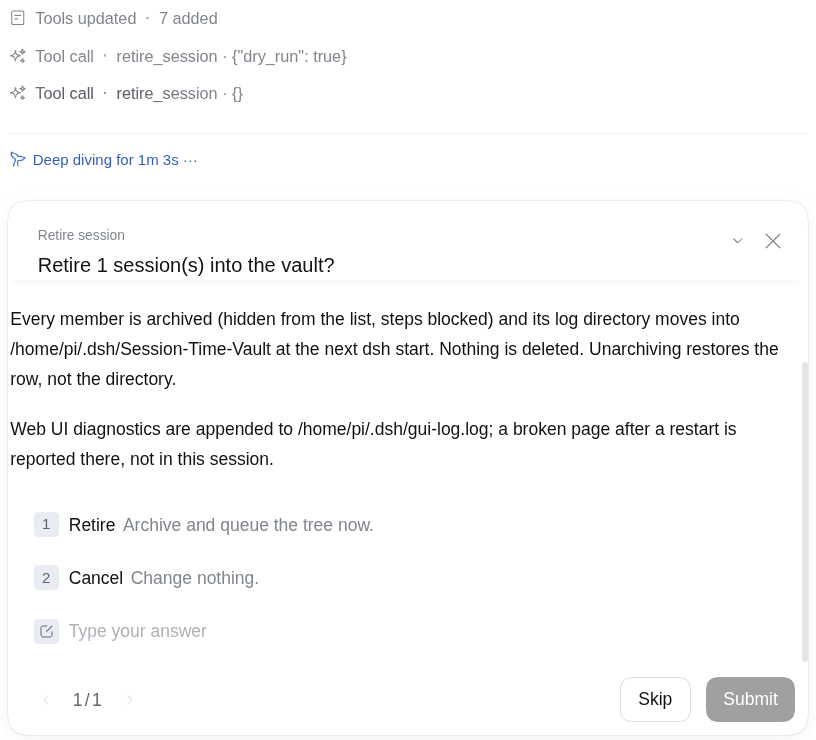
The session moves to the retired list and is hidden, and a new session starts immediately.
retire_session (model-facing tool):
retire_session dry run — call it with dry_run: true to see the plan without
changing anything: it reads the headers, builds the tree, resolves each member's
directory, and reports them. It asks no question, archives nothing, queues
nothing, and never reaches the confirmation in step 3 or the archiving after it.
Use it to inspect the tree before the real call.
parentSession from the calling
session;Retire / Cancel) and does
nothing unless Retire is chosen — the tool has no self-approval path, and
without the userQuestions service it refuses rather than proceeding;cwd differs from the
root's, or when a member is pinned; an already-archived member is skipped
instead of refused, so a partly retired tree can still be finished and a
second call is a no-op;<dshHome>/session-retirement-queue.json before archiving anything;ctx.workspaceRegistry.archiveSession(id, { stopActivity: true }), children
first and the root last, which is reversible, hides the session from every
grouping surface, blocks its next step, drops any pin, cancels any turn, job,
subagent, or schedule still running in the tree, and emits the change event
the Web UI already reacts to.Because the root's archive cancels the calling turn, retire_session returns as
aborted even when the retirement succeeded. The archive event in the UI is the
authoritative outcome, and the session does not accept another step.
At the next start the plugin drains that queue, after ctx.inject hands it the
workspace registry and the session store: rename into
<dshHome>/Session-Time-Vault/<id>, falling back to copy-then-remove when the
vault is on another filesystem. A live session, an existing vault entry, a
vanished directory, and an entry whose session is no longer archived are all
handled without failing the rest; survivors stay queued. The archive gate is
what keeps a crash between the queue write and the archive from moving the log
of a session that is still listed, and waiting for the registry is what keeps a
startup earlier than the registry from postponing the drain indefinitely.
The JSONL backend appends with open(path, 'a') → write → fsync → close, and the
lease verifies the locked inode against the lock path. Renaming a live session's
directory makes the next append recreate the old path: the vault gets a truncated
log and the split continues silently. At startup nothing holds those files, so
the move is safe — and portable, which is what a systemd ExecStopPost hook is
not.
The retired directories are the backup: they move to
<dshHome>/Session-Time-Vault/<session-id> and stay there. Unarchiving restores
the list row, not the directory.
The Web UI's own diagnostics go to <dshHome>/gui-log.log (boot manifest, failed
/api calls, script errors). Some setups append there through a separate logging
plugin; retirement never touches it either way. When a page misbehaves after a
restart, read that file before blaming the retirement:
tail -n 50 ~/.dsh/gui-log.logThe confirmation dialog prints both paths.
dsh plugin --profile web add retire-this-sessionRestart the service once (systemctl --user restart dsh, or stop and start it
however you run DSH) so the new bundle composes. The retire_session tool then
appears in the next session.
To work on a local checkout instead:
dsh plugin --profile web add "retire-this-session@link:$PWD"Verify composition (also writes cordis.yml into the profile, so run it outside
the service's read-only sandbox):
dsh --profile web --dump-config | grep session-retirementThe patch row needs no config; every path defaults from $DSH_HOME (or ~/.dsh
when it is unset). Override a path from the profile's cordis.patch.yml when
needed; relative values resolve against $DSH_HOME:
- id: session-retirement
  config:
    vaultDir: Session-Time-Vault
    queueFile: session-retirement-queue.json
guiLogFile: gui-log.logArchive and unarchive stay DSH's own state and can be changed from the UI at any
time. Removing the plugin stops the drain; already-archived sessions keep their
flags and their logs stay in sessions/. A non-empty
session-retirement-queue.json then needs a manual move.
node --test test/*.test.jsTwenty-two tests cover the tree closure, every refusal, directory discovery,
queue atomicity, the drain's move/live/archived/existing/missing behaviour,
root-last archiving with rollback, and the archive path against a host that
refuses an active session unless stopActivity is passed.
MIT. See LICENSE.
CLASSIFICATION EVIDENCE
系统优先读取 GitHub Topics,再与站内分类词典和词根规则比对。当前命中: deepseek-harness。
morluto
Reverse engineer anything with agents, from app behavior down to native binaries.

deepseek-ai
DeepSeek Harness: Everything is a Plugin.

nexu-io
The 1st Collaborative AI Design Agent Workspace. Local-first and open source. Create motion, prototypes, websites, apps, dashboards, presentations, images, and videos with your team and AI agents. Share work, exchange feedback, and iterate together in one workspace.