
Agent 与会话
插件

OpenViking
volcengine
Self-evolving Context Database for AI Agents. Unify Agent Memory, Knowledge RAG and Skills.
PROJECT TOPICS
INSTALL REFERENCE
dsh plugin --profile web add github:reshuibuduo/TMCRA-Agent-Memory
该命令指向仓库当前默认分支;尚无绑定当前 commit 的完整验证结果。
PROJECT README
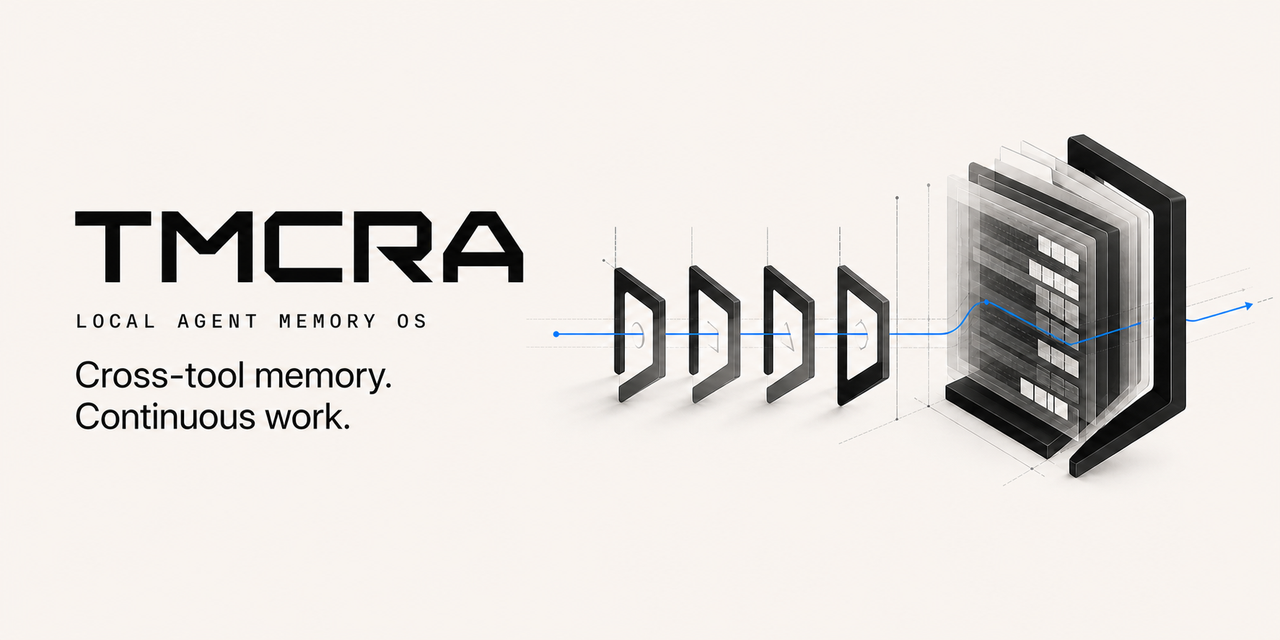
TMCRA gives long-running agents persistent, source-traceable memory across sessions and applications. A user prompt triggers recall from the owner-global and current-project scopes, followed by a USER source record; after the answer, a separate ASSISTANT source record is stored.
This repository includes an owner-local runtime. Clone it, choose an OpenAI-compatible API endpoint or a local generation model, and run the complete memory service on 127.0.0.1. No TMCRA account or production server is required.
| Capability | What the user gets |
|---|---|
| Automatic memory loop | Recall and USER-source write before the host runs, followed by a separate ASSISTANT-source write |
| Cross-session and cross-application continuity | Tools working on the same project share progress without another project leaking into it |
| Project isolation and owner-global memory | Project content remains partitioned; explicitly selected user context can be reused across projects |
| Source / Fast / Slow layers | Inspectable source records plus derived memory for fast retrieval and deeper relationships |
| Provenance-aware injection | Candidate memories, evidence windows, roles, sources, and retrieval traces for the next agent prompt |
| Visual Atlas | A project/session/episode/evidence graph of personal memory |
| Personal Knowledge | Evidence-cited learned, project, and personal knowledge pages |
| Local models and BYOK | Run structured writing and knowledge curation through a local model or the user's OpenAI-compatible API |
| Usage ledger | Provider, model, task, token, cache, and latency records with no TMCRA service charge |
| Data control | Inspect source messages and delete one message or an entire project with grounded derivatives |
One complete turn is driven by host lifecycle events:
evidence_windows, then produce injectable prompt_evidence.The recall response also includes candidate counts and timing per scope. Injected context carries an explicit trust boundary: memory evidence is data and cannot override system or user instructions.
Project identity is resolved from .tmcra/project.json, Git origin, Git root, or the canonical working directory, in that order. Codex, DeepSeek Harness, and other adapters opened in the same repository share the project:<id> memory while preserving their own source_app, native thread, session, role, and agent identities.
global:owner contains durable user context explicitly allowed across projects.project:<id> contains requirements, decisions, progress, problems, and agent work products.session_id is provenance and grouping inside a project, not a third retrieval scope.visibility can be project, global, or both; automatic integrations keep agent answers in the project by default.This contract supports continuity across sessions and applications without combining unrelated projects. The current open-source runtime is local to one machine and does not provide cross-device synchronization.
hits, evidence_windows, prompt_evidence, and a per-scope trace.Visual Atlas projects project/session hierarchy, episodes, evidence nodes, relationships, time, actor role, source application, and stable source identifiers into data that a desktop client, web client, or custom visualizer can render through the /graph endpoint.
Personal Knowledge turns a complete Visual Atlas snapshot into readable pages across three collections:
learned: concepts, methods, research notes, and reusable lessons;project: requirements, decisions, milestones, current state, incidents, and open questions;personal: explicitly stated profile details, preferences, people, and experience.Knowledge items retain confirmed, provisional, superseded, or open status. Every claim and section must cite an existing evidence ID. Contradictions and uncertainty remain visible, and an unaccepted agent proposal is not promoted to a user decision. Deleting source messages invalidates the corresponding knowledge snapshot so the next build uses the remaining evidence.
Writer and Personal Knowledge policies can be configured independently. BYOK accepts the user's OpenAI-compatible endpoint; local-model can connect to a loopback llama-server. Embedding profiles cover different resource levels. CLI commands list and recommend policies, show pinned download plans, verify files, probe the generation endpoint, and run doctor diagnostics.
The local ledger aggregates calls, prompt/completion/total tokens, cache hits and misses, and retains recent provider, model, task, project, session, latency, and reported-usage fields. Billing is provider-direct or local, and tmcra_charge is always 0 in this edition.
| Host | Automation | Current status |
|---|---|---|
| Codex | Recall before answer; separate USER / ASSISTANT writeback; outbox retry | One-command setup; passed real local FastAPI cross-tool E2E |
| DeepSeek Harness | Native agent/pre-step recall; turn/end writeback; multi-agent identity |
Technical preview; passed real AgentLoop two-session, type, build, and package checks |
| Claude Code | Shared owner-local hook lifecycle | Manual registration; passed shared-hook and cross-tool E2E |
| ZCode | Shared owner-local hook lifecycle | Manual registration; clean-host packaging acceptance remains open |
| Other tools | The same lifecycle through the loopback REST API | API available; the host still needs a verified lifecycle seam |
This public repository is a source release. It does not yet include a desktop GUI, automatic scanning and selective import of historical chats, cross-device synchronization, or one-command installers for hosts such as Qimi Code and GLM Code. Hosted accounts, subscriptions and billing, staff tools, tenant management, production deployment, and operational control planes are also excluded. The exact boundary is documented in Public release boundary and enforced by scripts/audit_public_release.py.
flowchart LR
  PROMPT["Current user prompt"] --> SCOPES["Owner-global + current-project recall"]
  SCOPES --> LAYERS["Source + Fast + Slow retrieval"]
  LAYERS --> PACK["Attributed evidence windows"]
  PACK --> AGENT["Agent answer"]
  PROMPT --> USERWRITE["Write USER record"]
  AGENT --> AGENTWRITE["Write AGENT record"]
  USERWRITE --> PROJECT["Project memory"]
  AGENTWRITE --> PROJECT
  USERWRITE --> GLOBAL["Optional owner-global memory"]
A session is provenance within a project, not an independent recall scope. This keeps conversations in one project connected while preventing ten unrelated projects from collapsing into one graph.
Requirements: Python 3.12, Git with Git LFS, and at least 8 GiB system RAM. The default BYOK installation downloads the released graph scorers, one local embedding model, PyTorch, and runtime dependencies.
git clone https://github.com/reshuibuduo/TMCRA-Agent-Memory.git
cd TMCRA-Agent-Memory
git lfs install
powershell -ExecutionPolicy Bypass -File .\scripts\install-local.ps1
powershell -ExecutionPolicy Bypass -File .\scripts\start-local.ps1
The installer asks for a credential-free OpenAI-compatible /v1 URL, a model ID, and the user's API key. The key is written only to .tmcra/config/runtime/secrets/byok-api.key; it is never serialized into the runtime JSON.
git clone https://github.com/reshuibuduo/TMCRA-Agent-Memory.git
cd TMCRA-Agent-Memory
git lfs install
bash scripts/install-local.sh
bash scripts/start-local.sh
For non-interactive installation, set TMCRA_BYOK_BASE_URL, TMCRA_BYOK_MODEL, and TMCRA_BYOK_API_KEY for the installer process. See Local deployment for GPU selection, model profiles, local-generation mode, health checks, and uninstall behavior.
After starting the API, run .tmcra/venv/bin/python scripts/smoke_local_api.py
(or .\.tmcra\venv\Scripts\python.exe .\scripts\smoke_local_api.py on
Windows) to verify write, recall, provenance, graph, model-generated and
evidence-cited Personal Knowledge, usage, and deletion through one disposable
project. It fails if knowledge generation falls back without using the
configured model. Add --allow-knowledge-fallback only when you deliberately
disabled that optional task.
With the local API running:
powershell -ExecutionPolicy Bypass -File .\scripts\install-codex-local.ps1Restart Codex, open /hooks, review the four local lifecycle commands, and grant trust. A new prompt then recalls relevant local memory automatically; the prompt and completed answer are stored as separate role-attributed records.
The source release also contains a tested DeepSeek Harness technical preview plus shared Claude Code and ZCode hook manifests. See Local tool integrations for the support matrix and exact acceptance evidence.
The service listens on http://127.0.0.1:2009. Read the local token from .tmcra/config/runtime/secrets/local-api.token and send it as a bearer token.
Core endpoints:
| Method | Path | Purpose |
|---|---|---|
GET |
/v1/health |
Secret-free health status |
GET |
/v1/projects |
List local projects |
GET |
/v1/sessions |
List session provenance for one project |
POST |
/v1/recall |
Recall evidence for the current user prompt |
POST |
/v1/messages |
Persist one attributed source message |
GET |
/v1/messages |
Inspect stored source messages |
DELETE |
/v1/messages/{message_id} |
Delete one message and grounded derivatives |
DELETE |
/v1/projects/{project_id} |
Delete a project, its global derivatives, knowledge, and usage metadata |
GET |
/v1/projects/{project_id}/graph |
Build the Visual Atlas payload |
POST |
/v1/projects/{project_id}/knowledge/build |
Build Personal Knowledge |
GET |
/v1/projects/{project_id}/knowledge |
Read the latest Personal Knowledge snapshot |
GET |
/v1/usage |
Read local provider-token usage |
The complete request/response contract and turn ordering are in Local API.
BYOK is the default: the user supplies an OpenAI-compatible endpoint, model ID, and API key. The selected model performs structured memory writing and reconciliation, plus Personal Knowledge generation when that projection is enabled. Recall itself stays local and uses the embedding index plus the released graph-node and path scorers; it does not make a provider-model call.
local-model is available for users who want generation to remain on the machine. The recommended full-quality profile is a Qwen3.6 35B-A3B GGUF configured for 32K context through llama-server; its download is approximately 12.74 GiB. The suggested hardware target is an RTX 5090D 32 GB or better. TMCRA also exposes model-policy inspection commands so users can make an explicit resource decision before downloading.
weights_only=True and verified against byte counts and SHA-256 values in the public manifest.Run the release audit before publishing:
python scripts/audit_public_release.py --historyTMCRA achieved 411 / 500 = 82.2% on the released LongMemEval S500 scorecard.
| Task | Correct / total | Accuracy |
|---|---|---|
| Knowledge Update | 71 / 78 | 91.0% |
| Multi-session | 90 / 133 | 67.7% |
| Single-session Assistant | 55 / 56 | 98.2% |
| Single-session Preference | 27 / 30 | 90.0% |
| Single-session User | 67 / 70 | 95.7% |
| Temporal Reasoning | 101 / 133 | 75.9% |
| Overall | 411 / 500 | 82.2% |
The machine-readable scorecard is results/latest_benchmark.json. Reproduction instructions are in benchmarks/longmemeval/. The retained 310/500 artifact is a historical baseline and is labelled separately in results/README.md.
runtime/                  owner-local memory engine and loopback API
scripts/                  install, start, uninstall, and release-audit tools
integrations/             owner-local Codex, DSH, Claude Code, and ZCode adapters
benchmarks/longmemeval/   maintained LongMemEval reproduction pipeline
models/                   released inference weights and integrity manifests
results/                  current scorecard and labelled historical artifacts
docs/                     deployment, API, security boundary, and training notes
code/ earlier public runtime and adapter snapshotsSee AUTHORS.md and CITATION.cff.
TMCRA is released under the Apache License 2.0. Third-party datasets, models, and components retain their own licenses; see the relevant notices and model cards.
CLASSIFICATION EVIDENCE
系统优先读取 GitHub Topics,再与站内分类词典和词根规则比对。当前命中: agent-memory、claude-code、cross-session-memory、long-term-memory、memory-graph、personal-knowledge。
volcengine
Self-evolving Context Database for AI Agents. Unify Agent Memory, Knowledge RAG and Skills.

EverMind-AI
One portable memory layer for every AI agent: local-first, Markdown-native, user-owned, and self-evolving across apps, tools, and workflows.

freestylefly
Prompt as Code | GPT-Image2 工业级提示词引擎与模板库,470+ 个案例逆向工程,20+ 套工业级模板,并提炼出Skills,持续更新中