
模型与 MCP
待识别

rea
morluto
Reverse engineer anything with agents, from app behavior down to native binaries.
PROJECT TOPICS
INSTALL REFERENCE
dsh plugin --profile web add github:pumbleblock/dsh-subagent-model-router
该命令指向仓库当前默认分支;尚无绑定当前 commit 的完整验证结果。
PROJECT README
Give every delegated task the right model and reasoning effort—automatically.
[!NOTE] This is the maintained continuation of CypherNaught-0x/DSH-Subagent-Model-Router, including poka-IT's DSH 0.1.7/0.2.0 port. It targets DeepSeek Harness 0.2.x and adds per-task reasoning effort. Full history and credit are preserved.
Stop using one model for every kind of work. Configure your preferred fast, affordable, specialized, and high-reasoning models once; the router gives your agent the aliases, tags, and guidance it needs to intelligently select the best route for each delegated task.
That means faster routine work, stronger results on difficult problems, better control over cost, and less model micromanagement. Subagents can run in parallel, their results are reliably joined before the parent responds, and the model chosen for each task stays visible throughout the UI.
low for mechanical work or xhigh for a stubborn bug, with an optional default per alias.[!TIP] Already using Better Sidebar? The router adds an optional Sub-agents tab through Better Sidebar's public
registerTabAPI.
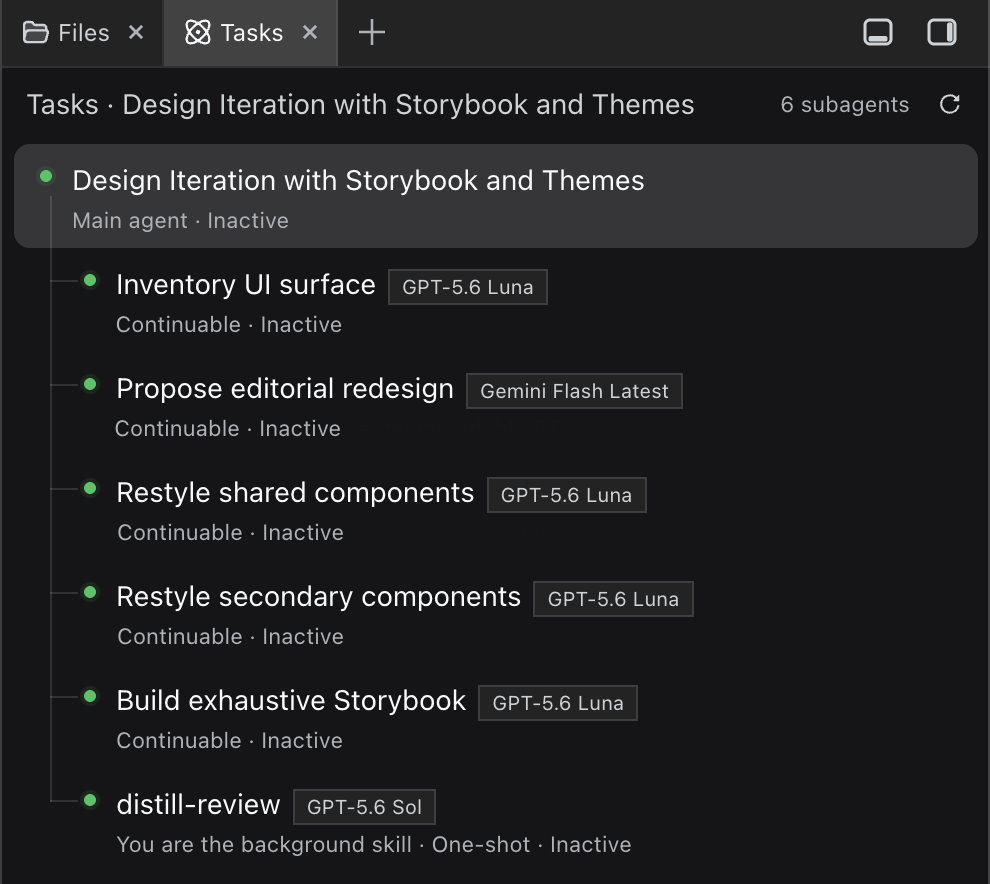
See parallel delegated work, current status, and the selected model together in the task tree you already use.
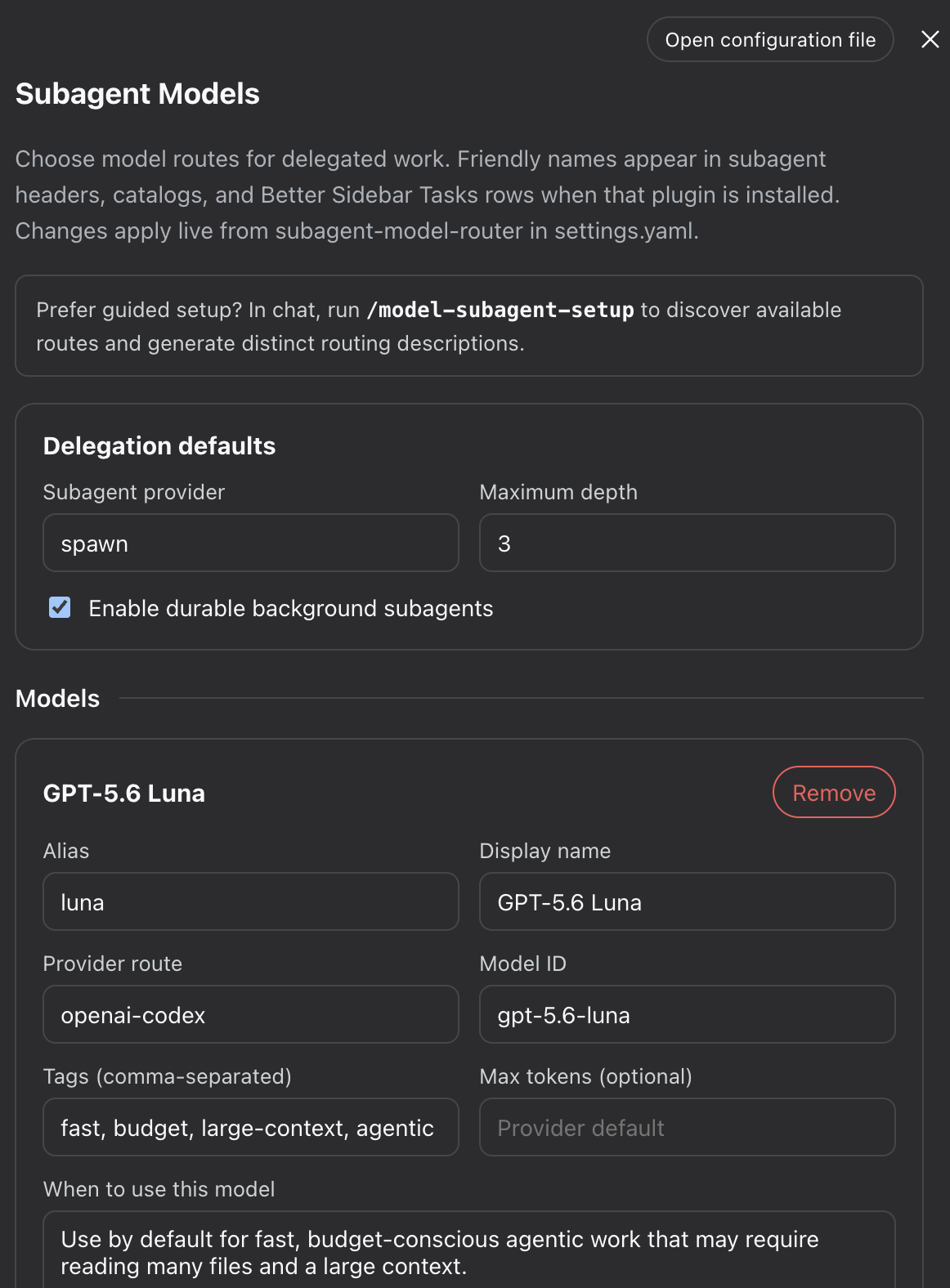
Define friendly routes and tell the orchestrator when each model shines—from quick, budget-friendly tasks to your most demanding work.
subagent_model: a delegation tool whose model argument is restricted to user-configured aliases, with an optional reasoning_effort.wait-for-subagents: a join tool that waits for this agent's outstanding continuable background children, including standard and model-routed delegations, and returns their terminal results.model_subagent_catalog: a read-only view of models advertised by registered LLM providers.configure_subagent_models: a model-facing tool that reads or replaces only this plugin entry's configuration, without filesystem access.model-subagent-setup: a guided skill for selecting routes, generating routing guidance, obtaining confirmation, and saving through the constrained configuration tool.config: of the - id: dsh-subagent-model-router Loader entry in a Cordis patch.With an empty models list, the catalog, configuration, and wait tools remain available alongside the settings page and setup skill, but subagent_model is not registered. This provides a bootstrap state for initial setup.
When model-selectable delegation is available, the system prompt tells the orchestrator not to duplicate work it delegated. After issuing all intended background delegations, it must call wait-for-subagents before synthesizing the child results or giving a final answer. While a same-session completion goal is active, the orchestrator must not merely report that another model is handling the task and end its turn with background subagents still outstanding: ending the turn triggers immediate goal continuation and can race child tracking. Waiting joins the outstanding work so the orchestrator can synthesize the results and continue or complete the goal. The wait tool joins every continuable background child started by that parent through subagent, subagent_fork, subagent_model, or auto_agent_run; it remains useful when no model routes are configured. It reserves standard, forked, and project-specialist delegation calls before they can publish a child, and after plugin reload it discovers direct continuable children when their durable descriptors confirm their mode and the live Agent is either running or interrupted with parked input (reported separately as paused). It preserves every terminal content block and drops retained records when the parent is disposed, while foreground one-shot runs and job-backed non-continuable delegations remain outside this join because their owning tool already returns or collects the result.
Direct human steering must not leave the parent blocked in an old join. When a committed agent/inbox/spliced event inserts a source.kind: user message at next-step for that parent, an active wait returns { kind: "interrupted", pending: [...] } without cancelling or consuming any child. Each pending entry carries the exact child and run identity when available. The DSH agent loop does not automatically schedule a second tool call after the parent answers. Instead, the plugin's system prompt, tool description, and interruption result explicitly require the parent to answer the steering message first and then call wait-for-subagents again before final synthesis. That second call resumes the retained records and returns their eventual terminal output; queued next-turn input, model-authored context, cancellations, and events for other sessions do not trigger this outcome. A simultaneous child completion remains retained for the resumed wait.
The continuation manager's durable settlement notice triggers immediate reconciliation when a terminal lifecycle event was missed. Recovery requires matching post-boundary evidence in both the retained child epoch log and the parent notice, so an absent registry entry or an idle/resumable child is never treated as success by itself. For an ordinary tracked start, the record remains bound to the exact child and run identity. After plugin reload, a genuinely running child can instead be discovered without a published run id; its exact retained Agent object plus child and parent log boundaries identify that observed activation safely. A ten-second watchdog provides the same reconciliation as a fallback if the live notice event was also missed. Cancellation still rejects the active tool call without consuming records, and parent disposal still releases tracked children and active waits. If another plugin already owns or scope-shadows the wait-for-subagents name, this plugin leaves it untouched and suppresses its wait-specific guidance and tracking for the affected agents.
An interrupted child can be idle with queued input that will not run until explicitly resumed. The wait returns { kind: "paused", pending: [...], paused: [...] } for an exact live child with parked input and an aborted activation suffix, including when discovered after reload. It does not settle the child, discard its queue, or wake it automatically. Address the paused state explicitly: if work should continue, use send_message with appropriate instructions, then call the wait again; otherwise report the pause and request direction. Do not blindly restart intentionally interrupted work or repeatedly re-wait. All pending records remain joinable. An idle child without parked input, or a child still running, is not classified this way.
As a defense in depth for Harness versions affected by the continuable ownership-hold ordering bug, the router rejects a model tool call that uses send_message to target its own calling agent id. The rejection happens in the public tools/execute waterfall before the built-in tool calls the subagent service, and a resident child receives its direct parent id in the error hint. This deliberately narrow guard does not replace the core fix: it cannot protect direct subagent-service callers, reject every other invalid resident relationship, or repair ownership state already corrupted in the current host process. Deploying this source requires the normal plugin rebuild/reload (or a host restart); an already-corrupted process still requires a host restart.
listingInactivityTurns keeps old continuable children from crowding model-facing discovery. For each direct parent, the router counts incoming human messages (or parent-agent relay messages for nested agents) and resets a child's window whenever that child receives a parent/user message. Once the configured number of turns passes without contact, list_agents omits that child. This is presentation-only: the durable child is not deleted, unloaded, or made unaddressable, so a known id still works with send_message and can reappear after contact. Set the option to 0 to disable filtering. After a router reload, children without reliable process-local contact history receive a fresh visibility window rather than being hidden on incomplete evidence.
If a committed manager settlement notice exists but the exact retained result is unavailable, corrupt, or inconsistent, watchdog reconciliation reports a diagnostic error rather than fabricating output or waiting forever. The immediate notice path leaves room for the normal terminal event to arrive first. Plugin unload explicitly rejects active waits and releases tracker state and watchdog timers.
subagent_model accepts an optional reasoning_effort, matching the built-in DSH subagent tool. Effort ids are adapter-owned: each exact route advertises its own levels (for example none, low, medium, high, xhigh, max), so the router does not hard-code a list.
reasoning_effort, then the alias's reasoningEffort, then the selected model's own default. The parent's effort is never inherited, because an alias names its own route (DSH applies the same rule when a subagent call changes route).resolveCallConfig before any child is created. An unsupported level fails immediately and the error lists the supported ones.resolveModelInfo and shows them in the tool description and system prompt, for example {default effort: low; efforts: none|low|medium*|high|xhigh|max}, where * marks the model default. Lookups re-run when the configuration or the registered LLM adapters change; a route that cannot be resolved is shown without levels and never blocks registration.send_message keeps it.To expose one model at two efforts with different routing guidance, configure two aliases on the same route:
      - alias: luna-quick
        provider: cliproxy-openai
        model: gpt-6-luna
        reasoningEffort: low
        description: Mechanical edits, test runs and scouting.
      - alias: luna-deep
        provider: cliproxy-openai
        model: gpt-6-luna
        reasoningEffort: xhigh
description: Stubborn bugs and subtle refactors.The opened subagent header and every row of the Better Sidebar Sub-agents tab show the configured friendly display name for the latest adapter-resolved request, falling back to the model id when that route is not in the current router settings. Hover and accessible text expose the complete provider/model route. The plugin resets the route at the child's own descriptor so a fork cannot inherit its ancestor's model, and it omits the chip until the child records an authoritative request route.
The native subagent catalog in the session header (subagent-catalog) belongs to DSH and shows no model chip; the router no longer replaces it.
When Better Sidebar is installed, the router registers a single-instance Sub-agents tab with betterSidebar.registerTab({ id, title, component, single, order }). The tab reads each parent's subagentCatalog Session projection from the Sessions service list, loads it with sessions.refreshProjections() for the root and every expanded branch while visible, renders nested children with model identities, and opens a child through uiWorkspace.openSession(). Registration is scoped with ctx.inject(['betterSidebar'], ...), so the native router never waits for the optional service; late service load and unload are handled automatically. The native Better Sidebar controls which tab is selected and currently restores its Start page after refresh; use the + menu to reopen Sub-agents. (The optional bottom workbench has separate persistence semantics.) When the service is absent, the integration is inert.
| Plugin version | DeepSeek Harness | Configuration store |
|---|---|---|
0.10.0 |
0.1.7-rc.2 through 0.2.x (verified daily on 0.2.0-rc.2) |
Loader entry config: in a Cordis patch |
0.9.0 |
0.1.7-rc.2 and later 0.1.7 builds |
Loader entry config: in a Cordis patch |
0.8.0 and earlier |
0.1.0-rc.6 to 0.1.6 |
subagent-model-router section of ~/.dsh/settings.yaml |
DSH 0.1.7 removed settings.yaml and the ctx.settings.register()/get()/watch() API. A plugin now declares a Config schema whose fields are .volatile(): DSH commits a changed value into the running plugin and emits loader/volatile-update instead of remounting it, and the Settings service (ctx.settings) exposes those fields as a form addressed by the plugin's Loader entry id. This release therefore:
loader/volatile-update;ctx.settings.replace('dsh-subagent-model-router', …), which persists into the active profile's cordis.patch.yml;@deepseek-ai/schemastery as a peer dependency, because DSH resolves only peer dependencies of a linked plugin root from the running installation and .volatile() exists only in the 0.1.7 copy;subagentCatalog projection.On first boot, DSH 0.1.7 renames ~/.dsh/settings.yaml to settings.yaml.imported and imports each section into the entry whose id matches the section name. The old subagent-model-router section does not match the entry id dsh-subagent-model-router, so it is not imported: move it by hand into a Cordis patch as shown in Configure through a Cordis patch.
DSH 0.2.0 no longer exposes Agent.inbox.hasPending; the router detects parked input from the public inbox.nextTurn/inbox.nextStep lists and still accepts the older flag.
DSH 0.1.7 also caps a parent at 8 active continuable children (maxActiveSubagents of the Host subagent entry). A background subagent_model call beyond that cap fails with ACTIVATION_LIMIT_REACHED; wait for a child to finish or raise the cap.
0.1.7-rc.2 or later, including 0.2.xspawn subagent provider, included by standard DSH profilesdsh-better-sidebar release exposing the public registerTab API (including the native right-sidebar surface)# From GitHub
dsh plugin --profile web add github:pumbleblock/dsh-subagent-model-router
# Or from inside this checkout
dsh plugin --profile web add .Restart dsh web after installation and refresh the page. Open Settings → Subagent Models, or invoke:
/model-subagent-setupThe Subagent Models settings page provides controls for:
The page talks to a package-owned, same-origin Host endpoint (/dsh-subagent-model-router/settings) backed by the DSH Settings service, with schema validation, provider-capability validation, and revision conflict protection. Saving writes the config: of the - id: dsh-subagent-model-router entry in the active profile's cordis.patch.yml; the change applies live: the old delegation tool is removed and the updated schema and prompt guidance are registered immediately. The router turns off the Settings service's generated form for its entry so the same fields are not edited from two pages.
A home patch ($DSH_HOME/cordis.patch.yml) or a --patch overlay applies after the profile patch. When one of them sets this entry, the Settings service refuses the write and the page shows an error that names both files; edit the overriding patch instead.
The endpoint rejects non-loopback transport and cross-origin mutations by default. A trusted loopback reverse proxy may allow specific browser origins with the comma-separated DSH_SUBAGENT_MODEL_ROUTER_TRUSTED_ORIGINS environment variable, for example https://dsh.example.test. Requests must still arrive over loopback, and each mutation Origin must exactly match both the request Host and an allowlisted origin.
configure_subagent_models is the preferred path for agent-assisted setup:
action: "get" reads the current normalized settings.action: "update" replaces the complete model list and optionally changes the backend, depth, or background policy.dsh-subagent-model-router, or the id it is mounted under); it accepts no filesystem path and cannot read or write other entries.cordis.patch.yml, and apply live.--patch overlay overrides the entry.The update action is intentionally documented for direct user-requested changes only. The setup skill must show the complete proposed list and receive explicit confirmation before calling it.
Put the configuration in the config: of the plugin's Loader entry. The entry already exists (the bundle mounts it), so the patch names only its id. Use the home patch $DSH_HOME/cordis.patch.yml (default ~/.dsh/cordis.patch.yml) to configure every profile at once, or a profile's own cordis.patch.yml to configure one profile:
- id: dsh-subagent-model-router
  config:
    subagentProvider: spawn
    maxDepth: 3
    enableRunInBackground: true
    listingInactivityTurns: 20
    models:
      - alias: fast
        provider: acme
        model: acme-fast
        displayName: Acme Fast
        tags: [fast, routine]
        description: Use for quick, well-scoped tasks where low latency matters.
      - alias: deep
        provider: acme
        model: acme-reasoner
        displayName: Acme Reasoner
        tags: [reasoning, review]
        description: Use for difficult analysis, architecture decisions, and adversarial review.
        maxTokens: 16384
        reasoningEffort: high
See examples/cordis.patch.yml for a copyable patch. A patch entry's config: replaces the entry's whole config, so list every field you set. With "patchReload": "live" in the profile's package.json (the web profile default), DSH reloads edited patches while running and the router applies the new routes without a restart; with "startup" the change applies at the next launch. An invalid edit is logged and the previous routes stay active.
A configuration in the home patch or a --patch overlay takes precedence over the profile patch, so Web UI saves and configure_subagent_models updates are refused while it is present (see above).
| Field | Default | Purpose |
|---|---|---|
models |
[] |
Routes exposed to AI agents. An empty list leaves setup/catalog only. |
models[].alias |
required | Stable selector shown in the tool's model enum. |
models[].provider |
required | Exact registered LLM provider route. |
models[].model |
required | Exact model id interpreted by that provider. |
models[].displayName |
alias | Human-readable label in routing guidance. |
models[].tags |
[] |
Lowercase kebab-case routing tags. |
models[].description |
required | One sentence describing when to use this route. |
models[].maxTokens |
provider default | Optional cap for an initially created or resident child. DSH rc.6 did not restore it after a continuable child was cold-resumed; not re-verified on 0.1.7. |
models[].reasoningEffort |
model default | Optional default effort id for this alias, validated against the route at delegation. A reasoning_effort call argument overrides it. |
subagentProvider |
spawn |
Subagent execution backend, not the LLM provider. |
maxDepth |
3 |
Maximum delegation depth enforced by the backend for subagent_model children. |
enableRunInBackground |
true |
Enable durable background children and default to them. |
listingInactivityTurns |
20 |
Omit children from list_agents after this many parent/user message turns without contact. 0 disables filtering; direct addressing and resumability are unchanged. |
Every field is volatile. The delegation tool is always named subagent_model; a legacy toolName field is ignored.
The live catalog is advisory: some adapters accept model ids they do not advertise. Manually entered ids remain allowed but should be user-confirmed.
The native session-header subagent catalog shows no model chip: DSH 0.1.7 has no additive slot inside a catalog row, and this release no longer replaces the host's subagent-catalog cell. The subagent-model header chip is still registered at priority: -1 so a host build that also fills that cell stays shadowed rather than clashing.
Better Sidebar's public tab registry is the supported integration seam. The router does not scrape foreign DOM, inject into native Tasks rows, or modify Better Sidebar source. The registered tab is optional and scoped to the service lifecycle; if Better Sidebar is unavailable, native headers, catalogs, settings, and model chips continue unchanged.
pnpm install
pnpm test
Project layout:
dsh-subagent-model-router/
├── lib/
│   ├── index.js
│   ├── client.js
│   └── model-catalog.js
├── skills/model-subagent-setup/SKILL.md
├── examples/cordis.patch.yml
├── test/
│   ├── client.test.js
│   ├── model-catalog.test.js
│   └── plugin.test.js
├── cordis.patch.yml
└── package.json
The Client bundle is plain window.__ModuleLoader__.load(...) JavaScript and requires no build step.
MIT. Originally written by CypherNaught-0x; DSH 0.1.7/0.2.0 port by poka-IT; maintained by pumbleblock.
CLASSIFICATION EVIDENCE
系统优先读取 GitHub Topics,再与站内分类词典和词根规则比对。当前命中: llm-routing、deepseek-harness。
morluto
Reverse engineer anything with agents, from app behavior down to native binaries.

deepseek-ai
DeepSeek Harness: Everything is a Plugin.

nexu-io
The 1st Collaborative AI Design Agent Workspace. Local-first and open source. Create motion, prototypes, websites, apps, dashboards, presentations, images, and videos with your team and AI agents. Share work, exchange feedback, and iterate together in one workspace.