
模型与 MCP
待识别

rea
morluto
Reverse engineer anything with agents, from app behavior down to native binaries.
PROJECT TOPICS
INSTALL REFERENCE
dsh plugin --profile web add github:patrickluvsoj/dsh-llm-nous
该命令指向仓库当前默认分支;尚无绑定当前 commit 的完整验证结果。
PROJECT README
Give DeepSeek Harness a direct line to the Nous Portal model buffet — without forking Harness or touching its core.
dsh-llm-nous is a standalone Harness bundle. It registers a nous provider route, speaks Nous's OpenAI-compatible API, and keeps the provider-specific weirdness where it belongs: inside the plugin.
noushttps://inference-api.nousresearch.com/v1NOUS_API_KEY[DONE]delta.reasoningnpm is optional. Pick your flavor:
# GitHub — easiest for sharing
dsh plugin --profile web add github:patrickluvsoj/dsh-llm-nous

# Local checkout
dsh plugin --profile web add /absolute/path/to/dsh-llm-nous

# Tarball
dsh plugin --profile web add ./dsh-llm-nous-0.1.0.tgz

# npm, if published there later
dsh plugin --profile web add dsh-llm-nous
For a Harness source checkout, prefix the first two commands with pnpm and add --ignore-workspace-root-check to the install command:
pnpm dsh plugin --profile web add --ignore-workspace-root-check github:patrickluvsoj/dsh-llm-nousexport NOUS_API_KEY='your-nous-portal-key'For a source checkout, a gitignored .env works too:
NOUS_API_KEY=your-nous-portal-keyThe key belongs in the environment or Harness's credential store — not in Cordis YAML, Git, screenshots, or package files. Tiny security basics; civilization survives another day.
dsh --profile webOr from the Harness source checkout:
pnpm dsh --profile webThe bundle defaults new sessions to:
deepseek/deepseek-v4-flash-0731That model is paid and requires available Nous Portal credits. The bundle also advertises this free model from the usage-ranked catalog:
poolside/laguna-s-2.1:freeHarness exposes configured providers in Settings → Models. After dsh-llm-nous is loaded, the Nous provider and its advertised models can appear in the model picker.
This is the upstream Harness model-settings UI; the Nous card/model entries appear after the Nous bundle is installed.
Select a model in the picker and it becomes the default for new sessions. A session that has already sent a request keeps the provider/model recorded in its own log. Model changes apply on the next request; no server restart is needed for an ordinary selection change.
With the current Harness composer picker, the live Nous catalog is no longer squeezed into one heroic dropdown. The picker keeps the first 12 models from each provider compact, then lets you:
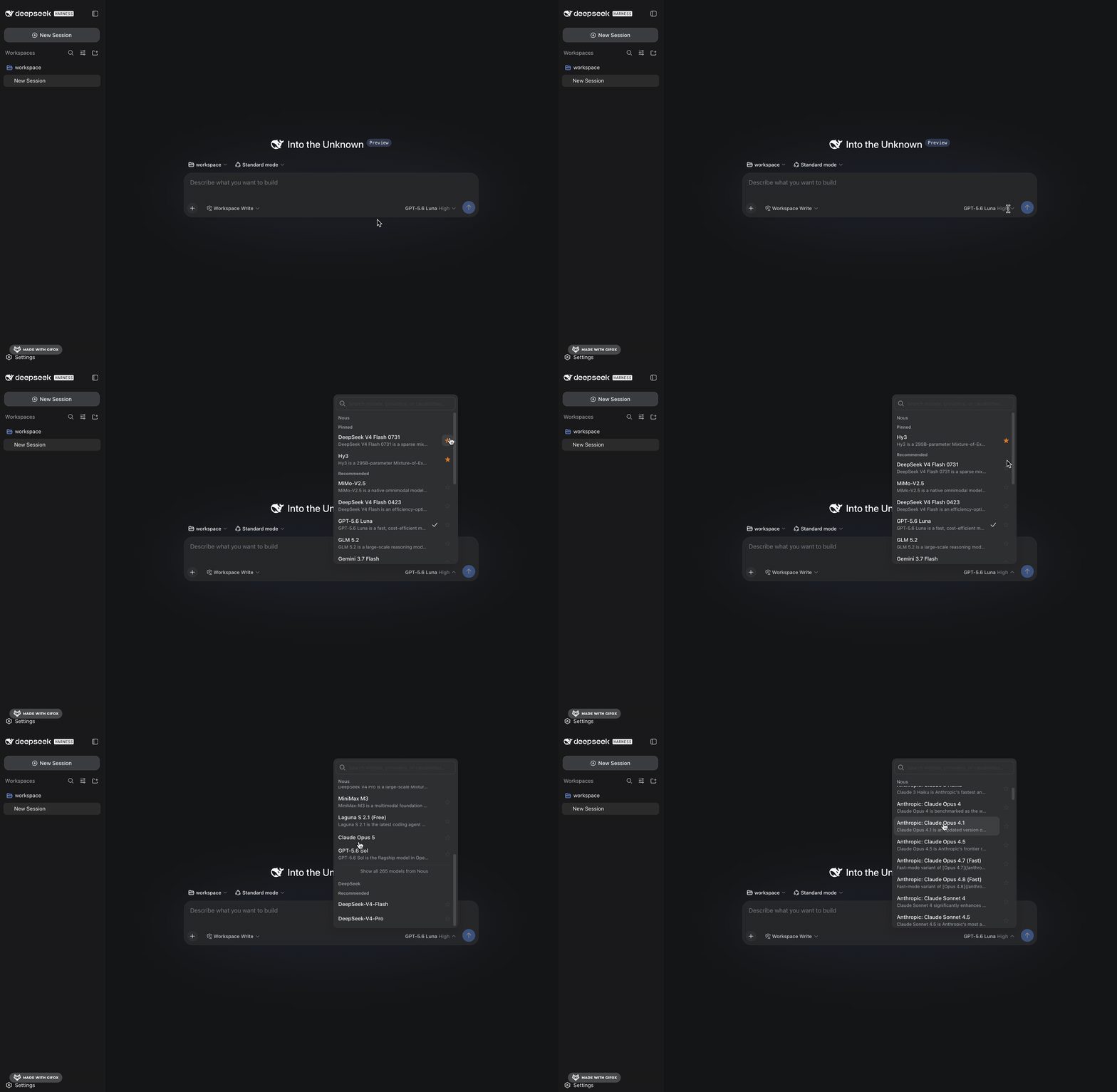
Live discovery is the default (catalogMode: live). The plugin makes an authenticated GET /models request to the configured Nous endpoint and merges compatible live routes into the picker. These twelve curated routes stay pinned first, preserving their OpenRouter trailing-week usage rank:
deepseek/deepseek-v4-flash-0731
xiaomi/mimo-v2.5
tencent/hy3
deepseek/deepseek-v4-flash
openai/gpt-5.6-luna
z-ai/glm-5.2
google/gemini-3.7-flash
deepseek/deepseek-v4-pro
minimax/minimax-m3
poolside/laguna-s-2.1:free
anthropic/claude-opus-5
openai/gpt-5.6-sol
The ranking measures adoption by prompt-plus-completion token volume, not model quality. OpenRouter-only routes and variants absent from Nous are skipped. Source and attribution: OpenRouter rankings, as of 2026-08-25. OpenRouter is not queried at runtime; runtime discovery calls only the configured Nous /models endpoint. The request carries the resolved Nous bearer credential and Harness's standard, non-secret User-Agent attribution header.
The merge is deterministic:
models remain first, in configuration order, and their name, description, context window, and output cap win over conflicting live metadata;:batch routes, tilde aliases such as ~latest, expired routes, non-text-output routes, routes without text input, and entries whose explicit supported_parameters array lacks tools are omitted;listModels() and exact-model resolution share the same successful live snapshot for one hour. Each refresh is limited to five seconds and 4 MiB of response bytes. Before the first successful refresh—or when credentials are missing—the configured/curated list remains available. After a success, an expired snapshot is returned immediately while one background refresh runs. If a refresh fails, the last-good snapshot remains available and credential/catalog retries pause for one minute by default. API keys and raw catalog responses are never cached or written to disk.
The Nous catalog is much larger. A model ID omitted from discovery can still be passed through unchanged by setting it explicitly; it then uses the plugin-wide context and output defaults.
The plugin does not add a separate terminal picker command. For terminal or headless runs, select the model with a normal Harness patch:
- id: agent-default-model
  config:
    provider: nous
    model: stepfun/step-3.7-flash:free
Run it:
dsh --profile headless --patch ./nous-model.cordis.yml \
'Reply with exactly: NOUS_OK'Create nous-model.cordis.yml:
- id: agent-default-model
  config:
    provider: nous
    model: openai/gpt-oss-120b
Then launch:
dsh --profile web --patch ./nous-model.cordis.ymlThe adapter passes the model ID through to Nous unchanged. The model does not have to be in the advertised catalog.
The defaults are live discovery, a one-hour successful-response cache, a five-second request timeout, and a one-minute failed-refresh cooldown:
- id: llm-nous
  config:
    apiKeyEnv: NOUS_API_KEY
    baseURL: https://inference-api.nousresearch.com/v1
    catalogMode: live
    catalogCacheTtlMs: 3600000
    catalogTimeoutMs: 5000
    catalogRetryCooldownMs: 60000
    models:
      - id: deepseek/deepseek-v4-flash-0731
        name: DeepSeek V4 Flash 0731
        contextWindow: 1310720
models is the ordered curated list and the fallback used when live discovery has not succeeded. It is separate from the favorites a user pins in the picker. Supplying models replaces the built-in twelve-entry list. Set catalogMode: curated to disable /models requests completely and expose only this configured list. catalogCacheTtlMs, catalogTimeoutMs, and catalogRetryCooldownMs must be positive integer milliseconds no greater than the platform timer limit. The cooldown applies after failed initial or background refreshes, preventing repeated credential lookup and /models requests until it expires.
A patch replaces the entire targeted config, so keep apiKeyEnv and baseURL when overriding discovery settings.
maxTokens limits generated tokens for one response. That includes visible text, reasoning, and model-generated tool calls. It is not the conversation-memory limit; that is the model's context window.
Raise it for a model with enough context:
- id: llm-nous
  config:
    apiKeyEnv: NOUS_API_KEY
    baseURL: https://inference-api.nousresearch.com/v1
    maxTokens: 32768
A patch replaces the entire targeted config, so keep apiKeyEnv and baseURL when overriding llm-nous.
Per-model caps are supported too:
- id: llm-nous
  config:
    apiKeyEnv: NOUS_API_KEY
    baseURL: https://inference-api.nousresearch.com/v1
    maxTokens: 32768
    models:
      - id: stepfun/step-3.7-flash:free
        contextWindow: 256000
        maxTokens: 8192
      - id: deepseek/deepseek-v4-pro-0813
        contextWindow: 1048576
        maxTokens: 32768
Effective precedence:
explicit request maxTokens
→ model-specific maxTokens
→ plugin-wide maxTokens
→ 8,192 defaultInspect the composed profile:
dsh --profile web --dump-configLook for the dsh-llm-nous layer and provider: nous.
Run a tiny smoke test:
dsh --profile headless \
  --patch ./nous-model.cordis.yml \
'Reply with exactly: NOUS_OK'The request reached Nous, but the selected model is paid and the Portal account has no available credits. Choose a free model or add credits.
The requested output cap plus the prompt, conversation, and tool definitions exceeds the model's total context window. Lower maxTokens or choose a model with more context.
MISSING_CREDENTIALHarness cannot find NOUS_API_KEY. Export it in the launching environment or store it through the Harness credential UI.
DUPLICATE_ADAPTERTwo plugins are registering the nous route. Keep only one dsh-llm-nous bundle active in the profile.
pnpm install
pnpm run build
pnpm test
The runtime artifact is lib/index.mjs. It bundles its runtime dependencies, so an installed bundle does not need a sibling Harness checkout.
MIT
CLASSIFICATION EVIDENCE
系统优先读取 GitHub Topics,再与站内分类词典和词根规则比对。当前命中: llm、deepseek-harness、openai-compatible。
morluto
Reverse engineer anything with agents, from app behavior down to native binaries.

deepseek-ai
DeepSeek Harness: Everything is a Plugin.

nexu-io
The 1st Collaborative AI Design Agent Workspace. Local-first and open source. Create motion, prototypes, websites, apps, dashboards, presentations, images, and videos with your team and AI agents. Share work, exchange feedback, and iterate together in one workspace.