
模型与 MCP
待识别

rea
morluto
Reverse engineer anything with agents, from app behavior down to native binaries.
PROJECT TOPICS
INSTALL REFERENCE
dsh plugin --profile web add github:orchispring/dsh-poor-router
该命令指向仓库当前默认分支;尚无绑定当前 commit 的完整验证结果。
PROJECT README
A budget-LLM pool router for DeepSeek Harness — keep a ledger of every free/cheap model you can reach, watch their health, and reroute around failures automatically, with a web panel and a live reroute badge.
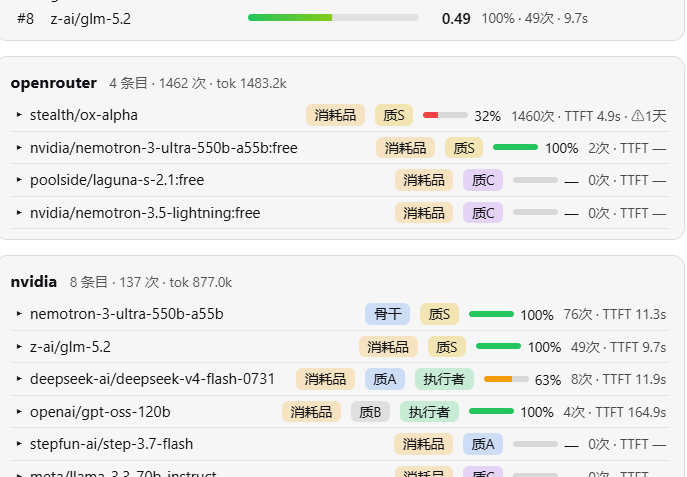
The settings-page dashboard — routing / adaptive / badge toggles, live stat chips, availability ranking (posterior mean × latency penalty), provider-grouped collapsible ledger (expand any row to edit expiry / grant / quality tier inline):
The ⚡ reroute badge at the left of the input box — shows where the most recent request was actually served and why (e.g. aux-explore exploration), hover for details, dims after ten minutes:

This plugin is built for the broke. If you can afford API bills, walk away.
It is well known that the broke have two defining traits: being poor, and being a ghost.
Poor: we glance at the pricing page and quietly close the tab. A ghost: wherever there is free quota, that is where we haunt. NVIDIA bonus credits, Qwen giveaway grants, GLM flash tiers, OpenRouter :free routes… free APIs are everywhere, yet every one of them dies halfway through the burn — you are mid-sentence when it flatlines; you scramble to another, and the next one is barely breathing too. By the end of the night you have spent hours conducting funerals for free APIs.
And so the poor-router makes its grand entrance —
The rich have budget alerts, account managers, SLAs.
What do we have? We have the entire free internet.
Free-tier LLM quotas are scattered: NVIDIA's bonus credits, Qwen's giveaway grants, GLM flash tiers, OpenRouter :free routes… Each one dies at a different time of day. This plugin treats them as one pooled resource: it meters everything you actually send, learns which entries are healthy right now, and quietly swaps the model on failing requests so your run survives instead of dying with the quota.
pool.json.3000ms/ttft), current-hour bucket double-weighted.YYYY-MM-DD:HH local key), with 7-day rolling prune. No more "forefully congested" ghosts from stale data.tier: S/A/B/C; reroutes prefer same tier first, then step down A→B→C, and only climb as a last resort. Tiers are editable from the panel, instantly persisted.role: executor; trivial/auxiliary subrequests get routed to whichever has the thickest remaining grant. Every 6th such request epsilon-explores an unused free model instead (34% same-tier sampling too).paid: true with per-M pricing and a daily cap; they are excluded from all candidate lists and only reachable through the escape hatch when every free candidate is dead — cheapest-first, half-cap SMS warning via text_me.llm/stream hook
├─ aux/small request? ──► executor pool (thickest remaining grant)
│ └─ every 6th ──► epsilon-explore unused free model
├─ provider cooling? ──► pickAlt(): same tier → down A/B/C → escape hatch (paid, capped, cheapest)
├─ model cooling? ──► pickAlt()
└─ hour-congested? ──► pickAlt() (today's bucket fail-rate > 60% @ n≥4)
pickAlt() samples candidates with Thompson sampling × TTFT penalty;
34% chance to inject an unused newcomer into the same-tier window.
Every decision is logged to the ring buffer; nothing writes back to config.dsh plugin --profile web add github:yishengdaxiaonengjihui/dsh-poor-routeror manually: add "dsh-poor-router": "github:yishengdaxiaonengjihui/dsh-poor-router" to the profile's package.json, list it under dsh.profile.bundles, then pnpm install.
# in <DSH_HOME>/profiles/web/
# package.json dependencies:
"dsh-poor-router": "link:D:/somewhere/dsh-poor-router"
Then restart DSH. The web client half is packaged by client-modules automatically.
Everything lives next to your models in pool.json. Plugin-level paths default to <cwd>/poor-router/; override in your profile's cordis.patch.yml:
- id: poor-router
  name: dsh-poor-router
  config:
    dataDir: 'D:/my-data/poor-router'   # base dir for all three files
    # or individually:
    # poolPath: '...'
    # statePath: '...'
    # importPath: '...'
    layerRules:                          # optional default layers by id prefix
      - { match: 'deepseek-official/', layer: 'backbone' }
      - { match: 'tokenrouter/', layer: 'matchstick' }
Entry fields that matter:
| field | meaning |
|---|---|
id |
provider/model — must match what the harness proposes |
expiresAt |
ISO date; urgency sort + panel countdown |
grantRemaining / grantUnit |
executor-pool budgeting |
tier |
S/A/B/C quality ladder (panel-editable) |
role |
"executor" joins the aux-request pool |
layer |
backbone (never burned) / burn / matchstick |
paid + priceIn/OutYuanPerM + dailyCapYuan |
real-money guardrail |
escapeHatch |
allow this paid model as last-resort |
The plugin registers two session tools:
pool_status — full snapshot (summary + per-entry stats).pool_control — overrides: setTier, setRouting, setAdaptive, setBadge, setExpiry, setGrant, setDisabled, clearProviderCooldown, reloadPool, …Does rerouting change my configured model permanently? No. Routing is stateless per request: every request starts from the configured model and may be swapped for that one call only.
What if all free models die at once? The escape hatch kicks in — the cheapest capped paid model serves the request, you get an SMS, and normal service resumes when anything recovers.
Does it work without the web GUI? Yes — tools work headless; the panel/badge simply have nowhere to render.
CLASSIFICATION EVIDENCE
系统优先读取 GitHub Topics,再与站内分类词典和词根规则比对。当前命中: llm-router、deepseek-harness。
morluto
Reverse engineer anything with agents, from app behavior down to native binaries.

deepseek-ai
DeepSeek Harness: Everything is a Plugin.

nexu-io
The 1st Collaborative AI Design Agent Workspace. Local-first and open source. Create motion, prototypes, websites, apps, dashboards, presentations, images, and videos with your team and AI agents. Share work, exchange feedback, and iterate together in one workspace.