dsh-llm-fallbacks
English | 中文






Automatic provider/model fallback chains for dsh (DeepSeek Harness): when an agent's LLM requests keep failing — retries exhausted, auth errors, quota exceeded, rate limiting (429) — the plugin switches provider/model along the fallback chain for the current role, and the current step/turn continues on the target model: tasks are not interrupted by model problems.
Works in both dsh front ends: the web profile (Settings → Plugins → Fallbacks card) and the dsh-tui terminal profile (/fallbacks session diagnostics, /fallbacks config readback, and the /settings fallbacks section for editing).
Time slots
Time slots rotate the effective root chain by wall-clock windows: each slot row carries its own fallback chain, and the first row whose window contains the current moment replaces the all-day chain for the next root request — the all-day chain stays as the last resort when no slot matches. Peak and valley windows can therefore use different chains while the failure walk (fallback switch) remains untouched.
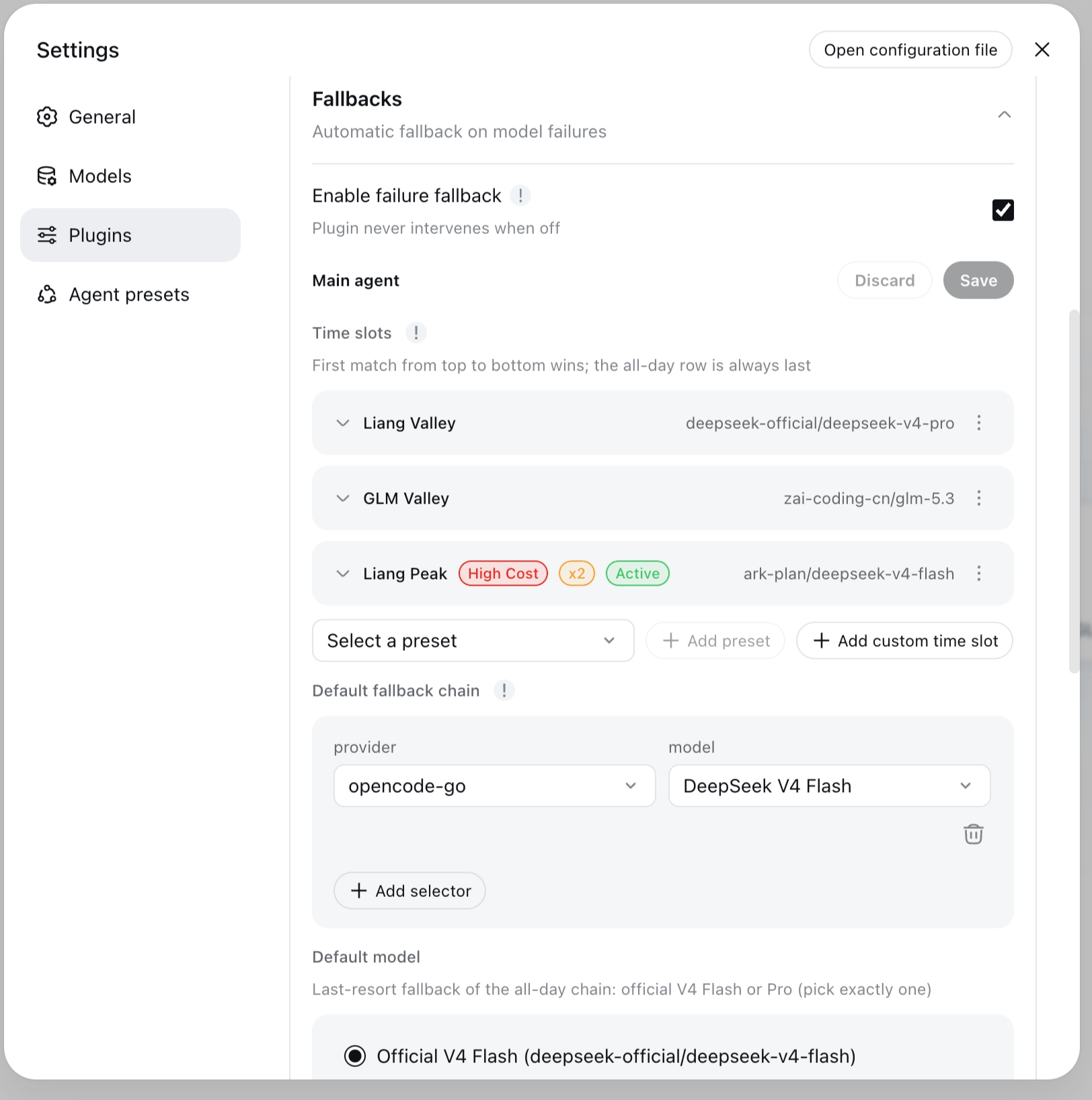
Four frozen UTC+8 presets (windows are code constants; preset rows lock tz to Asia/Shanghai):
| Preset |
Window |
liang-peak |
Monday–Friday 09:00–12:00 and 14:00–18:00 |
liang-valley |
every other UTC+8 time (complement of Liang Peak) |
glm-peak |
Monday–Friday 14:00–18:00 |
glm-valley |
every other time (complement of GLM Peak) |
GLM Peak and GLM Valley are offered in the card picker only when zai-coding-cn is configured.
The first extra row whose window contains the current moment (in fallbacks.tz, default Asia/Shanghai) wins; no match → the all-day rootChain, whose tail (Default model) must be exactly one official model — deepseek-official/deepseek-flash or deepseek-official/deepseek-v4-pro (XOR). Slot rotation is a routing seed, not a failure decision: it applies on the next root request, consumes no cooldown, and is logged as a time-slot switch — failure walks keep fallback switch. Full semantics → Time-slot presets and docs/configuration.md.
Quick start
Install
dsh plugin --profile web add dsh-llm-fallbacks      # web profile (Settings → Fallbacks card)
dsh plugin --profile dsh-tui add dsh-llm-fallbacks  # dsh-tui terminal profile
Same plugin, either front end — the only difference is the --profile flag. Pin a version with @<version>. A registry install fetches the built package (dist/), nothing builds on the target machine. Registry / git / local-directory variants, uninstall, and --dump-config verification → docs/install.md. The plugin ships localized metadata (title/description for the Plugins-page detail view, English + 简体中文) and an icon — both declared in the package (locale/*.json + icon.svg) and picked up by the host automatically.
Configuration surfaces
The plugin's settings live in a shared fallbacks: namespace, editable from three surfaces:
| Surface |
What it is |
Notes |
| Web settings card |
Settings → Plugins → Fallbacks |
Full GUI editor for the fallbacks: namespace; writes the shared settings document |
$DSH_HOME/settings.yaml |
fallbacks: section in the dsh settings document |
The shared source of truth — the same file the web card writes; readable and editable everywhere, including scripted setups |
TUI /settings |
fallbacks section in the dsh-tui settings screen |
dsh-tui ≥ v0.8.5; native fields for simple keys, JSON text fields for complex structures (see dsh-tui profile (terminal)) |
Pick the surface that matches your front end: web users get the card, terminal users get /settings, and the YAML file works everywhere. (/fallbacks and /fallbacks config are diagnostics — read-only views, not edit surfaces.)
Minimal configuration
Add a fallbacks: section to the shared settings document ($DSH_HOME/settings.yaml — see Configuration surfaces):
fallbacks:
  rootChain:               # all-day chain: leading entries = fallback walk, last = Default model (official)
    - anthropic/claude-3-5-sonnet          # walked first
    - deepseek-official/deepseek-flash  # last resort (Flash or Pro)
  timeSlots:               # optional: rotate the effective root chain by wall-clock windows
    - kind: preset         # frozen UTC+8 window; only the chain is editable
      preset: liang-peak   # Monday–Friday 09:00–12:00 and 14:00–18:00
      chain:
        - anthropic/claude-3-5-sonnet
    - kind: custom         # custom window (may wrap midnight)
      name: evening        # optional display name
      start: '22:00'
      end: '02:00'
      days: [1, 5]         # optional; omitted/empty = every day (0=Sunday…6=Saturday)
      chain:
        - openai/gpt-4o
  roles:                   # optional: declare role entities, then reference them from rules
    list:
      - id: reviewer       # unique id; "inherit" is reserved
        persona: Code-review subagents
        chain:
          - openai/gpt-4o-mini
        fallback: inherit-root   # role chain first, then the inherited rootChain
    rules:                 # subagent-only: rules never match root requests
      - role: reviewer     # all subagents → the reviewer role
Build the section up in four steps:
1. Configure content. There is no feature switch in the section — the plugin intervenes exactly when something is configured: a non-empty rootChain, at least one timeSlots row, or one declared role. An empty section is a complete no-op, and the Plugins-page row toggle is the master switch (disabling the plugin row stops it entirely).
2. Set the all-day rootChain. Leading entries are the fallback chain, walked first when a request fails; the last entry is the Default model.
Conformance: the last entry must be exactly one official model — deepseek-official/deepseek-flash or deepseek-official/deepseek-v4-pro (XOR). The settings card and gateway reject any other tail on save; a legacy non-official tail warns at startup and keeps working as a fallback-only walk, but cannot be saved as-is. The retired deepseek-v4-flash id is no longer a legal tail — a saved tail with it now warns, goes inert (slot rows + virtual picker), and blocks save until a legal tail is picked. The official Pro tail is catalog-served as deepseek-official/deepseek-v4-pro (dsh 0.2.0-rc.2) and selectable in the card; a hand-written legacy deepseek-official/deepseek-pro tail — never catalog-served — reads back as non-conforming (no migration; re-pick the tail). The plugin does not probe catalog availability — a chain containing deepseek-official/deepseek-v4-pro dispatches to it like any other exact entry, and on the virtual route the stream() delegate serves the first dispatchable exact head of the effective chain, so a chain with a working entry before Pro still routes to that earlier entry.
3. Add timeSlots (optional). Rows rotate the effective root chain by wall-clock windows. Preset rows use frozen UTC+8 windows (only their chain is editable; while a preset row exists, tz locks to Asia/Shanghai); custom rows take start/end (may wrap midnight) and an optional days list. The first row whose window contains the current moment wins; no match → the all-day rootChain. Rotation is a routing seed — it applies on the next root request and consumes no cooldown (see Time slots).
4. Add roles (optional). Declare role entities in roles.list (id, persona, chain, optional fallback policy), then map subagents to them with roles.rules. Rules never match root requests — with no rule match (or on a root request) the built-in inherit role applies and appends the rootChain.
Full reference (role entities, fallback strategies, rules, selectors, preset roles, time-slot presets) → docs/configuration.md.
Upgrade note (breaking, behavior change): the config-level enabled switch is removed — a stored section still carrying enabled: true/false loads cleanly (the key is ignored and stripped on the next save), but the switch no longer gates anything. If you relied on enabled: false to keep the plugin inert, empty the section (or disable the plugin row on the Plugins page) instead.
Verify
Save the config and restart the session, then type /fallbacks — the read-only in-session diagnostics (origin, resolved role, chain, recent fallback switches, cooldown status). In a dsh-tui profile, /fallbacks config reads back the composed configuration; see dsh-tui profile (terminal).
Repair existing sessions
A session log reaches the GUI only through the frozen released migration chain. That chain throws at the first row it cannot classify, so a pre-V3 log written by an older release — or by any plugin that merged a custom message-source kind — makes the session fail to load, and the bytes never change on their own. Two classes cover nearly every case, and both are the same kind of root cause: content outside what a released format edge admits.
| Class |
What the log carries |
Root cause |
source-kind |
a message source.kind outside the released vocabulary |
the vocabulary is frozen per format edge, so a plugin that merged a custom kind into MessageSourceMap leaves the V2→V3 edge refusing the log (cannot safely transform unclassified message source). The released kinds are user, plugin, model, tool, agent-instructions, session-reference, team-message, goal, skill-invocation, skill-catalog, coordinator, subagent-report, subagent-settled, webhook, agent-message |
subagent-descriptor-version |
a subagent/descriptor row with version: 2 |
the V0→V1 edge admits only descriptor version: 3, and dsh releases v0.1.0-rc.7 … v0.1.1-rc.2 wrote version 2 |
A third class — the legacy fallbacks/switch event type — is not repairable by a rewrite: see Lossy recovery for fallbacks/switch.
If you author a plugin: through dsh 0.1.6 the persisted source vocabulary was frozen per format edge, and the sanctioned arm was { kind: 'plugin', plugin: '<stable-id>', form: … }. Since dsh 0.1.7-rc.1 that vocabulary is producer-declared instead ("each producer declares its own kind in its own module" — dsh's own model-selection notice writes { kind: 'model-selection', form: 'notice', … }), and the one rule a released edge enforces on a direct kind is that it is non-empty. Old logs written against the frozen vocabulary are exactly what this tool's source-kind class repairs.
Usage
The tool is run from this repository (clone + pnpm install). Its sources do ship in the npm tarball, but there is no runnable entry there — no bin is registered and tsx is a dev dependency — so a registry install cannot run it. It is a read-only report by default: it walks a session root, classifies every pre-V3 log into exactly one refusal class and prints per-class counts. Nothing is written unless --apply is given.
git clone https://github.com/omdsh-dev/dsh-llm-fallbacks.git
cd dsh-llm-fallbacks
pnpm install
pnpm repair:session-logs                             # read-only report (the default)
pnpm repair:session-logs -- --root ~/.dsh/sessions   # explicit session root
pnpm repair:session-logs -- --apply                  # publish a repaired successor generation
--dry-run no longer exists: the report is the default mode, and --dry-run is rejected as an unknown argument (exit 2).
| Flag |
Meaning |
--root DIR |
session root to walk (default: $DSH_HOME or ~/.dsh, then /sessions) |
--apply |
run the rules' proofs and publish a current-generation successor beside each repaired original (requires a resolved released catalog) |
--class NAME |
restrict what --apply repairs to one refusal class; the listing, the class table and the exit code still cover every log, and the repairable verdict is always computed over the full policy, so it can never hide a refusal or promise a repair this invocation cannot perform |
--catalog PATH |
explicit released catalog path (package directory, a directory holding it, or its module entry file). The resolved module is executed, not parsed — the same privilege as running this tool — and must declare a current format version ≥ 3; a below-version catalog, or a file candidate owned by a different package, is refused (exit 2) rather than trusted to verify its own output |
--backup |
copy the original generation to <name>.bak before publishing; a run that publishes nothing removes the copy it created again (a pre-existing one is never touched, and one holding different bytes blocks the repair until you inspect and delete it) |
--drop-legacy-events |
opt-in lossy recovery for legacy fallbacks/switch rows (see below) |
--json |
machine-readable report instead of the text report |
--quiet |
suppress the per-log lines and the by-class table (warnings and errors are never suppressed) |
--help, -h |
print the usage text (including the --apply precondition) and exit 0 |
The original generation is never modified and never truncated; rollback is deleting the published successor, which makes the original the generation dsh opens again.
--apply precondition: run it only while NO dsh instance is writing the sessions under --root. The publisher links the successor into the session directory without observing the host's flock lease (that lease is host-internal and cannot be taken from this repo), so a dsh that is still appending to the old generation would be orphaned once the host prefers the successor. Stop dsh first.
Runtime floor: Node ≥ 22.15. Reading and writing need node:zlib zstd, which that release added (engines.node allows >= 22); an older runtime fails closed with an actionable message instead of a module-link stack trace.
Two policies, and ok-truncated. A log's class and its ok come from the host loader's policy — the one that decides whether the GUI opens the session — but that policy can swallow a refusal and drop every row after it. Every ok log is therefore cross-checked with the same loader policy under strict recovery (one axis apart, so a refusal there means rows were dropped rather than "not current-shaped"): when it refuses, the log is reported ok-truncated (a strictRefusal reason in --json, an ok-truncated count in the summary) because the session opens without the rows that refusal swallowed. Such sessions still exit 0 — they do load.
Discovery never fails open. A namespace/session directory that cannot be read, a canonical generation below the format floor that is a symlink or not a regular file, and a leftover session.repair.*.jsonl.zstd.tmp are reported (a skipped/staleStagingFiles entry, always printed and never hidden by --quiet), suppress the "no session log …" line, and make the run exit 1. Symlinks are reported, never followed: a repair writes beside the generation it repairs, which must stay inside --root. An unreadable --root is fatal (exit 2) — never an empty report.
--apply refuses a revision it did not decode. The digest of the bytes this run read is compared with the file before anything is staged, so a concurrent append is refused before the first write. If the source moves after a publication this run created, that successor is removed again; if it moves after accepting a pre-existing identical successor, the failure names that file and says to delete it — never "nothing was published".
A closed report stream is not a store event. Piping the report into a consumer that stops reading (pnpm repair:session-logs -- | head -n 5) closes stdout, and the next write would otherwise raise an unhandled EPIPE. Instead the tool stops writing to that stream (with no stack trace), still finishes the run — an --apply pass publishes every remaining successor — and exits with the exit code below, which always describes what happened to the store, never whether the reader stayed. A stream error that is not a closed pipe (a full disk, an I/O failure) is not swallowed: it still surfaces as an uncaught error.
Exit codes: 0 = every log loads (a session that opens with rows dropped under the strict policy is ok-truncated and still exits 0); 1 = at least one log is still refused/unrepairable, a repair failed, a log was left unpublished (including one --class excluded), an input could not be inspected (a skipped path), or a stale session.repair.*.jsonl.zstd.tmp was found under the root; 2 = fatal (bad arguments, a missing or unreadable --root, --apply without a resolved catalog, a catalog below format v3, --apply --drop-legacy-events without --backup, or a runtime without node:zlib zstd).
Lossy recovery for fallbacks/switch (opt-in)
Versions before 0.2.2 wrote durable fallbacks/switch session events (issue #52: the apply()-time event-type registration is ineffective because plugin and host resolve different module instances). The frozen V0→V1 edge refuses that event type even when the row carries ignorable: true, so no rewrite can make such a row load — removal is the only in-repo recovery. Opting in means accepting two consequences:
- The session's recorded provider/model switch audit rows are deleted. They survive only in the original generation (and in its
.bak when --backup is used): the published successor is the only readable generation that lacks them.
- The surviving events are renumbered. The same edge requires every event's
seq to equal its running event count, so each surviving event receives the seq of its position in the surviving event stream and every Session-seq reference it carries is shifted with it. Their content is otherwise unchanged, byte for byte.
pnpm repair:session-logs -- --drop-legacy-events                   # report: count what would be dropped
pnpm repair:session-logs -- --drop-legacy-events --apply --backup  # --backup is required here
The mode is off by default, report mode writes nothing, and --apply --drop-legacy-events requires --backup (exit 2 without it). It fails closed, writing nothing, when a surviving row references a seq that would be dropped, when the source rows are not densely numbered, or when the renumber would cross the header's seed cut. --json reports legacyEventCount (legacy rows in the source log), droppedEventCount, renumberedEventCount and a machine-readable lossyRefusal reason per log; text runs print the dropped/renumbered counts as a loud warning. A row of any other unknown event type is never dropped — such a log stays unrepairable. Without the flag those sessions stay unreadable by design, with their bytes preserved.
The durable fix belongs upstream at the migration edges (the frozen V0→V1 edge admitting the descriptor versions it shipped, and custom message-source kinds moving to the plugin arm).
Features
- Automatic fallback for root and subagents: any agent switches down the chain to the next available provider/model on model failure — no manual model switching.
- Two-block config:
rootChain for the root agent; declared role entities (roles.list) referenced by roles.rules (or the built-in inherit).
- Chain as root primary from the picker: whenever the plugin has content configured, the host model picker (web and TUI alike) shows a virtual
FallbacksChain / Auto row — selecting it uses the configured chain as the root primary (a conforming all-day head is required for the delegation to succeed); selecting a real model keeps fallback-only (see FallbacksChain in the model picker).
- Time slots: optional
fallbacks.timeSlots rows rotate the effective root chain by wall-clock windows in the config-level tz timezone (default Asia/Shanghai) — four frozen UTC+8 presets (liang-peak / liang-valley / glm-peak / glm-valley, windows are code constants, models-only edits) or custom start/end/days windows. The first matching row wins; the all-day row is always last. A slot change applies on the next root request and is logged as a time-slot switch — a routing seed, never a failure decision: it consumes no cooldown and does not count against maxSwitchesPerStep. Failure walks keep the fallback switch copy (see Time-slot presets).
- Dispatch-time role resolution: on a subagent's first request its role is resolved in three stages — explicit (
agentPreset matches a declared role id) → deterministic rules (matching either the recorded pair or the served head — see FallbacksChain in the model picker) → LLM auto-match from the declared role taxonomy (fallbacks.roleAutoMatch, default true). The resolved role's chain-head model is injected into the first request and recorded via an explicit role → model log line (no durable fallbacks/switch event is written — issue #52 stop-write); set roleAutoMatch: false to disable the LLM auto-match stage (the explicit agentPreset stage still applies — with no explicit role this reproduces the previous rules-only behavior). The settings card always renders an Enable role auto-match switch (default true) to toggle it — the schema default applies even to legacy configs that never declared the key.
- Role persona on the child (chain-independent): when a subagent's dispatch declares a role this plugin knows (the
**Execute as**: <id> field of its Assignment), that role's persona is installed on the child as its own persona — the role is the child's identity, not only a routing decision, and delivery does not depend on routing: a role with an empty chain gets its persona exactly like a chained one (the chain only picks the model). A persona the caller already set is never overwritten; a provider that cannot carry a persona skips it and the dispatch runs natively.
- Role announced inside the subagent's own session: a child dispatched with a declared role gets exactly one plugin notice row in its own session, naming the role it was dispatched as —
[role: <id>], with (persona not applied) when the role declares a persona that was skipped — written once at the child's first non-empty pre-step, never for a root session and never for inherit/unresolved dispatches. The row is a durable transcript row, so the role stays readable in the child's session after it settles.
- Subagent role badge: when a subagent is dispatched with a declared role — the
**Execute as**: <id> field of its Assignment, the same declaration that carries the persona, and the badge's ONLY source (policy on or off) — its session shows a compact role badge next to the session's agent-preset (mode) chip in the web session header; hover shows role → latest request route (the route of the newest recorded request, not the dispatch-time route). Only the DECLARED header is read, so a child whose role came from another stage (agentPreset match, a role rule, or the LLM auto-match) but which declares no Assignment header is still routed as that role yet shows no badge — the badge never reports a role inferred after the fact. inherit/unresolved sessions render no badge. The badge is durable: it is read from the child's own session record, so it is still shown for a settled subagent session and after a host restart.
- Context-window-aware fallback:
triggerCodes accepts any dsh failure code, including CONTEXT_WINDOW_EXCEEDED — a request too big for the current model fails over to a candidate with a larger context window (candidates that cannot fit either are skipped), and because the route itself is healthy the switch is request-scoped: no cooldown, no half-open probe burned (see Fallback triggers).
- Cooldown and revert: failed / switched-away models are not re-selected during cooldown;
revertPolicy: cooldown-expiry returns to the primary model automatically.
- Host subagent model policy (dsh 0.1.2): when the host
subagent-model-selection policy is enabled, its allowlist is a hard constraint on every plugin-originated subagent route — an explicit authorized spawn route stays the chain head (role-inject skipped), inheritance inject heads and failure-switch targets are intersected with the effective allowlist, and an empty intersection skips the inject/switch (warn log + read-only card warning; no out-of-allowlist request is ever sent). A present-but-unreadable policy fails closed. Policy off/absent → inject and failure-switch selection exactly as 0.3.5. Override reasoningEffort follows the upstream routeChanged rule on every path (same route → keep; route change → drop unless explicit). See Host subagent model policy.
- Half-open recovery (opt-in):
recovery: half-open makes recovery evidence-driven — an expired cooldown leaves the route half-open for one logged probe instead of restoring the preference; consecutive failures escalate the suppression duration (×2 per failure, capped at 1 h); an observed completion closes the circuit and fully restores the preference. revertPolicy: 'never' keeps the mechanism inert; state is session-scoped in-memory (a restart resets). YAML-only — the default timer keeps every existing behavior byte-identical (see docs/configuration.md).
- Visible behavior: every switch is recorded in an info-level log line (from/to/role/reason) — no silent model switching. The plugin deliberately writes no durable
fallbacks/switch session events (issue #52: the apply()-time event-type registration was proven ineffective, and a session containing the event refused to load after a dsh restart). Sessions written by older plugin versions that contain such events cannot be repaired by an ignorable flag — the released session-format migration chain (v0→v1) refuses unknown event types even when marked ignorable — so pnpm repair:session-logs reports them (and recovers them only with the opt-in lossy --drop-legacy-events — see Repair existing sessions).
- Safety valves:
maxSwitchesPerStep caps switches per step and alwaysModeRetryCap caps always-mode retries — chain loops cannot amplify latency.
- No-config no-op: with nothing configured the plugin behaves exactly like not being installed — content presence is the gate (see Minimal configuration).
dsh-tui profile (terminal)
In a dsh-tui profile the plugin has three operator surfaces, with a strict duty split:
/fallbacks — what happened this session: origin, resolved role, effective chain, recent fallback switches, cooldown status (half-open marker rows when recovery: half-open is active). Read-only./fallbacks config — what is configured: composed-config readback (trigger codes, root chain, time slots, timezone, roles, role rules, cooldown, revert policy, safety valves, presets, role auto-match). Read-only apart from the one action command /fallbacks config revert-seed <role-id>, which restores a seeded role's persona to its declared seed default — the web settings card presents seeded personas read-only (no revert affordance), so the command is that action's only surface./settings — the edit surface. The plugin registers a fallbacks section with full parity to the web settings card: booleans (roleAutoMatch) render as toggles, selects (presets, revertPolicy) as pickers, and numbers (cooldownMs, maxSwitchesPerStep, alwaysModeRetryCap) as numeric inputs; complex structures (rootChain, timeSlots, roles.list, roles.rules) are JSON text fields and triggerCodes a comma-separated text field. Invalid drafts (bad JSON, non-conforming chains, malformed time-slot rows) block the save — the section never corrupts the config.
Requirements: the /settings fallbacks section needs dsh-tui ≥ v0.8.5 (commit c51661f or later on main; the settings seam shipped in v0.8.0, the groups shape + validation in v0.8.5). On an older dsh-tui the section is absent, and file editing remains the only TUI edit surface.
File editing still works everywhere: the shared $DSH_HOME/settings.yaml (fallbacks: section — the same file the web card writes) for global settings, or the profile patch ~/.dsh/profiles/dsh-tui/cordis.patch.yml (config: overrides on the plugin row) for dsh-tui-specific values. A patch row replaces the targeted row's whole config — restate every field you want to keep (schema defaults fill the rest).
FallbacksChain in the model picker
Whenever the plugin has content configured (a non-empty rootChain, at least one timeSlots row, or one declared role), it registers a virtual provider, FallbacksChain, with a single catalog row: Auto. The web profile and dsh-tui both see the row: they share the same adapter catalog, so the row needs no settings-page wiring or host patch (it is independent of the /settings fallbacks section, which edits configuration rather than the picker catalog). A legacy or empty all-day chain does NOT hide the row as long as other content is configured (the delegate just refuses to serve it); with nothing configured there is no row.
Selecting FallbacksChain / Auto uses the configured chain as the root primary: the request stays on the virtual pair and the adapter's thin delegate dispatches the effective chain's first exact provider/model at request time, so the fallback engine degrades from that head as usual. Serving the selection unchanged (instead of rewriting the route to the head) is also what keeps the host's model-change notice quiet: the recorded route equals the session selection, so the notice appears once on a genuine selection change rather than being re-armed on every step. Selecting any real catalog model keeps the v0.2.2 fallback-only behavior — the session model is primary and the chain engages only after it fails.
There is no rootMode switch — no config key, YAML field, settings toggle, or gateway flag. The mode is the session's {provider, model} selection itself: FallbacksChain = chain primary; any real model = fallback-only.
Notes:
- Picker label: the row's catalog
name (what the composer trigger shows) is live — Auto: DeepSeek Flash[Liang Peak] / Auto: DeepSeek Flash[all-day] (catalog display name, not the model id); the id stays Auto. Bare Auto if the all-day tail is not conforming. Refresh by reopening the picker.
- Thin delegate on every origin: the row is served by the same
stream() delegate for the root agent and for a subagent session that inherits the selection — subagent role resolution and injection keep their semantics apart from one deliberate widening: dispatch-time rule matching accepts either the recorded pair or the served head (a superset of the previous matching, so a rule keyed on the real head keeps matching), and the virtual row is never a second routing engine. A subagent that inherits the selection still routes through the chain head.
- Conformance gate on the tail: a successful delegation requires the all-day chain to be tail-conforming — its last entry must be exactly one official model (
deepseek-official/deepseek-flash or deepseek-official/deepseek-v4-pro, the card's Default model panel); leading entries (Default fallback chain) are walked first. Deactivating the plugin (the Plugins-page row switch, or clearing all configured content) hides the row again (slot-row/chain edits never churn registration).
- Stale selection: if the row disappears (plugin deactivated) while
FallbacksChain / Auto is selected, the session keeps showing it as the current model with routable: false — pick a real model from the catalog to continue (host-native catalog semantics).
- Capabilities and retry policy follow the head: the row's model metadata (context window, modalities, reasoning) mirrors the current effective head, and
providerRetryPolicy returns that head's policy — so a user's llm-deepseek.retryPolicy applies on this route too, not the permissive default. The host captures the policy once at registration, so a later policy edit or a slot-driven head-provider rotation shows up only after the plugin re-registers. Retry events are keyed by the virtual provider — the route the runtime actually sees. Full semantics → docs/configuration.md.
Time-slot presets
Time slots are introduced in the featured overview above; this section is the reference. Time-slot rows rotate the effective root chain by wall-clock windows — useful for peak/valley pricing without confusing wall-clock rotation with failure fallback. The copy split is strict: slot rotation logs and UI say time-slot switch; the failure walk keeps fallback switch; the conversation notice Model downgraded stays on the failure path only.
- Match order: at every root request, the first extra row whose window contains the current moment (in
fallbacks.tz, default Asia/Shanghai / UTC+8) wins — that row's chain replaces the all-day chain. No row matches → the all-day rootChain is used. The all-day row is always last and required: its last entry must be exactly one official model (Flash / Pro XOR; leading Default fallback chain entries are walked first).
- Presets (frozen, not user-editable):
liang-peak = Monday–Friday 09:00–12:00 and 14:00–18:00; liang-valley = every other UTC+8 time; glm-peak = Monday–Friday 14:00–18:00; glm-valley = every other time. One preset id = one row; the card picker never offers a duplicate.
- Custom rows:
start / end (HH:mm, may wrap midnight) + optional days (0=Sunday…6=Saturday; omitted/empty = every day) + models.
- Next-request apply: a slot boundary crossing never preempts an in-flight step — the new row takes effect on the next root request. Rotation is mount-only: info log + card/
/fallbacks status line, no durable switch event.
- Flat settings card (the official Plugins-page form language): the card is always open — no collapsible chrome and no feature switch — and one footer Save/Discard pair writes the whole validated draft. The Main agent section groups Time slots (extra rows — add preset / add custom / remove / reorder by buttons or drag; preset rows show a read-only window summary and edit models only; custom rows carry an editable name; the timezone picker lives here and locks to Asia/Shanghai while any preset row exists, since preset windows are frozen UTC+8 constants), Default fallback chain (walked first when no slot matches) and Default model (the official Flash | Pro last-resort fallback). Rows are collapsible to name + first model (content disclosure). There is no
timeSlots.enabled master switch (adding a row is the opt-in) and no rootMode control.
Preset roles
The plugin ships 5 bundled generic subagent roles out of the box — reviewer / scout / security-reviewer / sonic / task — declared automatically on apply as seeded roles.list rows ({ id, persona }): idempotent, and never overwriting an operator persona. They appear in the Settings card as read-only rows (a source badge on every row; the id and persona cannot be edited there) and in the /fallbacks config role summary, ready for roles.rules to reference. (designer and librarian are no longer bundled: rows saved by earlier versions keep their persona and now show source user as ordinary editable rows only when no live producer still declares the id, even though the operator never wrote them; a companion's live declaration keeps them seeded and read-only with source external when unnamed or its registered set name otherwise.)
- Switch:
fallbacks.presets — 'bundled' (default) declares the preset roles on apply; 'none' disables the automatic declaration (already-materialized rows stay).
- Full semantics (upgrade behavior, conflict handling, library reuse of
presetRoles) → docs/configuration.md.
Agent presets (plugin composition)
Agent presets are a dsh feature for composing plugins — they are declarative child-plugin lists a user can apply as a set, and they carry no model fields of their own. The fallbacks plugin needs no preset-specific configuration: because a preset composes plugins, the fallback applies wherever the plugin's row is mounted — a preset that includes the dsh-llm-fallbacks row gives that preset's sessions the same chains and roles configured for the plugin.
Two composition caveats:
- A user preset override replaces the entire child list (no merge): a preset that omits the fallbacks row silently unmounts the plugin for sessions using that preset. Restate every plugin row you want to keep.
- Preset-scoped chain configs are possible by mounting the row inside a preset: the plugin row's
config: overrides in a preset composition produce a chain configuration that applies to that preset's sessions only (patch rows replace the whole config, so restate every field).
Fallback triggers (triggerCodes)
fallbacks.triggerCodes is a plain list of dsh failure codes, and any code the harness can report is accepted — not only the three defaults (AUTH / QUOTA / RATE_LIMIT). A failure whose code is not listed passes straight through to llm-retry or to the original error, exactly as if the plugin were not installed. Retryable failures (5xx / TRANSPORT / TIMEOUT / EMPTY_RESPONSE) need no extra entries: llm-retry backs them off first and the failure enters the chain decision the same way once that budget is exhausted.
Context-window rejections
A request larger than the model's context window is reported as CONTEXT_WINDOW_EXCEEDED — dsh core's canonical code for a provider 400 "maximum context length". It is not a retryable code, so list it explicitly to fail over to a larger-context model:
fallbacks:
  triggerCodes:
    - AUTH
    - QUOTA
    - RATE_LIMIT
    - CONTEXT_WINDOW_EXCEEDED  # fail over when the request does not fit
  rootChain:
    - anthropic/claude-3-5-sonnet          # walked first
    - deepseek-official/deepseek-flash  # last resort (Flash or Pro)
Ordering — the fallback runs before compaction. With CONTEXT_WINDOW_EXCEEDED in triggerCodes, this plugin's agent/request-error listener handles the rejection before the harness's compaction plugin gets to compact: the conversation moves to the fallback model on the first overflow, and the context is never compacted. Leave the code out of triggerCodes if you would rather have compaction tried first.
Request-scoped switching. A context-window rejection says the request was too big, not that the route is unhealthy. Such a switch is request-scoped: the from-route is recorded as failed for the current step (so the step does not bounce straight back to it) and still counts against maxSwitchesPerStep, but it is not put on cooldown for cooldownMs and does not feed the half-open recovery counter — the next, shorter prompt goes to the primary model as usual, and no half-open probe is spent on a route that never failed. Every other trigger code stays route-scoped (cooldown + recovery bookkeeping) exactly as before.
Candidates that cannot fit are skipped. On a context-window walk the chain skips any candidate whose advertised context window is not larger than the failing model's — falling over from a 128k model to an 8k one would only fail again. Windows come from the host model catalog: the catalog row's contextWindow when it carries one, otherwise llm.resolveModelInfo(provider, model)'s context.contextWindow. A model that discloses no window either way is kept as a candidate, so a provider without capacity metadata never empties a chain. Skipped candidates are named in the switch log line as skipped: context-window.
Host subagent model policy (dsh 0.1.2)
dsh 0.1.2 adds host-side child-model selection for subagents: a subagent-model-selection settings allowlist, a per-session subagent/model-selection-policy event, and spawn-time provider/model/reasoning_effort routing. The plugin reconciles with it under one runtime arbiter — plugin roles/chains remain the failure-recovery layer the host does not provide.
Policy read (per session): the session subagent/model-selection-policy event wins; otherwise the subagent-model-selection settings service when enabled. Missing service / enabled: false / no event → policy off.
When the policy is enabled:
- Authorized head preserved (skip inject): a subagent spawned with an explicit
provider+model (spawn options, durable request/header, or a model/selection selection) keeps that route as its chain head — role-inject is skipped and the authorized route is never overwritten at the first request; the plugin chain applies only from failure time onward. Pure inheritance (no explicit selection fields) is not an authorized route.
- Allowlist-constrained inject: pure inheritance still resolves a role in the three stages above, but the injected chain head is plugin-originated and must be on the effective allowlist — the first resolved in-allowlist candidate wins. Empty intersection → inject is skipped and the host seed stands (warn log).
- Allowlist-constrained failure switching: after a triggering failure, the resolved candidates (wildcards already expanded; cooldown / step-failed / same-as-current filters already applied) are intersected with the allowlist in walk order. Empty intersection → no switch, no out-of-allowlist request, a warn log plus an in-memory blocked-attempt record (no durable session write — issue #52 stands).
- Fail-closed: a present-but-malformed policy event, or enabled settings with an unreadable route list, disables plugin-originated injects and switches for that session (warn log); the host seed and non-switch behavior are untouched.
- Card status area (read-only): the Fallbacks card Subagents section shows the effective allowlist, the effective chain head with its source (
authorized / injected), and an empty-intersection warning when a switch was blocked — the same numbers the runtime uses, never a second write-face.
- Virtual-route carve-out: a subagent explicitly spawned on the plugin's virtual provider (
FallbacksChain / Auto) is user-authorized for that route (spec D2 — explicit selection). The virtual adapter's internal delegation of its requests to the configured effective chain head is that route's documented purpose and is outside D1's selection semantics — D1 governs provider/model selection the plugin makes, not delegation inside an explicitly chosen virtual route — so the delegated head is not allowlist-filtered.
When the policy is disabled or absent, inject and failure-switch selection are unchanged from 0.3.5 (no allowlist filter, no authorized-route skip).
Effort rule (policy-independent): reasoningEffort on every override path (role-inject, failure switch, always-cap switch) follows the upstream 0.1.2 routeChanged rule — an unchanged provider+model route keeps the seed effort; a route change drops it unless an effort is explicitly named for the override (explicit always survives). A stale effort is never carried into a different provider.
Full semantics → docs/configuration.md.
Mount-only (no dsh modification)
The plugin installs as a pure mount: bundle insert + client inject + its own gateway channel (/api/fallbacks/get|set|reset) — no dsh patches, no postinstall step, and dsh upgrades never require re-patching. Stale leftover patches from an older patched install are harmless.
Documentation
| Doc |
Content |
| docs/install.md |
profile install (web + dsh-tui) / registry / git / local variants / uninstall / --dump-config verification |
| docs/configuration.md |
full fallbacks namespace reference, selector syntax, example YAML, plugin-config card usage, TUI readback, behavior notes, preset roles |
| docs/consumer-api.md |
developer consumption contract: library API + named llm-fallbacks service + role seeds, export inventory, lifecycle, typing |
| docs/release.md |
release process: Trusted Publishing setup, Release prep SOP, fragment format, rollback |
| docs/verification.md |
verification records (test matrix, bundle layer order, runtime contracts, QA gate script) |
License
Released under the MIT License — see LICENSE. The LICENSE file is authoritative for copyright and license terms.


