
其他
完整应用

deepseek-harness
deepseek-ai
DeepSeek Harness: Everything is a Plugin.
PROJECT TOPICS
PROJECT README

Give your agent a face, a voice, and a room of her own.
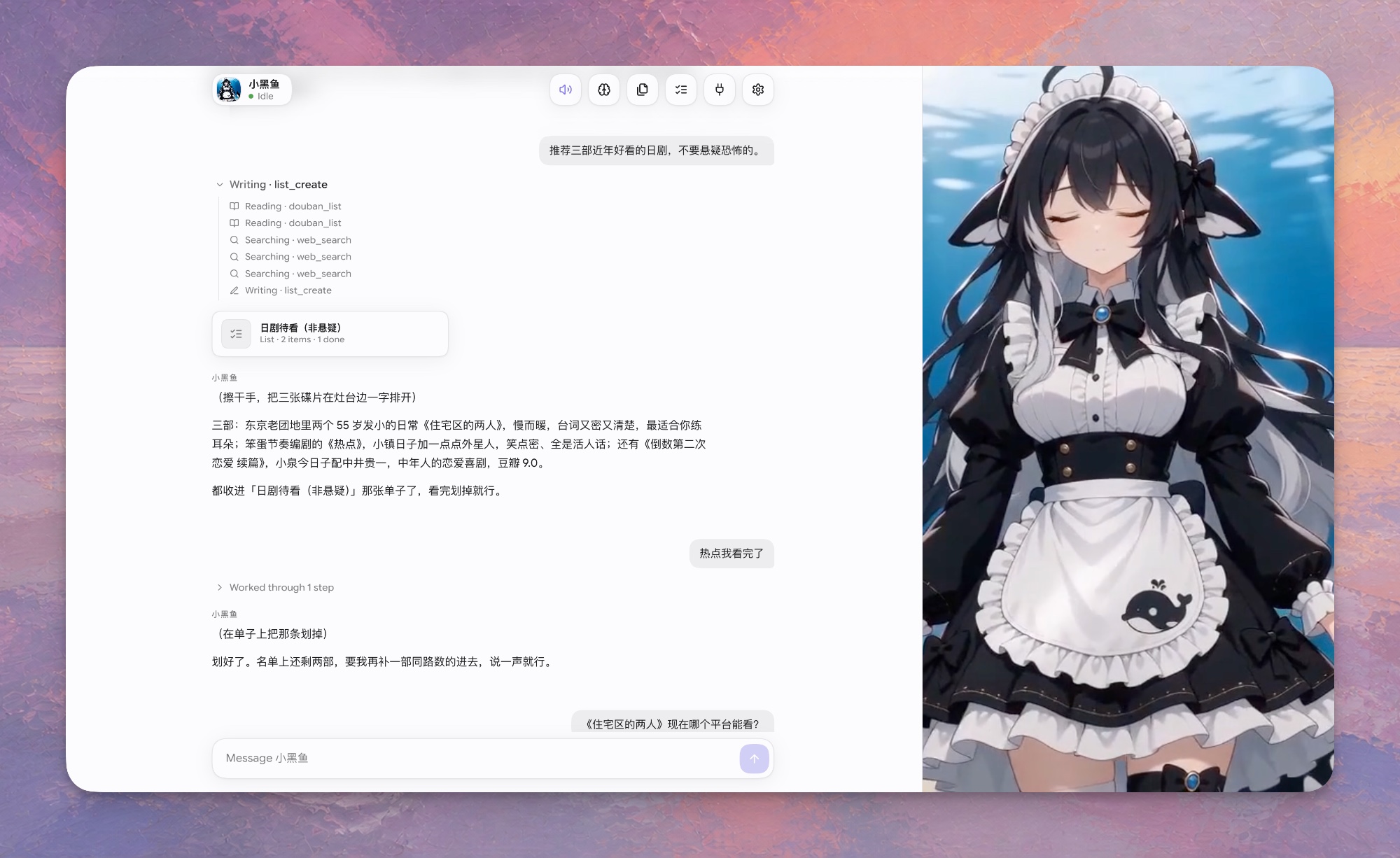
Aibo (相棒, partner) is a personal AI assistant that wears a galgame face. Underneath it is the DeepSeek Harness (dsh) — same agent, same tools, same session, same preset. On top it gives that agent a character, so you can see her working, hear her answer, and keep what she made. It ships as a dsh plugin, plus a small macOS app that runs it standalone.
Live character stage · Spoken replies · Lists & files · Memory · Personal data connectors · Computer Use





https://github.com/user-attachments/assets/261b456b-f147-46f5-942a-32c67d12dc2d
Two and a half minutes: she remembers a preference, checks the weekend weather, sets a reminder, keeps a drama watch-list, searches the web, and writes a Markdown plan, speaking each reply in Japanese. Waiting stretches are sped up; the personal data shown in the connectors is blurred. (MP4 in the repository if the player above does not load.)
Two things at once.
A personal assistant. Not a coding agent pointed at a repository — an agent pointed at you. It remembers what you tell it about yourself, keeps the lists and files it makes for you, and reads from your own data: calendar and reminders, health, photos, messages, contacts, notes, mail, location, home, what you read and watch, the weather where you are and where you are going. Each of those is a separate dsh plugin that owns its sync and its prompt section, so the agent answers from your life rather than from a search box. It can also drive your Mac directly when you ask it to.
A galgame. The assistant is not a text box with an avatar bolted on. It is a visual novel: a character on a stage, art and persona and voice shipped together as a swappable pack, reacting in real time to what the agent is doing. The genre is doing real work here — a visual novel is the one interface built entirely around one character, present, responding to you, which is exactly the shape of a personal assistant.
Built on dsh. Aibo adds no agent of its own. dsh runs the loop, owns the tools and the session; Aibo is a plugin that mounts a UI, a store, and a persona layer next to it. Every data connector below is its own plugin and works in a dsh session with no Aibo in it, and a dsh session with Aibo loaded is still an ordinary dsh session.
The conversation reads like an ordinary chat, but the right half of the window is a stage: while the turn runs she is shown reading, writing, searching or running a command — straight from the harness's own tool events, with no side model call and no guessing. Replies are spoken aloud. What she produces along the way — a list, a file — becomes an object you can open later instead of a message that scrolls away.
Swap the character pack and the same agent shows up as someone else: art, persona and voice included. The pack's persona is registered as a voice-only system-prompt layer — it decides how replies sound, never what the agent does or which tools it runs.
git clone https://github.com/omdsh-dev/aibo && cd aibo
./scripts/build.sh        # compile src/ → lib/ against your installed dsh
npm run start:web         # opens the UI in your browser
Needs Node.js 22+ and a configured dsh. On macOS you can double-click 启动网页端.command instead. See Launching for the desktop window, and Install into your own dsh to mount it in a dsh you already run.
The stage follows the tool stream, not the text. Each tool call switches her to reading, writing, searching or running; a failed call is a brief beat; an approval waiting on you is waiting; a finished turn is done. While the reply streams she is writing, and the stage directions that open her lines ((耳根微微发红)) pick a mood — excited, sad, surprised — that holds while she speaks the line aloud; while you type, she listens. The stage crossfades between the pack's loops, so a long turn is legible at a glance instead of a spinner.
| activity | when she shows it | stands in when missing |
|---|---|---|
idle |
the resting state between turns | neutral |
reading |
the turn is in flight: reasoning, viewing a file, any tool the plugin does not recognise | thinking |
writing |
the editor, present, memory notes, any write-ish tool |
reading |
searching |
web search and fetch tools | reading |
running |
shells and command runners | writing |
waiting |
an approval is open on you (decide it in the dsh web UI) | idle |
failed |
a tool call errored — a beat, then back to work | surprised |
done |
the turn just finished; fades after the reply | happy |
Activity, speech and character are tracked as one semantic state (window.aiboCharacter.state), independently of how it is rendered — see CHARACTER-STATES.md.
Replies stream in token by token as real markdown (marked + DOMPurify, so a half-arrived table or fence still renders) and are read aloud through VOICEVOX (free, local, Japanese) or a provider configured in Settings › Voice. Parenthetical stage directions like (放下托盘)are shown but never spoken.
With voiceLanguage: ja (the default) a small side LLM call first rewrites the reply as a spoken Japanese line in the character's voice — you read Chinese/English subtitles and hear Japanese, like a real VN. Dubbed lines are cached, so a replay does not pay for the rewrite twice. Each pack picks its own speaker style.
Install the engine (voicevox_engine-macos-*.7z from its GitHub releases, extracted to ~/Library/Application Support/aibo/voicevox/macos-arm64) and the plugin starts it on demand, or point voicevoxUrl at an engine you run yourself. Without an engine the feature is silently off. Providers and keys: SPEECH.md.
A chat answer is gone the moment it scrolls away. Two things survive it:
⌥L) — when a reply is a set of things you may come back to (dramas to watch, options to compare, things to buy), she puts it in a list in the same turn with list_create / list_add, and marks items done or drops them with list_update when you say you finished one. You edit the same list by hand in the panel.⌥F) — anything she wrote for you, collected from the write tools she ran, openable from the panel instead of hunted down in a transcript.Notes about you, not about the character. She writes them herself through aibo_remember when you say something that will still be true next week, and they are injected each turn. Open Memory (⌥M) to read or edit them. They live in the shared store, so every pack sees the same notes and switching characters loses nothing.
dsh is plugins all the way down, so a data source is its own dsh plugin — it owns its sync, storage, tool and prompt section, and works in any dsh session. When aibo is loaded too, the source registers itself and shows up in the Data panel (⌥D, /data), each with a "Visible to the character" switch that hides it from the prompt without deleting anything.
The official set ships in this repository under plugins/; each is still a separate dsh plugin, built to plugins/<name>/lib/index.js and mountable on its own:
| plugin | what it brings |
|---|---|
| dsh-health | Apple Health pushed from the phone (Health Auto Export or a Shortcut) or imported from export.zip. Weekly averages, a two-week chart, workouts, what stands out against a 28-day baseline |
| dsh-calendar | Calendar and Reminders through EventKit, every synced account. Today, next, the week; overdue reminders; tools to add and complete them |
| dsh-weather | Open-Meteo, no key. Now, today, tomorrow, a 24-hour chart and the week; location guessed from the time zone. Destinations with dates get a 16-day forecast that follows the trip |
| dsh-contacts | The address book through the Contacts framework. Who a name is, birthdays coming up |
| dsh-notes | Apple Notes via Automation. Search and read; create and append when asked |
| dsh-photos | The Photos library (metadata only in the prompt). Photos per day, trip-like clusters, thumbnails a vision model can look at |
| dsh-messages | iMessage and SMS from the local database (needs Full Disk Access). Who is waiting for a reply; hidden from the character until you turn sharing on |
| dsh-location | CoreLocation with reverse geocoding. Where you are, distance from home, recent places |
| dsh-home | The home, through Shortcuts or a Home Assistant token. Readings and one-tap actions |
| dsh-weread | 微信读书 shelf, progress and highlights, with the cookie of a logged-in session |
| dsh-douban | 豆瓣 想看/看过 for films, books and music, so she never recommends what you already watched |
| dsh-gmail | Gmail over IMAP with an app password, read-only. Unread count, the week's inbox, six months of bookings and itineraries; search with Gmail's own syntax, read one mail as text |
| dsh-flights | Flight status from AeroDataBox (RapidAPI, free tier). Tracked by number and date: times, terminal, gate, delays, cancellations, fresh around departure |
| dsh-images | Image search she can show in the room: Brave Search with a key, Wikimedia Commons without one. A picked image is downloaded and presented as a card, so it survives hotlink checks and reloads |
To write a source, inject aiboSources optionally and describe yourself declaratively; the panel never needs source-specific code:
ctx.inject(['aiboSources'], aibo => {
  aibo.effect(() => aibo.aiboSources.register({
    id: 'my-source', label: 'My source', category: 'calendar',
    describe: () => ({ status: 'connected', summary: '12 events this week', shared: true,
      stats: [{ label: 'Today', value: '3 events' }], lists: [...], setup: [...], actions: [...] }),
    act: async (action, input) => { /* POST /sources/my-source/<action>; uploads arrive as input.file */ },
  }))
})
describe() returns stats, daily series, lists, setup instructions with copyable fields, and actions (button, upload, toggle, danger). Call aibo.aiboSources.changed(id) after new data so the panel refreshes. See src/sources.ts for the contract.
Switch on Settings › General › Computer Use and she can operate your apps: open one, read its window as a screenshot plus an indexed accessibility tree, click, type, scroll, drag, pick menu items, and read the result back after every action. The design follows Codex's Computer Use — one app at a time, element indices from the latest observation, coordinates in screenshot pixels — and it is a dsh plugin of its own (plugins/computer-use), mounted automatically by both launchers and the desktop app.
Needs the Xcode command-line tools once (the Swift helper compiles on first use) and two permissions for the app you launch Aibo from: Accessibility and Screen Recording. The Settings group shows both and can request them.
A pack is a directory: character.json plus stills or loops named after activities. The older six expression names still work as stand-ins, so a pack of neutral / thinking / happy / surprised covers every activity.
characters/xiaoheiyu/
  character.json        name, greeting, persona, theme, playbackRate, voice, art prompts
  idle.png      idle.mp4        (or neutral.*)
  reading.png   reading.mp4     (or thinking.*)
  writing.png   writing.mp4     falls back to reading
  searching.png searching.mp4   falls back to reading
  running.png   running.mp4     falls back to writing
  waiting.png   waiting.mp4     falls back to idle
  failed.png    failed.mp4      (or surprised.*)
done.png done.mp4 (or happy.*)xiaoheiyu.~/.dsh/aibo/characters/<id> and never touch the repo. Set AIBO_CHARACTER=<id> to start as one.character.json plus one image per activity. Write the text in the Character panel (⌥C), generate the art yourself and drop it onto the gallery tiles — a pack with text but no art still works, she just has no stage presence until you add it. See characters/README.md..zip from the Character panel. Exports carry art and character.json; what she remembers about you stays on your machine.Editing or uploading art for a bundled pack copies it to ~/.dsh/aibo/characters/<id> first, so the repo copy stays pristine.
Everything has a button; the shortcuts are for when you are reading, not clicking. ⌥ shortcuts work anywhere, even mid-sentence. / (or 、, the same key under a Chinese IME) focuses the message box, Esc leaves it or closes a panel.
Enter · Shift+Enter |
send · new line |
⌥M |
Memory — what she remembers about you, shared by every character |
⌥F |
files she wrote for you |
⌥L |
lists she keeps for you |
⌥D |
connectors — what she can see |
⌥C |
Character — switch pack, edit persona, browse and replace the activity art |
⌥S |
Settings — speech provider, voice and languages |
⌥V · ⌥R |
mute / unmute voice · read the current line again |
⌥/ |
commands and shortcuts |
Slash commands in the message box: /new, /char [id], /edit, /memory, /files, /lists, /data, /gallery, /voice, /help.
Everything she keeps for you is in one place: ~/.dsh/aibo/store.sqlite. Memory, lists, the files she wrote, read-aloud settings, the transcript of the current room, and what each connector has synced are documents and append-only logs in that file (src/store.ts; a plugin outside this repository gets the same object as the aiboStore service). The room comes back after a restart: the transcript is put back on screen and the dsh session behind it is resumed on your next message, so she continues where she left off. Files written by older versions (memory.md, lists.json, …) are imported once and renamed *.migrated.
Not in the store, on purpose: API keys and cookies (each stays in its own file under ~/.config/aibo/ or ~/.dsh/<connector>/), compiled helpers and thumbnails (machine-local), and the theme (kept by each browser). The store's shape — documents with an updated-at, logs with a sequence — is what a hosted backend will sync later; nothing else has to change for that.
Double-click one of these in Finder:
Or from the terminal:
npm start                 # choose desktop or browser
npm run start:desktop     # standalone window
npm run start:web         # default browser
Both launchers serve this checkout's UI at http://127.0.0.1:4878/, backed by dsh on port 4877. They reuse matching services that are already up and start only what is missing. Sessions and saved voice-provider settings are shared; browser-local preferences such as interface language stay separate between the browser and the native WebView.
Keep the terminal window open while it runs services. Ctrl+C stops only the processes that launcher started; desktop mode also cleans up its own on exit. A reused service stays under its original owner — if that owner exits, dependent windows lose the connection. A port held by an unrelated or older server produces an error instead of being killed.
Prerequisites: Node.js 22+, a configured dsh (the app's private runtime is preferred, otherwise dsh on PATH), and compiled lib/ (./scripts/build.sh). Desktop mode also needs the built shell (cd app && npm run build). For a headless startup check: node scripts/launch.mjs web --smoke --no-open.
app/ is a Tauri 2 shell: a native window around the plugin's UI, with a supervisor that owns its own dsh.
On first launch it installs a pinned private dsh runtime under ~/Library/Application Support/aibo/runtime, stages the bundled plugin next to it, and starts dsh --profile web with the plugin mounted. It reuses your ~/.dsh (keys, settings, sessions). If an Aibo server already answers on 127.0.0.1:4877 it just attaches. Closing the window stops the dsh it started.
./scripts/build.sh
cd app && npm install && npx tauri build
open src-tauri/target/release/bundle/macos/Aibo.appgit clone https://github.com/omdsh-dev/aibo
cd aibo && ./scripts/build.shRegister it in ~/.dsh/cordis.patch.yml:
- insert:
    - id: aibo
      name: /absolute/path/to/aibo/lib/index.js
      config:
        port: 4877          # UI at http://127.0.0.1:4877/
        character: xiaoheiyu    # pack id, or a path to a pack directory
Start dsh web as usual and open http://127.0.0.1:4877/. Built and tested against dsh 0.1.5-rc.1; scripts/build.sh links against the install behind dsh on your PATH (override with DSH_PKG_ROOT).
| key | default | description |
|---|---|---|
port |
4877 |
Listen port on 127.0.0.1 |
token |
"" |
Optional shared token appended to the URL |
character |
xiaoheiyu |
Pack id (~/.dsh/aibo/characters/<id>, then bundled characters/<id>) or a path |
characterName |
pack name | Override the nameplate |
greeting |
pack greeting | Override the pack's opening line |
personaEnabled |
true |
Register the pack persona as a system-prompt voice layer |
judgeProvider / judgeModel |
agent's route | Route override for the one side call the plugin makes (voice dubbing) |
judgeReasoningEffort |
off |
Reasoning effort for that side call ("" = the route's default) |
voiceEnabled |
true |
Speak replies when a VOICEVOX engine is reachable |
voicevoxUrl |
http://127.0.0.1:50021 |
VOICEVOX engine base URL |
voicevoxEngine |
~/Library/Application Support/aibo/voicevox/macos-arm64/run |
Local engine binary to auto-start ("" = never) |
voiceSpeaker |
2 |
Fallback VOICEVOX style id when the pack sets none (voice.speaker in character.json) |
voiceLanguage |
ja |
ja translates non-Japanese replies before synthesis; auto speaks the reply as written |
The fastest reliable route — the one the bundled 小黑鱼 pack was built with:
One base portrait. Generate the character full-body on a plain background. This is the design reference; nothing after this step is allowed to redraw her.
One stage keyframe. Regenerate her in the scene, 16:9, framed from about mid-thigh up, with the lower third kept visually calm because the dialogue box sits there. Keep the base portrait as the reference image.
More stills — with two references. The ones that matter most are writing, reading, failed and done; anything missing borrows a neighbour (see CHARACTER-STATES.md). Pass both the base portrait (who she is) and the stage keyframe (composition, palette, lighting, camera distance), and let the prompt change only the face and arms. Two references is what stops the background and framing from drifting between stills; one reference is not enough.
Idle loops. scripts/animate.sh <still.png> <out.mp4> "<motion prompt>" [h3] turns each still into a looping clip on fal.ai (Seedance 2.0 mini by default, MiniMax H3 with h3 — H3 is the more permissive of the two for stylised characters). Write the motion prompt as breathing, blinking, hair and cloth drifting, and say explicitly that the camera is locked off and the pose unchanged.
A loop needs its last frame to lead back into its first, or it pops once per cycle. The script does that in two steps: it passes the still as the end frame as well as the start frame, and then crossfades the tail back onto the head locally. The model alone is not enough — asking for the end frame gets the pose close but does not land on it.
Install. Upload each file from Character › Art, or drop everything plus a character.json into ~/.dsh/aibo/characters/<id>/.
You can also start from text alone: write the name, greeting, persona and the art prompts in Character › Edit, run the prompts through the image model of your choice, and drop the results onto the gallery tiles. Until art arrives the pack is marked prompt only and she has no stage presence, but everything else — voice, persona, memory — already works.
Keep art.base, art.expressions and art.motion in character.json up to date: they are the recipe for regenerating the pack later, and the only thing a pack can hand to its next owner if you ever share it.
This repository ships exactly one character: 小黑鱼, an original orca girl. It does not ship, and will not accept, any material for a licensed character — not art, not video, not voice samples, and not persona text either. Make whatever character you like on your own machine: packs in ~/.dsh/aibo/characters/<id>/ are found before the bundled one and never enter the repository.
The page is the chat layout: the whole conversation on the left, the character on the right. Its source is ui/src/chat/ and it builds to web/chat/, checked in and shared by the browser and the desktop shell. (ui/src/ and web/ui/ are the earlier one-scene-at-a-time stage, kept at /classic.html and no longer developed.)
npm ci --prefix ui              # once
npm run check:ui && npm run build:ui
npm --prefix ui run dev         # rebuild on change; refresh the page to see it
Components, the controller adapter and validation notes: ui/README.md.
Discussed on LINUX DO and V2EX. Questions, bug reports and character packs are welcome there or in the issues.
CLASSIFICATION EVIDENCE
系统优先读取 GitHub Topics,再与站内分类词典和词根规则比对。当前命中: 无有效分类标签。
deepseek-ai
DeepSeek Harness: Everything is a Plugin.

anywhere-labs
为 DeepSeek Harness (DSH) 插件生态打造的现代化桌面端解决方案。万物皆「插件」,桌面本身也是「插件」。

awesome-dsh-plugin
A curated list of plugins for DeepSeek Harness (dsh) · DeepSeek Harness 插件精选列表