
模型与 MCP
待识别

rea
morluto
Reverse engineer anything with agents, from app behavior down to native binaries.
PROJECT TOPICS
INSTALL REFERENCE
dsh plugin --profile web add github:mrzturn/dsh-switchman
该命令指向仓库当前默认分支;尚无绑定当前 commit 的完整验证结果。
PROJECT README
English | 简体中文 | 繁體中文 | 日本語 | 한국어 | Español | Français | Deutsch | Italiano | Português | Русский
The switchman family, same author, same dispatch doctrine: opencode-switchman (the OpenCode original) · zcode-switchman (the ZCode port) · dsh-switchman (this repo, the DeepSeek Harness edition).
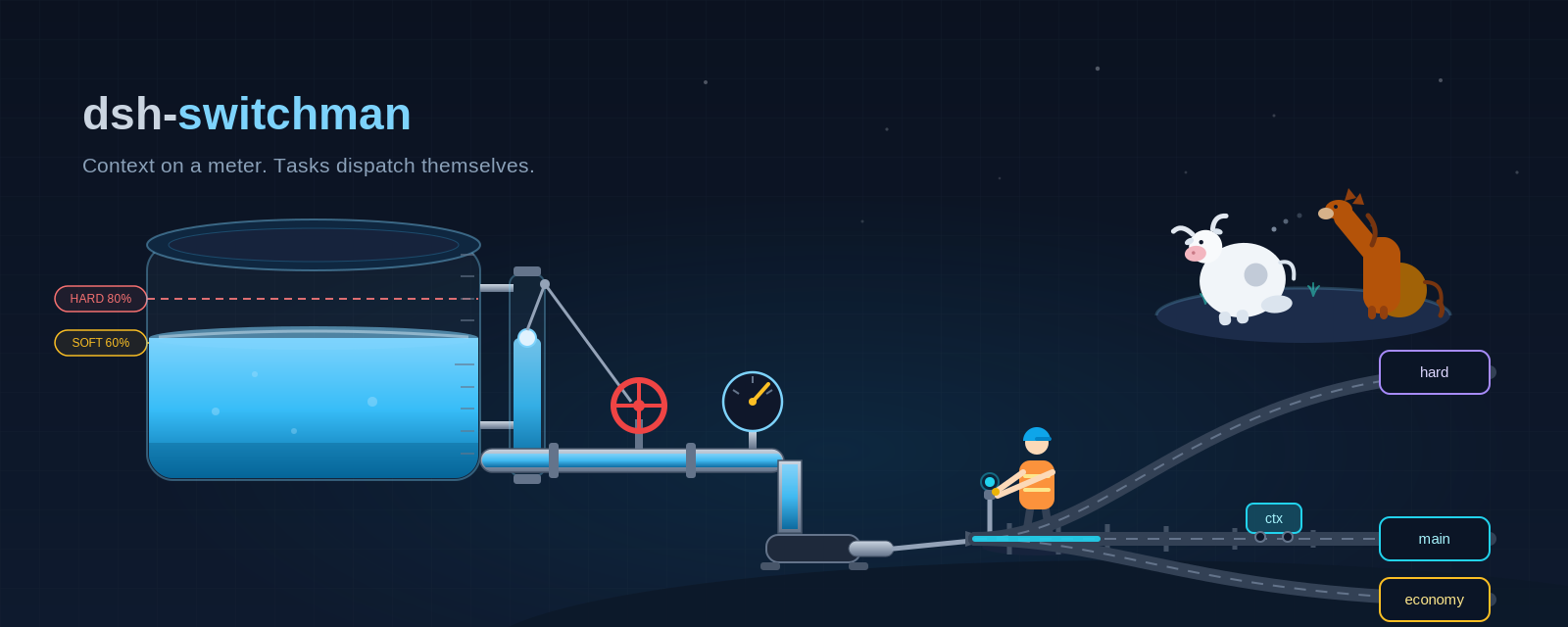
A water meter on the context; every task finds its own lane.
Two pains creep in once you've worked in DSH for a while. First, sessions get heavier the longer they run: history bloats the context into hundreds of thousands of tokens, the model starts forgetting, slowing down, costing more — and a manual /compact loses detail. Second, the main model does everything itself: chasing files, running tests, reconciling data — most of that work belongs on a cheaper model.
dsh-switchman is a plugin for DeepSeek Harness (DSH). Once installed, the main model keeps doing the work itself — just smarter about it: it chooses its battles, handing small chores to cheap lanes and letting intent routing land urgent or hard work on the right model, stepping in personally only where it counts; it sheds bloat and keeps the essence — digested history folds into compact summaries while the watermark meters every spend, keeping context lean; and when the load outgrows one pair of hands, it pulls in standing teammates to divide the work on a shared task board and steps back to dispatch and verify. It's not a new model — it's a dispatch doctrine hooked onto DSH plus a settings page, and it does nine things:
1. Automatic context trimming: sessions grow longer, costs stay flat. A manual /compact waits on you, loses detail, and punches through the vendor's prompt cache. The trim engine automates all of it: digested stretches of the conversation are folded into compact deterministic summaries at idle boundaries (written by a side model, or folded mechanically without one under emergency pressure), and every outbound request is rebuilt from the fold state from then on — summary blocks stand in for the folded ranges, the live tail kept verbatim. The stored session log is never rewritten, and nothing touches the stream mid-flight. Folds are append-only and the rebuild is deterministic, so the serialized prefix stays byte-identical between folds and vendor caches keep hitting; any internal failure fails open into pass-through — never a malformed request. Three fully automatic tiers (growth gate / pressure / emergency), plus an advisory mode where the model folds on its own — the mechanics live in the "Automatic context trim" section at the bottom.
2. Context watermark: long sessions don't blow up. Every turn counts session tokens in real time, and three escalating lines tighten the screws: 80k (soft, adjustable) nudges "time to delegate"; 100k (hard) shrinks the single-read budget and steers toward wrap-up; 200k (force) hands over automatically — writes the handover document (the append-only session log is the full-fidelity backup), compacts the context, wakes the session to continue, task unbroken. Background subagents still running at handover aren't lost: their ids, tasks, and report paths go into the handover document, so the resumed session knows where to collect reports and never dispatches twice; every subagent also carries its own hard cap and exits after writing its HANDOFF summary. The watermark reads the post-trim view — what the model actually sees — so heavily folded sessions are no longer pinned at the high lines. When the automatics don't suit you: /ctx-pause stops all actions (measurement keeps running), /ctx-resume restores them any time — and they come back on their own after a restart; /ctx-handover starts the same handover on demand, no waiting for the ceiling.
3. Intent routing: messages come in, models fall into place. Pick "Auto (intent routing)" for the session and every user message is first typed by a small classifier model, landing on the best-fitting candidate — each candidate carries a one-line capability note to steer the call. The decision locks for the turn: when confidence is lacking or the cache window is still open, the current model stays (its prompt cache keeps paying off); switching happens only when confidence is high enough or the current model isn't among the candidates. The switch completes silently at the call layer — no "model switched" noise in the session — while a chip above the input box shows the live route and confidence. Decision-style small models and general chat models both work as the classifier; candidates, thresholds, and the cache window are always one settings page away.
4. Agent Teams: from solo to a team. Off by default — after install it's lightweight subagent dispatch; build a team when you want one. Two independent toggles on the settings page: Agent teams injects the team doctrine (delegate by default + tiered verification + shared task-board discipline) and enables DSH's Agent Teams automatically — the main model can pull standing teammates (spawn_teammate), put work on the shared task board (team_task_*), and message teammates. When to form a team follows clear discipline: parallelizable independent subtasks, bulky self-contained work, a high main-context watermark, a need for role separation; one-off single-point investigations still go to a subagent. Switch it off and the team clauses vanish without residue, and tools are never yanked from sessions still running. Subagent model whitelist sync writes the union of all six pools wholesale into DSH's authorization whitelist — switchman becomes the single source of truth, no double configuration (effective as a per-new-session snapshot).
5. Six dispatch pools: the right model for every job. Economy (batch small chores), mechanical (template rewrites), main (day-to-day coding), hard (hard reasoning and large refactors), vision (images), review (independent verification). On the settings page you tick candidates, order priorities, grade S/A/B/C, and pin a per-route thinking effort — the effort dropdown lists the levels that model actually supports, not a generic three. Every turn's prompt carries a [SWITCHMAN:POOLS] recommendation table, and the main model dispatches by it. Three enforcement modes: off / advice / force (force = out-of-pool models get rejected outright).
6. Language preferences: ask once, remember forever. One dropdown each for replies, code comments, and documents; scope is global or per-project (.switchman/lang.json). Skipping is fine — on first use you're asked once in your DSH interface language, and every session obeys the answer afterwards.
7. Interface language: the plugin itself speaks your language. In the "Interface" section atop the settings page sits the "Interface language" dropdown (setting key uiLocale): Auto (follows the DeepSeek Harness app language; factory default: Simplified Chinese), or any built-in interface language picked by hand — options always appear under the language's own endonym, never translated. It switches only the plugin's own interface (badge, home panel, settings page), never the DSH app language: selecting previews live with no restart, the choice is remembered after save and restored on the next launch, and any failure falls back to the app language; the dictionaries ship inline in the plugin bundle, nothing to download.
8. Tiered verification: every change gets checked. Changes over 20 lines go to a tester; over 300 lines, or touching core / security / data-consistency logic, additionally to an independent reviewer. The review model is picked anchored on the model of "the agent that wrote the diff", avoiding it where possible; when the pool can't, the conclusion declares DOWNGRADED. Say "don't use the team" once and it drops back to solo instantly.
9. /vision: text-only models can still handle images. When the main model can't read images, DSH rejects image-bearing messages at the gate. Paste the image, type /vision what's wrong with this image, and the image goes to a vision-pool model; the verdict comes back into the current session. A heads-up "current model can't read images" appears above the input box; when a direct image send is rejected, the message is rewritten as /vision and resent automatically — no manual redo; with no vision pool configured the command refuses and points to the settings.
Worth installing even with a single model — automatic trimming, watermark control, and tiered verification don't care how many models you have, and long single-model sessions benefit just the same; intent routing only means something with multiple model candidates, so leave it switched off until you scale up the roster.
docs/requirements-and-design/.Install — have an agent run it in any session, or use the Web plugin management page:
plugin_manager: install_bundle target=dsh-switchmanOr install from a local checkout (link mode; after an update, remove_bundle + install_bundle again):
plugin_manager: install_bundle target=/path/to/dsh-switchmanOr with the dsh CLI in a terminal — pick the profile matching how you run it:
dsh plugin --profile web add dsh-switchman      # Web GUI
dsh plugin --profile desktop add dsh-switchman   # desktop app
Restart DSH — quit the app completely and reopen it (a page refresh doesn't count); only then does the client module table recognize the bundle.
Configure — Settings → dsh-switchman, or "Switchman Dispatch Center" in the home sidebar. It's a single page of config and looks like this — walk it top to bottom and you're done:
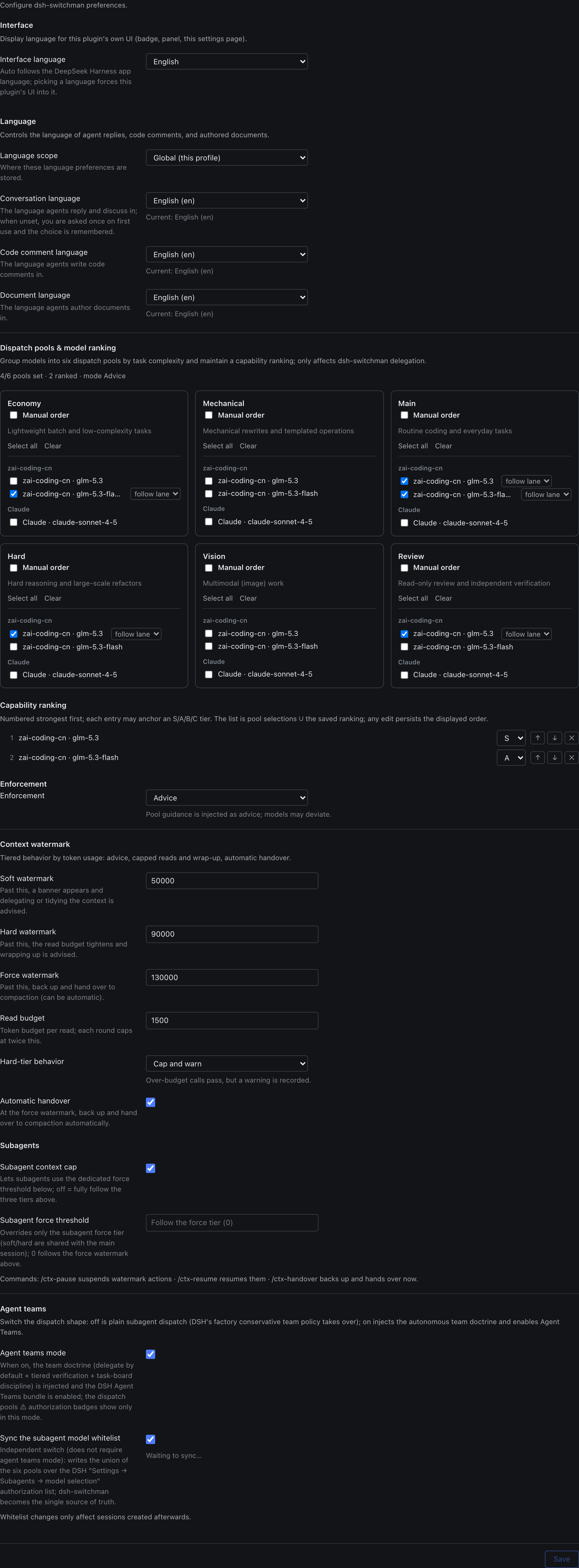
.switchman/lang.json); the reply / code comments / documents dropdowns in the shot all sit at English, each displayed as "endonym (tag)" — e.g. "English (en)" — with a "current: …" status line beneath each. Leaving all three unset is fine too: asked once on first use, remembered from then on./ctx-pause pause intervention · /ctx-resume resume · /ctx-handover write the handover doc and compact now (it steers the session to an idle boundary before compacting — the result can take a few minutes).Verify — the ⚡ "autonomous team" badge appears in the session header (with ◇ beside it showing the session's current model); or simply ask the model "what's the heading of the last section of your system prompt" — the answer should mention the dsh-switchman doctrine.
db-query one-time initialization (script dependencies install inside the skill directory, nothing pollutes your project):
bash <install-dir>/skills/db-query/scripts/setup.shClassifier model tips: to run the decision model locally, serve d3:4b-mxfp8 with Ollama — set the classifier kind to the decision endpoint (systemone), fill the endpoint with http://127.0.0.1:11434/v1/systemone, and set the model name to d3:4b-mxfp8. For the chat classifier from the LLM catalog, prefer a small cloud model, or a small local model without thinking (reasoning) — turning thinking off lowers both latency and the classification-timeout failure rate.
Everything below is the full set of defaults after a fresh install (authoritative source: the zod schema in host/config.js).
Interface and languages: uiLocale = zh (Simplified Chinese; auto follows the DSH app language); langScope = project; langConversation = zh-CN; langComments/Docs = empty (factory default; if cleared, asked once in the first session and then remembered; the comment and document languages follow the conversation language).
Dispatch pools: all six lanes (economy/mechanical/main/hard/vision/review) start with empty candidates (= the system default models, no intervention); manual ordering and pinned effort are off/empty; dispatchEnforce = advice (advisory only, nothing enforced).
Context watermark: soft 80000 / hard 100000 / force 200000 tokens; single-read budget 3500; over-budget behavior cap (truncate with a warning); wmAutoHandover = on (at force, automatic handover: write doc + compact); the subagent hard cap = on (sharing 200k).
Agent Teams: teamsMode = on; syncWhitelist = on (the two toggles are independent of each other).
Intent routing (unavailable by default; needs a classifier + at least one candidate + the master switch on): intentEnabled = off (while off, the Auto entry stays hidden and sessions already on Auto fall through the fallback chain); the classifier route is unset; the classifier type is chat; the candidate list is empty (the preset categories join routing only once given a model); cache window 300 s / switch confidence threshold 80 / classification timeout 60000 ms; history 6 messages / 2400 characters; optional intentFallbackRoute is unset, and its own effort is model-default when later configured; intentContextWindow = 250000.
Context trim: trimEnabled = on; trimMode = auto (nudges + fold tools + automatic idle-boundary folds: growth gate / pressure / emergency); growth gate 22500 tokens + increment 45000 tokens; pressure 45% / emergency 90%; advisory nudge 50% / 80%; protected tail 6 messages; fold cadence cap 30 per hour; side model unset (follows the session provider/model, not the session call's effort); without an explicit effort pin, use the lowest enabled reasoning level from model metadata, choose off for toggle-only models, and omit effort when reasoning is unsupported or metadata is unavailable (model default). Ladder distillation shares that route and policy; a configured fold-fallback route has an independent effort pin with the same model-aware default. Ladder folding on — T2 distills accumulated T1 summaries (8000-token mass, ≥3 blocks), T3 distills T2 (6000-token mass, ≥2 blocks); the engine never shows the model a water level, percentage, or progress number — details in the "Automatic context trim" section below and docs/ladder-fold.md.
Out-of-the-box notes: ① intent routing being unavailable out of the box is by design — three steps to switch it on (classifier, candidates, the master switch); ② Auto's effective window is 250000 out of the box — the guardrail guarantees 0.8×window ≥ force (200000), and the core compaction line (200000) lands exactly on the smooth-handover line (200000); ③ the most tangible out-of-the-box effect is the watermark trio: 80k nudges delegation / 100k tightens reading / 200k backs up and hands over automatically — no configuration needed.
Long sessions stay cheap: consumed conversation ranges are folded into compact deterministic summaries — fully automatically, without breaking the provider prompt cache. At an idle boundary the trim engine (host/context-trim/) picks the ranges worth folding, a side model writes the summary (only under emergency pressure does a mechanical fold run instead — no side-model call), and the fold is committed to the session's fold state. From then on every outbound request is rebuilt from that state — summary blocks replace the folded ranges, the live tail stays untouched. The stored session is never rewritten, and nothing ever happens mid-stream.
Automation levels (trimMode):
off — measure only: usage and cache-hit sampling still runs; no banner, no folds.advisory — the session model folds itself: the ctx_trim_fold and ctx_trim_status tools plus the protocol head are exposed for it. When session pressure reaches trimAdvisoryPercent of the effective window the engine appends a one-off pinned fold nudge as a user/message suffix to the live session surface tail (not the dispatch system head) — it is re-spoken immediately on escalation to critical and pruned once pressure falls back below the line. At the critical line the engine itself performs one mechanical relief fold (90 s cooldown, trimCriticalRelief = on).auto (default) — everything above plus automatic folds at the idle boundary, in three tiers: a growth gate (growth > trimGrowthTokens measured from the last fold's post-fold low — the anchor that keeps the gate armed after folds committing at high view points — AND a contiguous compressible increment ≥ trimIncrementTokens; the increment floor is what actually binds), a pressure tier (trimPressurePercent of the context window), and an emergency tier (trimEmergencyPercent — a mechanical fold with its own cooldown). Pressure and emergency usage is measured on max(view, wire), i.e. on the real provider prompt when it is known.All keys live in Settings → dsh-switchman; defaults from host/config.js:
| Key | Default | Meaning |
|---|---|---|
trimEnabled |
true |
Master switch. OFF disables folding and metrics entirely (the listener degrades to a pure pass-through). |
trimMode |
auto |
off measure only / advisory model-driven folds / auto system-driven folds. |
trimGrowthTokens |
22500 |
Growth gate: fold when the outbound view grew this much since the last fold. |
trimIncrementTokens |
45000 |
Gate companion: the contiguous compressible increment must also reach this size. |
trimPressurePercent |
45 |
Pressure tier: fold when view usage reaches this percent of the context window. |
trimEmergencyPercent |
90 |
Emergency tier: forced mechanical fold (no side-model call) at this percent. |
trimAdvisoryPercent |
50 |
Advisory nudge line: when pressure reaches this percent of the effective window, the engine nudges the model to fold now with ctx_trim_fold (advisory mode only). |
trimAdvisoryCriticalPercent |
80 |
Critical nudge line: reaching it re-speaks the nudge immediately, bypassing the 10-minute same-band throttle. |
trimWindowTokens |
0 |
Effective-window cap for tier math: tiers are computed against min(model window, cap). 0 = follow wmForceTokens. |
trimCriticalRelief |
true |
Advisory critical relief: at the critical line the engine itself performs one mechanical (emergency-style) fold, on a 90 s cooldown. |
| — | — | Trim percentages are not comparable with the composer's context meter: trim divides the last paid prompt (max of view/wire) by the effective window (cap included), while the meter shows the meter's projected next prompt over the model's full window. |
trimProtectedTail |
6 |
The last N messages are never folded. |
trimMaxFoldsPerHour |
30 |
Side-model fold cadence cap per rolling hour (emergency folds are exempt). |
trimSideModel |
unset | Route for the summary side model. Empty follows the session provider/model only, not its effort. The independent effort pin defaults to the lowest enabled reasoning level from model metadata; toggle-only models use off, while unsupported reasoning or missing metadata omits the effort and leaves the model default. Ladder distillations share the route and policy. |
trimFoldFallbackModel |
unset | Route used when a summary call fails; a pressure fold then degrades to mechanical if the retry also fails. Its effort pin is independent; when unset, use the same model-aware recommendation as the summary route. Empty = no fallback leg. |
trimStateDir |
unset | Fold-state directory override. Empty = <dshHome>/.dsh-switchman/state/trim/. |
surfaceFold |
true |
Ship committed folds onto the session surface (shadow-price + surfaceOp replace event pair). OFF keeps the splice-only view. |
Trigger paths. Tier checks run at the idle boundary and, as a fallback for hosts where idle status events are unreachable, after each model-stream completion (throttled to one evaluation per 60 s per session). Every decision — folds and no-ops alike — is appended as one timestamped key=value line to decisions.log in the trim state directory (see trimStateDir), giving folds an offline audit trail; the row vocabulary (view-applied, fold decision/outcome rows, surface-replace, surface-replace skipped reason=…) is catalogued in docs/context-trim.md.
Wire truth and steady state. Decision rows carry view=<n> and, once a response has landed, wire=<n> — the real provider prompt (uncached input + cache read + cache write, sampled from the stream's usage event). The view estimate counts the messages array only and always reads smaller than the wire by the fixed overhead (measured ≈ 17.3k: system prompt + tool schemas + persona), so pressure and emergency tiers evaluate on max(view, wire), and only wire is a prompt-size reading. On a 200k window the healthy sawtooth runs wire ≈ 40k just after a fold ↔ 64–90k at the next one (≈20%–45% of the window), one fold per ~45k of raw growth, with the ceiling pinned near 90k by the pressure tier rather than by the window. If view climbs while no surface-replace row ever appears, read the skip rows (incomplete-seqs, no-service, compaction-lock).
Host-compaction epochs. Fold refs are anchored in message ids and content hashes, so a host-side compaction that replaces the re-send history ages the whole ledger out at once: no block locates, the view silently falls back to raw history (fail-open — the decision log records view-applied applied=0), and the plugin re-anchors its growth baseline at the post-compaction view on the next request. The host compaction is thus the backstop trim layer, and plugin folds do the fine-grained work within one host epoch. Some dispatches hand out fully frozen request arrays or option objects (the current agent loop deep-freezes assembled requests); for those injectView reports the outcome in the decision log: nothing-to-apply (no located fold blocks — raw history IS the view), in-place/swapped (the fold view shipped), or none (a fold existed but the frozen dispatch could not carry it — the wire ships raw history). Surface replace is the shipping path when available (surfaceFold, default on): at the serial agent/turn-stopping boundary plus an idle sweep, the plugin appends the host-style shadow-price metering event and ONE user/message replacement carrying surfaceOp {op:'replace', startSeq, endSeq} with sourceEventSeqs covering every shadowed surface node — the same mechanism the host's own compaction uses — so a committed fold reaches the wire from the source level, frozen dispatches included. While a session's recent dispatches log none, the view is meter-only: the watermark measures the provider-reported tally instead (so the force tier and the auto-handover keep working). Folding pauses only when the surface channel is unusable as well — a durable capability probe (live session exposing append/surface.nodes, no open compaction lock), never a recency window, so a restart no longer freezes the engine. The banner marks the line with wire=raw only when no fold block has ever shipped a surface replacement, so a session with a shipped block stays quiet across restarts; hosts without the surface mechanism (or with the flag off) keep exactly the legacy behavior.
How folds preserve cache hits. Every fold re-pays the prefix once; the goal is amortized cost, not a perfect hit rate. The engine enforces the cache contract: folds are append-only — the frontier only moves forward and the frozen zone is never edited again; the view is rebuilt deterministically from (history, fold state), so the serialized prefix stays byte-identical between folds and the provider cache keeps hitting; fold boundaries never split an assistant tool-call from its tool result; the last trimProtectedTail messages are exempt; and everything fails open — an internal error degrades to a pass-through, never a broken request.
Compaction arbitration. Two automatic trimmers over one history would double-summarize and destroy each other's frontier, so cordis.patch.yml sets auto: false on the host's dsh-compaction-basic rows: context-trim becomes the single semantic trimmer. Manual /compact keeps working, and the force-tier handover (which borrows that same manual path) is untouched. Overflow recovery moves to trim: an over-window attempt fails once, then the emergency tier folds the view so the next attempt fits.
The ladder (v1.11): T1/T2/T3 tiered folding. Every raw-range fold produces a T1 block. As T1 summaries themselves accumulate (≥8000 tokens of summary mass across ≥3 blocks), the engine distills them into ONE T2 block; T2s condense into a T3 the same way — month-long sessions stop drifting upward, because the folded floor no longer grows with every fold. Consumed blocks deactivate (never deleted), so coverage stays expressible and the ledger stays inspectable. Distillation runs through the same side model, on its own 120 s cadence, mass-gated so it stays rare (each distill rewrites the wire from its anchor onward — the mass gates keep that cost rare on purpose).
Nothing leaks to the model. The engine never tells the session model a water level, a fill percentage, a window size, or a growth number — judgment stays rooted in the task (a model told "you're at 20%" anchors on "looks healthy" and refuses to fold). What the model MAY see, on demand, is ctx_trim_status: concrete compressible ranges with their true sizes. All metering lives in decisions.log and the settings-page badge — human channels. The advisory-mode pressure nudge is the deliberate exception: in advisory mode the model drives the fold, so the engine does tell it the pressure and the fold line, on the explicit instruction channel.
Fork inheritance. A forked session (a subagent fork) inherits the parent's fold state copy-on-fork — but only when the parent state exists and the child's history actually resolves the parent's frontier; otherwise the child starts clean. One inheritance per child, idempotent across restarts.
The watermark reads the view. The watermark banner reports the outbound view's token count (what the model actually sees after folding) instead of the stored tally, so a heavily folded session no longer pins the watermark at the hard tier.
index.js + host/) injects the byte-stable system-prompt sections (language / lanes / watermark protocol / teams / PTC guard) plus the live watermark line through the tail runtime-context snapshot (a channel that appends instead of rewriting the prompt head, so the provider prompt cache stays intact), the read-budget plus enforce double gate, and four slash commands (the ctx trio + /vision). A saved setting takes effect at the very next prompt assembly — no restart. In PTC sessions (programmatic tool calls) the PTC guard renders as the final section and restates that every named tool must be invoked inside a run_code program (await tools.name(args)), making unknown tool rejections much less likely when doctrines or skill catalogs name tools directly (a prompt-level mitigation, not a hard guarantee).client.js) renders the settings page, the ⚡ badge and ◇ model marker in the session header, and the live handover indicator; config snapshots are read and written through the Host route family.cordis.patch.yml keeps the factory preset plugin list fully intact and only extends the persona suffix; the Agent Teams tools themselves come from the factory bundle and switch on automatically with teams mode.cordis.patch.yml from the new presets/*.patch.yml (keeping the doctrine suffix and the compaction arbitration — auto: false on the compaction-basic rows), then reinstall.[SWITCHMAN:LANG|POOLS|WATERMARK|TEAMS|PTC]) are deliberately English and byte-stable — don't localize them.npm pack --dry-run should keep the audited 60-file / ~380 kB tarball shape (~1.26 MB unpacked). docs/ stays out of the package (it is not in package.json files), while the 11 README.* translations are always shipped by npm.@deepseek-ai/schemastery, cordis, …) are declared as peerDependencies only, and the running DSH satisfies them from its own copy. An ordinary dependencies entry is physically installed into the profile workspace (<profile>/node_modules/…), where it shadows the host's copy for every other profile-resident plugin — this is exactly what crashed the dshmarket plugin market while 1.7.0 carried schemastery as a dependency (two schemastery instances in one process; the market's schemas no longer matched the host's). scripts/validate.mjs fails if a dependencies entry ever reappears, so installing, updating, or removing dsh-switchman can never touch what dshmarket or any other community bundle resolves at runtime.The tiered folding design (T1/T2/T3) was inspired by billion-context — thank you for open-sourcing the idea.
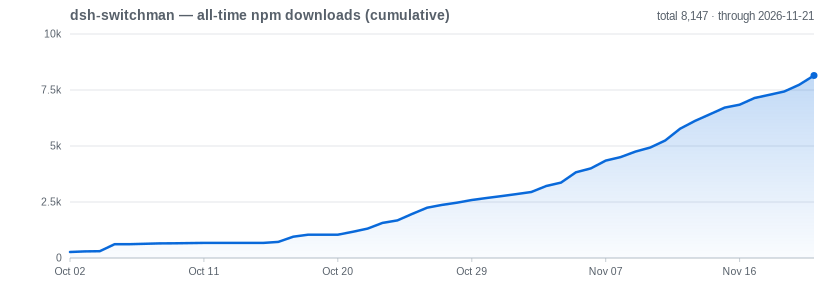
All-time npm downloads since the first release, cumulative — drawn from the official npm downloads API and refreshed daily by GitHub Actions (chart script):
MIT
CLASSIFICATION EVIDENCE
系统优先读取 GitHub Topics,再与站内分类词典和词根规则比对。当前命中: deepseek-harness。
morluto
Reverse engineer anything with agents, from app behavior down to native binaries.

deepseek-ai
DeepSeek Harness: Everything is a Plugin.

nexu-io
The 1st Collaborative AI Design Agent Workspace. Local-first and open source. Create motion, prototypes, websites, apps, dashboards, presentations, images, and videos with your team and AI agents. Share work, exchange feedback, and iterate together in one workspace.