
其他
完整应用

deepseek-harness
deepseek-ai
DeepSeek Harness: Everything is a Plugin.
PROJECT TOPICS
INSTALL REFERENCE
dsh plugin --profile web add github:maxiaovivi/dsh-cloak-browser
该命令指向仓库当前默认分支;尚无绑定当前 commit 的完整验证结果。
PROJECT README
English | 简体中文
0.1.0-rc.6dsh plugin --profile web add -w github:maxiaovivi/dsh-cloak-browser
# Confirm that the bundle was composed into the profile.
dsh --profile web --dump-config | grep -A24 cloak-browserRestart DSH after installation:
dsh --profile web-w is required because a DSH profile is a pnpm workspace root. Replace web
with another profile name if that profile provides the DSH tools and
attachments services.
Version 0.1.1 and newer reuse the profile's existing dsh-tools and dsh-llm
runtime instances. This prevents the duplicate-runtime error reported as
Cannot read properties of undefined (reading 'prepare').
If version 0.1.0 was previously installed, remove it once before reinstalling:
dsh plugin --profile web remove -w dsh-cloak-browser
dsh plugin --profile web add -w github:maxiaovivi/dsh-cloak-browserUse this path when developing or auditing the plugin:
git clone https://github.com/maxiaovivi/dsh-cloak-browser.git
cd dsh-cloak-browser
npm ci
plugin_tarball=$(npm pack --silent)

# Ubuntu/Debian only; this may request sudo permission.
npx playwright-core install-deps chromium

dsh plugin --profile web add -w "$PWD/$plugin_tarball"
dsh --profile web --dump-config | grep -A24 cloak-browser
dsh --profile web
The GitHub installation installs package dependencies through pnpm. The local workflow installs a packed artifact rather than linking the development tree, so development-only copies of DSH host packages cannot enter the profile.
Do not put credentials in cordis.patch.yml or tool arguments. Export them in
the environment that starts DSH:
export CLOAKBROWSER_LICENSE_KEY='your-license-key'       # optional
export CLOAKBROWSER_PROXY_URL='http://user:pass@host:port' # optional
dsh --profile web
Without a license key, CloakBrowser selects its available free build. On first
browser use it downloads and verifies a roughly 200 MB Chromium archive. The
extracted cache can use substantially more disk space under ~/.cloakbrowser.
You do not need playwright install chromium.
When a saved or environment license validates as the Free plan, the plugin defaults to an available seat and launches without asking the user. It serializes concurrent Free-session launches inside one DSH process and reports local or license-server occupancy without retrying in a loop. It cannot revoke a session owned by another machine or an abnormal prior process; that server-side lease must close or expire upstream.
When a proxy URL is present, the plugin enables CloakBrowser GeoIP matching
automatically. Its first use may also download the approximately 70 MB GeoLite
database into the same cache; mmdb-lib is already included, so there is no
separate install command.
dsh plugin --profile web remove -w dsh-cloak-browserRestart DSH after removal. Browser binaries cached under ~/.cloakbrowser are
managed separately by the CloakBrowser CLI.
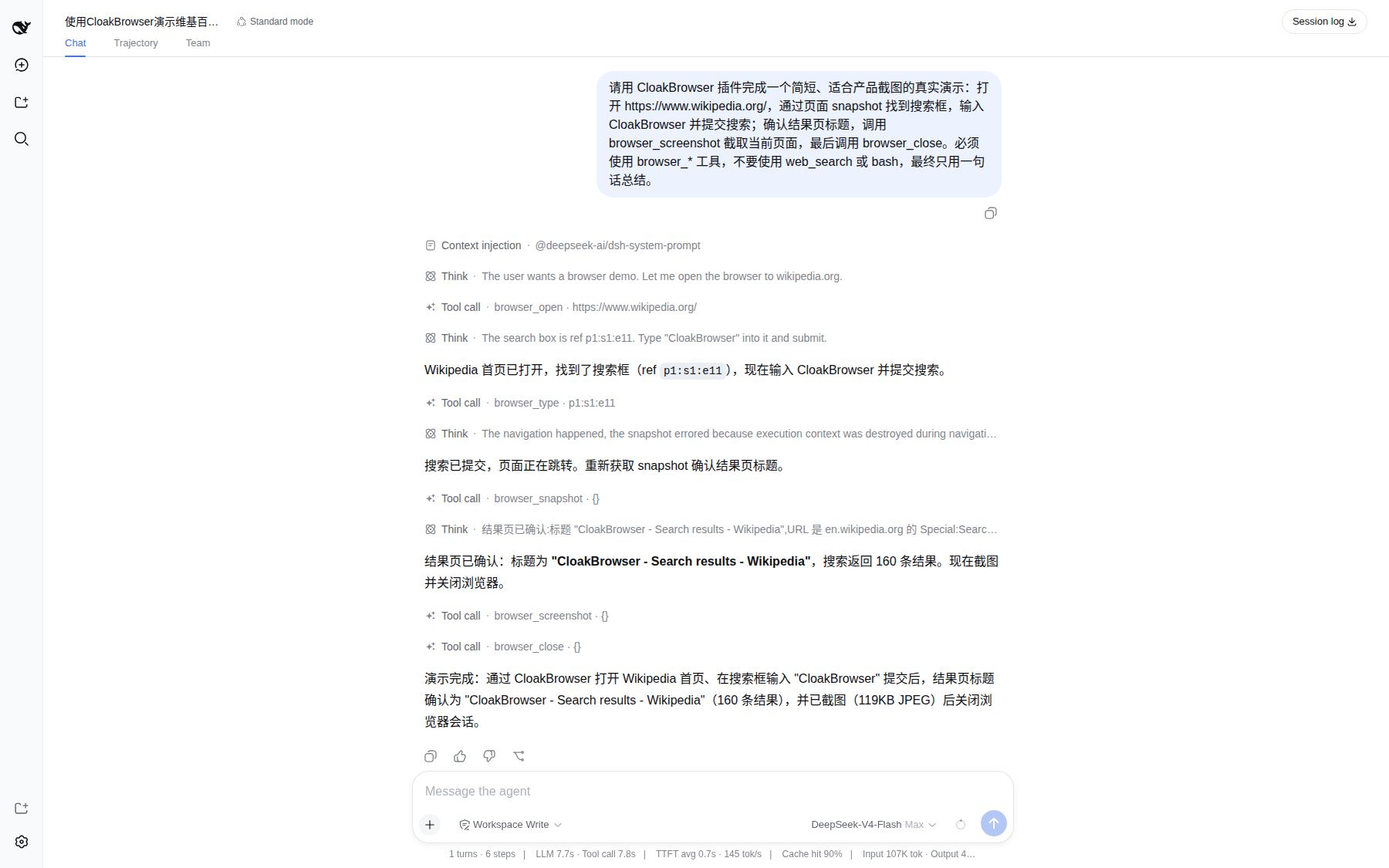
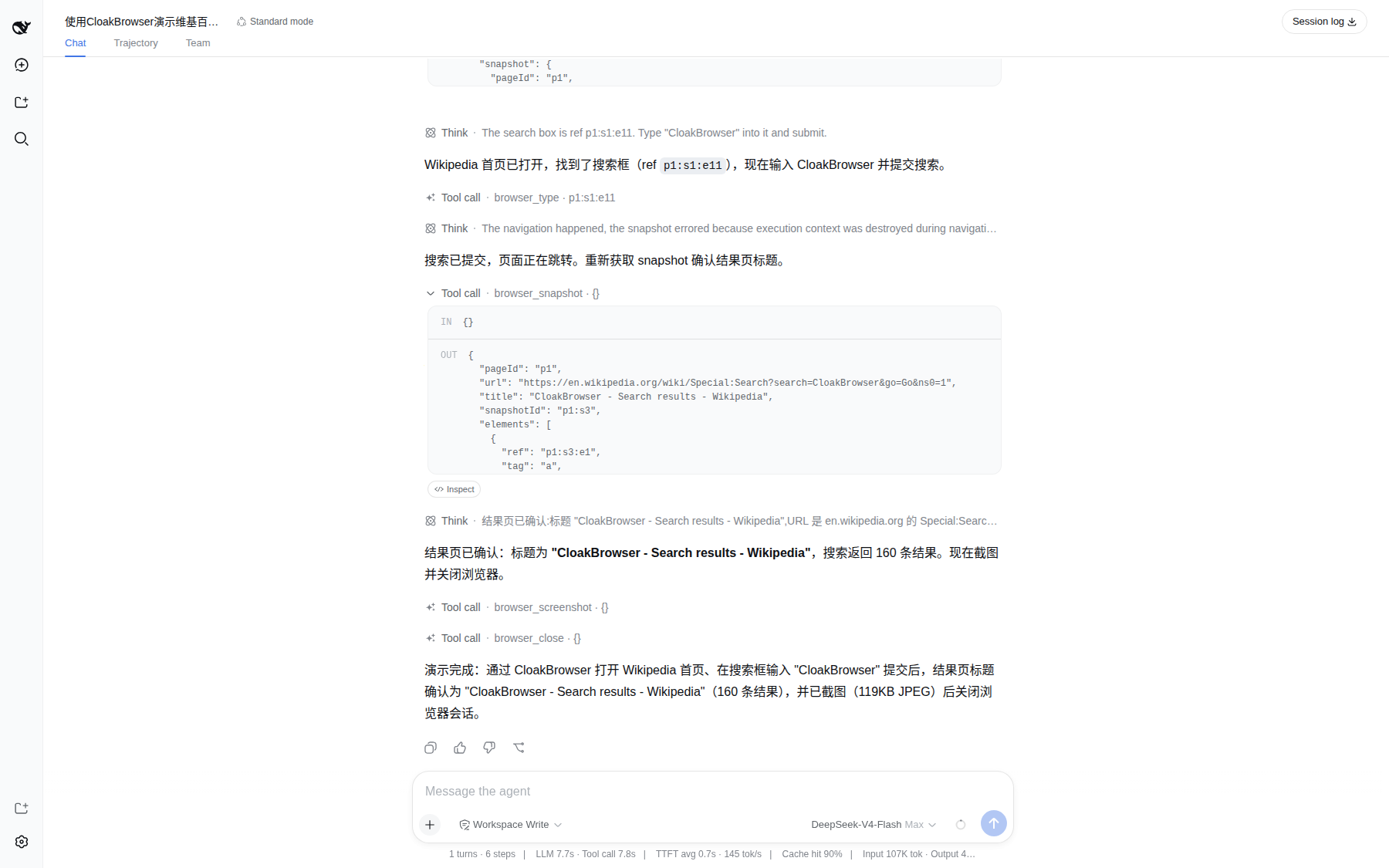
This real DSH session opened Wikipedia, discovered the search field from a
bounded snapshot, submitted CloakBrowser, verified the result page, captured
a screenshot, and closed the browser. The complete Agent run took 15 seconds.
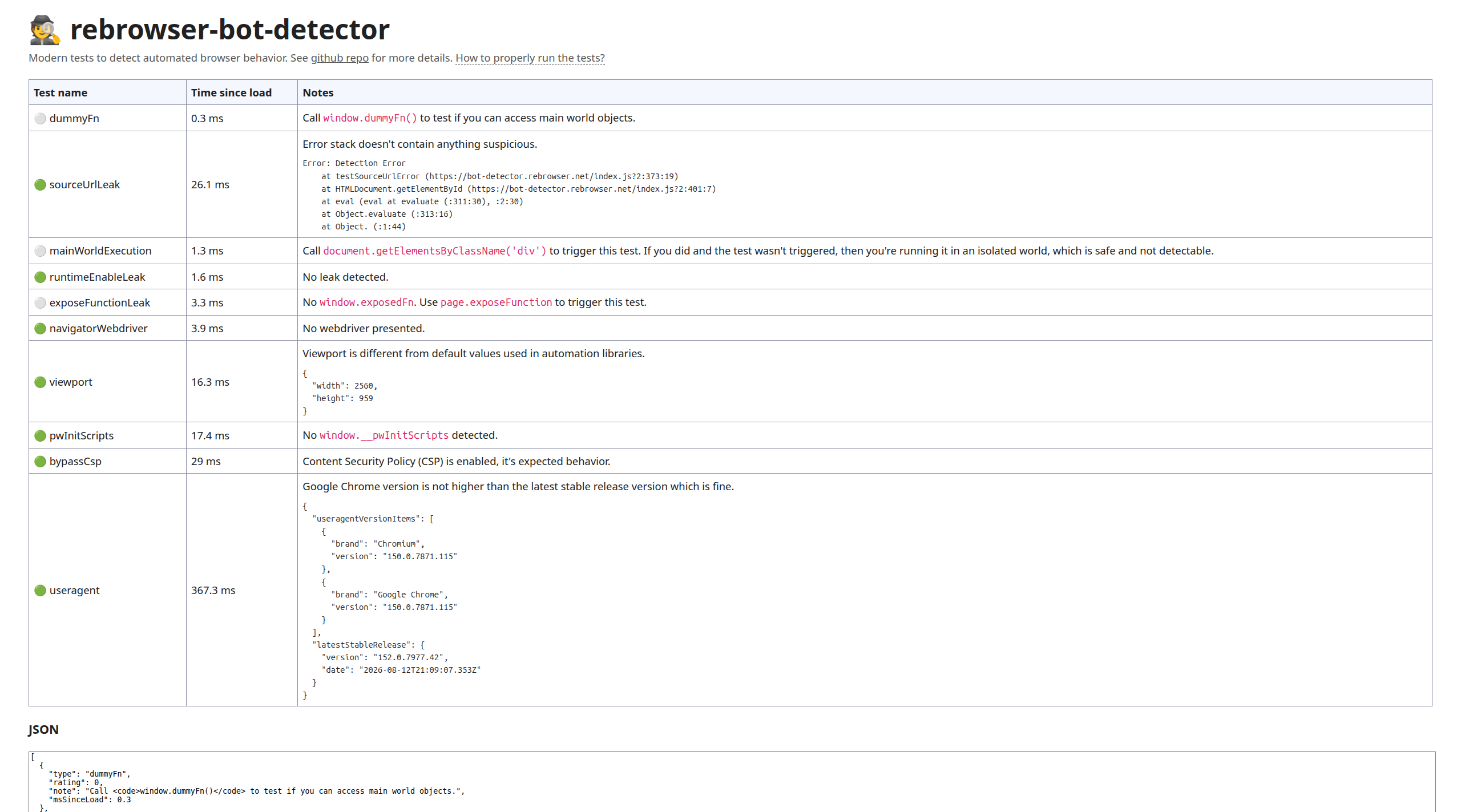
In a separate real DSH session, the Agent opened Rebrowser's public bot detector, waited for the checks, confirmed the rendered results, and closed the browser. A separate reproducible Pro 150 runner captured the detector page and reported 5 passed, 3 not triggered, and 0 failed checks. This is evidence for that public detector only, not a claim that every production anti-bot system can be bypassed.
dsh-cloak-browser is an independent, community-maintained native browser
tool bundle for DeepSeek Harness. It connects two upstream products:
This repository is not an official DeepSeek or CloakHQ project and is not affiliated with or endorsed by either organization.
The integration is deliberately thin:
DSH native Tool → per-Agent BrowserContext map → CloakBrowser → PlaywrightThere is no MCP server, separate middleware process, remote browser service, or model-supplied JavaScript evaluator. The small session map is retained because browser state must survive across tool calls and must not leak between Agents.
agent/disposed or plugin unload.p1:s3:e8. Agents can continue from
the returned state without a separate observation call.covered by <none> false positive during click/fill; other failures still
fail closed.Recommended flow:
browser_open(url)
  → Free, paid, or keyless: launches directly without asking
  → occupied Free seat: returns not_started without retrying in a loop
  → returns snapshot + refs
  → browser_click / browser_type / browser_select → returns next snapshot + refs
  → browser_close when the browser task is complete
The default flow needs no manual browser_snapshot between actions. The
explicit snapshot tool remains available when a page changes independently or
an Agent wants to refresh its view.
| Tool | Purpose |
|---|---|
browser_open |
Lazily open the session without user confirmation; with a URL, also return a snapshot |
browser_navigate |
Navigate and return a fresh snapshot with refs |
browser_snapshot |
Explicitly refresh bounded page/frame text and refs |
browser_click |
Click a ref and return the next snapshot |
browser_type |
Fill a textbox, optionally submit, and return the next snapshot |
browser_select |
Select an option and return the next snapshot |
browser_press |
Press a bounded navigation key and return the next snapshot |
browser_wait |
Wait for text/time and return the resulting snapshot |
browser_extract |
Extract bounded text, HTML, or an attribute without arbitrary JS |
browser_screenshot |
Attach an image on vision routes or return metadata on text routes |
browser_tabs |
List, select, or close tabs |
browser_close |
Close and forget the current Agent's browser session |
The resident prompt routes requests containing actions such as open, browse,
click, fill, submit, log in, inspect rendered state, or capture a webpage to
browser_*. Simple public-text research remains on web search/fetch until real
rendering or interaction is required.
Example request:
Use the browser to open https://example.com, inspect the rendered page, list
the interactive elements, and close the browser when finished.The default Bundle configuration is in cordis.patch.yml.
| Setting | Default | Description |
|---|---|---|
headless |
true |
Run Chromium without a visible window |
humanize |
true |
Enable CloakBrowser humanized interactions |
humanPreset |
default |
default or careful behavior preset |
geoip |
auto |
Automatically derive locale/timezone when proxyEnv is set; accepts true or false overrides |
proxyEnv |
CLOAKBROWSER_PROXY_URL |
Name of the environment variable containing the proxy URL |
persistentProfileRoot |
empty | Root for hashed per-Agent persistent profiles |
fingerprintSeed |
empty | Empty derives a stable, hashed per-Agent seed automatically; an explicit seed overrides it |
fingerprintNoise |
false |
Disable injected canvas/WebGL/audio/client-rect noise; this removed five CreepJS lies in the documented test |
fingerprintWindowsFontMetrics |
false |
Enable Chromium 148+ Windows font metrics; requires a real Windows font set on Linux |
allowThirdPartyCookies |
false |
Chromium 148+ compatibility switch for embedded reCAPTCHA/SSO/payment flows |
fingerprintStorageQuotaMb |
0 |
Optional storage quota override; 0 keeps the upstream automatic value |
viewportWidth, viewportHeight |
0, 0 |
Optional matching viewport and fingerprint screen size; 0 keeps safer automatic handling |
allowedDomains |
[] |
Empty permits public hosts; supports exact and *.example.com patterns |
blockedDomains |
[] |
Host patterns denied before the allowlist |
blockPrivateNetworks |
true |
Block explicit localhost, private, link-local, and reserved IP URLs |
maxPages |
5 |
Maximum tabs per Agent session |
actionTimeoutMs |
15000 |
Ordinary Playwright action timeout |
typingTimeoutMs |
90000 |
Longer timeout for deliberately slow humanized typing |
navigationTimeoutMs |
30000 |
Navigation timeout |
maxSnapshotElements |
100 |
Maximum refs returned by a snapshot |
maxTextChars |
12000 |
Maximum returned page/extraction text |
autoSnapshot |
true |
Include a fresh bounded snapshot in navigation and interaction results |
screenshotFormat |
jpeg |
jpeg or png |
screenshotQuality |
80 |
JPEG quality |
routePrompt |
true |
Install browser-selection guidance in the system prompt |
For production automation, restrict navigations in your profile override:
- id: cloak-browser
  config:
    allowedDomains:
      - 'example.com'
      - '*.example.com'
    blockedDomains:
      - 'admin.example.com'
    persistentProfileRoot: '/var/lib/dsh/cloak-profiles'
Keep profile, fingerprint, proxy, timezone, and locale consistent for the same site identity. Never give an Agent your everyday Chrome profile.
browser_type.text is recorded in DSH tool logs. Do not pass passwords, API
keys, cookies, or tokens through it. A credential-store-backed input tool is
intentionally outside the current release.allowedDomains applies to top-level navigations. It is an application guard,
not a complete network sandbox. DNS rebinding and page subresources require
container/firewall enforcement in high-assurance deployments.The code in this repository is released under the MIT License.
CloakBrowser's wrapper source is MIT-licensed, but the Chromium binary it downloads is distributed under CloakHQ's separate Binary License. Review that license before redistribution, reverse engineering, binary modification, or offering a customer-controlled Browser-as-a-Service product.
The current release pins:
| Component | Version |
|---|---|
| dsh-cloak-browser | 0.3.0 |
| DeepSeek Harness packages | 0.1.0-rc.6 |
| CloakBrowser wrapper | 0.5.7 |
| Playwright Core | 1.62.0 |
| Node.js | >=20 |
Validation performed for this release:
npm audit, syntax checks, and npm package dry-run.Run local checks with:
npm run check
npm test
npm audit --omit=dev
npm pack --dry-run
The tests use a fake BrowserContext and do not download Chromium.
On the documented Linux host with free Chromium 146, headless mode, no proxy,
and no Windows fonts, the plugin passed 5/6 core public detectors. A direct
CloakBrowser launchContext control produced the identical result; both failed
only Device & Browser Info's hasInconsistentTimingResolution. CreepJS improved
from 5 lies to 0 after disabling fingerprint noise, so that is now the plugin
default. The FingerprintJS demo still blocked this old binary/environment, while
one reCAPTCHA v3 run scored 0.9 and a repeat was inconclusive.
See the bilingual methodology, commands, strict verdict rules, complete results, and upgrade path. Live detector results are environment- and time-dependent, not a guarantee for unrelated sites.
On the documented Linux test host, cached browser startup was about 635 ms on
the first lazy call and 183 ms afterward. A 100-ref snapshot took 29 ms P50,
12,000-character extraction 1.2 ms, and a viewport screenshot 51 ms. With
humanize=false, snapshot-click-snapshot took 161 ms; the default humanized
workflow intentionally took 6.27 seconds. Automatic observation reduces
navigate/observe from two Tool calls to one and action/observe workflows from
three calls to two without a measured browser-time regression. See the
bilingual methodology, memory measurements, comparison table, and raw JSON in
docs/PERFORMANCE.md.
CLASSIFICATION EVIDENCE
系统优先读取 GitHub Topics,再与站内分类词典和词根规则比对。当前命中: 无有效分类标签。
deepseek-ai
DeepSeek Harness: Everything is a Plugin.

anywhere-labs
为 DeepSeek Harness (DSH) 插件生态打造的现代化桌面端解决方案。万物皆「插件」,桌面本身也是「插件」。

walkinglabs
Harness engineering beginner tutorial, from 0 to 1