
模型与 MCP
待识别

rea
morluto
Reverse engineer anything with agents, from app behavior down to native binaries.
PROJECT TOPICS
INSTALL REFERENCE
dsh plugin --profile web add github:markmuteki/dsh-session-prompt-optimizer
该命令指向仓库当前默认分支;尚无绑定当前 commit 的完整验证结果。
PROJECT README
中文说明 · MIT · a plugin for DeepSeek Harness
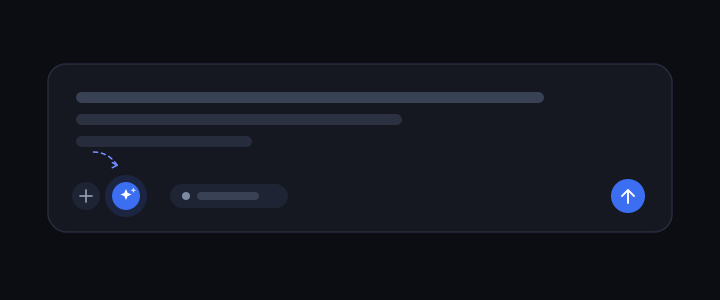
One button in the composer. It takes the draft you have typed, rewrites it into a clearer instruction for the agent, and shows both versions side by side above the composer. Your text is only replaced when you say so.
dsh plugin --profile web add github:markmuteki/dsh-session-prompt-optimizeror from npm:
dsh plugin --profile web add dsh-session-prompt-optimizerRestart dsh web after installing. No configuration is needed.
| Gesture | Result |
|---|---|
| Click | Rewrite the draft, close to its original length and shape |
| Shift+click | Structured rewrite: goal, then context and constraints, then the finished result |
| Alt+click | Compress: same intent, fewer words |
The button sits left of the model chip. It is disabled while the composer is empty, while a message is being sent, and while a rewrite is already running.
A finished rewrite opens a card just above the composer with the draft on the left and an editable result on the right: Use this writes it into the composer, Copy leaves the composer alone, Dismiss closes the card. If you kept typing while the request was running, the card says so instead of overwriting the newer text.
It drops pleasantries and framing, leads with the task, and replaces vague verbs with the concrete action. A draft that is already a good prompt is left nearly alone.
A draft written into a running conversation is rarely self-contained. Each rewrite is given a bounded excerpt of the session: at most six recent messages (600 characters each, about 2,400 in total), the session title and active goal, and the workspace directory. The excerpt is only read — the plugin adds no messages to the session and persists nothing beyond its own template cache.
One extra model request per click, on the model the composer is set to, with reasoning effort pinned to its lowest level. The draft and that excerpt go to the same model that would receive the message itself. Nothing else is sent anywhere except the upstream release check described below (a plain HTTPS request to GitHub).
The rewrite instructions are the user-optimize templates of the open-source
prompt-optimizer project, not text
written inside this plugin:
| Mode | Template |
|---|---|
| Click | User prompt basic optimization |
| Shift+click | Step-by-step planning |
| Alt+click | Basic optimization plus a brevity rule |
mode: "professional" (API only) |
Professional optimization |
A background check reads that project's latest release shortly after the harness starts
and then every six hours, validates the six templates (Chinese and English) and caches
them in .state/upstream.json. New templates are picked up on the next click; no
restart and no install. Offline, the cached copy is used, falling back to the built-in
prompt. GET /_prompt-optimizer/health reports the release being followed and
POST /_prompt-optimizer/refresh forces a check.
@path text.| File | Role |
|---|---|
index.js |
Host half: the three same-origin routes and the model call |
client.js |
Browser half: the button, the card, setDraft |
context.js |
Builds the bounded session excerpt |
upstream.js |
Fetches, validates and caches the upstream templates |
docs/DETAIL.md |
Longer notes on behaviour and design |
node _prompt_check.mjs runs a local check of the prompt assembly.
MIT © markmuteki. The rewrite templates come from linshenkx/prompt-optimizer, which is distributed under its own license.
CLASSIFICATION EVIDENCE
系统优先读取 GitHub Topics,再与站内分类词典和词根规则比对。当前命中: deepseek-harness。
morluto
Reverse engineer anything with agents, from app behavior down to native binaries.

deepseek-ai
DeepSeek Harness: Everything is a Plugin.

nexu-io
The 1st Collaborative AI Design Agent Workspace. Local-first and open source. Create motion, prototypes, websites, apps, dashboards, presentations, images, and videos with your team and AI agents. Share work, exchange feedback, and iterate together in one workspace.