

模型与 MCP
待识别

rea
morluto
Reverse engineer anything with agents, from app behavior down to native binaries.
PROJECT TOPICS
INSTALL REFERENCE
dsh plugin --profile web add github:lucagiftzek/dsh-plugin-updates
该命令指向仓库当前默认分支;尚无绑定当前 commit 的完整验证结果。
PROJECT README
An update checker that only offers plugin releases your running DSH core can actually load.
dsh plugin --profile web add dsh-better-sidebar   # the tab host, skip if installed
dsh plugin --profile web add @lucagiftzek/dsh-plugin-updates
# or from GitHub: dsh plugin --profile web add github:lucagiftzek/dsh-plugin-updates
# restart dsh web, then open the Updates tab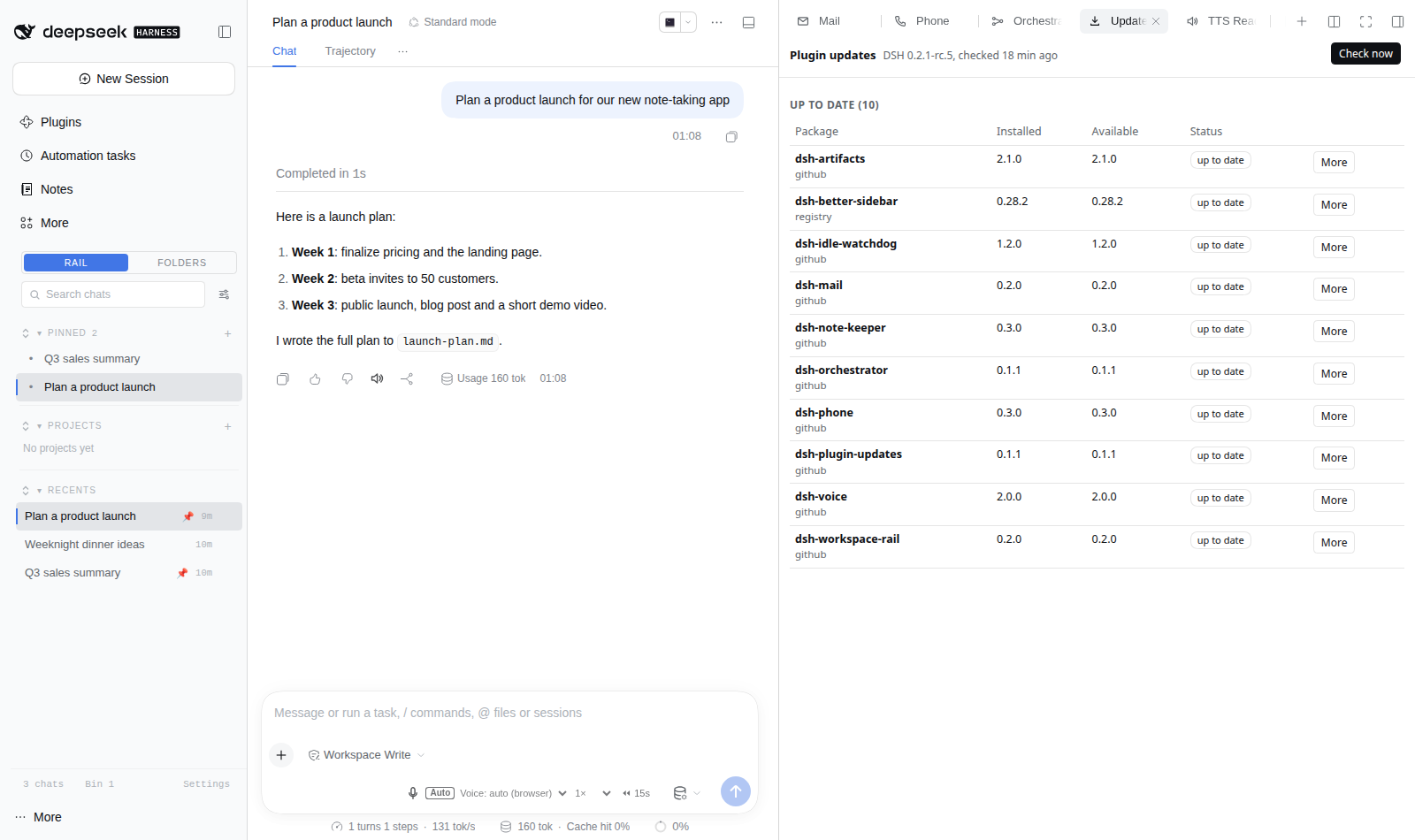
Screenshot from a demo DSH instance with sample data.
A DeepSeek Harness (DSH) web-profile plugin that tells you which of your installed plugins have a newer release that your running DSH can actually take. It only notifies. It never installs, never edits your profile, never runs a child process.
npm name. The bare name
dsh-plugin-updatesis already taken on npm by an unrelated data package, so this plugin is published as@lucagiftzek/dsh-plugin-updates. The loader row id staysplugin-updateseither way.
Updating DSH plugins blind is risky. Two things go wrong in practice:
link: folders or GitHub installs whose names also exist on npm as unrelated projects. A checker that looks packages up by name reports false "updates" and, if you approve, installs somebody else's package. This plugin classifies every dependency by its specifier (^1.2.0, link:, github:, a release tarball URL), never by its bare name.It also keeps a list of holds (versions you know to avoid), per package notes, and gives you a memory-capped apply command to copy, because a bare pnpm add on a busy machine can exhaust memory.
dsh-better-sidebar, optional) with a live count badge, grouped results, links (npm, releases, changelog, compare), Check now, Ignore this version, Snooze and Copy command.plugin_updates (and plugin_updates_doctor).GET /dsh-plugin-updates/api/doctor and a bundled doctor skill.Install from npm: dsh plugin --profile web add @lucagiftzek/dsh-plugin-updates, or from GitHub: dsh plugin --profile web add github:lucagiftzek/dsh-plugin-updates.
dsh plugin --profile web add @lucagiftzek/dsh-plugin-updates
# or from GitHub: dsh plugin --profile web add github:lucagiftzek/dsh-plugin-updates
# then restart dsh web: the server half loads at start only
The package declares dsh.bundle, so dsh plugin add lists it in dsh.profile.bundles. A local checkout works too: clone it, run npm install --omit=dev in it, then dsh plugin --profile web add link:/absolute/path/to/dsh-plugin-updates. Requires Node 22.5 or newer and DSH 0.1.5-rc.1 up to (not including) 0.3.0. The browser half hot-reloads; only the server half needs the restart.
Kill switch without uninstalling: add - id: plugin-updates with disabled: true to the profile cordis.patch.yml, or set DSH_PLUGIN_UPDATES_DISABLE=1.
Settings live in the dsh-plugin-updates namespace on DSH 0.1.5 (Settings page, stored in settings.yaml) and in the plugin-updates row of the profile cordis.patch.yml on DSH 0.2.x (settings forms). The plugin imports an old settings.yaml section once.
| Key | Default | Meaning |
|---|---|---|
enabled |
true |
Master switch. |
intervalHours |
12 |
Hours between automatic checks (minimum 1). |
initialDelaySeconds |
60 |
Delay of the first check after start. After a restart the next check respects the last one, so restarts do not cause extra requests. |
registry |
https://registry.npmjs.org |
Registry base URL. Must be on the host allowlist. |
allowHosts |
[] |
Extra hosts, explicit opt-in only. |
githubTokenEnv |
"" |
The name of an environment variable that holds a GitHub token. Never the token. It is sent only to api.github.com and never stored or logged. |
channels |
["latest"] |
Extra dist-tags to show (for example next). Never counted in the badge. |
holds |
seeded | Package name to a semver range to avoid. A value may end in when dsh <range> to apply only on some cores, for example ">=0.3.2 when dsh <0.2.0-0". |
upstream |
seeded | Local plugin (folder or package name) to owner/repo, or owner/repo@<base> to record the base version. Used for link: and file: plugins that are forks or clones. |
notes |
seeded | Per package notes shown next to the result. A note ending in when dsh <range> (the hold syntax) is shown only while the running DSH matches that range. |
afterInstall |
{} |
Per package reminder printed with the apply command (for example a patch script to re-run). |
checkOwnRemotes |
false |
Compare plain local plugins with their github.com origin. |
snoozeDays |
7 |
Default snooze length. |
badge |
true |
Show the count badge. |
badgeCountsIncompatible |
false |
Also count updates that need a newer core. |
chatNotice |
false |
Post one short notice per new finding set, at most once a day. Best effort; it never starts a model turn. |
runningDshVersion |
"" |
Test override of the detected DSH version. Leave empty. |
Seeded holds and upstream come from a manual audit of real plugins: they encode knowledge that registry metadata cannot carry (a desktop-only 0.2.x line, stepping-stone builds, an archived upstream). Replace them freely.
registry (semver range, tag, npm: alias) is checked on npm. github: and git+https://github.com/... are checked against GitHub tags and the default branch HEAD, with the pinned commit read from pnpm-lock.yaml. A https://github.com/<owner>/<repo>/releases/download/<tag>/<file>.tgz URL is checked against GitHub releases. link:, file:, workspace: are local: they are compared with an upstream only when the upstream map names them, or with their own github.com origin when checkOwnRemotes is on. Anything else (another git host, another tarball host) is shown as manual.engines.dsh is declared, that range decides alone; otherwise every @deepseek-ai/dsh and @deepseek-ai/dsh-* peer range must match. Matching uses semver.satisfies(running, range, { includePrerelease: true }), so >=0.2.1 refuses an rc and >=0.2.1-0 accepts it. The DSH 0.1.5 core has no gate of its own, so there the result is "declared compatible", not "verified". Nested dsh.engines.dsh ranges are shown as a hint only.up-to-date, update-compatible, update-needs-newer-core, update-needs-older-core, no-declared-range (the new version declares nothing, verify by hand), held, snoozed, ignored, unreachable, manual, local, unknown. A failed lookup is unreachable, never up-to-date.^0.7.4) would pick a version your core cannot take, the package is flagged so you do not run a bare pnpm update.The badge counts update-compatible only.
For a safe update the result carries applyHint, for example:
XDG_RUNTIME_DIR=/run/user/$(id -u) systemd-run --user --scope -p MemoryMax=1500M -p MemorySwapMax=0 \
  pnpm --dir "${DSH_HOME:-$HOME/.dsh}/profiles/web" add --save-exact --ignore-scripts <package>@<version>
The cap makes a runaway install kill only itself. Check free -m first. Git and release tarball dependencies get the matching pnpm add 'name@github:owner/repo#ref' or release URL form. Local forks get a manual hint (rebase onto the upstream tag), because no package manager command applies. Add afterInstall reminders for packages that need a follow-up step. The agent tool says the same: do not run pnpm add, pnpm update or dsh plugin add on your own; present the list and let the human decide.
plugin_updates { scope?, package?, refresh? } with scope one of actionable (default), outdated, safe, held, local, all. Read-only. refresh: true runs a new check (60 second cooldown).
Routes under /dsh-plugin-updates/api: GET status, GET list?scope=, GET detail?pkg=, GET doctor, GET health, GET settings, POST refresh, POST ignore {pkg,version?}, POST unignore {pkg}, POST snooze {pkg,days?}, POST settings {patch}. POSTs require the header X-Requested-With: dsh-plugin-updates, a JSON body, a matching Origin and a loopback connection (or the host connection admission when it offers one). None of them touches anything except the plugin's own state file.
allowHosts is an explicit opt-in that is empty by default.npm view would send.$DSH_HOME/dsh-plugin-updates/state.json (mode 0600), never in the profile. Registry and GitHub text is never shown or given to the model: only validated version strings and links the plugin builds itself.unreachable until the reset.plugin-updates-doctor skill (bundled; see docs/TROUBLESHOOTING.md if it is not listed).GET /dsh-plugin-updates/api/doctor (no secrets in the output).code: docs/ERRORS.md.The skill is registered automatically at the next dsh web start. Manual fallback:
P=$(node -p "require('path').dirname(require.resolve('dsh-plugin-updates/package.json',{paths:[(process.env.DSH_HOME||require('os').homedir()+'/.dsh')+'/profiles/web']}))")
mkdir -p "${DSH_HOME:-$HOME/.dsh}/skills" && cp -r "$P/skills/plugin-updates-doctor" "${DSH_HOME:-$HOME/.dsh}/skills/"npm install # dev dependencies: esbuild, react, react-dom, jsdom
npm run build # bundles src/client.jsx to lib/client.js, verifies it loads like the browser loader does
npm test # unit tests with mocked HTTP, fake 0.1.5 and 0.2.1 contexts, jsdom client boot
DSH_GLOBAL_PREFIX=/path/to/a/dsh-0.2.x/prefix npm test # same suite against another DSH linetest/dry-eval.mjs evaluates a read-only copy of a real profile against the live registry. Release history: CHANGELOG.md. License: MIT.
All of them are open source and run on DeepSeek Harness 0.2.x (several on 0.1.5 too).
| Plugin | What it does |
|---|---|
| dsh-artifacts | An Artifacts tab that lists the files an agent produced and previews them in place, plus a template library agents can use and extend |
| dsh-mail | Mail client and agent mail tools: IMAP, POP3, SMTP and OAuth2 accounts, scheduled and bulk sends with unsubscribe handling |
| dsh-note-keeper | Obsidian-compatible Markdown notes in the sidebar with search, graph, audio notes and transcription, OCR and client-side encryption |
| dsh-phone | SMS and calls (Twilio, SIP via Asterisk) with call audio through your own server, live voicemail and Telegram |
| dsh-voice | Read-aloud, dictation and language-aware speech with 23 TTS and STT providers, per-language routing and word highlighting |
| dsh-orchestrator | Agent swarm and task orchestration: an Orchestrate tab, orch_* tools, runners, provider cards and a machine API |
| dsh-workspace-rail | A workspace-first sidebar rail: pinned chats, projects as folders, live Recents, search and unread markers |
| DSH-Idle-Watchdog | Idle-chat nudges and an authenticated HTTP API that posts a prompt into any chat |
| dsh-plugin-updates (this one) | Update checker that only offers releases your running DSH core can load |
| dsh-subagent-tiering | Subagents default to a cheaper sibling of the parent model unless the agent names a route |
| dsh-fs-reobserve | Ends self-inflicted stale-file errors after an agent's own shell commands |
| dsh-request-image-cap | Clamps every image sent to the model to a pixel cap, fixing many-image request errors |
| dsh-seal | An encrypted channel in front of DSH: a Go reverse proxy plus a service worker that seal all DSH browser traffic |
Built by Luca Tzekos, who also makes Job Opportunities API: employer-direct job data with per-field provenance you can verify yourself, free to read and available as an API. If this plugin is useful to you, a star on this repo or a look at jobopportunitiesapi.org is the best thanks.
CLASSIFICATION EVIDENCE
系统优先读取 GitHub Topics,再与站内分类词典和词根规则比对。当前命中: deepseek-harness。
morluto
Reverse engineer anything with agents, from app behavior down to native binaries.

deepseek-ai
DeepSeek Harness: Everything is a Plugin.

nexu-io
The 1st Collaborative AI Design Agent Workspace. Local-first and open source. Create motion, prototypes, websites, apps, dashboards, presentations, images, and videos with your team and AI agents. Share work, exchange feedback, and iterate together in one workspace.