

模型与 MCP
待识别

rea
morluto
Reverse engineer anything with agents, from app behavior down to native binaries.
PROJECT TOPICS
INSTALL REFERENCE
dsh plugin --profile web add github:lucagiftzek/dsh-orchestrator
该命令指向仓库当前默认分支;尚无绑定当前 commit 的完整验证结果。
PROJECT README
Spawn, prompt and track agent chats and tasks from one Orchestrate tab, with orch_* tools and runners.
dsh plugin --profile web add dsh-better-sidebar   # the tab host, skip if installed
dsh plugin --profile web add @lucagiftzek/dsh-orchestrator
# or from GitHub: dsh plugin --profile web add github:lucagiftzek/dsh-orchestrator
# restart dsh web, then open the Orchestrate tab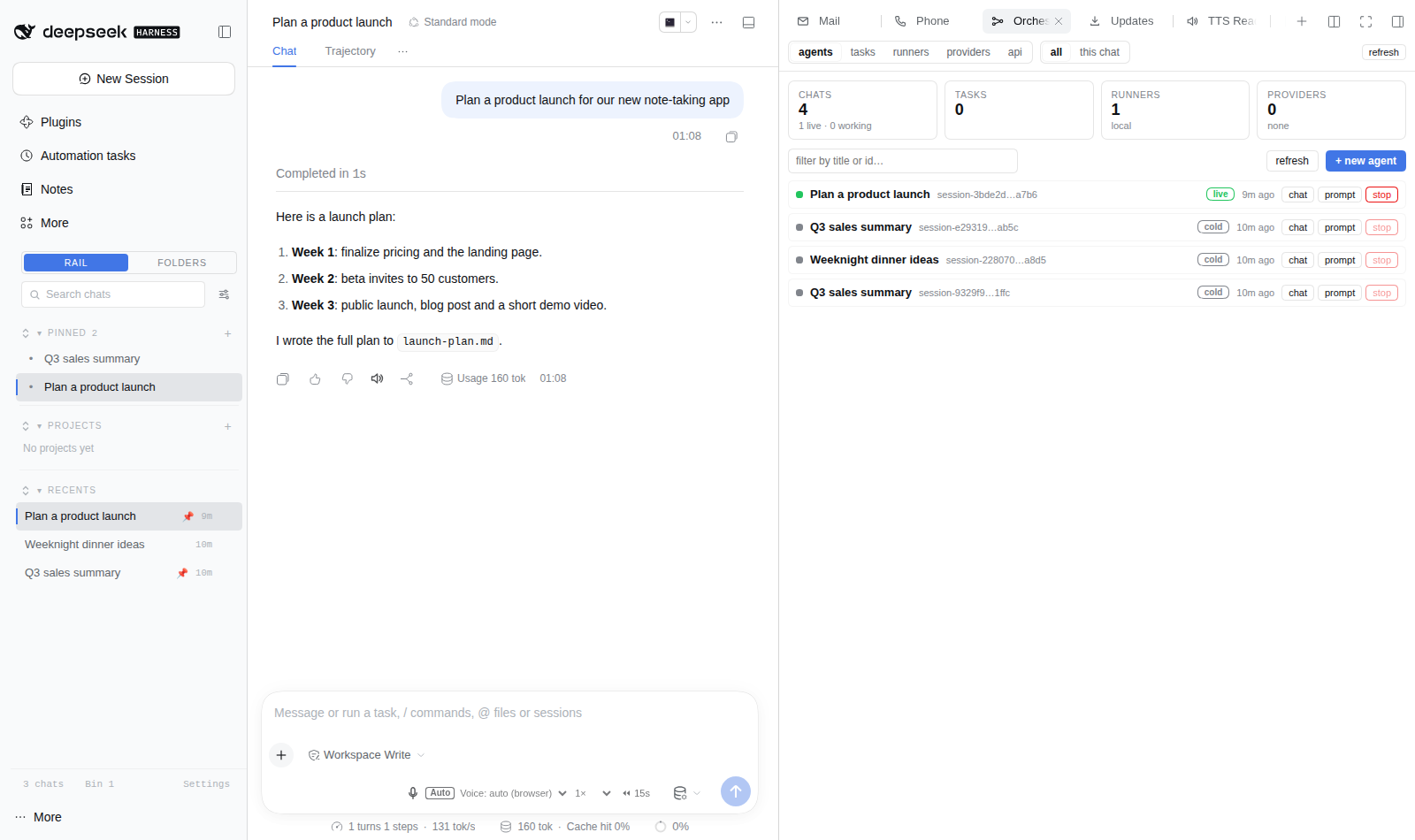
Screenshot from a demo DSH instance with sample data.
Agent swarm + task orchestration for DeepSeek Harness (DSH).
A plugin that adds an Orchestrate tab to dsh-better-sidebar, like the built-in Background Tasks view, but broader:
orch_* tools.command (shell on any runner), scrape (deterministic multi-URL extraction, no model in the loop), http (endpoint calls), agent (a spawned chat whose answer is the task output).Everything is settings-driven: runners, providers, presets, limits and the API secret live in Settings → Orchestrator (or the cordis config row). Nothing is hardcoded, no hosts, no commands, no credentials in the code.
Requires DSH >= 0.1.1-rc.1, Node >= 22.5, the web profile, and dsh-better-sidebar (the tab host).
Install from npm: dsh plugin --profile web add @lucagiftzek/dsh-orchestrator, or from GitHub: dsh plugin --profile web add github:lucagiftzek/dsh-orchestrator.
dsh plugin --profile web add @lucagiftzek/dsh-orchestrator
# or from GitHub: dsh plugin --profile web add github:lucagiftzek/dsh-orchestrator
The package declares dsh.bundle, so dsh plugin add lists it in dsh.profile.bundles. From a checkout instead:
git clone https://github.com/lucagiftzek/dsh-orchestrator
dsh plugin --profile web add link:$PWD/dsh-orchestrator
lib/ is committed, so no build step is needed. Then restart dsh-web (the client half mounts live after a browser refresh; the host half, tools, settings namespace, API route, needs the restart). Full steps are in cordis.patch.yml.
Open the sidebar + menu → Orchestrate. Five sections:
| Section | What it shows / does |
|---|---|
| agents | every chat (live + cold) with title, running state, recency; quick prompt, stop, chat drawer (transcript + send box + fork + cancel); + new agent spawn form with fan-out |
| tasks | every task with status, runner, live output (auto-polling while running), cancel; + new task form for all four types |
| runners | execution targets with health probes |
| providers | integration cards, an hpc provider shows the allocation headline, queue, collector health and staged proposals |
| api | machine-API secret management + ready-made curl examples + the tool-server contract |
A badge on the tab counts active work (running agents + running tasks).
Sessions get these tools (registered through the standard ctx.tools seam, they behave like any core tool):
| tool | what it does |
|---|---|
orch_status |
one-screen overview: agents, tasks by status, runners, providers |
orch_agents_list |
list chats (live/cold, titles, running flags), with search |
orch_agent_status |
one chat: running state + last user/assistant text |
orch_agent_prompt |
deliver a message into a chat (id, unique prefix, or exact title); cold chats resume |
orch_agent_spawn |
create chat(s), optionally with a first prompt; count fans out with {i} interpolation, how you split work across agents |
orch_agent_fork |
split a conversation: fork a chat's completed-turn history into a new session, then prompt the fork |
orch_agent_cancel |
cancel a chat's active turn (queued work is kept) |
orch_task_create |
create + run a task (see below) |
orch_task_list / orch_task_status / orch_task_output |
list / inspect / read tasks |
orch_task_cancel |
cancel a task (kills the runner process or cancels the agent turn) |
orch_runners |
runner inventory + health probes |
orch_providers |
provider status cards (for example an HPC allocation) |
| type | spec fields | output |
|---|---|---|
command |
command, cwd, runner, timeoutMs |
stdout + stderr, capped |
scrape |
urls[], extract (text/html/json), selector (tag/.class/#id/[attr]), attribute, pattern (regex) |
JSON rows: per-URL status + extracted data |
http |
url, method, body, headers, expectStatus, timeoutMs |
response body, capped |
agent |
prompt, count (fan-out), forkOf (split an existing chat), promptExisting (drive an existing chat), preset, cwd |
the chat itself, live status while it works, the assistant answer when it settles |
All tasks: global concurrency cap with queueing, cancellation, durable history with pruning, and an audit event log. Tasks also mirror (best-effort) into ctx.jobs so they appear in the built-in Background Tasks surface.
Live output: command tasks stream stdout/stderr into the task record as it arrives (the tab's output panel and orch_task_output show progress while the command runs, not just the final result); scrape tasks log per-URL progress lines ([2/5] https://… -> 200) before the structured JSON replaces them at settlement.
After mounting (restart), verify the host with bash scripts/verify-host.sh [port] [secret]: health, dashboard shape, the trust fence, the CSRF gate, and (with the secret) a machine probe round trip.
Declared in Settings, never in code:
bash -lc <command>, argv only, scrubbed env: no SSH_AUTH_SOCK, no inherited secrets)ssh <target> -- <command>; target, binary, connect timeout and extra args are operator config; the command is one argv element on this sidePOST {url} {kind, spec, timeoutMs} → {ok, status, output, detail}. Any host running dsh-orchestrator serves it at /dsh-orchestrator/api/remote/run: so your boxes can run work for each other. The auth token is read from an env var at call time (secretEnv), never stored.Selection: explicit runner id, else the configured default, else round-robin across enabled runners.
{url}/health and {url}/state; the contract is below. Leave it out if you have no such service.ok/health/status/headline keys are highlighted when present, everything else renders as fields. Optional secretEnv for a bearer token read at call time.The hpc contract (only the fields you have are needed; missing ones render as empty):
GET {url}/health  -> {"ok": true}
GET {url}/state?logbook=0 -> {
  "headline": "1,234 GPU-hours left, 24 days to the deadline",
  "balance":  {"gpu_hours_left": 1234, "billing_hours_left": 56789, "deadline": "2027-01-31"},
  "collector": {"status": "ok", "checked_at": "2027-01-07T10:00:00Z"},
  "queue":    {"running": [ ... ], "pending": [ ... ]},
  "staged":   [{"arm": {"armed": true}}, ...]
}
CamelCase keys (gpuHoursLeft, billingHoursLeft) are accepted too. secretEnv names an environment variable holding a bearer token, read at call time.
Add your own control planes (pods, orchestrators, dashboards) as http providers; add your remote boxes as ssh or http runners. The plugin has zero knowledge of any specific host.
Protected by a secret (DSH_ORCHESTRATOR_SECRET env or Settings), constant-time compared, rate-limited per IP, failing closed when no secret is configured. Present it as x-orchestrator-secret: <secret> or Authorization: Bearer <secret>.
# prompt any chat (id, unique prefix, or exact title), cold chats resume
curl -sS -X POST http://127.0.0.1:3080/dsh-orchestrator/api/remote/prompt \\
  -H "content-type: application/json" \\
  -H "x-orchestrator-secret: $DSH_ORCHESTRATOR_SECRET" \\
  -d '{"chat":"Research","message":"status report?"}'

# spawn an agent
curl -sS -X POST http://127.0.0.1:3080/dsh-orchestrator/api/remote/agents/create \\
  -H "content-type: application/json" \\
  -H "x-orchestrator-secret: $DSH_ORCHESTRATOR_SECRET" \\
  -d '{"title":"nightly-research","prompt":"summarize todays papers","count":3}'

# run work on this host from anywhere (the tool-server contract)
curl -sS -X POST http://127.0.0.1:3080/dsh-orchestrator/api/remote/run \\
  -H "content-type: application/json" \\
  -H "x-orchestrator-secret: $DSH_ORCHESTRATOR_SECRET" \\
  -d '{"kind":"command","spec":{"command":"uptime"},"timeoutMs":30000}'
# -> {"ok":true,"status":"completed","output":"..."}
Reads (/status, /agents, /tasks, /providers, /runners, /settings) also answer to the secret. Browser reads are trust-fenced (loopback + Host authority); browser mutations additionally require the same-origin CSRF header set and the harness session cookie (see Security).
Where the values live depends on the DSH line (lib/dual-settings.js picks it by capability): on DSH 0.1.5 they are the registered namespace dsh-orchestrator in settings.yaml; on DSH 0.2.x they are the dsh-orchestrator row of the profile's cordis.patch.yml (every field live except stateDir), imported once from settings.yaml.imported while the row is still empty. api.secret is a secret field and is redacted on every read.
Everything lives under the dsh-orchestrator settings namespace (Settings → Orchestrator) or the cordis config row. Highlights:
| key | default | meaning |
|---|---|---|
enabled |
true | master switch |
api.secret / env DSH_ORCHESTRATOR_SECRET |
, | machine API secret (env wins; never echoed back) |
api.rateLimitPerMinute |
60 | per-IP machine call budget |
agents.spawnMax |
8 | fan-out cap per spawn |
agents.defaultPreset / agents.defaultCwd |
, | defaults for new chats |
tasks.maxConcurrent |
4 | engine-wide live task cap |
tasks.defaultRunner |
local | runner for unqualified tasks |
tasks.allowCommandTasks |
true | can command tasks run at all |
tasks.allowRemoteRunners |
true | may tasks leave this host |
tasks.historyKeep |
400 | finished tasks kept |
mirrorJobs |
true | mirror tasks into ctx.jobs (Background Tasks tab) |
runners[] |
local only | execution targets, see above |
providers[] |
, | integrations, see above |
trustedHosts[] |
, | extra Host authorities for the public edge |
Two caller classes, two gates (full detail in docs/DESIGN.md):
sec-fetch-site/Origin, JSON content-type, the plugin's X-Requested-With header, and the harness session cookie presence on mutations. No GET ever mutates.# disable without uninstalling (needs a dsh-web restart):
# ~/.dsh/profiles/web/cordis.patch.yml
- id: dsh-orchestrator
disabled: true
# runtime, no restart:
DSH_ORCHESTRATOR_DISABLE=1 # in the dsh-web environmentnpm run check # node --check every file
npm install # devDependencies: esbuild, jsdom, react, react-dom
npm run build # bundle src/client.jsx -> lib/client.js (esbuild, or ESBUILD_MAIN)
npm test # host-half tests, lossless JSON checks, client render test, dual-settings testsThe client test needs jsdom and react from the devDependencies (or a package directory named by DSH_TEST_REQUIRE_SEED); without them it skips.
0.1.1: used daily on a real deployment. MIT license, see LICENSE. Issues and PRs welcome.
All of them are open source and run on DeepSeek Harness 0.2.x (several on 0.1.5 too).
| Plugin | What it does |
|---|---|
| dsh-artifacts | An Artifacts tab that lists the files an agent produced and previews them in place, plus a template library agents can use and extend |
| dsh-mail | Mail client and agent mail tools: IMAP, POP3, SMTP and OAuth2 accounts, scheduled and bulk sends with unsubscribe handling |
| dsh-note-keeper | Obsidian-compatible Markdown notes in the sidebar with search, graph, audio notes and transcription, OCR and client-side encryption |
| dsh-phone | SMS and calls (Twilio, SIP via Asterisk) with call audio through your own server, live voicemail and Telegram |
| dsh-voice | Read-aloud, dictation and language-aware speech with 23 TTS and STT providers, per-language routing and word highlighting |
| dsh-orchestrator (this one) | Agent swarm and task orchestration: an Orchestrate tab, orch_* tools, runners, provider cards and a machine API |
| dsh-workspace-rail | A workspace-first sidebar rail: pinned chats, projects as folders, live Recents, search and unread markers |
| DSH-Idle-Watchdog | Idle-chat nudges and an authenticated HTTP API that posts a prompt into any chat |
| dsh-plugin-updates | Update checker that only offers releases your running DSH core can load |
| dsh-subagent-tiering | Subagents default to a cheaper sibling of the parent model unless the agent names a route |
| dsh-fs-reobserve | Ends self-inflicted stale-file errors after an agent's own shell commands |
| dsh-request-image-cap | Clamps every image sent to the model to a pixel cap, fixing many-image request errors |
| dsh-seal | An encrypted channel in front of DSH: a Go reverse proxy plus a service worker that seal all DSH browser traffic |
Built by Luca Tzekos, who also makes Job Opportunities API: employer-direct job data with per-field provenance you can verify yourself, free to read and available as an API. If this plugin is useful to you, a star on this repo or a look at jobopportunitiesapi.org is the best thanks.
CLASSIFICATION EVIDENCE
系统优先读取 GitHub Topics,再与站内分类词典和词根规则比对。当前命中: deepseek-harness。
morluto
Reverse engineer anything with agents, from app behavior down to native binaries.

deepseek-ai
DeepSeek Harness: Everything is a Plugin.

nexu-io
The 1st Collaborative AI Design Agent Workspace. Local-first and open source. Create motion, prototypes, websites, apps, dashboards, presentations, images, and videos with your team and AI agents. Share work, exchange feedback, and iterate together in one workspace.