其他
完整应用

deepseek-harness
deepseek-ai
DeepSeek Harness: Everything is a Plugin.

lpeixin/dsh-qualityforge
QualityForge is an enterprise-grade DeepSeek Harness QA plugin that automates systematic end-to-end testing and delivers P0–P3 severity-based, actionable reports and quality gates to help developers identify issues and prioritize fixes. QualityForge 是一个面向企业级项目的 DeepSeek Harness QA 插件,自动执行系统性端到端测试,并通过 P0–P3 严重度分级、可勾选的测试报告与质量门禁,帮助开发者快速识别问题并确定修复优先级。
PROJECT TOPICS
INSTALL REFERENCE
dsh plugin --profile web add github:lpeixin/dsh-qualityforge
该命令指向仓库当前默认分支;尚无绑定当前 commit 的完整验证结果。
PROJECT README
English | 简体中文




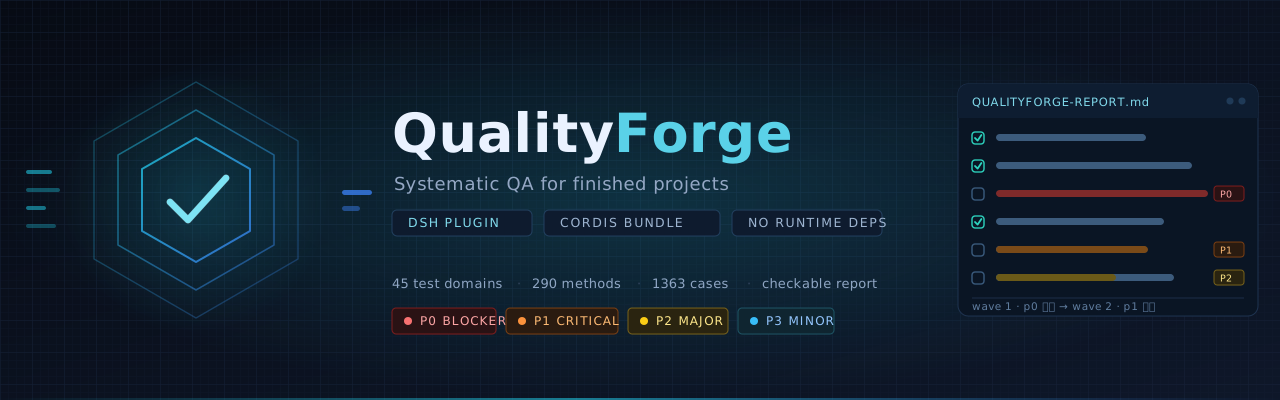
QualityForge is a DeepSeek Harness plugin that runs a systematic, enterprise-grade test pass over a finished project and produces a per-item checkable report with P0–P3 severity — a quality verdict, and the artifact developers and the Harness use to agree on what to fix and in which order.
| Question | What QualityForge gives you |
|---|---|
| Can this ship? | A verdict: ⛔ Blocked / ⏳ Audit incomplete / ⚠️ Conditional / ✅ Ready |
| What exactly is wrong? | 45 test domains, 290 methods, 1363 independently verifiable checks — each with a conclusion, evidence and a fix suggestion |
| What first? | Fix waves (Wave 1 clears blockers → Wave 2 criticals → …) plus a handoff sheet you can paste back into the Harness |
| What after fixing? | Tick items in the report → qf_update sync=true reads them back → qf_exec re-tests → only then does an item become verified |
The report, catalog, tool descriptions and the documents under
docs/are written in Chinese today; an English report locale is on the roadmap. Identifiers (QF-001), statuses and the JSON artifacts are language-neutral.
"The code is written" and "this is shippable" are two different claims, and the second one needs evidence. What usually gets in the way:
QualityForge turns that into a repeatable pipeline: recon → exhaustive checklist → run what can be run →
agent analyses the rest → checkable report → agree the fix scope → re-test to close.
Every intermediate artifact stays inside the audited project under .qualityforge/, so the report can be
re-rendered, reviewed in a pull request, and diffed.
| Feature | Detail |
|---|---|
| Enterprise test-method catalog | 45 domains / 290 methods / 1363 cases: build & dependencies, static quality, unit and advanced testing, integration & contracts, API layer, UI & accessibility, E2E & acceptance, data, performance & capacity, security & compliance, reliability, observability & ops, engineering process, plus DSH-plugin-specific and open-source-readiness domains |
| Four depths | smoke 331 / standard 984 / deep 1295 / exhaustive 1363 items, expanded by tier, filterable by domain |
| Project-type aware | Detects library / cli / service / web / desktop / mobile / plugin / data / ml / monorepo and skips what cannot apply (a CLI has no multi-region failover) — skips are reported with reasons, never counted as passes |
| Evidence first | Reconnaissance conclusions come from disk evidence only; every defect needs evidence, reproduction steps, files and a recommendation |
| Automated runs with exact write-back | 11 preset commands (build, typecheck, lint, format, test, coverage, e2e, dependency audit, secret scan, install, outdated); results are written back to the exact test item by method + title. A missing tool is skipped, never a failure |
| Checkable report + read-back | One checkbox per item in Markdown; qf_update sync=true writes the ticks back into structured data (WONTFIX / DEFER / NA markers supported) |
| Fix-scope negotiation | qf_fixplan builds fix waves and a handoff sheet: fix everything, only P0-P1, specific ids, or everything except some ids |
| Zero runtime dependencies | Node built-ins only, no build step, no install scripts — it cannot break because a host package version or symlink layout changed |
| Read-only recon, narrow execution surface | Recon never writes; qf_exec only runs whitelisted preset commands; qf_probe only reaches loopback addresses |
In-session (needs danger-full-access):
plugin_manager install_bundle target=dsh-qualityforge
plugin_manager install_bundle target=github:lpeixin/dsh-qualityforge
plugin_manager install_bundle target=/absolute/path/to/dsh-qualityforgeCLI:
dsh plugin --profile <profile> add dsh-qualityforge
dsh plugin --profile <profile> add github:lpeixin/dsh-qualityforge   # lib/ is committed, no build needed
dsh plugin --profile <profile> add /absolute/path/to/dsh-qualityforge
dsh --profile <profile> --dump-config | grep -A3 qualityforge       # verify the bundle layer
Restart DSH (or start a new session) after installing so the module is loaded.
Disable without uninstalling — in ~/.dsh/profiles/<profile>/cordis.patch.yml:
- id: qualityforge
disabled: trueAsk, in a session, with the target project as the working directory:
Run a full QA audit on this project at standard depth, then give me a report I can tick off item by item.
The Harness then works through:
qf_scan   → recon: stack, project type, runnable commands, confirmed engineering gaps
qf_plan   → generate the checklist (depth=standard, applicability-filtered by default)
qf_exec   → build / typecheck / lint / test / coverage / dependency audit / secret scan
qf_probe  → loopback HTTP probes against a locally started service (optional)
qf_record → record the agent's deep-analysis conclusions (batched, with evidence)
qf_report → render Markdown + JSON, with verdict and fix waves
then: developer ticks → qf_update sync=true → qf_fixplan → fix → qf_exec to re-test
Artifacts live inside the audited project, never in the plugin:
<project>/.qualityforge/
├── audit.json                  structured data (single source of truth)
├── QUALITYFORGE-REPORT.md      the checkable report
└── report.json                 machine-readable snapshot (for CI)
See what a report looks like: sample report excerpt (a real self-audit of this very repository).
qf_scan{ "projectPath": "/path/to/project", "force": true }Produces a project profile: stack and package manager, project type, languages, runnable commands
(each with its source, e.g. package.json#scripts.test), test frameworks, CI/container/IaC/security
tooling, documentation completeness, and confirmed engineering gaps (a missing lockfile, suspected
hardcoded credentials, and so on). Secret findings record location and kind only — never the value.
qf_plan{ "depth": "standard", "categories": ["sec-input", "api-semantics"], "includeAll": false }| depth | items | use |
|---|---|---|
smoke |
331 | pre-release blocker list |
standard |
984 | normal delivery audit (default) |
deep |
1295 | deep audit of an important release |
exhaustive |
1363 | first full audit, compliance evidence |
Every item gets a stable id (QF-001), a priority (P0–P3), a severity, a judgement mode
(auto / agent analysis / human confirmation) and an explicit pass criterion. Re-running is safe:
existing items keep their status and history; only reset=true rebuilds from scratch.
qf_exec / qf_probe{ "presets": ["build", "typecheck", "lint", "test", "coverage", "audit", "secrets"] }{ "urls": ["http://127.0.0.1:3000/health"], "expectStatus": 200, "itemId": "QF-512" }qf_exec spawns only the preset commands discovered by recon (no shell, no arbitrary command strings);
install is opt-in because it mutates the working tree. qf_probe is restricted to loopback http(s),
GET/HEAD, with a truncated body.
qf_record{
"items": [
{
"id": "QF-142",
"status": "fail",
"actual": "`ORDER BY ${sort}` is interpolated into SQL at src/api/orders.ts:88",
"recommendation": "Map sort fields through an allowlist; return 400 otherwise",
"files": ["src/api/orders.ts:88"],
"repro": ["GET /api/orders?sort=id;DROP TABLE users--"],
"evidence": ["SQL log shows the interpolated statement"],
"cwe": ["CWE-89"],
"effort": "S"
}
]
}Judgement discipline: fail (with reproduction) / pass (with evidence) / blocked (environment or
dependency missing — do not record as fail) / na (does not apply, with a reason) / wontfix
(risk accepted).
qf_report{ "reportPath": ".qualityforge/QUALITYFORGE-REPORT.md", "waveScope": "defects" }Sections: how to use the report · verdict summary · priority & severity distribution · fix waves · problem list with one checkbox per defect · full checklist · skipped items · command evidence · project profile · re-test and sign-off table.
qf_update / qf_fixplanDevelopers tick - [x] in the report (or `WONTFIX` / `DEFER` / `NA`); the Harness runs
qf_update sync=true to read the ticks back. Ticking a defect sets it to fixed, pending re-test — only
a re-test makes it verified.
Then pick a scope:
| scope | meaning |
|---|---|
all |
everything still open |
p0 / p0-p1 |
blockers only / the minimum shippable fix set |
defects (default) |
every failing or blocked item |
pending |
only items not judged yet |
ids + excludeIds |
explicit include/exclude |
Output is a fix handoff sheet — per item: expectation, observation, location, suggestion — plus the constraints (touch only what is in scope, every fix must be verifiable, write ticks back when done).
| Tool | Purpose | Key parameters |
|---|---|---|
qf_scan |
Recon + confirmed gaps | projectPath, force |
qf_plan |
Generate the checklist | depth, categories, includeAll, withRecon, reset |
qf_exec |
Run preset checks, write results back | presets, timeoutMs, maxOutputBytes, autoRecord, recordPass |
qf_probe |
Loopback HTTP probes | urls, method, expectStatus, expectBodyContains, itemId |
qf_record |
Record conclusions (batched) | items[], createMissing |
qf_list |
Query and filter items | priorities, statuses, category, method, search, onlyOpen, limit |
qf_update |
Change status / read ticks back | ids+status, or sync=true |
qf_report |
Render Markdown + JSON | reportPath, waveScope, includePassedDetail, writeJson |
qf_fixplan |
Fix waves + handoff sheet | scope, ids, excludeIds, maxPerWave, format, writeFile |
qf_reset |
Delete audit data | confirm=true |
The plugin also registers a methodology skill, qualityforge-audit (workflow, judgement discipline,
anti-patterns), whose body lives in lib/SKILL.md and can be edited after installation without touching code.
45 domains / 290 methods / 1363 cases — counts are verified by npm run catalog:stats.
| Group | Domains |
|---|---|
| Build & release | build, deps, release |
| Static quality | static-analysis, lint-format, code-quality |
| Testing | unit-test, test-isolation, advanced-testing, integration, contract, test-double |
| Interfaces | api-semantics, api-errors, api-evolution, ui-interaction, ui-a11y, ui-compat, ui-i18n |
| End-to-end | e2e-journey, acceptance, regression |
| Data | data-schema, data-integrity, data-quality |
| Performance | performance, scalability, efficiency |
| Security | sec-authn, sec-authz, sec-input, sec-data, sec-supply |
| Reliability & ops | fault-tolerance, resilience-testing, recovery, observability, deployment, continuity |
| Process & ecosystem | docs, workflow, maintainability, dsh-plugin, oss-ready, distribution |
Methods map to real standards where genuinely applicable: ISO/IEC 25010, ISTQB, ISO/IEC/IEEE 29119, OWASP ASVS / Top 10, CWE Top 25, WCAG 2.2 AA, NIST SSDF, SLSA, Twelve-Factor, SRE golden signals, ITIL, SemVer, Keep a Changelog, OpenSSF Scorecard, GDPR / PCI-DSS.
| File | Purpose |
|---|---|
.qualityforge/audit.json |
Single source of truth: profile, items, runs, probes, skips, full history |
.qualityforge/QUALITYFORGE-REPORT.md |
Human-readable checkable report (deterministic render — safe to diff) |
.qualityforge/report.json |
Machine-readable snapshot (verdict, defects, waves, counters) for CI |
Minimal CI gate:
node -e "
const r = require('./.qualityforge/report.json');
if (r.summary.p0Open > 0) { console.error('blockers:', r.summary.p0Open); process.exit(1); }
if (r.summary.verdict === 'incomplete') { console.error('audit incomplete:', r.summary.pending); process.exit(1); }
console.log('quality gate passed:', r.summary.verdictLabel);
"QualityForge runs inside the DSH host process, outside the workspace sandbox, so its surface is deliberately narrow (see SECURITY.md):
| Capability | Boundary |
|---|---|
| Filesystem | Read-only recon of the audited project; writes only inside its .qualityforge/ |
| Execution | Only recon-discovered preset commands, spawned without a shell; install is opt-in |
| Network | Loopback http(s) only, GET/HEAD, truncated responses |
| Credentials | Never read or stored; secret findings record location and kind only |
| Session | No custom session events are written |
| Dependencies | No external imports, no install scripts |
Recommended reproductions in the report are harmless probes (random-token echo, timing, errors) — never destructive exploitation.
A code review depends on improvisation; coverage is neither reproducible nor comparable. QualityForge draws items from an explicit catalog, so the same project at the same depth yields the same ids — you can answer "are the 300 items that passed last time still passing?" and the report diffs cleanly.
Pick your depth: 331 / 984 / 1363. You can also narrow by categories; inapplicable items are filtered
by project type; and most automation-judged items are settled in bulk by qf_exec.
No. Recon is read-only, qf_exec runs only discovered presets (install off by default), qf_probe
only reaches loopback, and every write goes into .qualityforge/.
No — it is recorded as skipped and the item stays "not judged", with the reason attached.
Items are skipped only when the project type cannot have that surface (a CLI has no multi-region
failover). Every skip is listed with its reason in section 6. Use qf_plan includeAll=true to force them.
No: ticking sets fixed, pending re-test; only a re-test sets verified. The two states are counted separately.
Yes — that is what scope is for: p0, p0-p1, defects, pending, or ids + excludeIds.
"Fix everything except QF-003 and QF-017" is scope=defects with excludeIds=["QF-003","QF-017"].
Whatever is left stays visible via qf_list onlyOpen=true.
git clone https://github.com/lpeixin/dsh-qualityforge.git
cd dsh-qualityforge

node --test                       # 27 tests (catalog + recon + end-to-end)
npm run validate                  # catalog contract + preset-mapping checks
npm run catalog:stats
Zero dependencies, no build step: the plugin uses Node built-ins only, so a clone is immediately runnable.
Three hard rules (see CONTRIBUTING.md):
export default — the Loader's unwrapExports would otherwise drop inject;Adding test cases is the most valuable contribution: edit a pure-data module under lib/catalog/,
follow docs/CATALOG-AUTHORING.md, then run npm run validate.
| Item | Requirement |
|---|---|
| DSH | Any version supporting Cordis plugins and the dsh.bundle.patch contract |
| Node.js | ≥ 20.11 (CI runs 20.x and 22.x) |
| Platform | macOS / Linux / Windows (built-ins and spawn only, no native modules) |
| Install size | npm tarball ~215 KB (~726 KB unpacked), excluding audit artifacts of audited projects |
If a composition lacks the skills service, skill registration is skipped and the tools still work.
qf_diff — compare two audits and report newly introduced / fixed / still present, for pre-release regression;lang=en);MIT © 2026 Peixin
CLASSIFICATION EVIDENCE
系统优先读取 GitHub Topics,再与站内分类词典和词根规则比对。当前命中: 无有效分类标签。
deepseek-ai
DeepSeek Harness: Everything is a Plugin.

anywhere-labs
为 DeepSeek Harness (DSH) 插件生态打造的现代化桌面端解决方案。万物皆「插件」,桌面本身也是「插件」。

walkinglabs
Harness engineering beginner tutorial, from 0 to 1