
模型与 MCP
待识别

rea
morluto
Reverse engineer anything with agents, from app behavior down to native binaries.

lordraiden/dsh-mistral-pro
DeepSeek Harness (DSH) plugin: Mistral AI subscription (Vibe Pro/Team) model provider with multi-account failover, prompt-cache tuning and a composer usage panel. · DeepSeek Harness(DSH)插件:接入 Mistral AI 订阅(Vibe Pro/Team)的模型提供方,支持多账号故障切换、提示词缓存调优和输入框额度面板。
PROJECT TOPICS
INSTALL REFERENCE
dsh plugin --profile web add github:lordraiden/dsh-mistral-pro
该命令指向仓库当前默认分支;尚无绑定当前 commit 的完整验证结果。
PROJECT README
Mistral subscription (Vibe Pro / Team) provider for DeepSeek Harness (DSH). Adds the mistral-pro model route, multi-account failover, prompt-cache tuning, and a sidebar usage card with a statistics panel.



| Model route | mistral-pro |
| Model catalog | 19 built-in models (11 visible by default), refreshed from /v1/models |
| Failover | Several Mistral accounts, switched before the first streamed output |
| Prompt caching | auto / shared / off cache keys, compaction-aware rotation, hit-rate route |
| UI | Sidebar usage card, statistics panel, Settings → Mistral Pro |
| Transport | Native node:https, with an opt-in fetch path |
mistral-pro route with a 19-model catalog (11 visible by default), a live /v1/models refresh, and per-model context-window, output and reasoning-effort overrides.auto / shared / off cache keys, compaction-aware key rotation, and a route that reports the real cached_tokens.0600 wire log, and read-only diagnostic routes.This is a fork.
lordraiden/dsh-mistral-promerges the two independent fix lineages that existed on top of upstream0.1.2:santera-pixel/dsh-mistral-pro(0.2.0-0.2.4) and the upstream issue #1 patch series (0.1.3-0.1.8). See CHANGELOG.md for the full reconciliation and Fork lineage for the version policy.
>= 0.2.1-rc.5^22.19.0 || >=24.0.0Install the fork pinned to a release tag:
dsh plugin --profile web add github:lordraiden/dsh-mistral-pro#v0.4.0Or add it to the profile's package.json and install:
{
  "dependencies": {
    "dsh-mistral-pro": "github:lordraiden/dsh-mistral-pro#v0.4.0"
  }
}
pnpm installFrom a local checkout, pack a tarball (recommended) or link the directory:
npm pack
dsh plugin --profile web add /absolute/path/to/dsh-mistral-pro-0.4.0.tgz
Linking a directory creates a symlink. Because pnpm does not resolve peerDependencies for symlinked
targets, the repo includes a node_modules/@deepseek-ai/* symlink directory pointing to the active
profile's shared dependencies (excluded when packing the tarball).
Once installed, enable dsh-mistral-pro on the Plugins page and reload. A host restart is required
after changing the installed version.
Open Settings → Mistral Pro → Accounts:
MISTRAL_API_KEY./v1/models.You can generate an API key under Code › Vibe CLI. The same key works across Free, subscription plans, and pay-as-you-go; requests consume your monthly plan allowance first before falling back to pay-as-you-go billing.
Accounts are tried in list order (use ↑ / ↓ to adjust). The first enabled account acts as the primary. When a failover succeeds, the working account is promoted in memory for the rest of the process lifetime without modifying your saved config.
For the common setup — a Vibe key with a Studio key behind it — Settings → Mistral Pro → Keys has one row per key:
| Row | Credential reference | Account | Order |
|---|---|---|---|
| Vibe API key | MISTRAL_VIBE_KEY |
Vibe |
primary |
| Studio API key | MISTRAL_API_KEY |
Studio |
fallback |
vibe --setup it is in ~/.vibe/.env; you can also
create one under Code › Extensions → Advanced → Vibe API Key.Each row has a password field, Save and Test, and shows whether the key is configured. Save
stores the key in the DSH credential store and creates or updates its account (Vibe or Studio), keeping
Vibe first and Studio second even when other accounts exist. Test runs a /v1/models check against that
account. The key value is never shown again and never logged.
Requests go to Vibe first. When Vibe answers 402 (budget exhausted) or 429 (rate limit), the adapter fails over to Studio before the first streamed token, and the failed account cools down for 300 seconds. The advanced account list stays available for more than two accounts or custom endpoints.
Terms of service. Using the Vibe key outside the official Vibe CLI may not be permitted by Mistral. Whether to do it is your decision; the plugin never ships or bundles keys.
Settings → Mistral Pro → Routing decides which key is tried first and whether a failure falls back:
Changing the priority also reorders the Vibe and Studio accounts, so the account list below never contradicts it; their reorder arrows are disabled there.
Settings → Mistral Pro → Models combines the built-in catalog with models returned by /v1/models.
Uncheck Visible to hide a model from the picker. Context window, max output tokens, and Default
effort (reasoning_effort) can be overridden per model.
Built-in catalog (2026-11, 19 models total, 11 visible by default). With a key, the live /v1/models
listing wins and aliases collapse into one entry:
| Model | Context | Reasoning |
|---|---|---|
mistral-large-4 |
1M | low / medium / high |
mistral-small-2603 |
256K | none / low / medium / high |
mistral-medium-3-5 |
128K | none / low / medium / high |
zai-glm-5-3 |
1M | low / high / max |
zai-glm-5-3-flash |
1M | low / high / max |
deepseek-v4-1-flash-1017 |
1M | none / low / high / max |
ministral-3-{14b,8b,3b}-25-12 |
256K | — |
codestral-25-08 / codestral-latest |
256K | — |
mistral-large-2512, devstral-2512, and mistral-medium-2508 are hidden by default and can be enabled
in the model table.
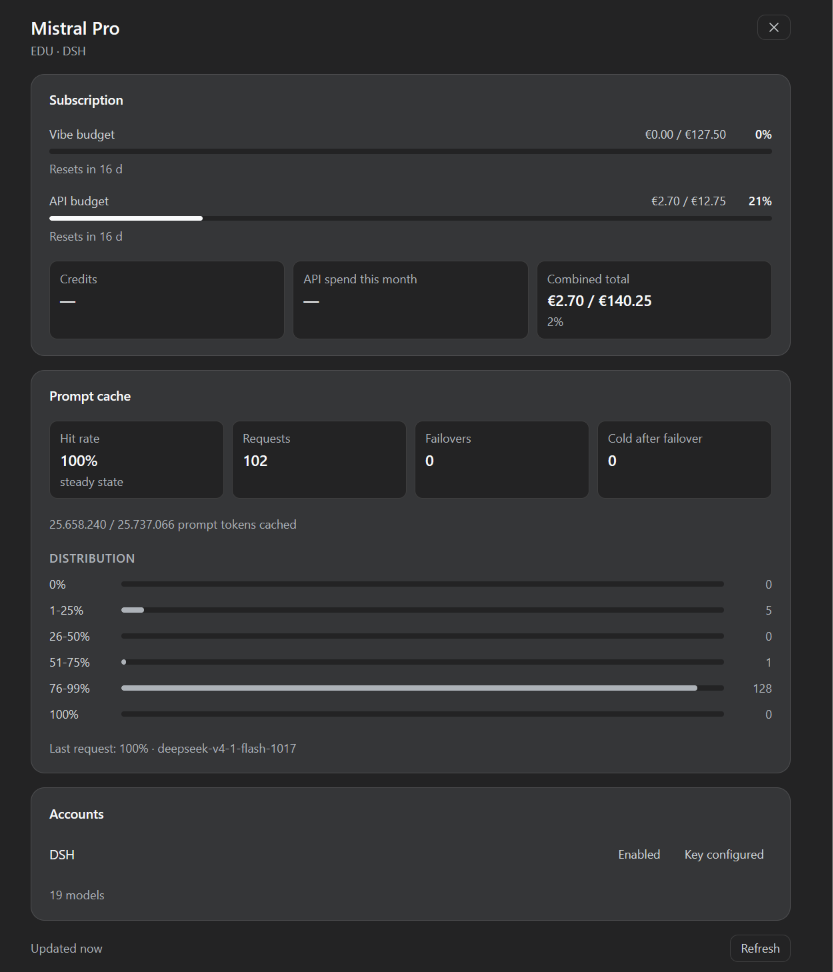
The plugin adds a card to the sidebar footer, beside Settings. It shows one combined figure for the two
Mistral wallets — the Vibe budget and the API budget — with a two-colour bar: grey for Vibe, the primary
text colour for API. The percentage is the shared consumption (used / total across both budgets), so it
no longer reads 0% while the API wallet is being spent.
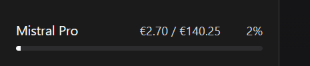
Clicking the card opens the statistics panel:
The cache card replaces the six per-range distribution rows with a stacked mix bar (one segment per range,
with a compact counter legend), a sparkline with one thin bar per request over the last 20 (height is the
hit rate, colour is the range, the tooltip shows model and percentage), and a one-line summary such as
18 of 20 requests ≥ 76% · 2 cold starts. The remaining cache figures are unchanged.
Visibility follows Settings → Mistral Pro → Usage → Sidebar card visibility: auto shows the card when
an account is configured, always pins it, and off hides it. Background tabs pause polling and refresh
immediately when brought back into focus.
Usage comes from api.mistral.ai/v1/billing/budget, read with the API key you saved. No extra setup is
needed. The endpoint returns the Vibe and API monthly budgets: percentage used, budget amount, and reset
time.
If the key lacks the usage permission (the billing endpoint answers 403), you can use an admin-site cookie instead:
admin.mistral.ai, and copy the full Cookie request
header. It must include ory_session_* (if csrftoken is present, the plugin sends X-CSRFTOKEN
automatically).The cookie path queries GET /subscription, GET /api/billing/v2/usage?month=&year=, and
GET /api/billing/credits independently, so a failure on one endpoint won't block the others. If the
session expires and redirects to the login page, the panel prompts you to update the cookie.
The llm service passes session messages to the adapter, which formats them into OpenAI-compatible
payloads, POSTs to https://api.mistral.ai/v1/chat/completions, and parses the SSE response into DSH
StreamChunks. Assistant reasoning history is replayed back as thinking chunks as required by Mistral's
API.
Account failover only triggers before the stream emits content:
The adapter follows DSH's stream contract on the way back:
function.name is
accepted — Mistral repeats function.name: "" on every chunk of a streamed tool call.block-start is emitted per block, so the live thinking panel does not collapse while
streaming.id is always a string on tool-call-delta.TRANSPORT instead of ending the turn "successfully" with partial output.max_tokens cap is injected by default (advanced.maxTokensCap is 0): reasoning shares the
completion budget, so a cap that looks generous for text can be consumed by thinking alone.Mistral's prompt caching reuses
previously computed prompt tokens when requests share the same prefix. Cached tokens are billed at 10%
of the standard input price and are reported in usage.prompt_tokens_details.cached_tokens.
Two facts from the documentation drive every decision here:
prompt_cache_key is a routing hint. It "increases the chance of a cache hit, but doesn't guarantee
one" — a hit happens when the API finds a compatible cached prefix. The key does not create the cache;
prefix stability does.cached_tokens is always a multiple of 64, and prompts under 64 tokens
never hit. Longer shared prefixes reuse more.What the plugin does to keep the prefix stable:
thinking blocks, so the prefix stays
byte-identical between turns.sanitizeMessage), deterministically, so a foreign field can never
change the prefix on one turn and not the next.stream_options.include_usage, without which cached_tokens would never be reported at all.advanced.promptCacheKey selects the key:
| Value | Key derivation | Best for |
|---|---|---|
auto (default) |
model + system prompt + first user message | One long conversation: every appended turn keeps the same key. |
shared |
model + system prompt only; falls back to auto when the session has no system/developer message |
Many short conversations that reuse the same (large) system prompt: the first turn of a new conversation can still hit the cached system-prompt prefix. |
off |
field omitted | Providers or proxies that reject the field. |
| any other string | sent as-is | Managing keys externally (one per workflow, team, or subscription). |
auto and shared are a trade-off, not a ranking. auto isolates conversations, which is what Mistral
recommends ("use a stable application-level identifier, such as a conversation ID"). shared gives up that
isolation so separate conversations can reuse the system prompt. The provider still verifies prefix
compatibility, so a shared key can only miss — it can never return another conversation's content.
With no leading system or developer message there is no shared prefix to reuse, so shared falls back to
the per-conversation auto key instead of emitting a model-only key that every conversation on the model
would share.
A compaction rewrites the conversation prefix, so the derived key (auto and shared) rotates once per
compaction: the newest compactionId from DSH's compaction checkpoint is mixed into the hash, giving the
rewritten prefix a clean cache entry instead of filing it under a key that pointed at the old prefix.
Sessions that never compact are unaffected — their key derivation is byte-identical.
The plugin also sends an x-affinity header with the same value as the cache key. The header is
undocumented: Mistral's prompt-caching documentation does not mention it, but Mistral has stated that
its API "uses it for cache routing ahead of prompt_cache_key"
(mistral-vibe#1481), and
Vibe derives it from its session family's root id. An A/B run against the live API measured no difference
in cache hits (7/8 with the header vs 8/8 without; the only miss was the first, cold call), and Mistral
separately acknowledged serving-side cache misses that no client change can fix
(#1512). Treat it as a hint that may help, not a
guarantee that requests land on the same server. cache.affinity and cache.reportUsage can be turned off
independently; turning off reportUsage also costs you the cache-hit numbers.
To see what actually happened, GET /plugins/dsh-mistral-pro/wire?limit=20 returns the request and
usage entries of the recent requests. The usage entry carries promptTokens, cachedTokens, the
serving account, a conversation digest and an affinity digest. The affinity digest is taken from the
x-affinity header that was actually placed on the request, not from the setting that was expected to
produce it, and it is omitted when no header was sent. While the adapter sends the cache key as the
affinity, the two digests are equal; they diverge the moment the two identities do.
The request entry carries prefixRelation and prefixReused, the only client-side signal that can tell
normal append-only growth from a rewritten prefix. prefixRelation is one of:
| Value | Meaning |
|---|---|
first |
No earlier request of this session was observed in this process (first turn, plugin reload, or the session was evicted from the bounded cache). |
append |
The whole previous message list matched the head of a longer current list. Verified even when the current list exceeds the comparison cap, because every previous message was retained and compared. |
repeat |
Both message lists were fully retained and are identical. |
rewrite |
A divergence was found inside the compared range, or the whole current list matched the head of a longer previous list (a truncation). |
unknown |
The compared range matched, but at least one list extends beyond the comparison cap, so the unexamined suffixes could still differ. Equality is never assumed for messages that were not compared. |
prefixReused is how many leading messages are byte-identical to the previous request, so rewrite with
prefixReused: 1 means only the system message survived. The comparison is bounded and in memory: it
covers at most the first 512 messages of a session and the 32 most recently used sessions, it keeps only
one digest per message, and it never writes message content anywhere. It is also process-local: after a
restart the first observed request is first.
The identity is DSH's session id only. A prompt-cache key is never used as a substitute: shared mode and
custom keys are designed to be shared across independent conversations, so comparing them would invent
relationships between unrelated sessions. A request without a session id carries no relation, and
auxiliary calls (session title, compaction, auto-review) are not part of the conversation's message
sequence, so they carry none either and do not disturb the next comparison.
The observer is only updated for a request that actually reaches the outbound transport: a call that fails first (missing credentials, an already-aborted request, a transport that cannot be prepared) is not observed, while a request that reaches the transport counts as attempted even if the transport then fails. One logical request is observed once, even when it fails over between accounts.
This compares the wire messages list only. It does not cover tools, tool_choice, temperature,
max_tokens or any other request field, and it says nothing about tokenization, the provider's cache
placement or routing. append therefore means "the messages this client sent are an append-only extension
of the previous message list", not "the complete effective prompt and every cache-relevant input are
unchanged". A hit rate near 0% with prefixRelation: append usually means the prompt is under 64 tokens,
the cache expired between turns, the provider missed on its side, or a non-message request field changed.
GET /plugins/dsh-mistral-pro/cache reports the whole-log requests, promptTokens, cachedTokens and
hitRate, plus the views that answer "why is it low":
steadyState — the same numbers without the first observed request of each prompt-cache-key digest in
the retained window. That group is a cache-key family, not necessarily one conversation: shared and
custom keys can span independent conversations. The excluded request is not necessarily a real cold
start, and the figure is neither a lifetime metric nor a guaranteed warm-conversation hit rate;steadyStateByRoute — the same numbers without the first request of each
(account, model, affinity, prompt-key) route. A hit also needs the same serving account, the same model
and the same effective affinity, so an account failover, a model change, a key rotation after compaction
or a new affinity is a cold start even when the conversation itself is warm. The model is part of the
identity because a custom prompt_cache_key does not carry it. This is the honest number when you switch
accounts; steadyState keeps its original prompt-key-only meaning;window — the retained log window the figures were computed over (maxLines, entries). Every rate
here is relative to that window: the request a steady-state view drops is the first one still visible, not
necessarily a real cold start, and a route may have been warm long before its earlier entries rotated out;distribution — how many requests landed in each per-request hit-rate bucket (0, 1-25, 26-50,
51-75, 76-99, 100);byAccount, byModel, byAffinity — the same totals per serving account, per model and per affinity
digest, busiest first, with a null group for requests that carried no label;failovers and coldAfterFailover — account switches and the cold request that follows one: prompt
caches are per account, so that miss is expected;recent — the 20 newest requests with their account, affinity and conversation digests.Only completed responses whose supplier reported usage are recorded, so an interrupted stream is absent from every figure instead of being counted as a zero-cache request.
Reading the numbers, in order:
hitRate with a high steadyState usually means cold starts, not a broken cache.steadyState but a low steadyStateByRoute is account failovers or key rotations — look at
coldAfterFailover and at byAccount.byAccount entry with the others healthy means that account's traffic is missing; the plugin is
not rewriting anything.prefixRelation: append (or unknown once the
conversation exceeds the comparison cap) on the missing turns in /wire, points at provider-side
eviction — the case Mistral acknowledged in #1512. No client setting fixes it. A rewrite instead means
this client changed the prefix, and that is actionable.DSH counts token usage in disjoint buckets: inputTokens is uncached input, cacheReadTokens is the
cached prefix, and the billed prompt is their sum. Mistral folds the cached prefix into prompt_tokens, so
the adapter subtracts it before reporting. The /cache route keeps reporting the total prompt count, so
its hitRate stays cachedTokens / promptTokens.
auto / always / off), refresh interval, credit balance,
prompt-cache section, and the optional admin cookie.cache.affinity, on by default): sends the cache key as x-affinity; an
undocumented, unverified cache-routing hint (see Prompt caching).cache.reportUsage, on by default): sends
stream_options.include_usage; turning it off also hides the cachedTokens counts.usage.showCache, on by default): the statistics-panel section that
reads /cache and shows the rate, the mix bar, the sparkline, the summary line and the last request.advanced.transport, default https): https posts the serialized body over
node:https; fetch routes through globalThis.fetch so in-process wrappers can see and rewrite
the request.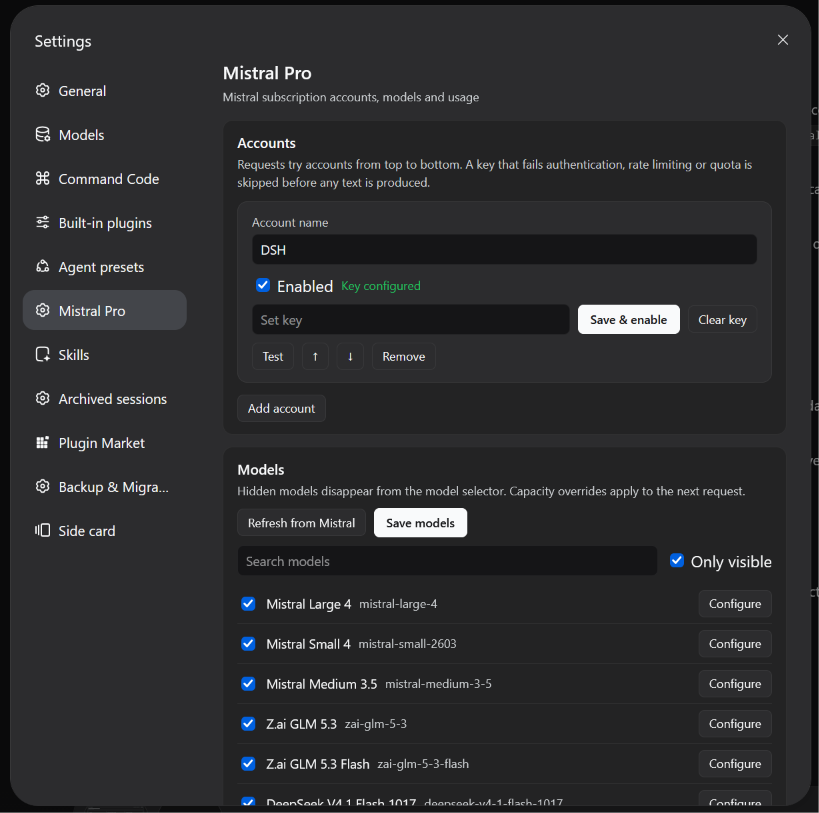
All settings take effect immediately without restarting the plugin.
Same-origin read-only routes registered for troubleshooting:
| Route | Description |
|---|---|
/plugins/dsh-mistral-pro/health |
account status, registered providers, model count |
/plugins/dsh-mistral-pro/meta |
active usage / advanced / accounts configuration |
/plugins/dsh-mistral-pro/models |
model catalog, visibility, limits, reasoning options |
/plugins/dsh-mistral-pro/usage?account=&force=1 |
aggregated usage snapshot |
/plugins/dsh-mistral-pro/test?account= |
run a /v1/models check against a specific account |
/plugins/dsh-mistral-pro/refresh |
force a live model catalog refresh |
/plugins/dsh-mistral-pro/settings |
settings namespace and revision |
/plugins/dsh-mistral-pro/wire?limit=20 |
newest wire fingerprints, per-message key layout, cache usage, conversation id, prefix digest and serving account |
/plugins/dsh-mistral-pro/cache |
aggregate, steady-state and route-aware hit rates over the retained log window, per-account / per-model / per-affinity breakdowns, per-request distribution, failover counts, and the 20 newest usage entries |
The chat request is posted over node:https with the body the adapter already serialized, not through
globalThis.fetch.
Proxy plugins replace globalThis.fetch and re-serialize request bodies on the way out. billion-context's
ACP loop, for one, adds reasoning_content: "" to every assistant tool-call message whenever the model id
matches /deepseek/i — and deepseek-v4-1-flash-1017 does. Mistral forbids that field on assistant
messages, so the rewrite turns every turn after the first tool call into 422 extra_forbidden. node:https
cannot be patched by another plugin in the same process, so the bytes the adapter builds are the bytes that
leave the machine.
DSH_MISTRAL_TRANSPORT=fetch restores the old path; use it only when no wrapper rewrites bodies.advanced.proxy always uses fetch + undici ProxyAgent, because that path needs the
dispatcher.Every request appends one line to %TEMP%\dsh-mistral-wire.log (override with DSH_MISTRAL_WIRE_LOG):
model id, message count, each message's role and keys, how many messages carry reasoning_content, the
serving account, a 16-hex digest of the exact x-affinity value placed on the request (omitted when no
header was sent), prefixRelation and prefixReused (omitted when there is no conversation identity to
compare), and a 16-hex SHA-256 of the serialized body. A second usage line records promptTokens,
cachedTokens, the serving account, the conversation digest, the affinity digest, messages and
sha256; an account switch appends a failover line with from, to and the failure code. The log is
trimmed to 400 lines and a logging failure never interrupts a call. Only a completed response whose
supplier reported usage produces a usage line, so an interrupted stream leaves no zero-cache record
behind. Every aggregate on /cache is computed over that retained window, which window reports.
The log is created with mode 0600: %TEMP% is usually /tmp (1777), and the entries are prompt
metadata. If an older version left the file world-readable, the next write tightens it to 0600, and
rotation keeps that mode.
Yes. The same API key works across Free, subscription plans, and pay-as-you-go. Requests consume your monthly plan allowance first and fall back to pay-as-you-go billing after that.
The Vibe key is in ~/.vibe/.env after vibe --setup, or under Code › Extensions → Advanced → Vibe API
Key. The Studio key comes from the Mistral admin under API › API Keys. Paste either one into
Settings → Mistral Pro → Keys — see Two keys.
Yes. Streamed tool calls are accumulated across continuation chunks, assistant reasoning is replayed as
thinking blocks, and image inputs use DSH's attachments service (falling back to placeholder text when
that service is unavailable).
Usually one of three things: the prompt is under 64 tokens, the cache expired between turns, or something
upstream is rewriting the first messages. Check /plugins/dsh-mistral-pro/wire?limit=20 for the per-request
cachedTokens and prefixRelation, and /plugins/dsh-mistral-pro/cache for the steady-state rate, the
route-aware rate and the per-account breakdown — a low whole-log rate with a high steady-state rate means
cold starts, not a broken cache; a healthy steadyState with a low steadyStateByRoute means account
failovers, model changes or key rotations; a low rate in every account with prefixRelation: append is
provider-side eviction, which no plugin setting can fix. A prefixRelation: rewrite is the one case this
client can act on: something changed the messages it sends.
No. Chat requests go only to the configured Mistral API endpoint, catalog refreshes send only the API key
and User-Agent, and usage queries go to admin.mistral.ai with the cookie you provide. Keys and cookies
stay in the host credential store; the browser only sees whether a credential is set.
01NGVI-QINGYI/dsh-mistral-pro?Upstream stopped at 0.1.2. This fork merges the two independent fix lineages built on top of it, adds CI
and regression suites, and ships the native node:https transport, prompt-cache key modes, the sidebar usage card, the statistics
panel and the diagnostic routes. Version numbers are not comparable between the two repositories — see
Fork lineage.
User-Agent.admin.mistral.ai (configurable) using the cookie you provide./v1/billing/budget and admin usage endpoints are undocumented. The plugin reads them by field name,
so upstream schema changes may hide individual windows.prompt_cache_key and x-affinity are hints, not guarantees: a stable prefix and a stable affinity can
still miss after the provider's cache expires, prompts under 64 tokens never hit, and Mistral has
acknowledged serving-side cache misses (mistral-vibe#1512)
that no client change can fix.prefixRelation is a process-local comparison: it covers the first 512 messages of a session and the 32 most
recently used sessions, reports unknown when either list extends past that cap, and reports first for the
first request after a plugin restart. It describes the messages this client sent, not the provider's tokenized
prefix or cache state.steadyState and steadyStateByRoute are calculations over the retained 400-line log window, not lifetime
counters: the request they drop is the first one still visible, which may already have been warm.attachments service and fall back to placeholder text if unavailable.undici to be resolvable in the host environment; otherwise proxied requests fail
with an explicit error.npm test # every test/*.mjs suite, no network, no keys
npm run check # node --check over every shipped JS file
node test/tool-name.mjs # or run a single suite directlyTests run against a local mock HTTP server simulating Mistral SSE streams, with no external network calls and no API keys.
01NGVI-QINGYI 0.1.2 (263a4f0)
├── santera-pixel 0.2.0 … 0.2.4
└── upstream issue #1 patch series 0.1.3 … 0.1.8
        └── this fork 0.3.0 → 0.4.0
This fork tracks upstream 01NGVI-QINGYI/dsh-mistral-pro
by cherry-picking concrete fixes — never by merging upstream main, which would revert the 0.2.x/0.3.0 work.
Add the remote once and inspect what is new:
git remote add upstream https://github.com/01NGVI-QINGYI/dsh-mistral-pro
git fetch upstream --depth=50
git log --oneline upstream/main
The two 0.x lines are independent: a higher number in one repository does not mean a newer tree in the
other. See CONTRIBUTING.md for the merge policy, the version policy and how to record a
sync in CHANGELOG.md.
MIT · originally by 01NGVI-QINGYI, fork maintained by lordraiden.
CLASSIFICATION EVIDENCE
系统优先读取 GitHub Topics,再与站内分类词典和词根规则比对。当前命中: llm、deepseek、llm-provider、deepseek-harness。
morluto
Reverse engineer anything with agents, from app behavior down to native binaries.

deepseek-ai
DeepSeek Harness: Everything is a Plugin.

nexu-io
The 1st Collaborative AI Design Agent Workspace. Local-first and open source. Create motion, prototypes, websites, apps, dashboards, presentations, images, and videos with your team and AI agents. Share work, exchange feedback, and iterate together in one workspace.