
其他
完整应用

deepseek-harness
deepseek-ai
DeepSeek Harness: Everything is a Plugin.
PROJECT TOPICS
INSTALL REFERENCE
dsh plugin --profile web add github:linziyanleo/dsh-custom-provider
该命令指向仓库当前默认分支;尚无绑定当前 commit 的完整验证结果。
PROJECT README
A DSH plugin for configuring static provider routes and model catalogs from the Web settings UI or settings.yaml. Each route can use OpenAI Chat Completions, OpenAI Responses, or Anthropic Messages.
A model endpoint may need more than a base URL and an API key: its wire protocol must be selected, its model catalog may be known in advance, model capacities may need to be declared explicitly, and request fields for reasoning or message replay may differ between providers.
dsh-custom-provider turns that information into provider routes that DeepSeek Harness (DSH) can use directly. Configured models appear in DSH's native model picker and continue through its standard streaming, tool-call, usage, finish-reason, cancellation, and reasoning-effort flows.
openai-completions, openai-responses, and anthropic-messages.llm-custom.providers configuration for settings.yaml./models endpoint.settings.yaml.Install the published package directly into the DSH Web profile:
npx @deepseek-ai/dsh plugin --profile web add @linziyanleo/dsh-custom-providerVerify that DSH loads the bundle and its configuration namespace:
npx @deepseek-ai/dsh --profile web --dump-configPin a package version for reproducible installations, for example @linziyanleo/dsh-custom-provider@0.1.1.
^22.19.0 or >=24.0.0 (minimum verified version: 22.19.0)0.1.0-rc.7 compatible packages; see peerDependencies for the complete contractProvider credentials, endpoints, models, capacities, and advanced compatibility fields can be managed in DSH Web.
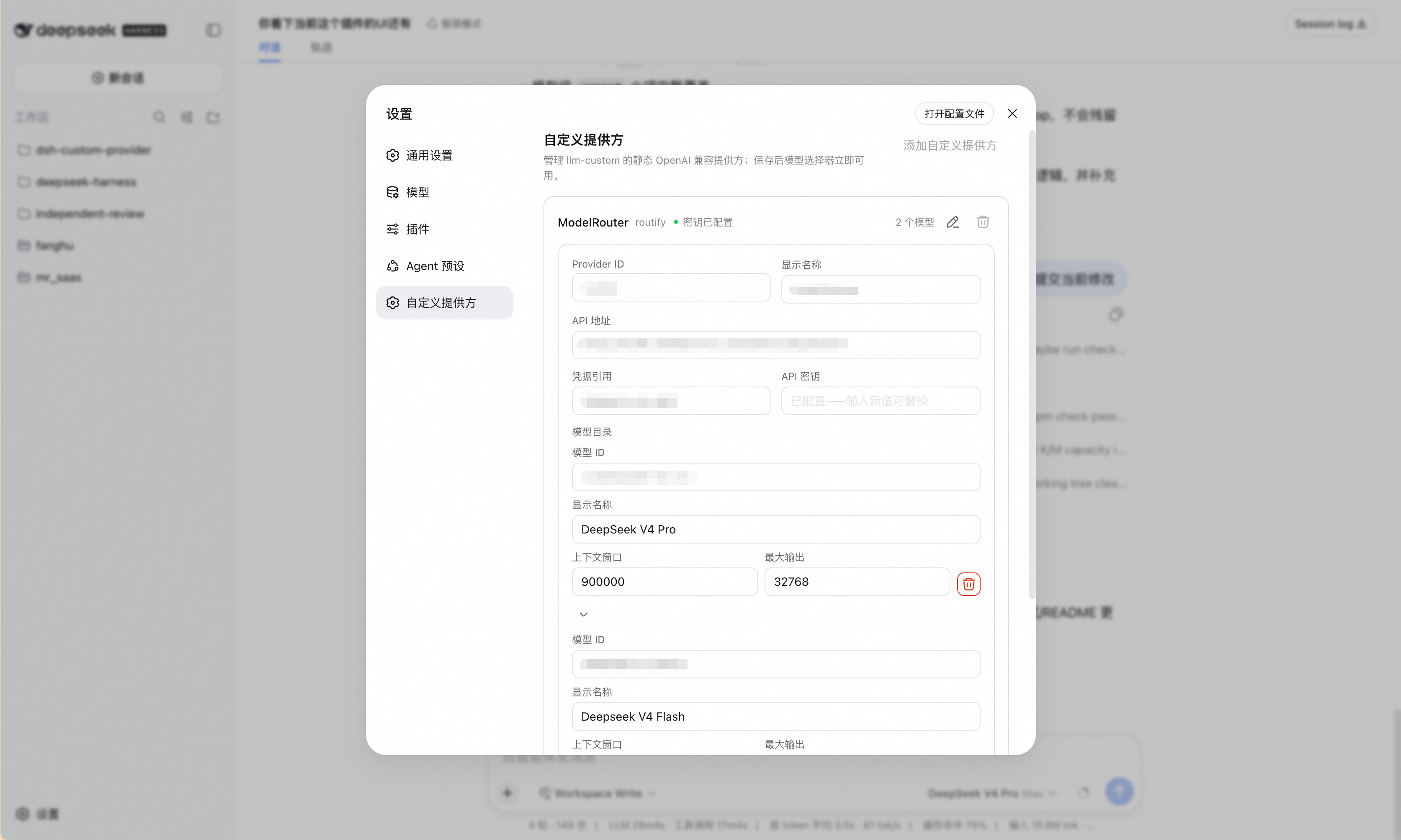
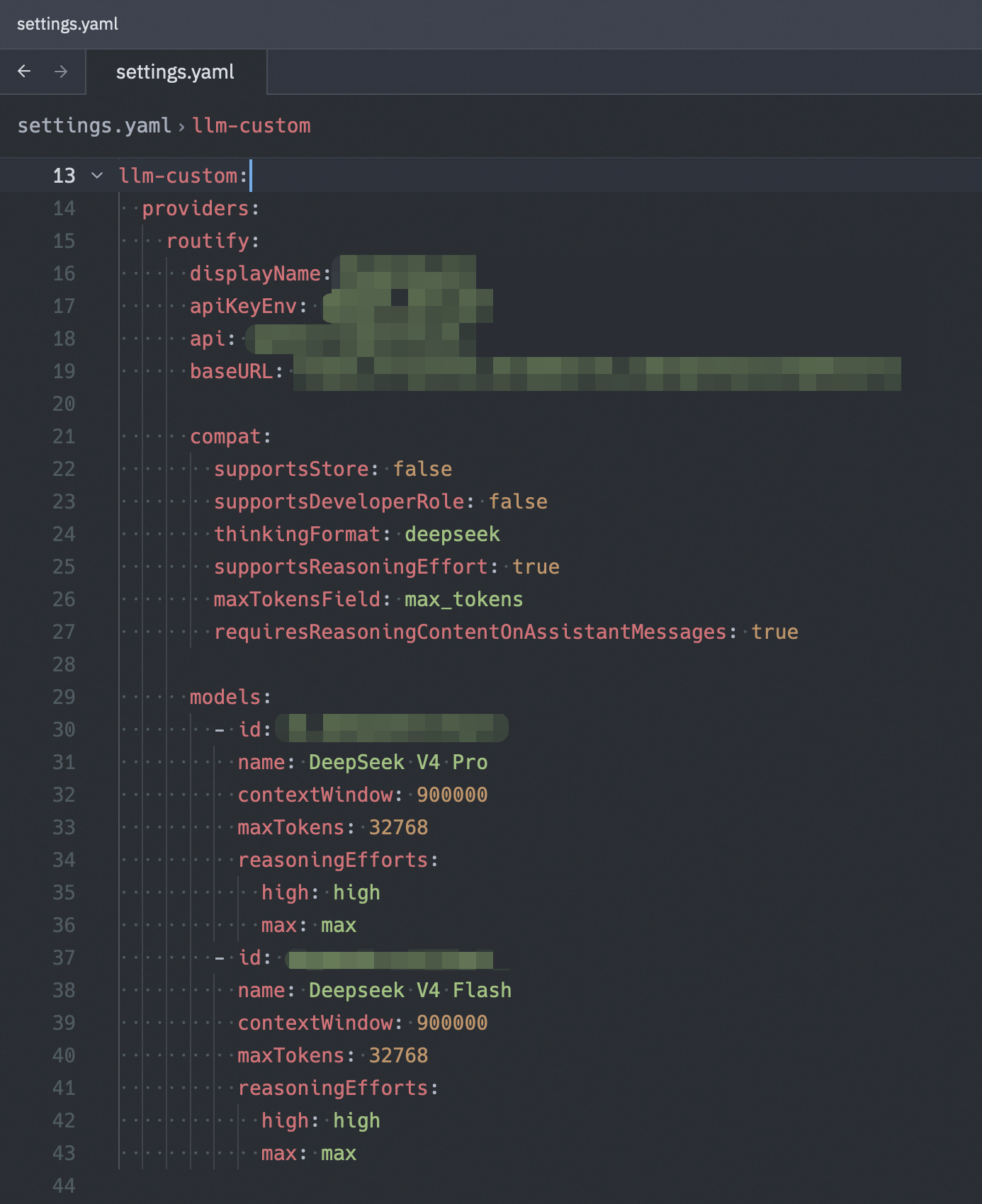
The same provider and model catalog can be managed directly in settings.yaml.
Open Settings → Custom Providers in DSH Web, then:
K/M suffixes such as 200K or 1m.settings.yamlllm-custom:
providers:
example:
displayName: Example Provider
apiKeyEnv: EXAMPLE_API_KEY
api: openai-completions
baseURL: https://api.example.com/v1
compat:
supportsStore: false
supportsDeveloperRole: false
thinkingFormat: deepseek
supportsReasoningEffort: true
maxTokensField: max_tokens
requiresReasoningContentOnAssistantMessages: true
models:
- id: example-model
name: Example Model
contextWindow: 262144
maxTokens: 32768
reasoningEfforts:
off:
high: high
max: maxapiKeyEnv is a credential reference, not the secret itself. Configure its value through DSH's credentials service or the Web settings page.
The plugin passes baseURL to the selected protocol adapter. Configure the URL at the level expected by that adapter:
api |
Request path appended by the adapter | Typical baseURL |
|---|---|---|
openai-completions |
/chat/completions |
https://api.example.com/v1 |
openai-responses |
/responses |
https://api.example.com/v1 |
anthropic-messages |
/v1/messages |
https://api.example.com |
For a compatible gateway, choose the base URL that makes the resulting request path resolve on that gateway. The plugin normalizes trailing slashes but does not probe or rewrite endpoints.
To use OpenAI Responses, change the route protocol while keeping an OpenAI-style /v1 base:
api: openai-responses
baseURL: https://api.example.com/v1
To use Anthropic Messages, use the endpoint root before /v1/messages:
api: anthropic-messages
baseURL: https://api.example.comEach key below is relative to llm-custom.providers.<provider-id>.
In the Web UI, a provider ID must start with a lowercase letter and contain only lowercase letters, digits, and dashes.
| Field | Required | Description |
|---|---|---|
displayName |
No | Name shown in the model picker. Defaults to the provider ID. |
apiKeyEnv |
Yes | DSH credential reference resolved before every request. |
api |
Yes | Wire protocol: openai-completions, openai-responses, or anthropic-messages. |
baseURL |
Yes | Absolute HTTP(S) base URL at the level expected by the selected protocol. Trailing slashes are normalized. |
compat |
No | Chat Completions compatibility defaults inherited by every model on the route; rejected for other protocols. |
models |
Yes | Static model catalog containing at least one model. Model IDs must be unique within the provider. |
| Field | Required | Description |
|---|---|---|
id |
Yes | Model ID sent to the provider. |
name |
No | Name shown in the model picker. Defaults to id. |
contextWindow |
Yes | Positive integer context-window size in tokens. |
maxTokens |
Yes | Positive integer maximum output size in tokens. |
reasoningEfforts |
No | Selectable DSH reasoning levels mapped to provider wire values. Set to false to disable the reasoning control. |
compat |
No | Per-model Chat Completions compatibility values; rejected for other protocols. Each declared field overrides the provider-level value. |
For openai-completions, compat accepts the same fields at provider and model level. These fields are not part of OpenAI Responses or Anthropic Messages routes, and the Web UI removes them when a route switches away from Chat Completions.
| Field | Values | Effect |
|---|---|---|
supportsStore |
true / false |
Whether the request may send the OpenAI store parameter. |
supportsDeveloperRole |
true / false |
Whether system prompts may use the developer role. |
thinkingFormat |
openai, deepseek, openrouter, together, zai, qwen, string-thinking, ant-ling |
Reasoning-content format understood by the endpoint. |
supportsReasoningEffort |
true / false |
Whether the request may send a reasoning-effort parameter. |
maxTokensField |
max_completion_tokens / max_tokens |
Request field used for the maximum output limit. |
requiresReasoningContentOnAssistantMessages |
true / false |
Whether replayed assistant messages retain reasoning_content. |
Only declare compatibility fields required by the endpoint; omitted model fields inherit the provider-level values.
The supported DSH levels are off, minimal, low, medium, high, xhigh, and max. A mapping value is the exact string expected by the provider. Only off may be empty (null in YAML), and a mapping must expose at least one non-off level. Omitted levels are unavailable in the picker.
reasoningEfforts:
  off:
  medium: medium
  high: high
Use reasoningEfforts: false when the model does not provide a reasoning control.
baseURL using the selected protocol.llm-custom settings and referenced DSH credentials.llm-custom settings section.llm-custom section. Remove those separately when they are no longer needed.npx @deepseek-ai/dsh plugin --profile web remove @linziyanleo/dsh-custom-providerThe uninstall command removes the plugin bundle only. See the lifecycle notes above for settings and credential cleanup.
pnpm install --frozen-lockfile
pnpm check
pnpm check runs the offline test suite, server and client type checks, the production build, and a client-bundle assertion. Live-provider acceptance is intentionally opt-in and is not part of the default check.
Pushes to main are published only after the matching CI run succeeds. The publish workflow treats the version declared in package.json as a minimum: it uses that version when it is newer than npm, otherwise it increments the latest published patch version. prepublishOnly repeats the complete check and validates the package contents before npm accepts the release.
CLASSIFICATION EVIDENCE
系统优先读取 GitHub Topics,再与站内分类词典和词根规则比对。当前命中: 无有效分类标签。
deepseek-ai
DeepSeek Harness: Everything is a Plugin.

anywhere-labs
为 DeepSeek Harness (DSH) 插件生态打造的现代化桌面端解决方案。万物皆「插件」,桌面本身也是「插件」。

walkinglabs
Harness engineering beginner tutorial, from 0 to 1