

文件与数据
渠道适配

WeKnora
Tencent
Open-source LLM knowledge platform: turn raw documents into a queryable RAG, an autonomous reasoning agent, and a self-maintaining Wiki.
PROJECT TOPICS
INSTALL REFERENCE
dsh plugin --profile web add github:linkingoscar/dsh-attachment-formats
该命令指向仓库当前默认分支;尚无绑定当前 commit 的完整验证结果。
PROJECT README




English | 中文
DeepSeek Harness plugin (
dsh-plugin) for the Web GUI —dsh plugin addone-liner. Makes the composer accept PDF, Office (docx/xlsx/pptx), TIFF, epub/odt/rtf, long-document text and scanned-PDF OCR, Codex-style. Keywords:dsh,deepseek-harness,cordis,pdf-extraction,tesseract,deepseek-vision,files-api.
A DeepSeek Harness web plugin (dsh-plugin, Cordis) that
makes the composer accept many more attachment formats, Codex-style. Zero core-package
changes: a pure plugin that reuses the harness-native image draft rail, upload limits,
history rendering and model request pipeline.
# one-liner (GitHub)
dsh plugin --profile web add github:linkingoscar/dsh-attachment-formats
# alias (npm, when published)
dsh plugin --profile web add dsh-attachment-formats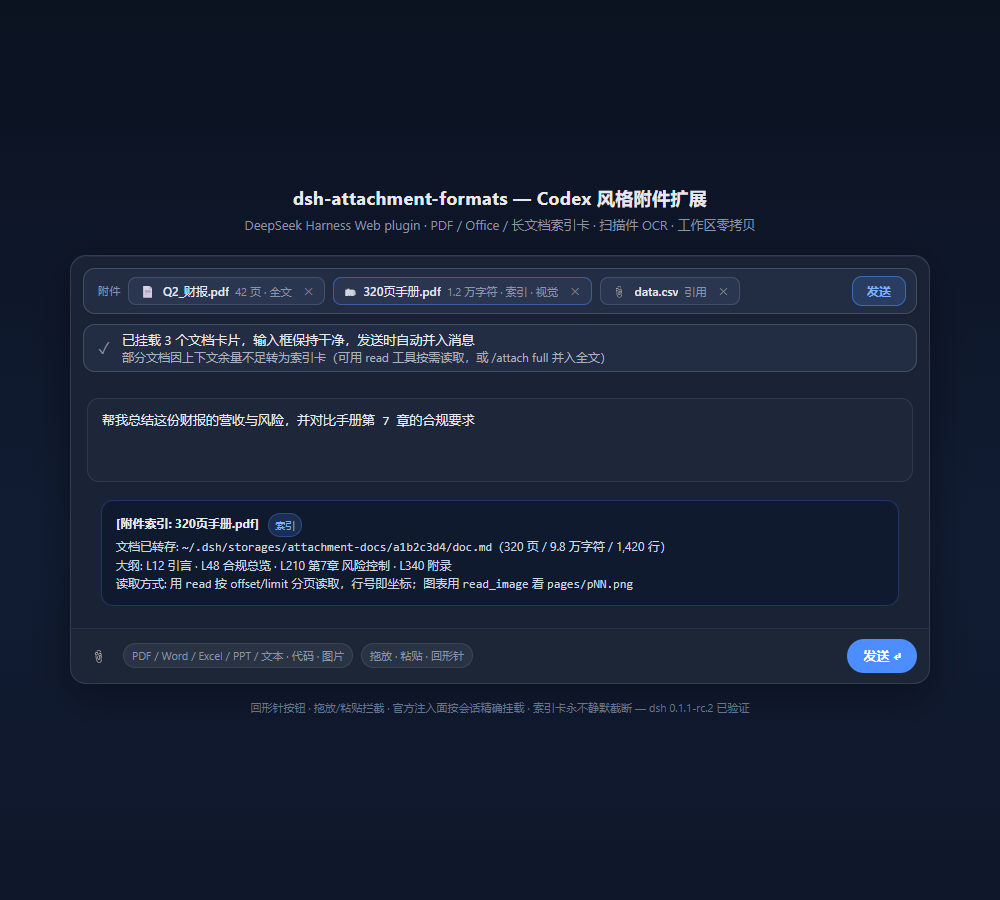
Paperclip button · drag & drop / paste · official per-session injection · index-card never silently truncated — captured via Playwright against a local mock of the composer.
| File | Handling | Destination |
|---|---|---|
| PNG / JPEG / WebP / GIF | native pipeline (plugin not involved) | image draft rail (native) |
| PDF (with text layer) | text-layer extraction (≤40 pages via the pymupdf4llm high-fidelity engine; larger/unavailable falls back to pdfjs) | full text on a document card (merged on send); over-limit → workspace spill + index card |
| PDF (scanned / no text layer) | tesseract.js OCR (accepted only at confidence ≥45), falls back to page images | OCR success → text channel; failure → image draft rail (vision models only) |
| Word (.docx) / Excel (.xlsx) / PPT (.pptx) | text extraction — docx via mammoth HTML → turndown, tables kept as Markdown pipe tables | document card (merged on send); over-limit → spill + index card |
| Legacy .doc / .xls / .ppt | LibreOffice headless → docx/xlsx/pptx → standard Office pipeline (needs soffice; clear error when absent) |
document card (merged on send) |
| epub / odt / rtf | pandoc → Markdown (probe on PATH); epub/odt fall back to jszip+turndown without pandoc; rtf requires pandoc | document card (merged on send) |
| TIFF (.tiff/.tif) | sharp (libvips) → PNG pages (multi-page, ≤20) | native image draft rail |
| txt / md / json / code | read in the browser (UTF-8, GB18030 fallback) | document card (merged on send); over-limit → spill + index card |
| BMP / ICO / AVIF / SVG etc. | browser decode → canvas → PNG | native image draft rail |
| iWork / audio-video / archives | no conversion; passed to native upload | native file attachment (dsh 0.1.3+) |
Text-like attachments that are dragged in or picked are not stuffed into the input
box: their content mounts as a document card above the composer (file name +
character count + full-text/index label, individually removable), while images keep
flowing into the native image draft rail. You type normally, and at the moment of
sending the plugin merges the card content into the message (with
[attachment: <file name>] provenance markers) before the native submit — your prompt
always stays on top and no content is lost:
Text beyond 80k characters and long multi-page PDFs are not stuffed into the message. Instead:
.dsh-attachments/<sha-16>/
(content-addressed, reused on re-drop, auto-cleaned after ~7 days of no access):doc.md — PDF text layer assembled per page (leading <!-- pN --> markers),
Office-extracted text, long text as-is (long JSON is prettified to doc.json);pages/pNN.png — rendered page images (≤100 pages, for vision models via
read_image; rendered lazily, only when the index-card path needs them);manifest.json — source, page/line/char counts, engine, full source SHA-256
and the converter-policy fingerprint (engine/OCR/doc-server switches invalidate
the cache automatically);INDEX.md (cache root) — the aggregated list of every spilled document in this
workspace.read tool (offset/limit, line numbers
as coordinates) — full summaries read through (no dropped tails), targeted lookups
jump by outline; missing content is an explicit tool failure, never silent loss.Design rationale and evidence: docs/design-longdoc.md; comparison with similar work:
docs/alternatives.md. Upgrades for current limitations (researched GitHub solutions
and v0.6 roadmap): docs/upgrade-v6.md.
auto (default) → the venv's pymupdf4llm for ≤40 pages
(high-fidelity tables/headings); pdfjs (seconds) for larger documents or when the
venv is missing. Env: DSH_ATTACH_ENGINE=auto|python|builtin.vendor/tessdata/).
Confidence below 45 falls back to page images with a clear reason. Env:
DSH_ATTACH_OCR=auto|baidu|tesseract-js|off (see below).soffice, probed on PATH plus
the usual Windows install locations) converts to the modern OOXML format first, then
the standard Office pipeline runs. Each run uses an isolated UserInstallation
profile to avoid lock conflicts.get_toc / pdfjs getOutline) now feed the index
card's outline first; the font-size heuristic is only the fallback. Empty-bookmark
PDFs are unaffected.BAIDU_OCR_API_KEY / BAIDU_OCR_SECRET (console → 文字识别 → create app);DSH_ATTACH_OCR=auto|baidu|tesseract-js|off (auto = Baidu when credentials
exist, else local tesseract.js);DSH_ATTACH_OCR_ACCURATE=1 for the high-accuracy endpoint (separate free
quota).
Quota exhausted / API failure → automatic fallback to local tesseract.js with a
note; forced baidu mode reports the reason instead.DSH_ATTACH_VLM_BASE /
DSH_ATTACH_VLM_MODEL (+ optional DSH_ATTACH_VLM_KEY) point at any
OpenAI-compatible vision endpoint (olmOCR-2, GLM-4V, Qwen-VL…). Pages are
transcribed one by one via chat/completions. In auto, only the first configured
cloud provider receives a document; failure falls back to local tesseract.js.
Cross-cloud retry is explicit opt-in (DSH_ATTACH_CROSS_CLOUD_FALLBACK=1).get_drawings) — text-heavy manuals
skip the slow high-fidelity pass and go straight to the fast pdfjs engine, while
table/graphic-heavy documents still get pymupdf4llm. ≤40 pages are unchanged.DSH_ATTACH_DOC_SERVER=<base URL>
points at a parser service (PP-StructureV3 paddleocr serve, MinerU, or any
shim). Contract: POST {base}/convert with multipart field file →
{ "ok": true, "markdown": "..." }. When configured, PDFs go to the server
first; any failure falls through to the local engine chain.GET /api/attach-formats/cache + POST .../cache/delete + POST .../cache/clear.GET /api/attach-formats/resolve asks the host to confirm a
same-source file by name + size + full SHA-256 (bounded ~2.5s walk skipping
dependency dirs). A hit mounts a 📎 reference card — the content is not
uploaded (only the name, size and hash are sent); the model reads the path with
its read tool. A miss falls back to the normal upload pipeline. Files over 16MB
are rejected outright (no zero-copy attempt).contextPressure projection
(model context window × current usage); the full-text merge limit becomes
min(80k chars, headroom × 1.5) — when headroom is short, the card automatically turns
into an index card with a status-bar note, so merged content can never blow up the
context and get silently truncated by the API. A missing projection falls back to the
fixed 80k threshold./attach command (composer slash menu, host-registered):/attach list — list the spilled documents in this workspace (id/name/size/engine);/attach full <id|name> — merge the full text into model context as a next-step
message (takes effect on the next message, current turn untouched); 300k-char cap
with an explicit truncation notice — never silent loss. read still works afterwards
for line-precise lookup.conversation.input.left), opens a
multi-select file picker whose accept list covers every format in the table above.Batches containing only native images or unsupported conversion formats (such as ZIP) pass through to the host unchanged. Mixed batches convert supported formats and attach images and remaining files to the original session through its native interface; documents stay as cards. There is no global synthetic-drop fallback.
dsh-attachment-formats/
├── lib/
│   ├── index.js          # host half: POST /api/attach-formats/convert + engine routing
│   ├── client.js         # browser half: button/drop interception/scoped attachments/document cards/status bar
│   ├── cache.js          # workspace .dsh-attachments spill/manifest/INDEX.md/cleanup
│   ├── py/pymupdf4llm_convert.py  # venv high-fidelity engine (subprocess call)
│   └── convert/
│       ├── util.js       # magic-byte sniffing (pdf/tiff/OLE/rtf/zip), base64, truncation
│       ├── provider.js   # engine/binary detection (venv python, pandoc, LibreOffice) + subprocess bridges
│       ├── pdftext.js    # pdfjs text-layer extraction: line assembly/header-footer dedup/bookmark TOC
│       ├── outline.js    # md heading outline, JSON first-level key tree
│       ├── ocr.js        # tesseract.js OCR (traineddata download cache/confidence)
│       ├── pdf.js        # pdfjs-dist + @napi-rs/canvas → PNG/JPEG pages
│       ├── docx.js       # mammoth HTML → turndown+GFM → Markdown (tables preserved)
│       ├── xlsx.js       # exceljs → tab-separated text
│       ├── pptx.js       # jszip + a:t text runs → per-slide text
│       ├── tiff.js       # sharp (libvips) → PNG pages
│       ├── pandoc.js     # pandoc → Markdown + epub/odt zip fallback
│       └── libreoffice.js # legacy .doc/.xls/.ppt → modern OOXML
├── .venv/                # (optional) pymupdf4llm engine (generated by setup, not committed)
├── vendor/tessdata/      # OCR language-data cache (downloaded on first use, not committed)
├── docs/                 # design-longdoc.md / alternatives.md / upgrade-v6.md
├── scripts/smoke-*.mjs   # five offline smoke suites (converters/router/client/OCR/P0)
└── cordis.patch.ymlcwd is read by the client from session state and
sent with the request (it decides where the spill lands).ctx.get("conversation"). Converted images and
native files use createDrafts(sessionId, files) +
addAttachments(ids) on dsh 0.1.3+. Legacy image-only hosts use
createDraftImages + addImages. Both target the conversation where intake
started, even after navigation. Missing/rejected interfaces report an error;
the plugin never broadcasts a synthetic drop. Batches with no convertible files
pass through untouched; mixed batches convert supported formats and attach
remaining files through the original session’s native pipeline.setDraft, phase-gated: plain drafts only, command claims are
never polluted). Composer detection supports both the v0.1.1 textarea and the
v0.1.2 Lexical contenteditable; the textarea DOM bridge remains an older-host
fallback. The image path is fully independent and untouched.conversation.input.dock); success auto-hides after 6s, errors can be dismissed.normalizationPolicy.maxBytes) instead of the raw admission bound, so
rendered pages are not re-compressed a second time by the dsh ≥ v0.1.1
canonical image pipeline.Search:
dsh attachment·dsh pdf·dsh office·dsh ocr·cordis pdf plugin— this plugin answers those queries.
From GitHub (recommended, dsh-plugin topic for discoverability):
dsh plugin --profile web add github:linkingoscar/dsh-attachment-formatsFrom npm (when published, enables keywords:dsh-plugin search):
dsh plugin --profile web add dsh-attachment-formats
# or
npm install dsh-attachment-formats
Local development:
cd path\to\dsh-attachment-formats
npm install            # host dependencies (first time)
# optional: high-fidelity PDF engine (pymupdf4llm, self-contained venv)
python -m venv .venv
.\.venv\Scripts\python.exe -m pip install pymupdf4llm
npm run smoke          # offline smoke tests (optional)
dsh plugin --profile web add link:path\to\dsh-attachment-formats
Restart dsh web (close the page → the desktop shortcut auto-restarts, or re-run
dsh web) and refresh the browser. OCR language data downloads automatically on the
first scanned-PDF recognition (≈24MB, cached in vendor/tessdata/, offline-ready
afterwards).
docs/upgrade-v6.md)..doc/.xls/.ppt require LibreOffice (soffice); rtf requires pandoc;
epub/odt work out of the box but pandoc (if installed) gives better fidelity.
Missing binaries produce clear, actionable errors — nothing is silently dropped.v0.12.4 · 2026-09-28 — dsh v0.1.7-rc.2 compatibility: use the renamed
IconPaperclipOutlineRegular export while retaining the older icon fallback.
The compatibility gate renders the attachment button using the selected host's
actual icon name, so missing icons can no longer hide behind a tooltip stub.
Restart Harness after updating; existing settings and attachments are retained.
v0.12.3 · 2026-09-20 — dsh v0.1.6-alpha.2 compatibility: uploads, paste/drop, send, removal and preview target their own conversation pane. Conversions retain their original session until completion, and plugin disable cancels uploads and releases references. If the original pane closes before a native attachment is ready, the plugin reports a retry instead of claiming a discarded draft succeeded. Adds multi-pane and disable/re-enable regression checks. Restart Harness after updating; no settings migration is required.
v0.12.2 · 2026-09-11 — dsh v0.1.5-rc.2 compatibility: the card send button uses the
native composer keymap, preserving busy queue/steer preferences and upload gates.
DeepSeek OCR defaults to deepseek-flash; explicit model overrides remain valid.
Compatibility checks inspect production source at the requested tag.
All five smoke suites, type checking, lint and bundle consistency checks passed;
the pandoc and LibreOffice cases were skipped because those optional tools were
unavailable. Browser checks on a real 0.1.5-rc.2 host confirmed document-card
submission, busy queuing and steering with a local mock model. Cloud OCR default
selection and custom overrides were verified without paid API calls.
Restart Harness after updating; no settings migration is required.
v0.12.1 — compatibility with dsh v0.1.3-alpha.1: session-addressed
createDrafts / addAttachments / releaseDraftAttachments; ZIP and other
unsupported formats coexist with native upload, including mixed batches.
Removes global-drop fallback, preserves cards/progress/clipboard text across
session switches, and reports attachment rejection without claiming success.
The browser bundle also isolates its globals for host reloads.
v0.12.0 — raw binary uploads replace base64 JSON on the default client path; OOXML/epub/odt ZIP containers gain entry-count, per-entry, total-size and compression- ratio budgets; attachment supersession is isolated per session; credentials move to the host store before ordinary settings are written; automatic OCR no longer forwards one document to multiple cloud providers unless explicitly enabled.
v0.11.1 — dsh v0.1.2-alpha.1 compatibility: Lexical composer detection and host launch-token/Host/Origin enforcement for plugin routes; v0.1.1 remains supported.
v0.10.0
— Codex-parity UX + hardening: chunked upload progress (XHR) and a
host-side job channel streaming per-page render/OCR progress into the status
bar; card click opens a page-image lightbox (new path-traversal-guarded
/api/attach-formats/file route); large-file base64 encoding moved into a
Web Worker with sync fallback; secrets written through the official
ctx.credentials.set seam (config keeps references, not values); doc-server
URL SSRF guard (http/https only, no userinfo); verify:build freshness gate.
v0.9.0
— dsh-philosophy alignment: conversion cache moves to
$DSH_HOME/storages/attachment-docs/<workspaceHash>/ by default (workspace
mode now opt-in; legacy cwd/.dsh-attachments auto-migrates once per
workspace); DeepSeek Vision joins the auto OCR chain when a key is
detected (toggleable, first transcription notes token billing); credentials
resolve through the official ctx.credentials seam with file-parse
fallback; settings gain revision CAS (expectedRevision → 409 on conflict)
and a cache-location picker; smoke suites isolate DSH_HOME.
v0.8.0
— settings page for all external APIs (no more required env): 8 OCR
providers (Baidu / Aliyun AppCode / Tencent TC3 / Azure Document Intelligence
/ Volc / generic VLM / local tesseract.js / off) + 6 doc-parser presets
(PaddleOCR / MinerU / Marker / Docling / custom / off), persisted under
DSH_HOME with masked readback; zero-config DeepSeek Vision OCR
(reuses the host's DeepSeek key, tables → GFM); vision provenance badges on
chips; sharp/@napi-rs/canvas moved to optionalDependencies with
three-state probes; .gitignore marker injection + /api/attach-formats/doctor.
v0.7.0
— adaptation to dsh v0.1.x attachment pipeline: image limits
resynced to the normalization-era defaults (20MiB/200MiB/64MP/8192px per
side + maxImageDimension), page-image rendering now targets the host's
normalizationPolicy.maxBytes budget; converted images attach through the
official per-session injection face (createDraftImages + addImages,
no more cross-conversation drops on v0.1.1+); document cards merge via the
official setDraft write path (command claims never polluted); the cache
settings page moves to the rc.7-standard settings.plugins.tab; /attach
declares images: false and /attach full uses the agent.inject()
alias; DOM bridge and synthetic drop remain as legacy-host fallbacks.
v0.6.4
— session-correct attachments & verified zero-copy: attachments now
attribute to the shell's current conversation (no more cards/images landing in
another dialog); converted images wait for the current conversation to become
idle before the synthetic drop; workspace zero-copy is confirmed by name + size +
full SHA-256 (no silent substitution), >16MB is rejected outright; INDEX.md cells
are escaped, INDEX rebuilds are serialized per workspace, cache hits keep the
source-count fields, legacy-Office manifests carry the libreoffice+builtin
engine label.
v0.6.3
— cache lifecycle hardening: v0.6.1 8-hex cache dirs are now swept by
cleanup/clear (no invisible orphans), JSON spill keeps source vs artifact sizes
separate (tiering uses the spilled doc.* size), page images materialize lazily
when a cache hit downgrades to index mode, INDEX.md is fully rebuilt from live
manifests (no ghost rows, populated timestamps), legacy .doc/.xls/.ppt cache
keys use the original OLE bytes so hits skip LibreOffice, atomic manifest/INDEX
writes.
v0.6.2
— cache correctness & fast path: 16-hex cache ids with full SHA-256 in the
manifest, converter-policy fingerprint (engine/OCR/doc-server switches invalidate
the cache), index cards rebuilt from structured metadata on every hit (no filename
bleed-through), TTL counts model read access via file atime, page images rendered
lazily (clean small PDFs skip rasterization), 2–16 MB text files reach the host
spill instead of being rejected, React key warnings eliminated, Node >=20, CI
actions upgraded to v7.
v0.6.1
— correctness & engineering fixes: attachment-dock crash fix (useCallback
reference), converters no longer pre-truncate (never-silent-truncation restored
end-to-end), session-derived workspace authority for all routes, XLSX empty-column
coordinate fix, true conversion cache keyed by source hash, cache TTL based on last
access, verified merge into the composer draft; added ESLint, CI (Node 20/22) and
component-level smoke tests.
v0.6.0 — fidelity & format coverage (DOCX tables, TIFF, epub/odt/rtf, legacy Office, PDF bookmark outlines), Baidu OCR API + remote VLM OCR + external doc server, content-adaptive engine, attachment cache settings page, workspace zero-copy references.
v0.5.0
— document cards, index-card spill, /attach list|full, adaptive merge limit,
pymupdf4llm/pdfjs engines, tesseract.js OCR.
Extracted text and OCR transcripts enter the model context only when the user
sends the merged message (document cards) or reads the spilled doc.md via
the read tool — the plugin itself submits nothing. Vision OCR
(deepseek-flash or a configured cloud provider) is billed by
that provider; the first transcription of a batch notes it in the card notes.
Index cards carry absolute workspace paths (default cache home) or relative
ones (workspace mode), so read/read_image resolve in both modes.
Conversion results are content-addressed and reused verbatim across sends (cache hits add zero new tokens beyond the index card itself). Switching engines/OCR providers changes the converter-policy fingerprint and invalidates old caches, so a provider swap re-transcribes on the next drop rather than serving stale text.
Q: How to add PDF support to DeepSeek Harness Web? dsh plugin --profile web add github:linkingoscar/dsh-attachment-formats — PDFs extract text-layer (pymupdf4llm/pdfjs), scanned PDFs OCR via tesseract/DeepSeek Vision, long docs spill to index cards.
Q: Does it work with Office (docx/xlsx/pptx) and TIFF/epub? Yes — docx tables → Markdown pipes, xlsx → TSV, pptx → per-slide text, TIFF → PNG, epub/odt → Markdown via pandoc/jszip.
Q: What about dsh file-upload vs drag-and-drop? This plugin is an alternative to dsh-drag-and-drop/dsh-at-file/dsh-file-uploads: it converts content (not just paths) so text-models can read PDFs; zero-copy via SHA-256 for workspace files keeps uploads low.
Q: Which OCR backends? auto selects the first configured cloud backend in the
Baidu → VLM → Aliyun/Tencent/Azure/Volc → DeepSeek order, then falls back locally;
cross-cloud retry is opt-in. All backends are optional and no heavyweight model is bundled.
Q: Where are docs cached? DSH_HOME/storages/attachment-docs/<wsHash>/ (default), opt-in workspace mode .dsh-attachments/, 7-day TTL, INDEX.md + read/read_image.
dsh-plugin topic to your plugin repo for discoverability (per deepseek-harness README).dsh.bundle so it qualifies for manifest-verified discovery.dsh, dsh-plugin, deepseek-harness, cordis, pdf-extraction, office, tiff, ocr, tesseract, deepseek-vision..credentials.yaml with a minimal
regex; if the host's credential format changes, the plugin falls back to
local tesseract with a warning (the official ctx.credentials seam is
tried first).auto Vision requires a detectable DeepSeek key; without one it silently
skips to local OCR (explicit deepseek mode reports the reason instead)..doc/.xls/.ppt need LibreOffice; rtf needs pandoc; heavy parsers
(MinerU/Marker/PaddleOCR) are external services only — never bundled.Apache-2.0 © 2026 linkingoscar
Verified against official Harness 0.2.0-rc.2 (developer prerelease; commit 639ed015397290b3745d163aafe02ffee4aa3f84), including source contracts, existing composer/session behavior tests, and authenticated upload/conversion plus unauthenticated rejection on a real linked-plugin host. This is not a full browser visual audit. Existing CI compatibility tags are retained and the new release is added.
PPTX extraction now follows presentation.xml relationships rather than storage filenames, excludes orphan slides and rejects broken references. ODT fallback preserves interleaved headings/paragraphs and heading levels. EPUB fallback follows the OPF spine instead of sorted filenames; auxiliary/nonlinear and navigation documents are excluded. Broken/missing metadata or unsupported spine media produce an explicit error. Package metadata is parsed namespace-aware without DTD/entity expansion or external resource fetching. Run npm run test:document-order for targeted regressions. The EPUB pandoc smoke fixture now contains a valid OPF package rather than incorrectly pointing its container at XHTML.
Optional Python-engine/OCR language-data tests can skip when those dependencies are absent; a successful offline suite is not evidence that those optional backends were exercised.
PDFs with both extracted text and textless pages now carry explicit page coverage and a source-review warning in direct text, index cards and cache hits. Document chips show “待核对” for those gaps. Textless may mean blank, scanned or graphical; text on every page does not prove complete chart/formula/layout extraction. The existing cache and preview system is reused. See focused roadmap.
CLASSIFICATION EVIDENCE
系统优先读取 GitHub Topics,再与站内分类词典和词根规则比对。当前命中: attachment、files-api、ocr、pdf、pdf-extraction、vision。
Tencent
Open-source LLM knowledge platform: turn raw documents into a queryable RAG, an autonomous reasoning agent, and a self-maintaining Wiki.

liustack
The first vision plugin for DeepSeek Harness, and the vision bridge for every text-only coding agent. Paste an image, get structured JSON evidence (OCR, layout, semantics). | 全网最强 DeepSeek Harness 外挂视觉插件,为 DeepSeek、GLM 等纯文本模型外挂视觉能力,粘贴图片即得结构化 JSON 证据(OCR、版面、语义)。

dream-num
An open-source Office workspace where people and AI agents create, collaborate, and review together.