

其他
完整应用

deepseek-harness
deepseek-ai
DeepSeek Harness: Everything is a Plugin.
PROJECT TOPICS
INSTALL REFERENCE
dsh plugin --profile web add github:lifeopsgo/dsh-capability-toggle-plugin
该命令指向仓库当前默认分支;尚无绑定当前 commit 的完整验证结果。
PROJECT README
Control agent capabilities from the DSH WebUI — with real runtime enforcement.



English · 简体中文
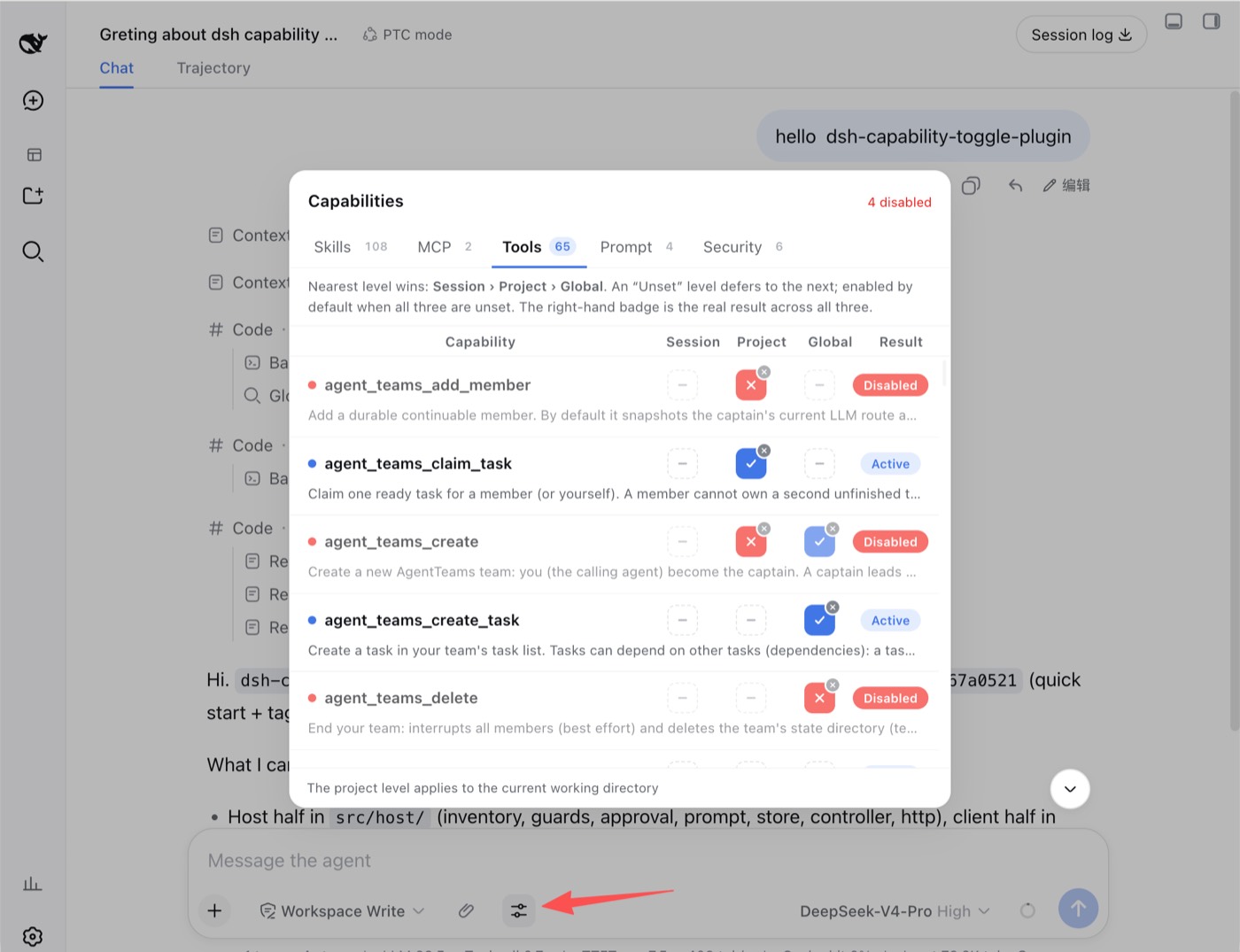
Session · Project · Global — blue check = on, red cross = off, dashed dash = unset.
A DeepSeek Harness (DSH) WebUI plugin for controlling skills, MCP servers, tools, prompt injections, approval escalation, and safety guards at session, project, or global scope. Depending on the family, disabling removes, suppresses, rejects, or intercepts the capability on the agent's next step.
This release targets DSH 0.2.0-rc.1. Every DSH peer dependency is pinned to that
release candidate. The Host uses the agent/created lifecycle, persistent
configEditor edits, and Loader volatile-config updates; each committed change
reconciles every live agent binding.
| DSH version | Status | How it was checked |
|---|---|---|
| 0.2.0-rc.1 | supported | Host and Client typechecks, 363 automated tests, production build, framework-link validation, composed-profile inspection, and browser verification |
This release makes no compatibility claim for other DSH versions.
Requires Node.js ^22.19.0 or ≥ 24.0.0 (same as DSH 0.2.0-rc.1).
dsh plugin --profile web add github:lifeopsgo/dsh-capability-toggle-plugin#v2.0.0Restart the existing DSH Web GUI process, then refresh the page. Start it with the command below when it is stopped:
dsh --profile web webOpen the control beside the ➕ button while the agent is idle. Replace web with another profile name when needed.
# Upgrade or downgrade: use any tag listed on the releases page
dsh plugin --profile web add github:lifeopsgo/dsh-capability-toggle-plugin#v2.0.0

# Remove
dsh plugin --profile web remove dsh-capability-toggle-pluginEach capability has three independent levels:
session › project › global › default (enabled)The nearest explicit value wins. Unset defers to the next level; with every level unset, the capability remains enabled. The row badge always shows the resolved result.
The button displays only its current state: click to toggle on ↔ off, or use its small clear badge to return to unset.
| Tab | Controls |
|---|---|
| Skills | Individual model-invocable skills, including project-level skills discovered from the session's workspace (.dsh/skills, .agents/skills) |
| MCP | MCP servers; expand a row to inspect member tools |
| Tools | Individual model-visible tools and their guidance sections |
| Prompt | A safe, presence-checked allowlist of prompt injections |
| Security | Approval escalation and five opt-in safety guards |
Every mechanism is scoped to the current agent; global registrations are not mutated.
| Family | Enforcement |
|---|---|
tool / mcp |
Removed with ctx.tools.restrict({ deny }); forced calls are refused |
skill |
Shadowed by a same-named modelInvocable:false runtime skill |
prompt |
Shadowed with empty text, or suppressed with suppressRuntimeContext() |
approval |
Scoped approval requests resolve to rejected |
guard |
tools/pre-execute blocks or requests confirmation for matching calls |
Turning off Approval escalation rejects every approval request from that agent without changing the system /permission setting.
Safety guards are opt-in:
| Guard | Action |
|---|---|
| Read-only mode | Block file writes, creates, and edits |
| Protect secrets | Block access to common secret files and credentials |
| Dangerous shell | Confirm high-risk shell commands |
| Destructive git | Confirm history- or work-losing git commands |
| Outbound network | Confirm network tools and outbound shell actions |
Skills, MCP servers, and tools carry a small badge showing how many times the model called them this session (called 7). Counts update when a turn ends while the panel is open, live for one agent's lifetime, and are never persisted — the same retention as a safety guard's matched N badge.
The tally counts requests, not successful runs: a call a guard blocked or sent to confirmation still counts, because the model asking for a capability is the signal worth seeing. Guards are matched against rather than called, so they keep their own badge and show no usage count; prompt and approval rows show none either.
A disclosure arrow beside the panel title opens three display preferences, stored in localStorage so they survive page reloads and restarts:
| Preference | Effect |
|---|---|
| Show “enabled / total” on tabs | Renders each tab badge as a fraction (67/106) instead of a bare total, so the strip reports how much of each family is active at a glance. The tooltip states both numbers in words either way. |
| Show call stats | Hides or shows the per-row usage badge described above. |
| Level columns to show | Narrows the grid to Session, Session + Project, or all three columns. |
The fraction counts a guard as enabled only while it is active. A guard row reuses the same disabled field to mean ACTIVE — the inverse of every default-on family — so a Security tab with the approval gate open and all five guards inactive reads 1/6, not 6/6.
Narrowing the level columns is display-only: the three-level resolution keeps running exactly as before, so a hidden project or global override still applies. Each row's badge and level switches always reflect the resolved state — a default-on family reads Active/Disabled, a guard reads Guarding/Inactive — which is why hiding a column cannot hide an effect. The name column absorbs the freed width, and the layout is driven by CSS variables so it stays aligned with the narrow-screen adaptation.
Additional behavior: while the agent runs, the controls that write a stance lock — each row's level switches, their clear badges, and the bulk menus — but browsing stays open, so the search box, the level-column selector, the tabs, and a row's expand still work. State survives popup close and turn boundaries, and the UI follows the WebUI language.
Planned, not yet implemented:
enabled / total, and the panel's disclosure arrow holds three display preferences. A guard counts as enabled only while active, so its inverted disabled flag never inflates the Security numerator.disabled to mean ACTIVE, so "only disabled" must not list a guard that is actually enforcing. The filter would also narrow what bulk actions apply to, since they act on every currently visible row.CLASSIFICATION EVIDENCE
系统优先读取 GitHub Topics,再与站内分类词典和词根规则比对。当前命中: 无有效分类标签。
deepseek-ai
DeepSeek Harness: Everything is a Plugin.

anywhere-labs
为 DeepSeek Harness (DSH) 插件生态打造的现代化桌面端解决方案。万物皆「插件」,桌面本身也是「插件」。

walkinglabs
Harness engineering beginner tutorial, from 0 to 1